
Trademark Registration Process: Steps, Costs & Timeline
The trademark registration process is a 7-step federal filing with the United States Patent and Trademark Office (USPTO) that takes a brand name or logo from clearance search to registration certificate. You choose a distinctive mark, search for conflicts, list your goods and services, pick a filing basis, and file online in Trademark Center. Review comes next. An examining attorney checks the application, the mark runs in the Trademark Official Gazette for opposition, and the certificate follows.
Timing is predictable. As of October 1, 2026, the average application takes 10.4 months (about 316 days) to register or abandon, and the base government fee is $350 per class of goods or services. Both numbers climb when an application draws an office action or uses custom wording, and that’s where most DIY filers lose time and money.
What Is the Trademark Registration Process?
The trademark registration process is the USPTO procedure that grants federal, nationwide rights in a word, logo, slogan, or sound that identifies the source of goods or services. Registration doesn’t create the trademark itself. Rights start the day you use a mark in commerce, but those common law rights stop at the edge of the area where customers actually know your brand.
Federal registration pushes that claim to all 50 states. It adds 4 legal advantages:
- Presumes nationwide ownership of the mark for every listed good or service
- Allows use of the ® symbol
- Opens recording with U.S. Customs and Border Protection (CBP) to stop counterfeit imports at the border
- Qualifies the brand for marketplace programs such as Amazon Brand Registry
State paperwork is a separate matter. Forming an LLC with your Secretary of State or buying a domain name from a registrar like GoDaddy gives you zero trademark rights, and a later federal registrant can force you to surrender that domain.
Should I Trademark My Business Name?
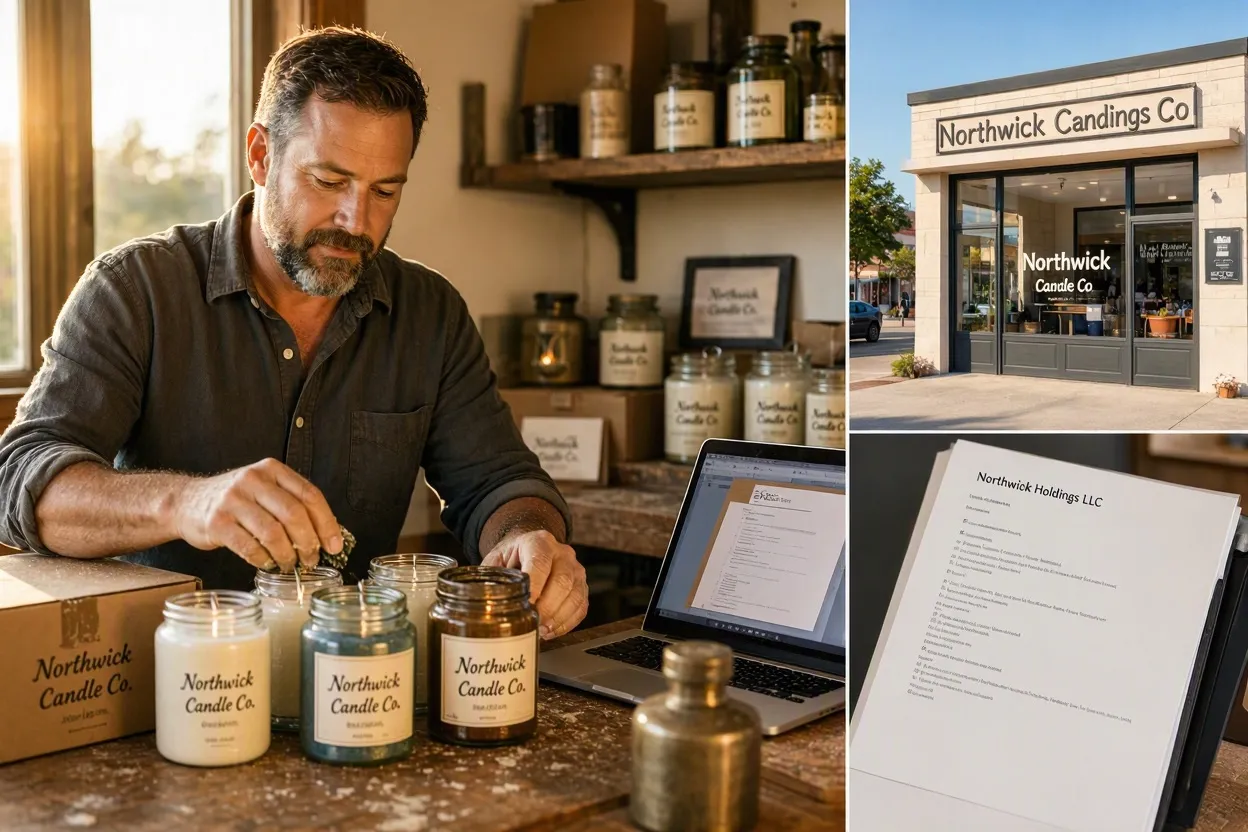
Yes, you should trademark your business name if you sell under it online or across state lines, because federal registration locks in nationwide priority before a competitor files first. Picture a Texas candle maker selling on Etsy as “Northwick Candle Co.” Without a registration, a Florida shop that files first can claim every state where Northwick has no customers yet.
A one-location bakery with no plans to grow gets less out of it. Even so, the $350 filing stops a later applicant from registering a confusingly similar name. One condition applies to both businesses: the name has to brand what you sell, and a legal entity name printed only on contracts, such as “Northwick Holdings LLC,” doesn’t count as trademark use.
Can You Copyright a Business Name?
No, a business name cannot be copyrighted, because the U.S. Copyright Office refuses to register names, titles, slogans, and short phrases under 37 C.F.R. §202.1(a). That job belongs to the USPTO, not the Copyright Office, for anyone hoping to copyright business name rights.
Logo artwork works differently. An original illustration, such as a hand-drawn fox inside a coffee shop logo, can hold copyright protection for the drawing and trademark protection for its role as a brand identifier at the same time.
How Do You Patent a Name?
A name is protected through USPTO trademark registration, because patents only cover inventions and product designs. Utility patents protect how something works for 20 years from the filing date. Design patents cover a product’s ornamental look for 15 years from grant.
Neither one touches a brand name. Most guides on how to patent a business name are describing the trademark registration process under the wrong label, so the steps below are the ones that actually apply.
Step 1: Choose a Distinctive Mark
Pick a mark from the strong end of the distinctiveness scale, because the USPTO refuses generic terms outright and refuses merely descriptive terms under Lanham Act Section 2(e)(1). The scale has 5 tiers:
| Tier | Example | Registrable? |
| Generic | “Shoes” for footwear | Never |
| Descriptive | “Fresh Bake” for bread | Only after it gains secondary meaning, usually through 5 years of substantially exclusive use |
| Suggestive | “Coppertone” for sunscreen | Yes |
| Arbitrary | “Dove” for soap | Yes, with strong protection |
| Fanciful | “Exxon” for fuel | Yes, with the strongest protection |
Founders lean toward descriptive names. They explain the product instantly, which feels like good marketing, yet “Rapid Plumbing” invites a 2(e)(1) refusal while an invented name like “Copperfox Plumbing” clears that hurdle on day one.
Step 2: Run a Clearance Search
Search federal records and unregistered marketplace use before you file, because the examining attorney runs the same federal search and refuses any confusingly similar mark under Lanham Act Section 2(d). The free USPTO Trademark Search system replaced the old TESS database in November 2023. It covers live registrations and pending applications. It doesn’t cover unregistered businesses, which still hold common law rights in their local markets.
A solid clearance search follows 4 checks:
- Search the exact spelling plus phonetic variants, such as “Copperfox,” “Kopperfox,” “Coperfox,” and “Copper Fox.”
- Check related goods and services in other classes, since coffee beans (Class 30) and café services (Class 43) conflict regularly.
- Review pending applications, because an earlier filing date beats yours even before it registers.
- Scan Google, Amazon, Etsy, and state trademark registers for unregistered users.
Skipping the fourth check is costly. A prior local user can’t block your federal registration everywhere, but it can freeze you out of its home territory for good.
Step 3: Identify Your Goods, Services, and Classes
List each product or service with its Trademark ID Manual entry and its Nice Classification class, because the USPTO charges $350 per class and adds $200 per class for free-form descriptions. The Nice system sorts everything into 45 classes, with 34 for goods and 11 for services.
Take a skincare brand that sells serums (Class 3) and runs facials (Class 44). It files in 2 classes, so its base fee lands at $700 before any surcharge.
Wording matters more than most filers expect. After filing, you can narrow an identification but never broaden it, so a description written for one product line today can’t stretch to cover a launch next year.
Step 4: Pick a Filing Basis
Choose Section 1(a) use in commerce when you already sell under the mark, and choose Section 1(b) intent to use when your launch is still ahead.
| Basis | Fits | What it adds | Later USPTO fees |
| Section 1(a) use in commerce | Brands already selling across state lines | Dates of first use anywhere and in commerce, plus 1 specimen per class | None |
| Section 1(b) intent to use | Pre-launch brands | A Statement of Use (SOU) before registration, with optional 6-month extensions | $150 per class for the SOU; $125 per class for each extension |
Foreign applicants have 2 more routes: Section 44, based on a home-country application or registration, and Section 66(a), an extension of a Madrid Protocol international registration.
Intent-to-use filers carry one extra duty. Keep dated proof of your plans, such as supplier quotes and a dated business plan, because an opponent can challenge an application that has no evidence of bona fide intent behind it.
Step 5: File the Application in Trademark Center
File online through Trademark Center, the USPTO’s only system for new applications, after signing in with a verified USPTO.gov account that uses two-step authentication. The older TEAS Plus and TEAS Standard forms were retired on January 18, 2025, and their two-tier pricing went with them.
The application asks for 6 items:
- Owner details, including legal entity type and domicile address
- Mark drawing, either standard characters or a special form image
- Goods and services from the ID Manual, grouped by class
- Filing basis for each class
- Specimen and first-use dates for every use-based class
- Verified declaration signed under penalty of perjury
Foreign-domiciled applicants must hire a US-licensed attorney under 37 C.F.R. §2.11. US residents can file on their own. Once you pay, the USPTO emails a filing receipt with a serial number, and you should check that number in Trademark Status and Document Retrieval (TSDR) every 3 to 4 months (roughly 90 to 120 days) so no deadline slips past.
How to Register a Logo
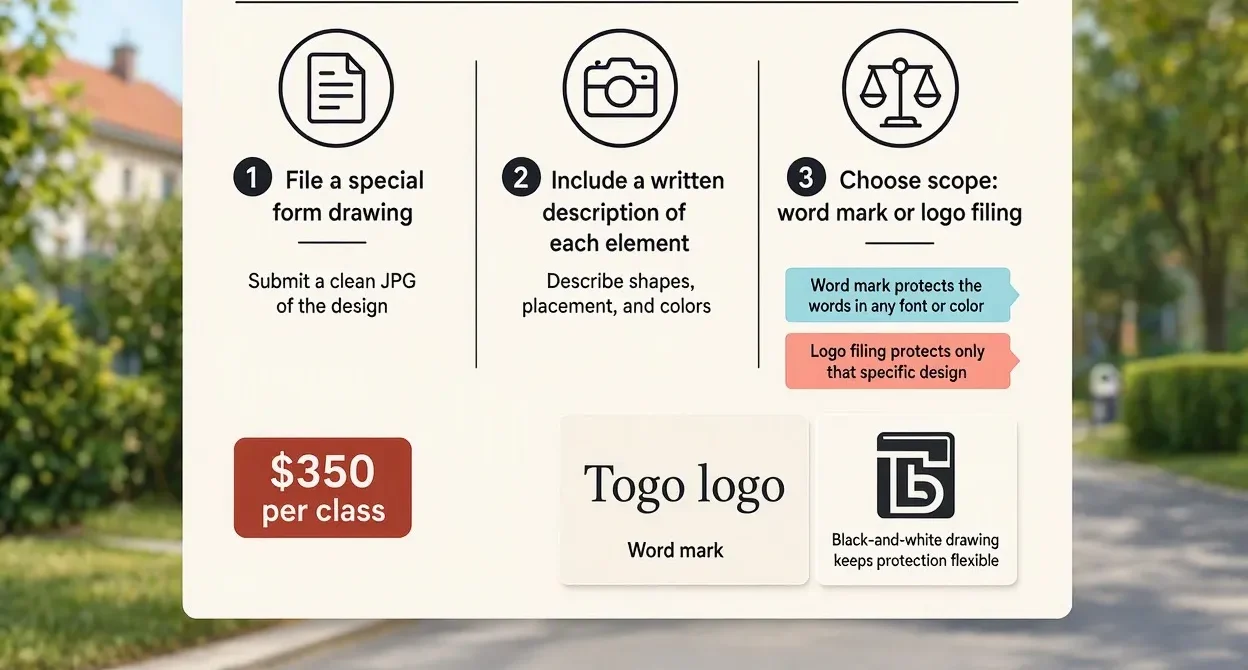
To register a logo, file it as a special form drawing with a clean JPG image of the design and a written description of each element. Scope is the key trade-off here. A standard character filing protects the words in any font or color, while a logo filing protects only that specific design.
Most small businesses file the word mark first. A logo application can follow later at another $350 per class, and a black-and-white drawing keeps it flexible, since claiming color limits protection to the exact shades named in the application.
What Specimens Does the USPTO Accept?
The USPTO accepts specimens that show the mark the way customers see it at the point of sale, such as product labels, packaging, hang tags, and web pages with an add-to-cart button for goods. Service marks need different proof, usually advertising or a web page that names the service.
| Accepted | Refused |
| Photo of a printed bottle label showing the mark | Digital mockup of a label that was never produced |
| Product page with the mark beside the price and a cart button | Product page with no way to order |
| Service web page naming “bookkeeping services” next to the mark | Business card listing only a name and phone number |
| Photo of a hang tag on a finished shirt | Shipping invoice for the goods |
Examiners screen for digitally altered images. An edited photo can sink the application and expose the filer to sanctions.
How Much Does the Trademark Registration Process Cost?
The trademark registration process costs $350 per class in base USPTO fees, and a one-class, use-based filing that uses ID Manual wording stays at exactly $350. Surcharges and later filings change the total:
| USPTO fee (per class) | Amount |
| Base application fee | $350 |
| Insufficient information surcharge | $100 |
| Free-form text instead of ID Manual entries | $200 |
| Each extra 1,000 characters of free-form text | $200 |
| Statement of Use or Amendment to Allege Use | $150 |
| Extension of time to file a Statement of Use | $125 |
| Petition to revive an abandoned application (per petition) | $250 |
Here’s a worked example. A 2-class intent-to-use filing with 1 extension costs $700 at filing, $250 for the extension, and $300 for the Statement of Use, which comes to $1,250 in government fees.
Refunds don’t exist in practice. The USPTO keeps the fee even when it refuses the mark, so a $350 search mistake stays a $350 loss.
Step 6: Clear Examination and Publication
An examining attorney reviews the application an average of 4.3 months (about 130 days) after filing, then either approves the mark for publication or issues an office action. Objections fall into 2 groups. Substantive refusals, such as Section 2(d) likelihood of confusion or Section 2(e)(1) descriptiveness, challenge the mark itself.
Technical requirements are smaller fixes. A filer of “Copperfox Coffee Roasters” will be asked to disclaim “Coffee Roasters,” since nobody owns those generic words, and vague identifications like “apparel” get rewritten into ID Manual terms such as “T-shirts” and “hooded sweatshirts.”
How to Respond to an Office Action
To respond to an office action, file a written response in Trademark Center within 3 months of the issue date, or buy one 3-month extension for $125. Madrid Protocol applicants get 6 months with no extension option.
Responses that work stay specific. Against a 2(d) refusal, effective arguments contrast the 2 marks’ commercial impression and separate the goods by trade channel, while technical issues usually close with an amended identification or an added disclaimer.
Silence has a price. A missed deadline abandons the application, and reviving it takes a $250 petition filed within 2 months of the abandonment notice. After a final refusal, your remaining paths are a request for reconsideration or an appeal to the Trademark Trial and Appeal Board (TTAB) within that same response window.
What Happens During the Opposition Period?
The mark appears in the weekly Trademark Official Gazette, and any party that believes registration would harm it gets 30 days to file an opposition or request more time. An opposition runs as a trial-style case before the TTAB.
Most published marks clear this window without a challenge. Expect 3 to 4 months between the notice of publication and the next status update, so keep watching TSDR during that stretch.
Step 7: Receive Your Registration and Keep It Alive
A use-based application registers once the opposition period closes without a challenge, and the USPTO issues the registration certificate electronically. From that date forward you can use the ® symbol. Before it, use the ™ symbol, because putting ® on an unregistered mark can be treated as fraud and jeopardize the application.
Intent-to-Use Applications: Notice of Allowance and Statement of Use
An intent-to-use application receives a Notice of Allowance (NOA) about 8 weeks after publication, which starts a 6-month deadline to file a Statement of Use or request an extension. Extensions come in 6-month blocks, up to 5 of them, for a ceiling of 36 months from the NOA date.
Statements of Use took an average of 53 days to process as of October 1, 2026. Approval leads to registration roughly 2 months later.
Maintenance Deadlines After Registration
A registration stays alive only when you file a Section 8 declaration between years 5 and 6, then a combined Section 8 and 9 renewal between years 9 and 10 and every 10 years after that.
| Filing | Window | USPTO fee per class |
| Section 8 declaration of use | Between years 5 and 6 | $325 |
| Section 8 and Section 15 combined (incontestability) | Between years 5 and 6 | $575 |
| Section 8 and Section 9 combined renewal | Between years 9 and 10, then every 10 years | $650 |
| Grace period surcharge | 6 months after a missed window | $100 |
Declare use only for goods you still sell. The USPTO’s Post-Registration Audit Program randomly checks Section 8 filings and demands proof for extra items, and a cancelled registration means starting the whole trademark registration process again from scratch.
How Long Does the Trademark Registration Process Take?
The trademark registration process takes an average of 10.4 months (about 316 days) from filing to registration or abandonment, based on USPTO data updated October 1, 2026. That’s ahead of the agency’s 11.0-month target. Intent-to-use filings run longer, because the allowance period adds up to 36 months on top.
| Stage | Average or set time |
| Filing to first examining action | 4.3 months (about 130 days) |
| Office action response window | 3 months (about 90 days), plus 3 more with a paid extension |
| Opposition window after publication | 30 days |
| Publication to next status update | 3 to 4 months |
| Publication to Notice of Allowance (intent to use) | About 8 weeks (56 days) |
| Statement of Use processing | 53 days |
| Statement of Use approval to registration | About 2 months |
| Filing to registration or abandonment | 10.4 months |
Two habits shorten the wait. Complete applications with ID Manual entries skip the most common technical office actions, and quick responses keep the file moving. Filers with several marks gain a small edge: the USPTO queues up to 10 applications from the same owner, filed within 3 months, alongside the first one.
Small Business Trademark Registration Process: DIY or Attorney?
A small business can handle the filing alone when it registers 1 distinctive word mark in 1 or 2 classes, backed by a clean search and a ready specimen. Outside that profile, mistakes get expensive fast.
DIY filing fits when you:
- File an invented or arbitrary word mark
- Sell in 1 or 2 classes with clear ID Manual entries
- Use the mark already and hold a qualifying specimen
- Find no close matches in federal or marketplace searches
A trademark attorney earns the fee when you:
- Live outside the US, where 37 C.F.R. §2.11 requires one
- Receive a Section 2(d) refusal or a notice of opposition
- Plan an intent-to-use strategy across 3 or more classes
- Need protection in other countries
Budget-limited founders have a free option. The USPTO Law School Clinic Certification Program pairs eligible applicants with supervised law students, which takes much of the risk out of the small business trademark registration process without adding legal fees.
International Trademark Registration Process
The international trademark registration process for US businesses runs through the Madrid Protocol, filed via the USPTO and based on your US application or registration. One international application, with fees paid to the World Intellectual Property Organization (WIPO) in Swiss francs, can extend protection to more than 130 countries.
Each country you designate still examines the mark under its own law. A skincare brand eyeing Europe, for instance, can designate the European Union once and cover all 27 member states in a single entry.
One risk deserves attention before you file. For 5 years, the international registration depends on the US basic filing, so a US refusal or cancellation in that period knocks out every designation. Direct national filings avoid that link, and the Paris Convention gives you 6 months from your US filing date to claim priority abroad.
How to Spot Trademark Scams
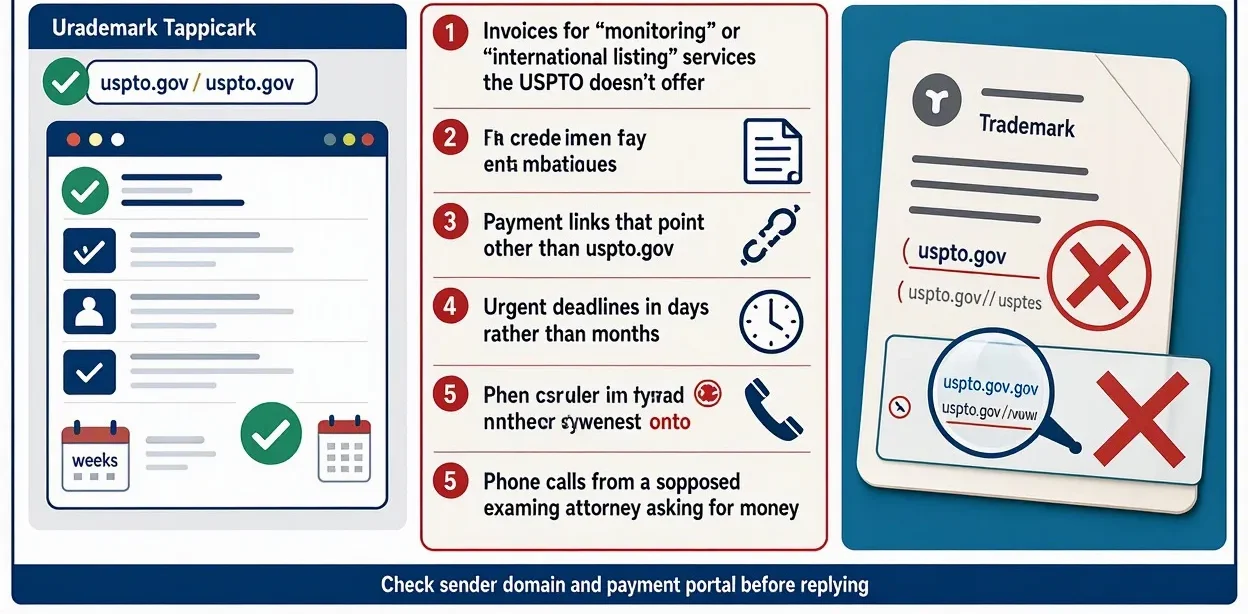
To spot trademark scams, confirm that every notice comes from a uspto.gov email address and every payment runs through Trademark Center or Financial Manager, because the USPTO never requests payment by phone or text message. Application records are public. Within weeks of filing, private companies with official-sounding names mail owners letters that look like government invoices.
Watch for 4 red flags:
- Invoices for “monitoring” or “international listing” services the USPTO doesn’t offer
- Payment links that point anywhere other than uspto.gov
- Urgent deadlines measured in days rather than months
- Phone calls from a supposed examining attorney asking for money
Genuine office actions always show up in the TSDR documents tab. A letter missing from TSDR didn’t come from the USPTO.
Conclusion
The trademark registration process rewards preparation more than paperwork. A distinctive name and a careful clearance search do more to secure registration than anything filed after submission. Get those 2 right first.
From there, the sequence is fixed: file in Trademark Center, then calendar the year-5 and year-9 maintenance windows the day your certificate arrives. Founders holding a 2(d) refusal, or planning sales abroad, should bring in a trademark attorney before the next deadline lands.
FAQs

Amanda Brooks
Amanda Brooks leads legal, justice, and community advocacy content at JusticeInTown, drawing on a background in legal research and public policy. She specializes in civil rights, access to justice, and legal awareness, bringing a careful, research-driven approach to complex legal and public-interest topics. Her guides help readers better understand their rights, legal options, and the issues affecting their communities.
Related Posts