

How to Get Child Custody: A Step-by-Step Legal Guide
Child custody is the legal right and responsibility to make decisions for a child and determine where that child lives. Courts split it into two separate rights: decision-making authority over things like schooling, medical care, and religion, and physical placement, which just means the actual home the child sleeps in on a given night. A judge in Texas might award a mother the right to choose the child’s school while splitting overnight stays 60/40 between both parents. Many states have swapped out the word “custody” for terms like parental responsibility and time-sharing, but the underlying concept hasn’t really changed across jurisdictions.
Types of Child Custody
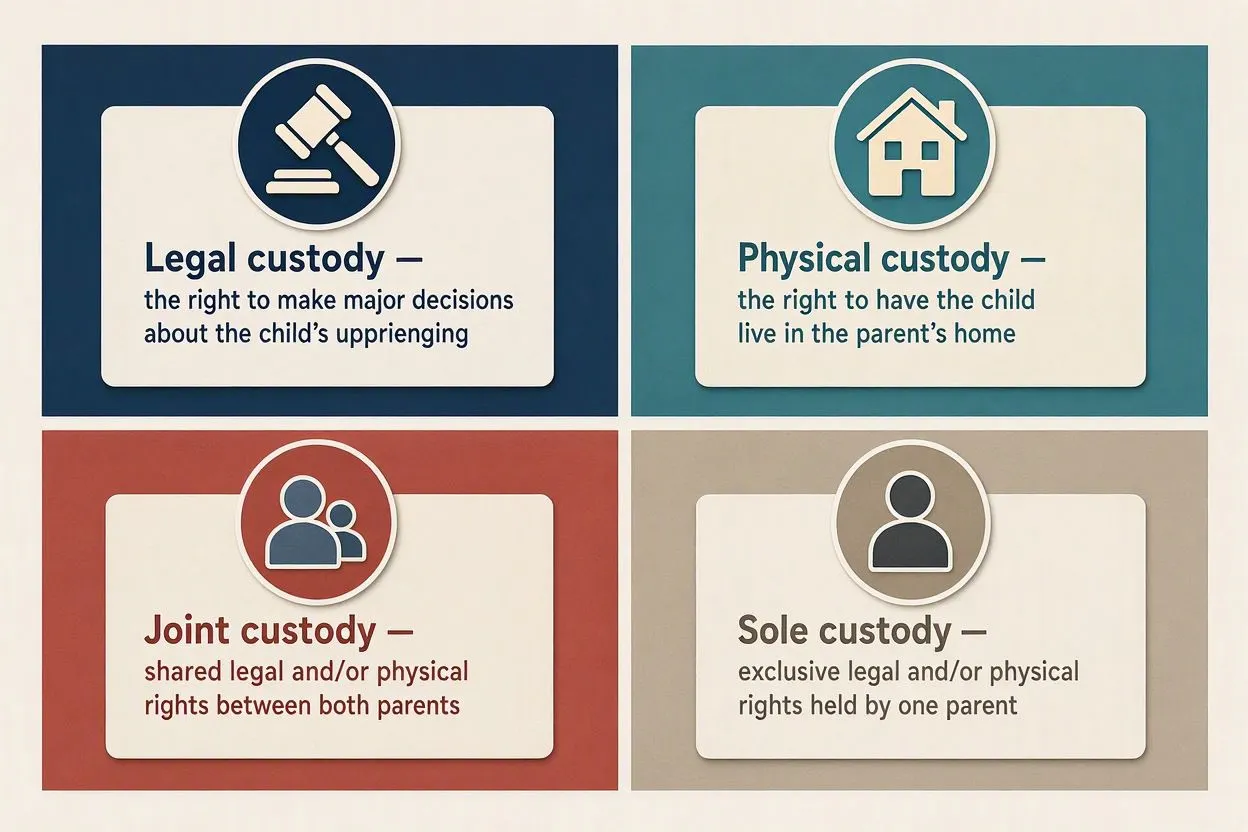
Custody in the U.S. falls into four main categories: legal, physical, joint, and sole.
- Legal custody — the right to make major decisions about the child’s upbringing
- Physical custody — the right to have the child live in the parent’s home
- Joint custody — shared legal and/or physical rights between both parents
- Sole custody — exclusive legal and/or physical rights held by one parent
Courts mix and match these all the time. One parent might hold sole legal custody over medical decisions while both share physical custody on a weekly rotation. Florida Statute § 61.13 uses “shared parental responsibility” as the default and reserves sole custody for cases involving proven harm to the child.
How to Get Child Custody: Step-by-Step Process
Getting custody means filing a petition with the family court, serving the other parent, submitting a parenting plan, and, if the parents disagree, presenting evidence at a hearing. Forms and deadlines vary by state, but this sequence holds up almost everywhere.
- Confirm jurisdiction. File in the child’s home state, generally wherever the child has lived for the past six consecutive months, under the Uniform Child Custody Jurisdiction and Enforcement Act (UCCJEA).
- File a custody petition. Submit it to the family or circuit court in the correct county, along with any required filing fee.
- Serve the other parent. This has to go through a sheriff, certified process server, or an agreed method. The case can’t move forward without proper notice.
- Draft a parenting plan. Lay out a time-sharing schedule, decision-making authority, and communication rules. Most states require this even in uncontested cases.
- Attend mediation. Many courts route contested cases to Family Court Services before scheduling a hearing. Something like 60-70% of custody disputes settle right here.
- Complete a parenting course. Several states, Florida included, require a four-hour parenting class before the court will enter a final order.
- Attend the hearing. If both parents agree, a judge usually approves the plan without a trial. If they don’t, each side presents evidence and testimony before the judge rules.
- Receive the custody order. The judge signs a final order that both parents have to follow. Violating it can mean contempt charges or a custody modification against whoever broke it.
A father who files in Ohio without an existing custody order starts out as a legal stranger to custody decisions until paternity is established and a petition is filed. It doesn’t happen automatically just because his name is on the birth certificate.
How Courts Decide Custody: The Best-Interest-of-the-Child Standard
Judges award custody based on what serves the child, not what feels fair to either parent. Every state uses some version of this standard, though the specific factors differ. Florida’s statute lists 20 separate considerations; California and New York use shorter but similar lists.
Judges commonly weigh:
- Each parent’s demonstrated ability to provide a stable, consistent routine
- The child’s relationship with each parent and any siblings
- Each parent’s willingness to support the child’s relationship with the other parent
- The child’s ties to school, home, and community
- Evidence of domestic violence, substance abuse, or neglect
- The mental and physical health of each parent
- The child’s own preference, if the court finds the child mature enough to express one
- Geographic proximity between the parents’ homes
Take a case involving a DUI conviction within the past two years. A judge will weigh that heavily against unsupervised overnight custody, even if every other factor favors that parent. Courts don’t average these factors mechanically. They weigh them together, and one serious safety concern can outweigh several minor advantages held by the other parent.
How to Get Full (Sole) Custody
Getting full custody usually means proving that shared custody would endanger the child, since courts start from the presumption that both parents should stay involved. The burden falls on the parent requesting sole custody, and a judge won’t grant it based on personal preference or general distrust between co-parents.
Grounds courts commonly accept:
- Documented child abuse or neglect
- Active substance abuse that impairs parenting ability
- Abandonment of the child for an extended period
- A parent’s incarceration for a significant portion of the child’s minority
- Credible evidence of domestic violence directed at the child or the other parent
Evidence matters more than allegations here. Courts want police reports, medical records, a licensed psychologist’s evaluation, or a guardian ad litem’s written recommendation (that’s the court-appointed advocate who investigates the child’s living situation and reports back to the judge). Family attorneys describe this pattern often: a parent seeking full custody after the other parent’s felony drug conviction needs certified court records, not just a description of the arrest. Florida law only creates a rebuttable presumption against custody when the conviction is documented and meets specific statutory thresholds.
How to Get Emergency Custody
Emergency custody orders exist for when a child faces immediate danger, and a parent can request one without waiting for the standard hearing schedule. Courts call this an “ex parte” order because the judge may rule before the other parent gets a chance to respond. Judges reserve this for genuine emergencies: a credible threat of abduction, active abuse, or a parent’s arrest that leaves a child without safe supervision.
Say a mother finds text messages showing the other parent’s plan to leave the state with the child overnight. She can file for an emergency order that same day instead of waiting weeks for a standard hearing. Courts typically schedule a full hearing within 10 to 14 days after granting an emergency order, so the other parent gets a chance to respond and contest it. Judges deny a large share of emergency filings that don’t meet the immediate-danger threshold, so save this option for genuine safety concerns, not scheduling disputes or minor disagreements.
Custody Rights for Unmarried Parents

Unmarried mothers automatically hold sole custody in most states until a father establishes paternity and requests custody rights through the court. This catches a lot of unmarried fathers off guard. Being named on the birth certificate doesn’t grant automatic parenting rights. It just doesn’t.
Paternity typically gets established one of two ways:
- Voluntary acknowledgment — both parents sign a paternity affidavit, often at the hospital right after birth
- Court-ordered paternity test — a judge orders DNA testing when the parents dispute biological parentage
Once paternity is established, fathers can petition for custody or time-sharing on equal footing with mothers in every state. Florida’s Good Dad Act, passed in 2023, addressed this gap directly by requiring courts to treat unmarried fathers and mothers equally in custody proceedings instead of defaulting to maternal custody once paternity is confirmed. But a father who waits two years after a paternity test to file for custody may find that the child’s established routine with the mother now works against him, since courts weigh stability and continuity heavily under the best-interest standard.
How Long It Takes to Get Child Custody
An uncontested case typically wraps up in 6 to 12 weeks. A contested case can run 6 months to over a year. The timeline mostly comes down to whether both parents agree on the parenting plan before filing. Court backlogs, mediation scheduling, and guardian ad litem investigations all add time to contested proceedings.
Three things most often push a case past a year: a parent’s refusal to attend mediation, the need for a full custody evaluation by a licensed psychologist, and any appeal filed after the initial ruling. Parents in high-conflict cases involving abuse allegations should expect the longer end of that range. Courts move carefully when a child’s safety is in question, and they won’t rush an evaluation just to hit an arbitrary deadline.
How Much It Costs to Get Child Custody
Custody cases range from under $500 for a straightforward, uncontested filing to $15,000 or more for a fully litigated, contested case. Filing fees alone typically run $300 to $450 depending on the county. Attorney fees make up the biggest cost variable: hourly rates for family law attorneys generally fall between $200 and $500, and a contested case can eat up 40 to 80 billable hours by the time it reaches trial.
Other costs to budget for:
- Mediation fees, often $100 to $300 per session
- Guardian ad litem or custody evaluation fees, which can reach $2,000 to $5,000
- Required parenting course fees, usually under $100
- Process server fees for delivering the petition, typically $50 to $150
Parents who reach a full agreement before filing (an uncontested case) often get away with just the filing fee and no attorney at all.
How to Modify a Custody Order
Modifying a custody order means proving a substantial, unanticipated change in circumstances since the last order was entered, then filing a supplemental petition with the same court. Courts won’t revisit custody just because one parent regrets the original agreement or wants a better schedule. The change has to be significant, and it typically can’t have been foreseeable when the original order was entered.
Changes that commonly qualify:
- A parent’s relocation more than 50 miles from the other parent
- A documented change in a child’s medical or educational needs
- A parent’s recovery from substance abuse that previously limited custody
- A new pattern of one parent violating the existing time-sharing schedule
- A significant, lasting change in either parent’s work schedule or income
If a father gets a promotion requiring relocation 300 miles away, he has to file a relocation petition and prove the move serves the child’s interests before he can modify the existing schedule. Moving first and asking permission later can mean contempt charges, and it works against him in the modification hearing itself.
Interstate Custody and the UCCJEA
The Uniform Child Custody Jurisdiction and Enforcement Act determines which state has authority over a custody case when parents live in different states. Adopted in some form by 49 states, the UCCJEA generally grants jurisdiction to the child’s “home state,” defined as wherever the child lived for the six consecutive months right before the case was filed.
Once a court in one state issues a custody order, that state typically keeps exclusive jurisdiction over future modifications, even after the child moves elsewhere. A parent who relocates to a new state can’t just file a new custody case there while an existing order is still active in the original state. Doing so risks the new filing getting dismissed for lack of jurisdiction. Anyone involved in an interstate custody dispute should confirm jurisdiction before filing, since courts routinely dismiss petitions filed in the wrong state, and that delay can cost months.
Do You Need a Lawyer to Get Child Custody?
No, you don’t need a lawyer to get child custody, though contested cases involving abuse allegations, relocation, or significant assets benefit a lot from legal representation. Self-help centers, court-approved forms, and legal aid organizations exist in every state specifically to help parents file without an attorney in straightforward, uncontested cases.
Legal representation matters most when:
- The case involves domestic violence or credible safety concerns
- There’s an interstate jurisdiction dispute under the UCCJEA
- The case is high-conflict and likely to reach a contested trial
- A custody evaluation or guardian ad litem gets involved
A parent facing an uncontested case with an amicable co-parent can often get through the whole process using court-provided forms and a self-help center, spending under $500 total. A parent facing allegations of unfitness or a contested relocation is looking at evidentiary and procedural complexity that a family law attorney is trained to handle.

Conclusion
Getting child custody comes down to proving, through evidence and a workable parenting plan, that a proposed arrangement serves the child’s best interests. Parents who understand the filing sequence, gather documentation early, and take mediation seriously tend to resolve cases faster and cheaper than those who treat the courtroom as the first option instead of the last resort. Rules on timelines, forms, and required courses vary by state, so checking local requirements with the family court clerk or a licensed attorney is still the surest way to avoid the procedural delays that turn a straightforward case into a contested one.
FAQs

Amanda Brooks
Amanda Brooks leads legal, justice, and community advocacy content at JusticeInTown, drawing on a background in legal research and public policy. She specializes in civil rights, access to justice, and legal awareness, bringing a careful, research-driven approach to complex legal and public-interest topics. Her guides help readers better understand their rights, legal options, and the issues affecting their communities.
Related Posts