
Family Sponsorship Requirements: Who Qualifies and What It Costs
Family sponsorship in the U.S. lets a citizen or green card holder petition for a relative to become a lawful permanent resident. Three separate tests have to hold up: the sponsor’s immigration status, the qualifying relationship, and the sponsor’s income. If any one of them breaks, the petition fails. Two policy changes in 2026 have also reshaped how that third test, income, gets applied.
What are the family sponsorship requirements?
There are three tests on the sponsor’s side. They need U.S. citizenship or lawful permanent resident status, a family relationship with the relative that immigration law actually recognizes, and household income at or above 125% of the federal poverty guidelines. A fourth test falls on the relative instead: the intending immigrant has to be admissible to the United States in the first place.
Each of these carries its own paperwork burden. Take a U.S. citizen petitioning for a brother. They need to prove citizenship (passport or naturalization certificate), prove the sibling relationship (birth certificates for both showing a shared parent), and file Form I-864, the Affidavit of Support, showing income above the household threshold. Miss any single piece and you get a request for evidence, which tacks months onto the case.
Who can sponsor a family member for a green card?
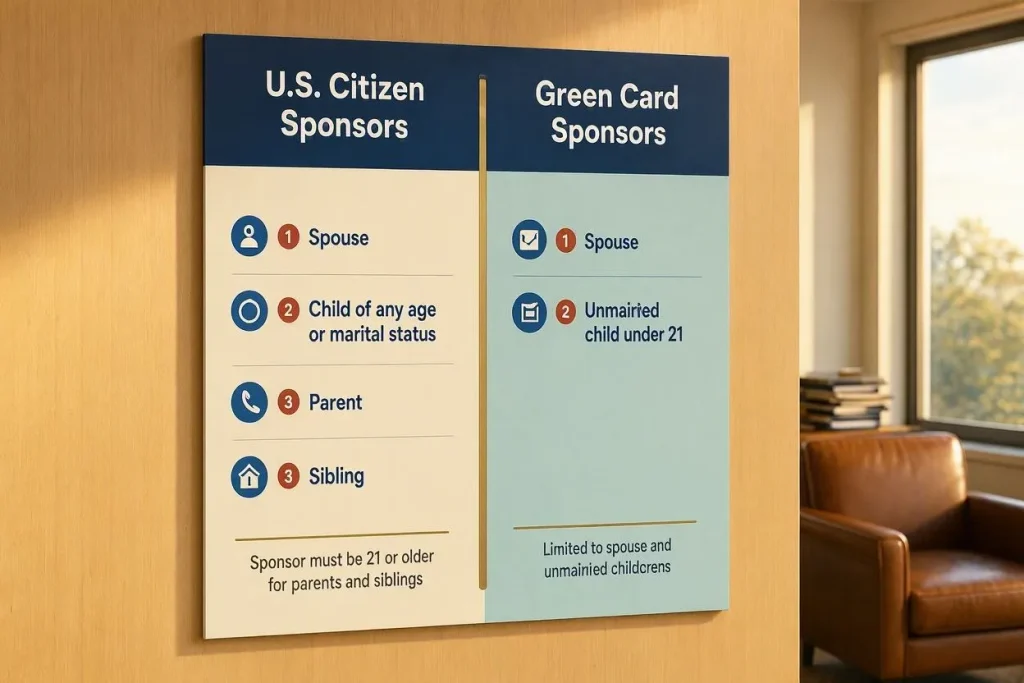
Both citizens and green card holders can sponsor relatives, but the gap between what each one can do is enormous, and it shapes everything about who’s eligible and how long they end up waiting.
U.S. citizen sponsors
A citizen who’s 21 or older can petition for a spouse, a child of any age or marital status, a parent, or a sibling. Under 21, the options shrink to just spouse or child. Parents and siblings are off the table until the sponsoring citizen actually turns 21, which shuts out a fair number of young adults trying to bring a parent over.
Green card holder sponsors
A lawful permanent resident can only petition for a spouse or an unmarried child, and there’s no age cap on the child. Parents, siblings, married sons or daughters: none of that is available to a green card holder, no exceptions. If you’re a permanent resident and want to bring a parent over, you naturalize first, then file.
There’s one silver lining here. If a permanent resident sponsor naturalizes while an F2B petition is still pending, the case converts automatically to F1 and keeps its original priority date.
What are the two family-based immigration categories?
U.S. immigration law splits family-sponsored immigrants into two buckets: immediate relatives, who face no annual cap at all, and four preference categories that share a pool of roughly 226,000 visas a year. Which bucket a relative falls into determines pretty much the entire timeline.
Immediate relatives
This group covers spouses, unmarried children under 21, and parents of U.S. citizens. Visas are always available, so once the paperwork clears, the case moves; there’s no queue and no priority date to wait out. Widows and widowers of U.S. citizens also qualify here and can self-petition within two years of the citizen spouse’s death.
Family preference categories
These cover more distant relationships, plus anyone sponsored by a green card holder:
- F1 — unmarried sons and daughters, 21 or older, of U.S. citizens
- F2A — spouses and unmarried children under 21 of permanent residents
- F2B — unmarried sons and daughters, 21 or older, of permanent residents
- F3 — married sons and daughters of U.S. citizens
- F4 — brothers and sisters of U.S. citizens, 21 or older
Annual caps plus a 7% per-country limit produce wildly different wait times depending on where the applicant was born. People born in Mexico, the Philippines, India, and China wait substantially longer than applicants born elsewhere in most preference categories. Check the State Department’s monthly Visa Bulletin for current dates rather than trusting any number you find published somewhere, because those dates move both forward and backward.
One trap worth flagging: an F2B beneficiary who marries before their sponsoring parent naturalizes kills the petition outright. There’s no preference category for a married child of a permanent resident. Timing a wedding around a naturalization ceremony isn’t overthinking it; it’s just basic case management.
How much income does a sponsor need?
Most sponsors need household income at or above 125% of the federal poverty guidelines for their household size. Active-duty military sponsors petitioning for a spouse or child only need to hit 100%. Household size includes the sponsor, their spouse and dependents, anyone claimed on the sponsor’s tax return, the intending immigrant, and any immigrant previously sponsored under a still-active I-864.
Current income thresholds
These numbers come from the 2026 HHS poverty guidelines, published January 15, 2026, applied through USCIS Form I-864P. Double-check against the live I-864P before you file; HHS updates these every year. Sponsors in Alaska and Hawaii use higher figures, and each household member past eight adds $5,680 to the 100% baseline before the 125% multiplier gets applied.
| Household size | 125% threshold (48 states + D.C.) | 100% threshold (military) |
| 2 | $27,050 | $21,640 |
| 3 | $34,150 | $27,320 |
| 4 | $41,250 | $33,000 |
| 5 | $48,350 | $38,680 |
Options when income falls short
If a sponsor doesn’t clear the bar, there are three ways around it. A household member at the same address can add their income by filing Form I-864A. A joint sponsor, unrelated to the case, can file a separate I-864 covering the whole requirement on their own (though the petitioning sponsor still has to file their own I-864 regardless). Assets can substitute for income too, at a set conversion ratio, but liquid assets like savings and stocks are far easier to document than home equity, which needs an appraisal plus proof it can be converted to cash within a year.
How long the obligation lasts
Signing Form I-864 isn’t a formality. It’s a legally enforceable contract with the U.S. government. The sponsor stays on the hook until the immigrant naturalizes, earns 40 qualifying work quarters (about 10 years), permanently leaves the U.S., or dies. Divorce doesn’t end it either. A sponsor whose marriage falls apart two years after the green card is issued is still financially responsible, and the sponsored spouse can sue to enforce it.
Does a sponsor have to live in the United States?

Yes. Anyone filing Form I-864 has to maintain domicile in the U.S. or one of its territories. Living abroad doesn’t automatically break that, as long as the sponsor can show the stay is temporary and that they’ve kept up a U.S. residence.
Domicile trips up citizens working overseas more than anything else on this list. Someone living in Dubai on a three-year contract who’s kept a U.S. mailing address, U.S. bank accounts, filed resident tax returns, and still holds property or a lease back home can usually satisfy the requirement. Someone who’s sold the house, closed the accounts, and filed as a non-resident for a decade will need to re-establish domicile before the case can move, or find a joint sponsor who actually lives in the country.
What does family sponsorship cost?
Government fees run about $2,115 for a case handled inside the U.S., and roughly $1,120 per applicant for consular processing abroad, not counting medical exams or attorney fees. Costs split at the point the case leaves USCIS.
| Fee | Amount | Applies to |
| Form I-130 (online) | $625 | All cases |
| Form I-130 (paper) | $675 | All cases |
| Form I-485 adjustment of status | $1,440 | In-country cases |
| Form I-485, child under 14 filing with parent | $950 | In-country cases |
| Form I-765 work permit, filed with I-485 | $260 | In-country, optional |
| Immigrant visa application (DS-260) | $325 per applicant | Consular cases |
| Affidavit of Support review | $120 per case | Consular cases |
| USCIS Immigrant Fee | $220 | Consular cases |
| Medical examination | 200–500 | All cases |
| Form I-751, removing conditions | $700 online / $750 paper | Marriages under 2 years at approval |
These fees were checked against the Form G-1055 schedule dated May 29, 2026. Confirm current amounts at uscis.gov before paying anything, since USCIS rejects filings outright if the fee is wrong.
Each relative needs their own Form I-130 and their own filing fee. A citizen sponsoring both parents pays that fee twice.
How does the sponsorship process work?
Three stages, roughly: the sponsor files Form I-130 with USCIS, the case waits for a visa number to open up, and the relative applies either through adjustment of status inside the country or consular processing abroad.
File Form I-130. The sponsor submits proof of status and proof of the relationship. Approval only establishes that the relationship is real, nothing more. It grants no status, no work authorization, no right to enter the country.
Wait for a visa number. Immediate relatives skip this step entirely. Preference-category cases get a priority date matching the I-130 filing date, and that date sets their place in line.
Apply for permanent residence. Relatives already in the country and eligible file Form I-485. Relatives abroad go through the National Visa Center, which collects fees and civil documents and schedules an embassy or consulate interview.
Derivative beneficiaries can ride along on preference petitions: the spouse and unmarried children under 21 of an F1 through F4 beneficiary get permanent residence off that same petition. Immediate relative petitions don’t work this way, so a citizen sponsoring a spouse with kids from a previous relationship has to file separate I-130s for each stepchild.
How long does family sponsorship take?
Immediate relative cases usually wrap up in 12 to 24 months. Preference categories run anywhere from around 5 years to more than 20, depending on category and country of birth. Only the Visa Bulletin has current numbers, since the dates shift every month.
Aging out is a real risk for preference cases with teenage beneficiaries. The Child Status Protection Act lets certain applicants subtract the petition’s pending time from their actual age, which can freeze them under 21 for immigration purposes even after their birthday has passed. A kid who turned 22 during an eight-year F3 wait might still count as a “child” once that calculation runs, and it changes the whole case. Run the numbers early. Finding out late almost never works out well.
Categories also convert automatically as circumstances shift, and the priority date carries through each conversion. An F2A child who turns 21 becomes F2B, and if the sponsoring parent later naturalizes, the case moves to F1 with the original filing date intact.
What recent policy changes affect family sponsorship requirements?
Two things changed in 2026: a USCIS memo that reframes adjustment of status as discretionary relief, and a new public charge rule taking effect September 18, 2026.
Adjustment of status now faces heightened discretion
USCIS issued Policy Memorandum PM-602-0199 on May 21, 2026, telling officers to treat adjustment of status as an extraordinary discretionary benefit rather than a routine alternative to consular processing. The statutory eligibility rules under INA Section 245 haven’t changed, and Congress’s grant of the adjustment pathway is still in force. What’s different is that meeting every eligibility requirement no longer guarantees approval, because officers now have to weigh the totality of the circumstances and decide whether the applicant deserves favorable discretion.
The press release that accompanied the memo went further than the memo’s actual text, and DHS clarified within a week that the policy gets applied case by case rather than as a blanket rule. Because discretion gets assessed at final adjudication, the heightened standard reaches applications that are already pending, too. Applicants are reporting tougher interview questions about why they chose to adjust status inside the country instead of going home first.
The public charge rule expands on September 18, 2026
DHS published a final rule on July 20, 2026, rescinding the 2022 public charge regulations, with USCIS implementation guidance following on August 18, 2026. Under the old 2022 framework, only cash assistance for income maintenance and long-term institutionalization counted against an applicant. Starting September 18, officers can weigh any means-tested benefit as one factor, including Medicaid, SNAP, CHIP, and housing assistance.
The filing date is what decides which framework applies. Anything postmarked or submitted electronically before September 18, 2026 falls under the narrower 2022 rule; anything filed on or after that date falls under the expanded one. There’s one explicit protection built into the guidance: benefits received by an applicant’s U.S. citizen children don’t count against the applicant, since receipt requires the applicant to be the actual listed beneficiary. USCIS has also announced a revised Form I-485 edition and won’t accept older editions postmarked on or after the effective date.
What disqualifies a sponsor or a relative?

Grounds of inadmissibility disqualify the intending immigrant. A prior finding of marriage fraud permanently disqualifies any petition filed for that person. Waivers exist for several inadmissibility grounds, if the applicant can show the required hardship to a qualifying relative.
Marriage fraud is in a category of its own. If USCIS finds a marriage was entered into to get around immigration law, that creates a permanent, non-waivable bar. No petition for that person can ever be approved again, in any category, no matter who files it later. Consular and USCIS interviews for marriage cases are usually short, but a suspicious officer can separate the couple for individual questioning, or open an investigation the couple never even finds out about.
Conditional permanent residence
Marriages that get permanent residence before the second anniversary end up with conditional status instead of the full thing.
- Couples file Form I-751 within the 90 days before the second anniversary of the green card to remove conditions.
- Spouses who’ve been battered, divorced, or widowed can file that petition alone, with a waiver of the joint filing requirement.
- Abused spouses and children can self-petition under VAWA without the abuser’s involvement at all.
The outdated K-3 route
You’ll still see older guidance around the web pushing the K-3 spousal visa as a shortcut. It isn’t one anymore. The State Department administratively closes most K-3 petitions once the underlying I-130 reaches the National Visa Center at the same time or earlier, and that’s what happens in nearly every case now. The route is effectively dead.
Conclusion
Family sponsorship rewards preparation more than speed. Confirm the sponsor’s status and age against the category, work out household size before checking income against Form I-864P, and start gathering civil documents early since birth and marriage records from some countries take months to track down. The State Department’s Visa Reciprocity and Country Documents Finder lists acceptable alternatives when a record no longer exists.
Timing matters more than usual this year. Adjustment of status applications postmarked on or after September 18, 2026 will be judged under the expanded public charge standard, and USCIS will reject any filing on an outdated I-485 edition submitted after that date.
Frequently asked questions

Amanda Brooks
Amanda Brooks leads legal, justice, and community advocacy content at JusticeInTown, drawing on a background in legal research and public policy. She specializes in civil rights, access to justice, and legal awareness, bringing a careful, research-driven approach to complex legal and public-interest topics. Her guides help readers better understand their rights, legal options, and the issues affecting their communities.
Related Posts