Criminal Case Process: What Happens at Each Stage
A criminal case moves through eleven distinct stages, from the initial police investigation to a possible appeal. Skip one of these stages and you can end up violating a defendant’s constitutional rights. Most cases never make it to a jury, in fact. Plea agreements account for roughly 90% of felony case dispositions in Bureau of Justice Statistics figures, though the exact share shifts by jurisdiction and year. Understanding the process means knowing what happens long before anyone sets foot in a courtroom, so this guide walks through each stage in order, using the terminology U.S. courts actually use: arrest, arraignment, bail, discovery, pretrial motions, plea bargaining, trial, sentencing, and appeal.
What Is the Criminal Case Process?
It’s the legal sequence a case follows after someone is accused of a crime, running from arrest or citation through investigation, charging, court proceedings, and, if the person is convicted, sentencing and appeal.
Each stage has its own rules under the Federal Rules of Criminal Procedure or a state’s equivalent code, and courts can’t skip a stage just to move things along faster. A misdemeanor shoplifting charge might resolve in six weeks. A federal racketeering indictment can take three years to reach trial. The stages themselves stay the same regardless of case type; only the pace and complexity change. Defendants who understand this sequence going in are far less likely to miss a filing deadline or accidentally waive a right.
How Does a Criminal Case Begin?
With a police investigation or a direct arrest, followed by a prosecutor’s decision to file formal charges.
Officers who witness a crime, or who develop probable cause through an investigation, can arrest a suspect on the spot. In cases built on evidence gathered over weeks, prosecutors may instead issue a summons ordering the person to appear in court on a set date. Once someone is in custody, authorities generally have 48 to 72 hours to file charges or release them (the exact window varies by state). This stage runs on the Fourth Amendment, which requires probable cause before an arrest and protects against unreasonable searches. The exclusionary rule is what enforces that: it bars illegally obtained evidence from trial.
What Happens at the Arraignment?
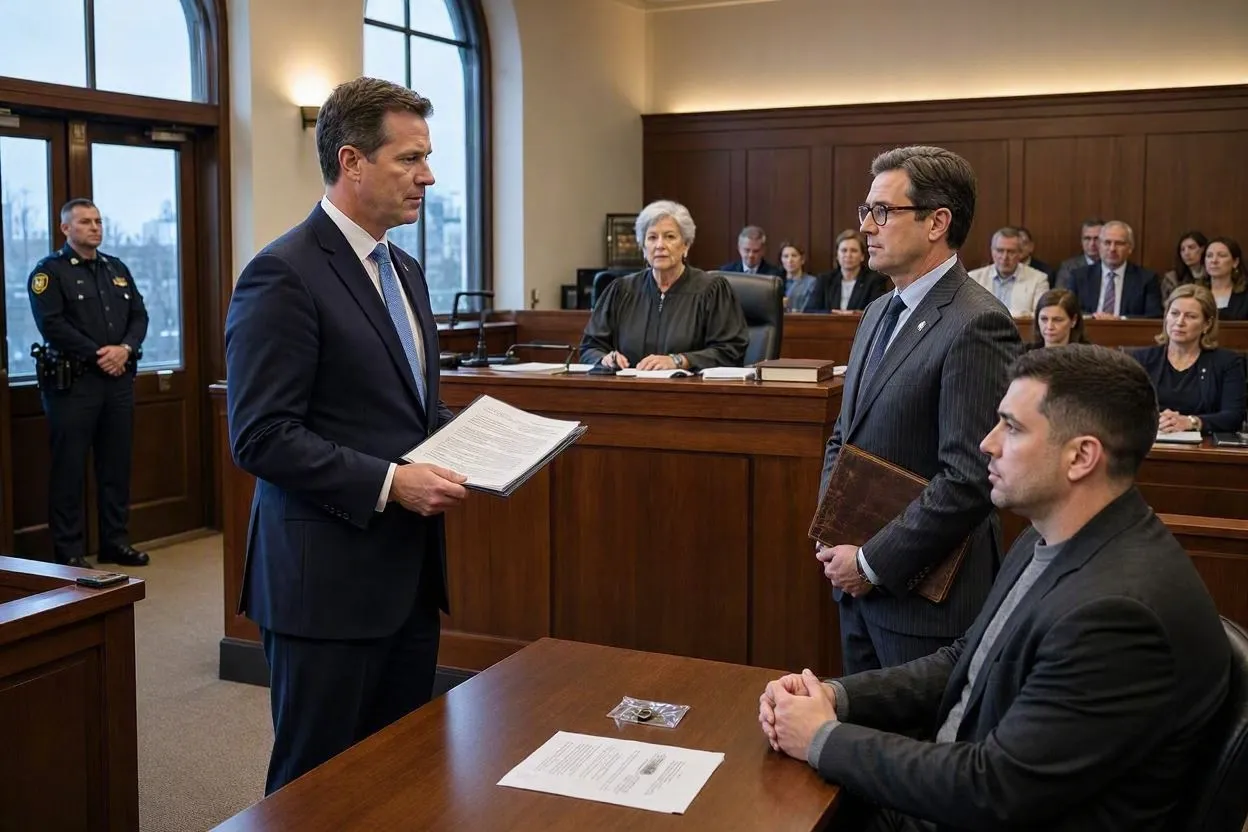
The defendant appears in court, hears the charges read aloud, and enters a plea: guilty, not guilty, or no contest.
California law requires felony arraignments within 48 hours of arrest, excluding weekends and court holidays, under Penal Code Section 825. A defendant who can’t afford an attorney has the right to a court-appointed public defender at this hearing, and the judge sets or reviews bail before adjourning. Once a not-guilty plea is entered, the speedy-trial clock starts running. Some jurisdictions combine the initial hearing and arraignment into one appearance; others split them across separate court dates.
What happens at arraignment, and how the case gets there in the first place, depends heavily on whether the charge is a felony or a misdemeanor. That distinction is worth pinning down before going any further.
What’s the Difference Between a Felony and a Misdemeanor Case?
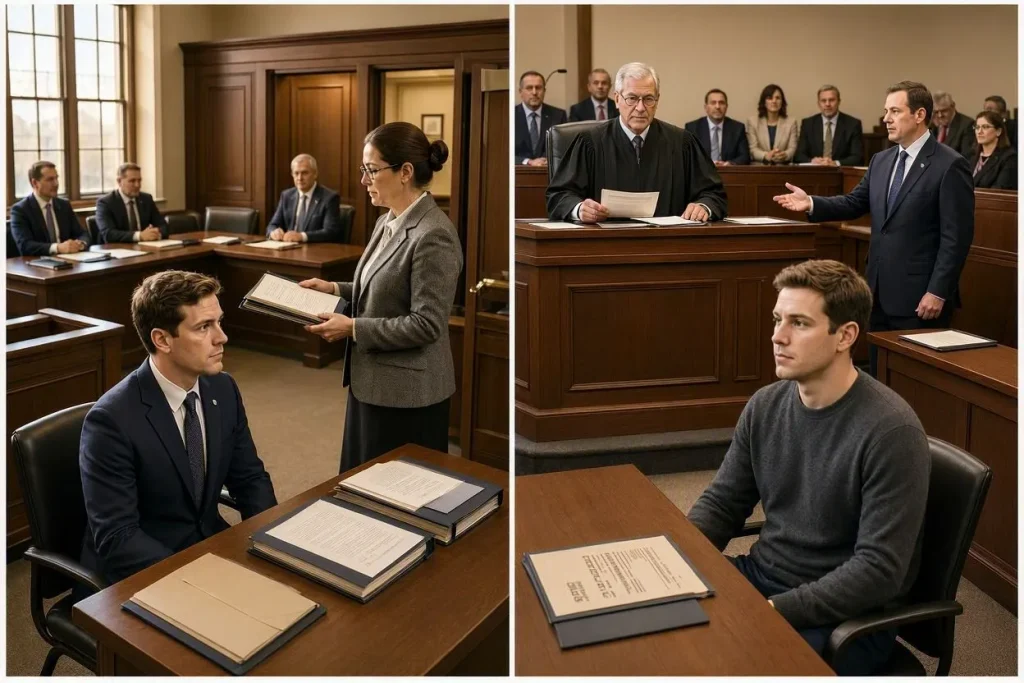
A felony involves a potential sentence of more than one year in state prison. A misdemeanor caps out at one year or less, usually served in county jail.
Felony defendants face grand jury indictment or a preliminary hearing in most jurisdictions, a step most misdemeanor cases skip entirely, which is why felony cases tend to have more pretrial process before ever reaching arraignment. Sentencing ranges diverge sharply too: a misdemeanor DUI might carry six months in county jail, while a felony DUI causing injury can carry three years or more in state prison. The felony-versus-misdemeanor line also determines whether a conviction can later be expunged, since several states, California included, bar expungement for anyone who served time in state prison.
How Does Bail Work in a Criminal Case?
Bail is a monetary or property guarantee that lets a defendant stay out of custody while the case proceeds, in exchange for a written promise to show up at every future court date.
A judge can deny bail entirely if a defendant looks like a flight risk or a danger to the community. Judges set the amount using a bail schedule tied to the charge, and those schedules vary by county and state: a first-time misdemeanor might land in the low hundreds of dollars, while a violent felony can run into six figures. Some defendants qualify for release on their own recognizance, meaning they sign a written agreement to appear without posting any money at all. Post bail and skip a court date, and you forfeit the full amount plus face a separate failure-to-appear charge.
What Is Discovery in a Criminal Case?
Discovery is the formal exchange of evidence between prosecution and defense before trial, including police reports, witness statements, and forensic results.
Prosecutors have to turn over any evidence that could point to innocence, a requirement the Supreme Court established in Brady v. Maryland. Defense teams get access to victim and witness contact information, criminal history reports, and expert analyses, though they rarely owe the prosecution the same materials in return. Reciprocal discovery does kick in once a case is set for trial in most jurisdictions, requiring the defense to disclose its own expert witnesses. Whether a defendant will testify stays undisclosed until the defense presents its case, if the defense even calls the defendant to the stand.
What Pretrial Motions Can Be Filed?
Pretrial motions ask the judge to resolve a legal issue before trial. The most common ones seek to suppress evidence, dismiss charges, or exclude certain testimony.
A motion to suppress can eliminate a confession or a piece of physical evidence if police obtained it through an illegal search, sometimes gutting the prosecution’s case outright. Motions in limine, typically filed days before trial, ask the court to block specific evidence or arguments from ever reaching the jury. Judges rule on these in written orders, and either side can appeal a ruling that excludes evidence, though mid-case appeals like that stay uncommon. This phase often lasts longer than any other, since attorneys use it to negotiate, investigate, and prepare all at once.
What Is a Plea Bargain?
An agreement where a defendant pleads guilty to a lesser charge, or to fewer charges, in exchange for a reduced sentence or the dismissal of other counts.
Plea deals resolve the large majority of criminal cases in the U.S. rather than going to trial, per the Department of Justice. A judge still has to approve the deal and can reject it if the proposed sentence looks disproportionate to the offense. Defendants give up the right to a trial, and to appeal most issues, once a judge accepts the plea. That’s why defense attorneys walk clients through the trade-off carefully before anyone signs. Prosecutors typically extend a formal offer only after reviewing discovery, so this stage rarely happens before evidence has changed hands.
How Does a Criminal Trial Work?
Through five phases: jury selection, opening statements, presentation of evidence, closing arguments, and jury deliberation, ending in a verdict of guilty or not guilty.
Attorneys question potential jurors during voir dire and can remove them for cause or through a limited number of peremptory challenges; the exact count is set by state rule and the charge, but felony cases commonly allow somewhere around ten per side. The prosecution carries the burden of proving guilt beyond a reasonable doubt, a standard that applies whether the charge is a red-light violation or homicide. A jury that can’t reach a unanimous verdict results in a mistrial, and prosecutors then decide whether to retry the case with a new jury. Bench trials skip the jury entirely, letting a judge decide both the facts and the law.
How Is a Defendant Sentenced?
At a separate hearing, where a judge weighs the statute’s sentencing range against aggravating and mitigating factors, things like a defendant’s criminal history or expressions of remorse.
Federal judges consult the Federal Sentencing Guidelines, which assign a numeric offense level and a criminal history score to calculate a recommended range in months. A defendant can address the court directly before sentencing through the right of allocution, offering an apology or explanation that might soften the outcome. Sentences can include prison time, probation, fines, and restitution paid directly to victims, often combined rather than standing alone. State sentencing hearings can happen the same day as a guilty plea, or weeks later once a pre-sentence report is finished.
Can a Defendant Appeal a Conviction?

Yes, but only by pointing to a specific legal error or abuse of discretion made during the trial.
An appeals court reviews the trial record rather than reweighing evidence or hearing new testimony, and it can affirm the conviction, reverse it, or send the case back for a new trial. The prosecution can’t appeal an acquittal, because the Double Jeopardy Clause of the Fifth Amendment bars retrying a defendant for the same offense after a not-guilty verdict. Federal defendants generally have 14 days after sentencing to file a notice of appeal. Miss that window and the right can be gone for good.
That covers the eleven stages in order. The sections below aren’t steps in the sequence; they’re protections and logistics that apply across the whole process, starting with the constitutional rights that back up every stage above.
What Rights Protect a Defendant During the Process?
Several constitutional rights, including the right to an attorney, the right to remain silent, the right to a speedy and public trial, and protection against double jeopardy.
Miranda rights require police to inform a suspect of the right to remain silent and the right to an attorney before any custodial interrogation begins, a rule the Supreme Court established in Miranda v. Arizona. A defendant who can’t afford a lawyer gets one at no cost, and that guarantee applies at every critical stage of the case, not just at trial. The right to a public trial keeps courtrooms open to the press and the community, with narrow exceptions for cases involving minors or sensitive testimony. These protections apply equally in state and federal court, though the specific procedures for enforcing them vary by jurisdiction.
Those rights exist throughout the process, but they don’t set a clock on how long the process itself takes. Timing is its own question.
How Long Does the Criminal Case Process Take?
Anywhere from six weeks for a straightforward misdemeanor to three years or more for a complex federal felony, depending on court backlog and case complexity.
Federal law sets a 70-day limit between indictment and trial under the Speedy Trial Act, though judges frequently grant extensions for complicated cases. State timelines vary by statute; some states require a trial within roughly 60 days of arraignment for defendants held in custody, while out-of-custody defendants can wait a year or longer for a court date, so it’s worth checking the specific rule in the state where a case is filed. Continuances requested by either side, forensic testing backlogs, and ongoing plea negotiations all push timelines past these statutory minimums. Cases with multiple co-defendants tend to run longer still, since scheduling conflicts among several defense attorneys can push hearings back by months.
What Happens If a Defendant Misses Court?
A judge issues a bench warrant, authorizing police to arrest the person on sight.
Missing court revokes bail and forfeits any bond money posted, and a new charge for failure to appear can stack onto the original case. Courts in most states treat a missed felony court date as a separate misdemeanor or felony offense, punishable by up to a year in jail on top of the original charge. Contacting the court or a defense attorney right after a missed date can sometimes recall the warrant before an arrest happens, especially if there’s a documented emergency behind the absence.
Are Diversion Programs an Alternative to Prosecution?
Yes. Certain defendants can complete counseling, community service, or restitution instead of facing a conviction, and successful completion typically gets the charges dismissed.
Prosecutors reserve diversion mostly for first-time, nonviolent offenders; drug possession, petty theft, and some DUI cases are common candidates. A defendant usually has to plead guilty or no contest before entering the program, and that plea only gets withdrawn if every requirement is met on schedule. Programs run anywhere from three months for a basic theft diversion to two years for drug court, with regular check-ins before a supervising judge. Fail a drug test or miss a required session, and the case can go straight back to standard prosecution, wiping out months of completed work.
Does a Criminal Conviction Affect Immigration Status?
Yes. It can trigger deportation, denial of a green card, or ineligibility for naturalization for a non-citizen defendant, depending on the offense and the person’s immigration status.
Federal immigration law treats certain offenses as an “aggravated felony” or a “crime involving moral turpitude,” categories that carry near-automatic removal consequences regardless of how minor the underlying state sentence looks. A single drug conviction, even for simple possession, can bar a green card holder from returning to the U.S. after travel abroad. Immigration consequences attach even to convictions resolved through a plea bargain, which is why defense attorneys representing non-citizen clients typically loop in an immigration specialist before any plea gets entered. The Supreme Court’s ruling in Padilla v. Kentucky requires defense counsel to advise clients of these risks before a guilty plea; failing to do so can be grounds to withdraw the plea later.
Can a Criminal Record Be Cleared After the Case Ends?
Yes, through expungement or record sealing, though eligibility depends on the offense, the sentence, and the state.
California allows expungement for most misdemeanors and felonies that didn’t involve state prison time, once probation is complete. Defendants who served time in state prison can’t expunge the underlying conviction, but California Penal Code Section 4852.01 lets them petition for a Certificate of Rehabilitation after seven years, a process that also triggers an automatic pardon recommendation to the governor. California law also restricts how employers can weigh a conviction once a certificate is granted; the specific protections have been amended more than once, so it’s worth checking current code rather than treating any single year’s version as final. Other states use different terms (sealing, set-aside, nondisclosure), but the goal is the same: limiting who can see the record on a background check.
Do You Need a Criminal Defense Attorney?

Yes, at every stage. Whether that’s a hired attorney or a court-appointed one.
The rules governing evidence, motions, and plea negotiations are technical enough that self-represented defendants routinely miss deadlines and waive protections without realizing it. A defendant who can’t afford a private attorney has a constitutional right to a public defender at no cost, established in Gideon v. Wainwright. Private attorneys for a misdemeanor case often charge somewhere in the low thousands of dollars, and considerably more for a felony that goes to trial, though fees vary widely by region and by how complex the case is, so cost is a real factor many defendants weigh against a public defender’s caseload and availability. An attorney’s involvement matters most in the earliest stages, since decisions made at arraignment or during discovery often shape everything that follows.
Conclusion
The criminal case process rarely moves in a straight line. A case can loop back to plea negotiations after a motion hearing, or stall for months while a forensic lab processes evidence. Trial is the exception rather than the rule; most cases end in plea deals, dismissals, or diversion long before a jury ever gets involved. Anyone facing a charge is better off tracking every court date on a calendar the moment charges are filed. One missed appearance can undo months of progress.
FAQs

Amanda Brooks
Amanda Brooks leads JusticeInTown’s legal, justice, and community advocacy content division. She holds a background in legal research and public policy and specializes in topics related to civil rights, access to justice, legal awareness, and community issues. With years of experience researching legal and social justice topics, Amanda brings a careful, research-driven approach to complex legal information and public-interest issues. She is the primary author of JusticeInTown’s legal guides, justice-related resources, and community-focused content, helping readers better understand their rights, legal options, and the issues affecting their communities.
Related Posts