
Employment Law Guide: Employee Rights & Workplace Rules Explained
A wage dispute, a denied accommodation request, a termination that lands two days after you file a complaint: all three raise the same underlying question. What does the law actually require here? Federal statutes set a baseline for every worker in the country, but the real answer usually depends on which state’s labor code applies, how many people the employer has on payroll, and what paperwork already exists. This guide walks through the rules that come up most often, from at-will termination to overtime pay to family leave, with the specific numbers and deadlines that turn a vague right into something you can actually act on.
What Is Employment Law?
Employment law is the body of federal, state, and local rules governing the relationship between workers and the businesses that employ them. It covers hiring, pay, benefits, safety, discrimination, leave, and termination. Some of it comes from Congress, like the Fair Labor Standards Act (FLSA) and the Family and Medical Leave Act (FMLA). Some of it comes from state legislatures, and a Texas statute on final paychecks won’t look anything like a California one. Cities can add another layer on top of that. Austin and San Antonio, for instance, have their own local paid sick leave rules.
This guide focuses on the questions people actually search for: what counts as at-will employment, when an employer owes overtime, how leave and disability programs interact, and what to do if a termination or pay dispute looks illegal. Federal law sets the floor. States and cities can raise it, but they can’t lower it below the federal minimum.
At-Will Employment: What It Means and Its Exceptions
At-will employment means an employer can end the relationship at any time, for almost any reason, without advance notice, and the employee has the same right to quit. Forty-nine states follow this rule. Montana is the sole exception, once an employee completes a probationary period. The doctrine sounds absolute. It isn’t.
Courts have carved out three recurring exceptions. First, an employer can’t fire someone for refusing to break the law. Texas established this in Sabine Pilot Service, Inc. v. Hauck (1985), where the state’s highest court ruled that firing a worker solely for declining to commit an illegal act violates public policy. Second, termination motivated by a desire to dodge pension or benefit obligations can trigger liability. Third, firing someone for reporting discrimination or filing a workers’ compensation claim counts as retaliation, and retaliation claims exist in every state regardless of at-will status.
An employee handbook can also narrow at-will rights. If a handbook promises progressive discipline (a verbal warning, then a written one, then termination) and an employer skips straight to firing without cause, that gap between policy and practice sometimes supports a breach-of-contract claim. Read the handbook before assuming at-will employment leaves no room to push back.
Wage and Hour Law: Minimum Wage, Overtime, and Final Paychecks
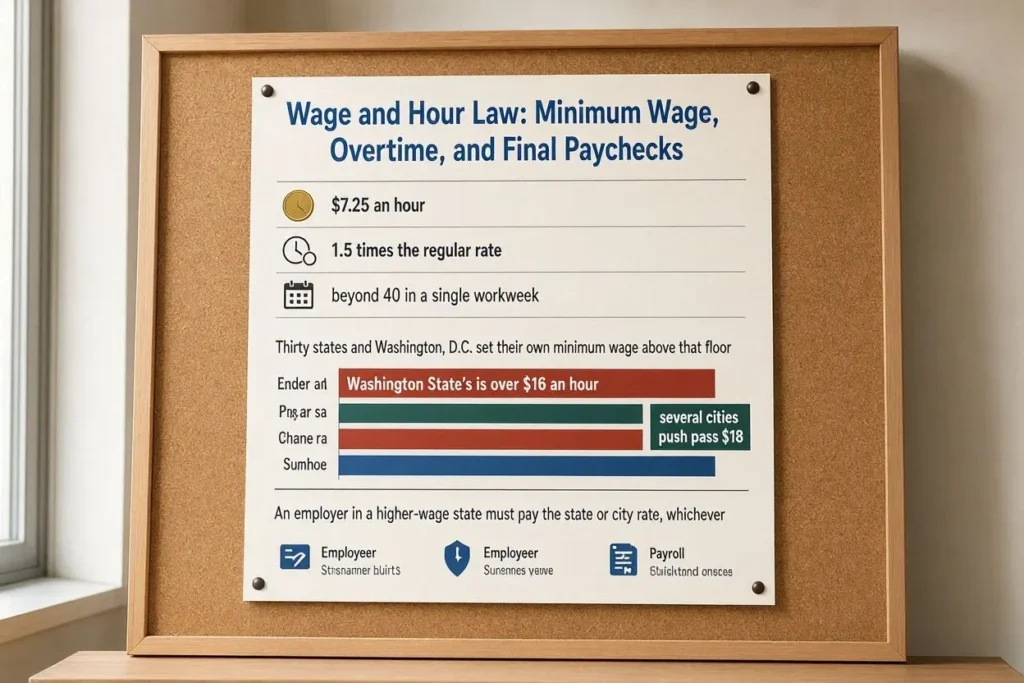
The federal minimum wage is $7.25 an hour. Federal law requires overtime pay of 1.5 times the regular rate for hours worked beyond 40 in a single workweek. Thirty states and Washington, D.C. set their own minimum wage above that floor, and the gap can be large: Washington State’s is over $16 an hour, and several cities push past $18. An employer in a higher-wage state must pay the state or city rate, whichever number is bigger.
Overtime eligibility hinges on classification, not job title. A worker labeled “manager” isn’t automatically exempt from overtime. The FLSA test looks at actual duties and salary level, and misclassifying a non-exempt employee as exempt to avoid paying overtime is one of the most common wage claims filed with the Department of Labor (DOL).
Final paycheck timing varies by state, and this is where the gap between states gets stark. California requires immediate payment on the day of an involuntary termination. Texas gives employers six calendar days after discharge, under Texas Labor Code Section 61.014. If an employee quits voluntarily in Texas, the employer has until the next regularly scheduled payday. Missing that deadline can expose an employer to penalties on top of the wages owed.
Tipped employees face a separate set of rules. Federal law allows a tip credit that lets employers pay a cash wage as low as $2.13 an hour, provided tips bring total pay up to at least $7.25. Seven states, including California and Washington, require the full state minimum wage before tips are counted at all.
Workplace Discrimination and Harassment Protections
Federal law prohibits workplace discrimination based on race, color, religion, sex, national origin, age (40 and older), disability, and genetic information. Title VII of the Civil Rights Act of 1964 covers the first four categories and applies to employers with 15 or more employees. The Age Discrimination in Employment Act adds age protection, but only for employers with 20 or more employees.
Sex discrimination now explicitly includes sexual orientation and gender identity, following the Supreme Court’s 2020 decision in Bostock v. Clayton County. That ruling settled a question that had split federal courts for years: firing someone for being gay or transgender is sex discrimination under Title VII, full stop.
Harassment claims require proof of a hostile work environment or a quid pro quo demand tied to employment decisions. A single offensive comment rarely meets the legal bar; a pattern of conduct severe enough to alter working conditions does. The Equal Employment Opportunity Commission (EEOC) investigates these claims at the federal level, and most states run a parallel agency that accepts the same charge.
State protections often go further than federal law. California, New York, and roughly 20 other states bar discrimination based on marital status. A growing number of cities, including New York City, now regulate discrimination based on criminal history through “ban the box” laws that delay background checks until after a conditional job offer.
Family and Medical Leave Act (FMLA) and State Paid Leave Programs
The FMLA entitles eligible employees to up to 12 weeks of unpaid, job-protected leave per year for a serious health condition, the birth or adoption of a child, or care of a family member with a serious health condition. Eligibility requires 12 months of employment, at least 1,250 hours worked in the prior year, and an employer with 50 or more employees within a 75-mile radius.
FMLA leave is unpaid by default, which is where state programs fill the gap. Thirteen states and D.C. now run paid family leave programs, and the wage replacement varies widely. New Jersey’s Temporary Disability Insurance program replaces 85% of wages for up to 26 weeks. New York’s disability benefit caps out at $170 a week, a number that hasn’t kept pace with the cost of living in most of the state. California’s State Disability Insurance replaces 70% to 90% of wages depending on income, for up to 52 weeks, filed on EDD Form DE 2501.
Intermittent leave is a lesser-known FMLA feature. An employee with a chronic condition, migraines being a common example, can take leave in blocks of hours or days as symptoms flare, rather than one continuous stretch. Employers can require medical certification, and they can request recertification periodically, but they can’t demand a doctor’s note for every single absence once certification is on file.
Reasonable Accommodations Under the ADA and PWFA
Employers with 15 or more employees must provide reasonable accommodations to qualified employees with disabilities under the Americans with Disabilities Act (ADA), unless doing so would cause undue hardship on the business. Accommodations run the range from a modified schedule to a piece of equipment to a reassignment of marginal job duties. The employee has to be able to perform the essential functions of the role, with or without the accommodation, for ADA protection to apply.
Pregnancy accommodations used to fall into a gray area. The Pregnant Workers Fairness Act (PWFA), in effect since June 2023, closed that gap. It requires covered employers to provide reasonable accommodations for pregnancy, childbirth, and related medical conditions, even when the condition wouldn’t independently qualify as a disability under the ADA. A worker who needs more frequent breaks or a temporary lifting restriction during pregnancy now has a direct federal claim if an employer refuses without a valid undue-hardship defense.
Requesting an accommodation doesn’t require magic words. An employee doesn’t have to cite the ADA by name or submit a formal written request. Telling a supervisor “I need a stool because standing all shift hurts my back” is enough to start the interactive process an employer is legally required to engage in.
Wrongful Termination and Retaliation
Wrongful termination happens when an employer fires a worker for a reason the law specifically prohibits, such as discrimination, retaliation, or refusal to break the law, even though at-will employment otherwise allows termination without cause. “Wrongful termination” isn’t a single statute. It’s a category that pulls from discrimination law, whistleblower statutes, and public policy exceptions all at once.
Retaliation is the most commonly filed charge type at the EEOC, ahead of every specific discrimination category on its own. A worker who files a harassment complaint, requests FMLA leave, or reports a safety violation to OSHA (Occupational Safety and Health Administration) is protected from adverse action taken because of that report. Timing matters here. A termination that follows a protected complaint by a matter of days, with no documented performance issue predating the complaint, tends to draw scrutiny from investigators and courts alike.
Constructive discharge is a related concept worth knowing. If working conditions become so intolerable that a reasonable person would feel forced to resign, courts sometimes treat that resignation as the legal equivalent of a firing, opening the door to the same discrimination or retaliation claims a direct termination would.
Non-Compete Agreements: Current Legal Status
No nationwide ban on non-compete agreements is currently in effect. The Federal Trade Commission (FTC) voted in April 2024 to prohibit most employee non-competes, but a federal court in Texas struck the rule down in August 2024, and the FTC abandoned its appeal in September 2025. The agency has since shifted to case-by-case enforcement against individual employers rather than a blanket rule. It scheduled a workshop for January 27, 2026 to consider next steps.
State law fills the gap left by that federal reversal. California, North Dakota, Oklahoma, and Minnesota ban most employee non-competes outright. Other states allow them but require the terms to be reasonable in scope, duration, and geography, and courts routinely strike down agreements that try to restrict a worker for multiple years across an entire region. If a signed non-compete feels overly broad, check the specific state’s enforceability standard first. Don’t assume the agreement holds regardless of location.
How to File a Complaint
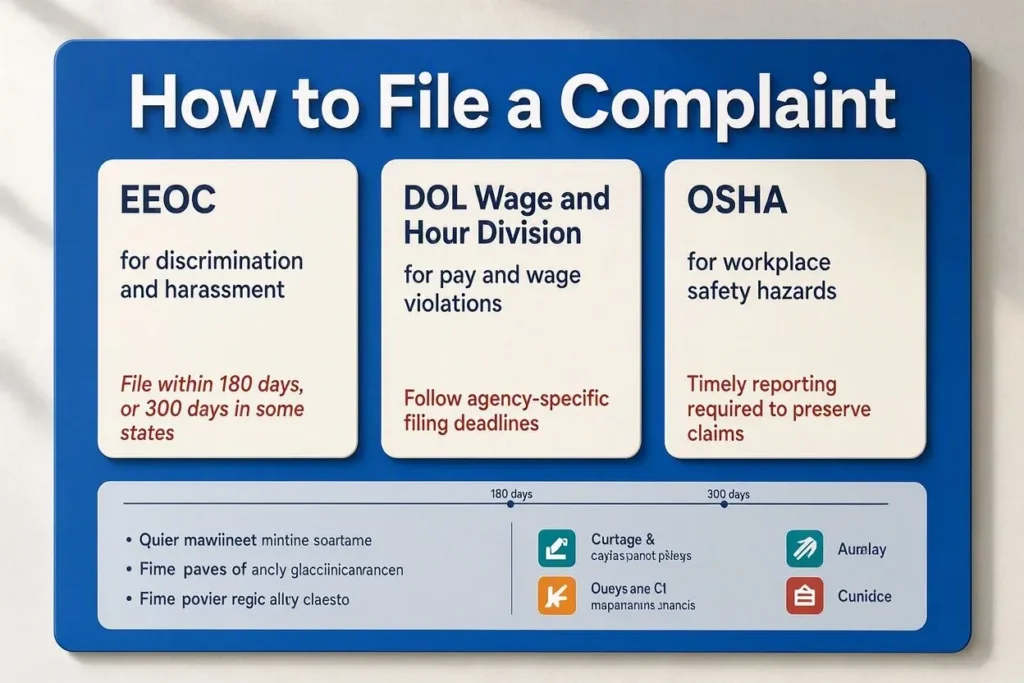
Filing a workplace complaint starts with identifying the right agency: the EEOC for discrimination and harassment, the DOL’s Wage and Hour Division for pay violations, and OSHA for safety hazards. Each agency has its own deadline, and missing it can end a claim before it starts.
EEOC charges must be filed within 180 days of the discriminatory act, extended to 300 days in states that run their own anti-discrimination agency alongside the federal one, which covers most of the country. Wage claims under the FLSA carry a longer window: two years for ordinary violations, three if the employer’s conduct was willful. OSHA complaints about unsafe conditions have no fixed statutory deadline for the underlying hazard, but retaliation complaints tied to a safety report must be filed within 30 days.
Documentation strengthens every type of claim. Save emails, take photos of unsafe conditions, and write down dates and specifics as close to the incident as possible, rather than trying to reconstruct a timeline months later from memory.
When to Contact an Employment Lawyer
Contact an employment lawyer if a termination, pay dispute, or accommodation denial happened shortly after a protected activity, involves a large sum of unpaid wages, or requires interpreting a contract or severance agreement before you sign it. Most employment attorneys handle discrimination and wage cases on contingency: no upfront fee, payment comes from a settlement or judgment.
A severance agreement deserves particular caution. Signing one typically waives your right to sue, and once signed, that waiver is hard to undo. Federal law requires a minimum 21-day review period for age discrimination waivers offered to employees 40 or older, extended to 45 days for group layoffs, plus a separate seven-day window to revoke after signing. Having an attorney review the agreement before that clock runs out costs far less than trying to unwind a signed waiver later.
Why State Law Changes the Answer
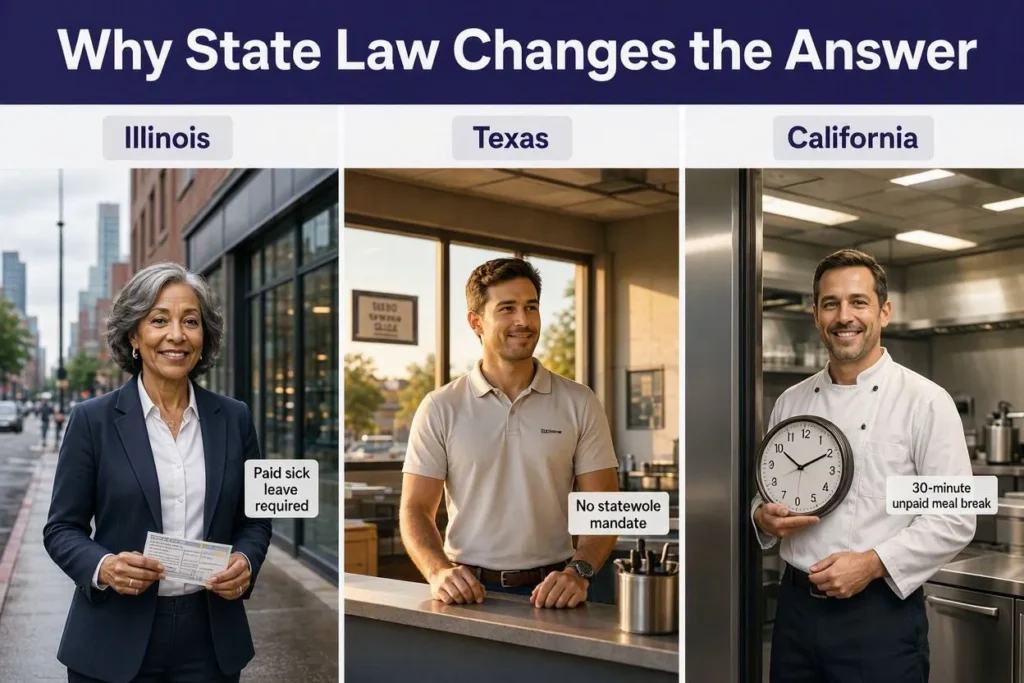
The same question about employment rights can have a different legal answer depending on which state the employee works in, because states set their own rules on top of the federal floor. A worker asking about paid sick leave gets a different answer in Illinois, which mandates it statewide, than in Texas, which leaves it to individual cities or employer policy. A question about meal breaks gets a firm answer in California (a 30-minute unpaid break required after five hours) and no answer at all in states with no meal break statute on the books.
Remote work has complicated this further. An employee living in one state while working for a company headquartered in another is typically governed by the law of the state where the work is physically performed, not the employer’s home state. A remote worker in Colorado employed by a New York company follows Colorado’s wage, leave, and termination rules. Getting that jurisdiction wrong is a common and costly mistake for growing companies with distributed teams.
Conclusion
Employment law rewards specificity over general impressions. An employee who knows the FMLA eligibility threshold, the state’s final paycheck deadline, and the EEOC’s filing window can act inside deadlines that otherwise close quietly and permanently. This guide draws the line between what federal law guarantees everywhere and what depends entirely on the state where the work happens, because that distinction decides most real-world outcomes. When a specific situation involves money, a signed agreement, or a termination that followed a complaint, a licensed employment attorney in the relevant state is the only source that can turn general rules into a specific answer.
FAQs

Amanda Brooks
Amanda Brooks leads JusticeInTown’s legal, justice, and community advocacy content division. She holds a background in legal research and public policy and specializes in topics related to civil rights, access to justice, legal awareness, and community issues. With years of experience researching legal and social justice topics, Amanda brings a careful, research-driven approach to complex legal information and public-interest issues. She is the primary author of JusticeInTown’s legal guides, justice-related resources, and community-focused content, helping readers better understand their rights, legal options, and the issues affecting their communities.
Related Posts