
Chapter 7 vs Chapter 13 Bankruptcy: Which Should You File?
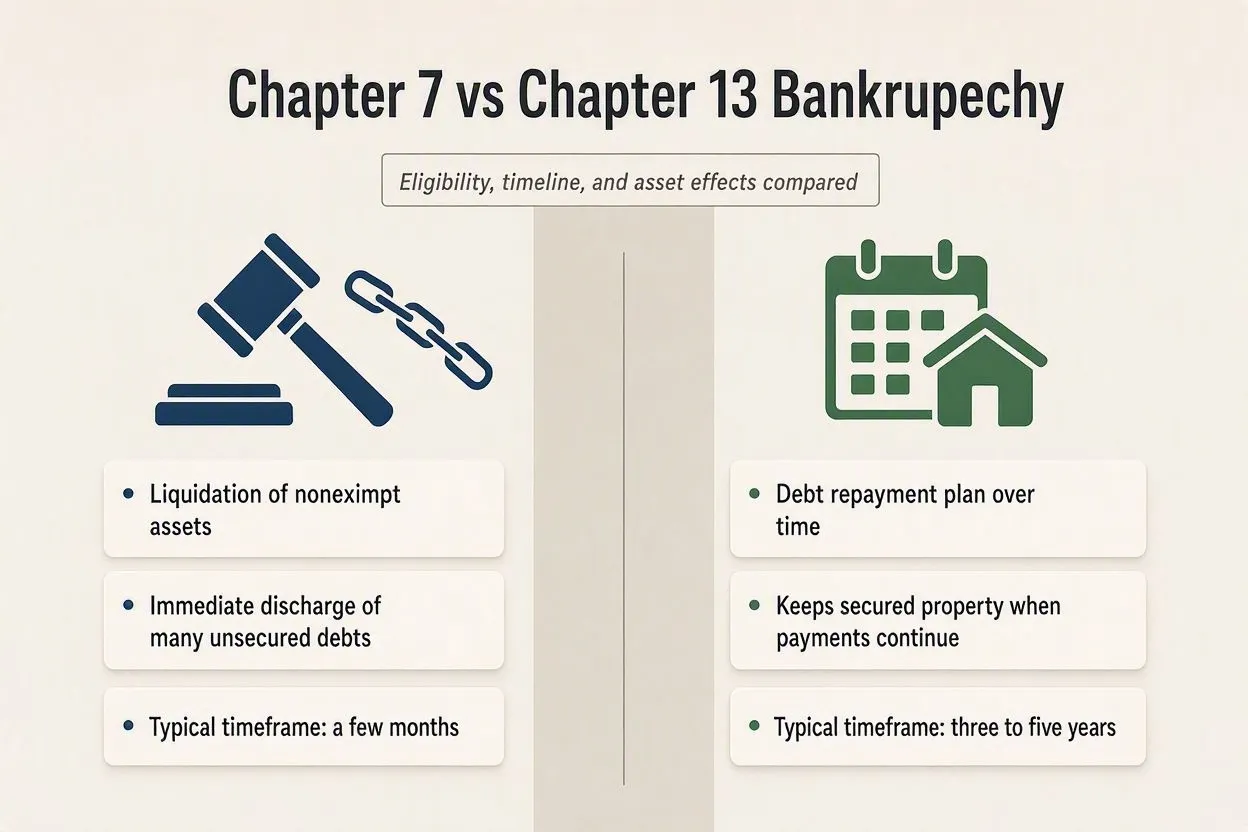
Chapter 7 bankruptcy liquidates nonexempt assets to wipe out unsecured debt in three to five months, while Chapter 13 sets up a three-to-five-year repayment plan that lets you keep your property. Your choice between the two usually comes down to income and what you’re trying to protect. Fall below your state’s median income with few assets, and Chapter 7 clears debt fast. Fall behind on a mortgage or car loan and earn steady wages, and Chapter 13 gives you room to catch up without losing the house or the car.
What Is the Core Difference Between Chapter 7 and Chapter 13 Bankruptcy?
Chapter 7 is liquidation bankruptcy; Chapter 13 is a court-supervised repayment plan. A trustee sells off nonexempt assets under Chapter 7 and distributes the proceeds to creditors, then discharges what’s left of your eligible unsecured debt, often within four to six months. Chapter 13 skips the asset sale entirely. Instead, you commit to monthly payments for three to five years, and whatever unsecured debt remains unpaid at the end gets discharged.
That single distinction, sell assets versus repay over time, drives nearly every other difference between the two chapters. Income level decides which one you can even file. Property you own decides which one protects it better. And the debts you’re carrying decide how much relief either option can actually deliver. Anyone comparing chapter 7 vs chapter 13 bankruptcy should start here, because the eligibility and property rules downstream all trace back to this one structural choice.
| Factor | Chapter 7 | Chapter 13 |
| Bankruptcy type | Liquidation | Reorganization / repayment |
| Typical timeline | 4 to 6 months | 3 to 5 years |
| Property treatment | Nonexempt assets may be sold | Property kept if the plan is completed |
| Filing fee | $338 | $313 |
| Credit report duration | 10 years | 7 years |
| Best suited for | Low income, few nonexempt assets | Steady income, property to protect |
How Does Chapter 7 Bankruptcy Work?
Chapter 7 bankruptcy discharges most unsecured debt within four to six months after a court-appointed trustee liquidates any nonexempt property you own. Filing starts with a petition, schedules of assets and debts, and proof you completed credit counseling within 180 days of filing. A trustee gets appointed almost immediately, and the automatic stay kicks in the moment you file, halting phone calls, lawsuits, wage garnishments, and repossession attempts.
Roughly 21 to 40 days after filing, you’ll attend a meeting of creditors, sometimes called a 341 meeting. The trustee asks about your finances under oath; most creditors don’t bother showing up. Assuming your paperwork checks out and no one raises an objection, the court issues a discharge order. Filers with no nonexempt assets, which describes a large share of Chapter 7 cases, never see a single item sold. Federal and state exemptions typically protect a primary vehicle, basic household goods, and a portion of home equity, so liquidation in practice touches far less than people expect.
How Does Chapter 13 Bankruptcy Work?
Chapter 13 bankruptcy reorganizes your debt into a three-to-five-year repayment plan supervised by a bankruptcy trustee. Also known as a wage earner’s plan, it requires regular income and a proposed plan filed with, or shortly after, your petition. If your current monthly income sits below your state’s median, the plan generally runs three years; income above the median usually locks you into five years under 11 U.S.C. § 1325(d).
Within 30 days of filing, you start sending payments to the trustee, even before the court formally confirms the plan. A confirmation hearing follows the creditors’ meeting, typically within 45 days, where the judge checks that the plan meets the disposable income requirement and pays priority debts in full. Chapter 13 also protects co-signers on consumer debts, something Chapter 7 doesn’t offer, and it lets filers cure mortgage or auto loan arrears over the life of the plan rather than losing the property to foreclosure or repossession.
Who Qualifies for Chapter 7 vs Chapter 13?
Eligibility hinges on income for Chapter 7 and on total debt load for Chapter 13. Neither chapter is available to everyone in every situation, and the qualification tests work in completely different directions.
What Is the Chapter 7 Means Test?
Yes, the means test decides Chapter 7 eligibility once your household income exceeds your state’s median for a family your size. The test compares your average monthly income from the past six months against that median figure.
- Income below the state median: you pass the means test automatically.
- Income above the state median: the court runs a deeper calculation of allowed expenses against disposable income.
- Too much disposable income left over: the court presumes abuse of Chapter 7, pushing the case toward Chapter 13 instead.
What Are the Chapter 13 Debt Limits?
Chapter 13 caps eligibility under 11 U.S.C. § 109(e) at two current filing thresholds:
- Unsecured debt limit: $526,700
- Secured debt limit: $1,580,125
Exceed either limit, and Chapter 13 isn’t an option; Chapter 11 becomes the fallback, though that route is far more expensive and built mainly for businesses. Self-employed individuals and sole proprietors can file Chapter 13 too, provided their debts stay under those caps and their income remains “regular” in the eyes of the court.
Married couples add another wrinkle. A husband and wife can file a joint petition under 11 U.S.C. § 302(a), combining both incomes and debts into a single case, or one spouse can file alone. Filing individually still requires disclosing the non-filing spouse’s income and expenses, since the court needs the full household picture to judge disposable income and means test results accurately. Anyone weighing chapter 7 vs chapter 13 bankruptcy as a couple should run both scenarios, joint and individual, before deciding, because the numbers can shift eligibility in either direction depending on whose income and whose debts get counted.
What Happens to Your Property in Each Chapter?
Chapter 7 can require selling nonexempt property, while Chapter 13 lets you keep everything you own as long as you complete the plan. Under Chapter 7, a trustee identifies assets that exceed state or federal exemption limits, sells them, and hands the proceeds to creditors. Common exempt categories include a set amount of home equity, one vehicle up to a capped value, and tools of the trade, so most filers with modest assets keep nearly everything anyway.
Chapter 13 works differently. You keep every asset you own, but in exchange, your repayment plan must pay unsecured creditors at least as much as they’d receive if those same assets had been liquidated under Chapter 7. That’s the “liquidation test” written into 11 U.S.C. § 1325. Own a boat, a second property, or valuable collectibles you don’t want to lose? Chapter 13 lets you retain them, provided the plan compensates creditors accordingly.
How Do Chapter 7 and Chapter 13 Treat Secured, Unsecured, and Priority Debt?
Secured debt, unsecured debt, and priority debt get handled differently depending on which chapter you file. Understanding the three categories matters more than most filers realize, since the treatment differs sharply between chapters.
- Secured debt (mortgages, auto loans) can be discharged under Chapter 7, but the lender keeps the right to repossess collateral unless you reaffirm the loan. Chapter 13 lets you cure missed payments over time and, in some cases, “cram down” the loan balance to match the collateral’s actual value.
- Unsecured debt (credit cards, medical bills, personal loans) gets wiped out entirely in most Chapter 7 cases. Chapter 13 only requires paying back what your disposable income allows; whatever’s left unpaid at plan’s end is discharged.
- Priority debt (recent taxes, domestic support obligations, filing fees) must be paid in full under Chapter 13’s plan. Chapter 7 doesn’t discharge these debts either, so they survive the case and remain your responsibility afterward.
Lien stripping, the process of removing a wholly unsecured junior lien from real property, is generally available only in Chapter 13, giving it another edge for homeowners carrying a second mortgage that’s underwater.
How Long Does Each Bankruptcy Take to Complete?
Chapter 7 typically finishes in four to six months, while Chapter 13 runs three to five years by design. Speed is arguably Chapter 7’s single biggest selling point. File the petition, attend one creditors’ meeting, wait out a short objection period, and the discharge arrives, often before the six-month mark.
Chapter 13 asks for patience instead. The repayment period isn’t negotiable in most cases; income above the state median locks the plan at five years regardless of how quickly you could otherwise pay off the debt. Miss payments partway through, and the case can convert to Chapter 7 or get dismissed entirely, which is why steady income matters so much before committing to this path.
How Does Filing Affect Your Credit Score?
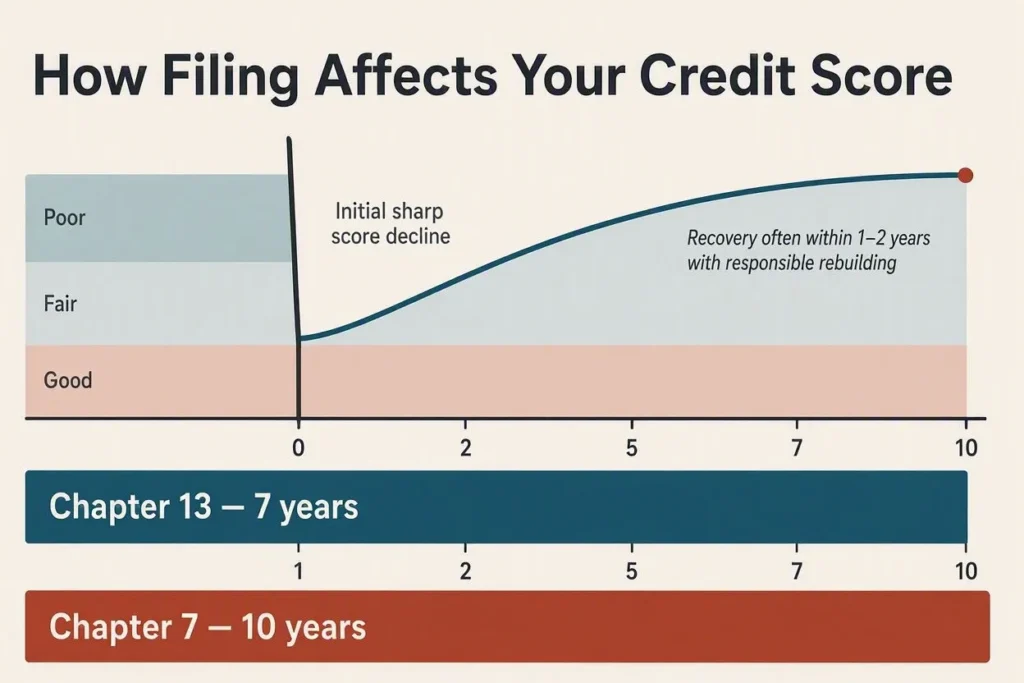
Chapter 7 remains on your credit report for 10 years, while Chapter 13 falls off after 7 years, both counted from the filing date. Neither timeline is negotiable, and both bankruptcies drop your credit score sharply in the months right after filing, though many filers see meaningful recovery within one to two years if they rebuild responsibly.
The seven-year window gives Chapter 13 a modest edge for anyone focused on long-term credit repair. That said, lenders reviewing an application don’t just check whether bankruptcy shows up; some view a completed Chapter 13, evidence that you honored a multi-year repayment commitment, more favorably than a Chapter 7 discharge with no repayment history behind it. Either way, secured credit cards and on-time payments after discharge do more for recovery than the choice of chapter itself.
Which Debts Survive Bankruptcy in Either Chapter?
No, not every debt disappears under Chapter 7 or Chapter 13. Five categories consistently survive both chapters: most federal and private student loans, recent income tax debt, child support and alimony, criminal fines and restitution, and debts from injury or death caused by driving under the influence.
Chapter 13 does discharge a few debt types Chapter 7 cannot reach, including debts from property settlements in divorce and certain willful, malicious injury-to-property claims. That broader discharge scope is one of the lesser-known reasons attorneys sometimes recommend Chapter 13 even to filers who’d otherwise qualify for Chapter 7.
Debts from fraud, embezzlement, or breach of fiduciary duty sit in a gray zone. Both chapters allow these debts to be discharged automatically unless a creditor files a timely objection and proves the fraud in court. Miss that filing window, typically 60 days after the creditors’ meeting, and the debt discharges regardless of how it was incurred, which is why creditors with fraud claims tend to move quickly once a bankruptcy case opens.
How Much Does It Cost to File Chapter 7 vs Chapter 13?
Chapter 7 costs $338 in court filing fees, and Chapter 13 costs $313, though attorney fees add far more to the total.
| Cost item | Chapter 7 | Chapter 13 |
| Court filing fee | $338 | $313 |
| Typical attorney fee | $1,000 to $2,500 (paid upfront) | $3,000 to $4,000 (rolled into the plan) |
| Credit counseling course | Under $50 | Under $50 |
| Debtor education course | Under $50 | Under $50 |
Chapter 7 fees get paid upfront since the case wraps up quickly. Chapter 13 fees, by contrast, typically fold into the repayment plan itself, spreading the cost across the plan’s three-to-five-year term instead of demanding a lump sum before filing. Credit counseling and a post-filing debtor education course remain mandatory in both chapters before a discharge can be granted.
Can You Keep Your House or Car Under Chapter 13?
Yes, Chapter 13 is specifically built to let you keep your house or car while you catch up on missed payments through the repayment plan. Filing triggers the automatic stay immediately, which halts a scheduled foreclosure sale or repossession the moment your case starts. From there, mortgage or auto loan arrears get folded into the plan and paid off over three to five years, provided you keep making the regular payments that come due after filing too.
Chapter 7 offers only temporary relief here. The automatic stay pauses foreclosure and repossession briefly, but it doesn’t cure the underlying arrears; once the case closes, the lender can resume collection action if you’re still behind.
What Happens to Retirement Accounts and Exemption Choices?
Retirement accounts like 401(k)s, pensions, and most IRAs stay protected under both Chapter 7 and Chapter 13, thanks to federal ERISA rules and bankruptcy-specific exemption caps. Traditional and Roth IRAs carry a protection limit that adjusts periodically for inflation, currently well above $1 million per filer, so the vast majority of retirement savers never see those funds touched in either chapter.
Where things get more complicated is the exemption system itself. Every filer must choose between the federal exemption package or their home state’s exemption list, and the two rarely match. Some states, Texas among them, offer unlimited homestead protection for a primary residence; others cap home equity protection at a much lower figure. A filer sitting on significant home equity might do better under state exemptions, while someone with modest home equity but valuable personal property could come out ahead choosing federal. This decision gets made once, at filing, and it can’t be revisited later, which is exactly why an attorney reviews asset lists before choosing either path.
Are Student Loans Dischargeable in Chapter 7 or Chapter 13?
No, student loans generally survive both Chapter 7 and Chapter 13 unless a filer proves “undue hardship” through a separate adversary proceeding, a legal step distinct from the bankruptcy case itself. Courts historically applied the Brunner test, a three-part standard asking whether a filer can maintain a minimal standard of living while repaying the loan, whether that hardship is likely to persist, and whether the filer made good-faith efforts to repay beforehand.
Recent years brought a shift. The Department of Justice updated its guidance in 2022, streamlining how attorneys present undue hardship claims and making successful discharges somewhat more common than they were a decade earlier, though outright discharge still isn’t the norm. Filers carrying heavy student debt alongside other unsecured balances sometimes still benefit from Chapter 13, since income-driven repayment plans can run alongside the bankruptcy plan and the automatic stay pauses collection on defaulted federal loans for the length of the case.
What Are the Alternatives to Filing Bankruptcy?
Not every debt problem needs a bankruptcy filing. Four common alternatives come up before filing:
- Debt management plan (DMP): a nonprofit credit counseling agency consolidates payments and negotiates lower interest rates, without the credit report impact of bankruptcy.
- Debt settlement: a negotiator arranges a lump-sum payoff for less than what’s owed, though it often damages credit nearly as much as bankruptcy while taking longer to resolve.
- 401(k) loan: you borrow against your own retirement balance, avoiding new interest charges but risking tax penalties if you leave your job before repaying it.
- Direct creditor negotiation: you contact lenders yourself to request reduced payments or a modified schedule, worth trying when debt load falls just short of qualifying for real relief through either chapter.
None of these alternatives carries the legal protection of the automatic stay, so anyone facing active lawsuits, garnishment, or an imminent foreclosure date usually finds bankruptcy the faster, more reliable fix.
Which Chapter Should You Choose?
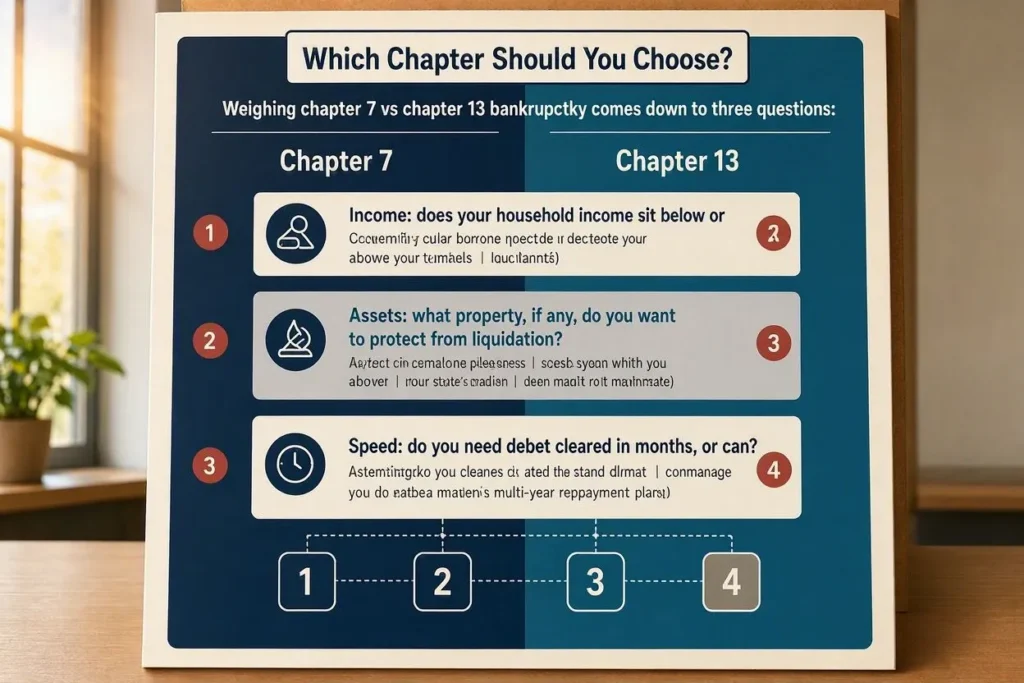
Weighing chapter 7 vs chapter 13 bankruptcy comes down to three questions:
- Income: does your household income sit below or above your state’s median?
- Assets: what property, if any, do you want to protect from liquidation?
- Speed: do you need debt cleared in months, or can you manage a multi-year repayment plan?
Low income, few assets, and a need for speed point toward Chapter 7. Steady income, a house or car you’re behind on, and debt levels within the Chapter 13 caps point the other way.
A licensed bankruptcy attorney can run the numbers specific to your state and household size before you file anything, since exemption amounts and median income figures vary and directly affect which chapter you even qualify for.
Conclusion
Chapter 7 and Chapter 13 solve the same underlying problem through opposite mechanics: one liquidates and discharges fast, the other repays and protects property over years. Income, assets, and the type of debt you’re carrying determine which path actually fits. Anyone still undecided after weighing chapter 7 vs chapter 13 bankruptcy against their own finances should talk to a bankruptcy attorney before filing, since a wrong choice can mean losing property that a different chapter would have protected, or committing to years of payments a faster discharge could have avoided.
FAQs

Amanda Brooks
Amanda Brooks leads JusticeInTown’s legal, justice, and community advocacy content division. She holds a background in legal research and public policy and specializes in topics related to civil rights, access to justice, legal awareness, and community issues. With years of experience researching legal and social justice topics, Amanda brings a careful, research-driven approach to complex legal information and public-interest issues. She is the primary author of JusticeInTown’s legal guides, justice-related resources, and community-focused content, helping readers better understand their rights, legal options, and the issues affecting their communities.
Related Posts