
Insurance Claim Tips: 15 Steps to a Fair Payout

The best insurance claim tips are to report the loss within 72 hours, photograph all damage before any repair, keep every exchange in writing, and compare the first offer against your own contractor estimate before you accept it.
Those 4 habits decide most outcomes. Insurers pay claims backed by dated evidence, and they trim claims that arrive late or thin. What follows covers filing, adjuster meetings, payment rules, state deadlines, and denial appeals for homeowners, auto, and health insurance policies in the United States.
15 Insurance Claim Tips That Protect Your Payout
These 15 insurance claim tips cover a claim from the first call to the final check. Each tip names a concrete action, so you can work down the list as the claim moves.
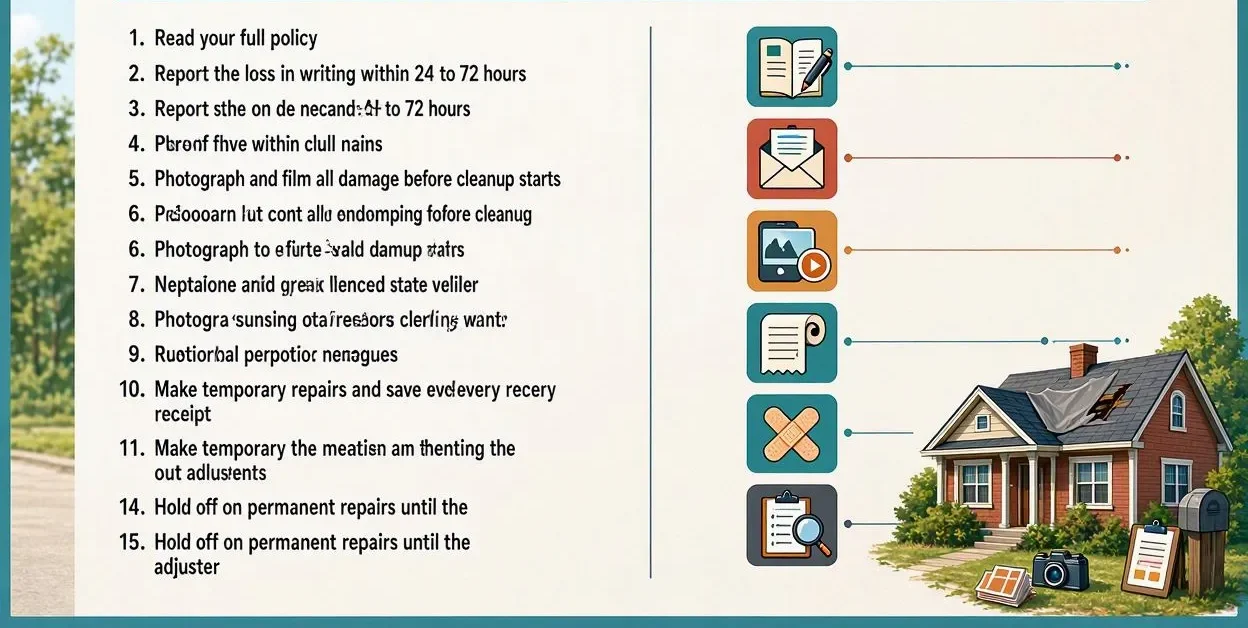
- Read your full policy, not only the declarations page.
- Report the loss in writing within 24 to 72 hours.
- Photograph and film all damage before cleanup starts.
- Make temporary repairs and save every receipt.
- Hold off on permanent repairs until the adjuster inspects.
- Log every call with the date and the representative’s name.
- Confirm every agreement by email or letter.
- Get 2 independent repair estimates.
- Request the adjuster’s itemized estimate and depreciation schedule.
- Challenge depreciation on items worth $500 or more.
- Decline a recorded statement to the other driver’s insurer.
- Refuse any check marked “full and final” unless the amount is complete.
- Track the Proof of Loss and replacement deadlines on a calendar.
- Demand a written denial that quotes the exact policy language.
- Contact your state Department of Insurance (DOI) when the insurer stalls.
Should You File an Insurance Claim at All?
No, not always: skip the claim when the damage only slightly exceeds your deductible, because a paid claim can raise your premium for 3 to 5 years.
Run the math before you call. Say hail cracks $3,400 worth of vinyl siding and your deductible is $2,500. You’d collect $900, and that $900 claim lands on your CLUE report, a shared claims database run by LexisNexis that insurers check before quoting or renewing a policy. CLUE reports hold up to 7 years of auto and property claims, and insurers log a claim once they open it, even if they deny it later. Most carriers weigh the last 3 to 5 years of claims when pricing a renewal.
Questions work differently. LexisNexis advises insurers not to report a call where you only ask about coverage or your deductible, so phrase it as “Does my policy cover roof leaks?” rather than “I’m reporting a roof leak.”
File without hesitation in these 4 situations:
- The damage exceeds your deductible by 2 times or more.
- Someone is injured, including you.
- Another driver or property owner caused the loss.
- A liability claim is possible, such as a delivery driver slipping on your icy steps.
Pull your free CLUE report every 12 months under the Fair Credit Reporting Act (FCRA). Errors happen, and a misfiled inquiry can cost you money at renewal.
How to File an Insurance Claim Step by Step
To file an insurance claim, notify your insurer in writing, stop further damage, document every loss, and submit a signed Proof of Loss before the policy deadline.
Order matters here. A claim filed on day 2 with 200 photos moves faster than one filed on day 40 with a handful of blurry shots.
Read the Policy Before You Call
Start with the declarations page, then read the exclusions and the conditions section, where your deadlines sit.
Home policies split coverage into lettered parts. Coverage A pays for the dwelling, and Coverage C pays for personal property, often at 50% to 70% of the Coverage A limit. Some items, such as built-in appliances and wall-to-wall carpet, can fall under either part. Endorsements change the math too: a water backup endorsement or a scheduled jewelry rider adds coverage the base form doesn’t include.
Highlight 2 things in the conditions section. One is your “duties after loss” list. The other is the lawsuit deadline, which many policies set at 1 or 2 years from the date of loss.
Report the Loss in Writing
Report the loss within 24 to 72 hours by email, app, or online portal, even before you know the full cost.
Policies require “prompt” notice, and late notice gives the insurer a ready reason to deny. Written notice matters for another reason. In Texas, the prompt-payment clock starts only when the insurer receives written notice, and a phone call doesn’t count. Save the confirmation screen. Put the claim number on every document you send after that.
Stop Further Damage Without Making Permanent Repairs
Make temporary repairs such as tarping a roof or shutting off the main water valve, but wait for the adjuster before any permanent work.
The Georgia Office of Insurance warns that an insurer can deny a claim when permanent repairs happen before inspection. Mitigation is different. Your policy expects it and pays for it, so keep receipts for tarps and fan rentals.
Insurers expect fast mitigation. A burst pipe that leaves 2 inches (5 cm) of standing water across a 12-by-15-foot (3.7-by-4.6-meter) bedroom calls for water extraction within 24 to 48 hours, and many homeowners policies cap mold coverage with a low sublimit. Keep damaged items for the adjuster to see. Throw out health hazards, such as spoiled food or sewage-soaked carpet, only after you’ve photographed them.
Document Every Loss Before Cleanup
Photograph and film every room and every damaged item, starting with the source of the damage, before anything moves.
Walk slowly while you record, and narrate what you see. Capture model and serial tags on electronics and appliances. Then prove pre-loss condition: a 2023 holiday photo showing an undamaged hardwood floor carries real weight with an adjuster.
For contents, build a home inventory listing each item’s age, purchase price, and replacement cost. Pull receipts from email and bank statements. United Policyholders reports that adjusters often accept grouped entries, such as 25 men’s T-shirts at $25 each, instead of line-by-line lists.
Keep a Claim Diary
Log every call and email with the date, the person’s name and title, and what they promised.
After each phone call, send a 2-line recap email: “Per our call today at 2:15 p.m., you confirmed the inspection for Thursday.” That email turns a verbal promise into a record. Track your out-of-pocket claim costs as well, since covered living expenses such as extra mileage and laundry bills add up.
How to Handle the Insurance Adjuster
Treat the adjuster as the insurer’s representative: answer factual questions, but never guess at facts or admit fault.
Staff and independent adjusters both work for the insurance company. Most price covered repairs in claims estimating software, and the default unit prices in those programs don’t always match local costs.
What Not to Say to an Insurance Adjuster
Avoid 4 kinds of statements that shrink payouts: health claims, apologies, cost guesses, and cause speculation.
- “I’m fine,” said right after a crash, when injuries such as whiplash or a concussion surface days later.
- “Sorry” or “It was my fault,” which can read as an admission of liability.
- “Probably around $5,000,” which anchors the offer before an estimate exists.
- “The roof was old anyway,” which invites a wear-and-tear exclusion.
Should You Give a Recorded Statement?
No, not to the other driver’s insurer, since you owe that company no statement and it can use your words to cut the payout.
Your own insurer is different. Most policies include a cooperation clause, and that clause can require a statement or even an examination under oath (EUO). Ask for the topics in writing beforehand. Keep answers short and factual. Ask your agent for guidance before any statement on a large claim.
How to Get Your Own Repair Estimate
To get your own estimate, hire 2 licensed local contractors to price the job in writing before you meet the adjuster.
Compare their numbers line by line against the insurer’s estimate. Gaps usually hide in permits, code upgrades, and contractor overhead and profit (O&P). Here’s a simple example: the insurer’s estimate allows 2.10persquarefoot(22.60 per square meter) for replacement flooring, while your contractor’s bid comes in at 3.40persquarefoot(36.60 per square meter). Across a 400-square-foot (37-square-meter) room, the claim is underpaid by $520.
How Insurance Claim Payments Work
Most property claims pay in stages, starting with an Actual Cash Value (ACV) check and ending with the withheld depreciation once you repair or replace the items.
The Insurance Information Institute (Triple-I) explains that the first check is often an advance, not the final payment. Expect separate checks for the dwelling, for contents, and for living expenses. Flood damage under a separate flood policy brings its own check.
ACV vs. RCV: What Each Check Pays
ACV pays the depreciated value, while Replacement Cost Value (RCV) pays the full cost of a new item of like kind and quality.
| Term | What it pays | Example: 8-year-old sofa |
| Actual Cash Value (ACV) | Replacement cost minus depreciation | $2,200 new price minus 50% depreciation = $1,100 |
| Replacement Cost Value (RCV) | Full cost to replace with a new equivalent | $2,200 |
| Recoverable depreciation | The holdback released after you replace the item | $1,100 paid after you submit the receipt |
| Deductible | Your share, subtracted once per claim | $1,000 taken from the first check |
Replacement windows vary. California gives policyholders at least 12 months to replace, stretched to 36 months after a declared state of emergency. Put your policy’s date on a calendar the day the ACV check arrives.
Why Depreciation Is Negotiable
Depreciation has no official schedule, so challenge any rate that ignores an item’s actual condition.
United Policyholders points out that some adjusters apply one flat percentage to everything. That’s not how value works. A 10-year-old dining table in excellent shape has lost less value than a 3-year-old couch in heavy daily use, and antiques often shouldn’t be depreciated at all. Ask for the depreciation schedule in writing, then focus your time on items worth $500 or more.
Who Gets the Check
Your mortgage lender’s name goes on dwelling repair checks, but the Additional Living Expenses (ALE) check belongs to you alone.
Lenders usually endorse the check and hold the funds in escrow, then release money in stages after inspecting the work. Share your contractor’s bid with the lender early. Watch for contractor paperwork too. A “direction to pay” form only routes money, but an assignment of benefits (AOB) hands your entire claim to the contractor. Florida banned new AOB agreements on residential property policies issued on or after January 1, 2023.
How Long Do Insurers Have to Pay a Claim?
Insurers have state-set deadlines, typically 10 to 15 days to acknowledge a claim and 15 to 40 days to accept or deny it once they have proof of loss.
Most states built these rules from the National Association of Insurance Commissioners (NAIC) Unfair Claims Settlement Practices Model Regulation. Deadlines differ by state, as this comparison shows.
| Standard or state | Acknowledge claim | Accept or deny | Pay after acceptance |
| NAIC model regulation | 15 days | 21 days after proof of loss | Set by each state |
| Texas (Ins. Code Ch. 542) | 15 calendar days | 15 business days after all items arrive | 5 business days |
| California (10 CCR §2695) | 15 calendar days | 40 calendar days | 30 calendar days |
| Arizona (R20-6-801) | 10 working days | 15 working days after proof of loss | Not specified |
| Alaska (3 AAC 26) | 10 working days | 15 working days | 30 working days |
Extensions exist, but they come with paperwork. Arizona requires a written explanation every 45 days while an investigation stays open. Texas adds teeth: an insurer that misses a Chapter 542 deadline owes 18% annual interest plus attorney fees. For every state’s rule, the NAIC publishes a claims settlement chart.
How to Negotiate a Lowball Settlement Offer
To negotiate a lowball offer, send a written counteroffer backed by your contractor estimates and dated photos, and cite the policy language behind each disputed line.
Adjusters work within settlement authority ranges. Evidence moves those ranges, while frustration doesn’t. Follow these 5 steps:
- Request the itemized estimate and the adjuster’s photo report.
- Mark every line that differs from your contractor’s price.
- Send a counteroffer letter with the corrected total and attachments.
- Ask for a supervisor review if the adjuster won’t explain a line.
- Set a response date, such as 15 business days out.
Look at both sides of every check. Words such as “full and final settlement” can close the claim once you cash it, so ask for a reissued check if the amount isn’t complete. Undisputed amounts should still be paid while you negotiate the rest.
What to Do If Your Insurance Claim Is Denied

To challenge a denial, get the reason in writing, file an internal appeal with new evidence, and escalate to outside options if the insurer holds firm.
Denials aren’t final. Many are overturned once a policyholder supplies a missing document or points to the correct policy provision.
Get the Denial Reason in Writing
Request a denial letter that quotes the exact policy provision the insurer relied on.
The Georgia Office of Insurance recommends this step for every disputed claim. Arizona goes further: its regulation bars an insurer from denying on a specific exclusion unless the denial letter references it. Read that clause yourself. Insurers sometimes cite an exclusion that doesn’t fit the facts, such as a flood exclusion applied to water from a burst supply line.
File an Internal Appeal
Send a written appeal within the policy’s time limit, attaching evidence the insurer didn’t have the first time.
Useful additions include an engineer’s report on the roof, a plumber’s statement on the cause of a leak, or a physician’s letter explaining medical necessity. Keep the appeal factual. Two pages with 6 exhibits beats 10 pages of frustration.
When to Use the Appraisal Clause
Use appraisal when you and the insurer agree the loss is covered but disagree on the dollar amount.
Each side hires an independent appraiser, and the 2 appraisers pick a neutral umpire. An award signed by any 2 of the 3 sets the amount. Picture a roof claim where your contractor says $48,000 and the insurer says $31,000; appraisal resolves that $17,000 gap in weeks, far faster than a lawsuit. It doesn’t decide coverage questions, though, and you pay your own appraiser plus half the umpire’s fee.
Where to File a State Complaint
File a complaint with your state Department of Insurance, online and free of charge.
Georgia routes complaints through its Consumer Services Division, and every state has an equivalent office. Once a complaint lands, the regulator forwards it to the insurer and requires a written response. That step alone restarts plenty of stalled claims.
When a Denial Becomes Bad Faith
A denial becomes bad faith when the insurer refuses to pay without a reasonable investigation or misrepresents what the policy says.
The NAIC Unfair Claims Settlement Practices Act lists 14 prohibited claim practices, such as underpaying amounts the policy clearly owes. Many homeowners policies set a deadline of 1 or 2 years after the loss for disputing a claim, so get professional help well before that date.
Insurance Claim Tips by Policy Type
Insurance claim tips shift by policy type, since home claims hinge on inventories, auto claims on fault, and health claims on appeal deadlines.
Homeowners and Renters Claims
Save every ALE receipt, because hotel bills and restaurant costs above your normal food budget are reimbursable while your home is unlivable.
Renters use the same process for Coverage C and loss of use, without a dwelling claim. After a wildfire, ask about inventory relief. California and Colorado now require insurers to offer part of the contents limit without an itemized inventory after qualifying disaster losses. Flood is separate. A National Flood Insurance Program (NFIP) policy requires a signed Proof of Loss within 60 days of the loss, a deadline many homeowners miss.
Auto Insurance Claims
File with your own insurer first when you’re in 1 of the 12 no-fault states, and with the at-fault driver’s insurer in the other 38.
No-fault states require Personal Injury Protection (PIP) coverage, which pays your claim regardless of who caused the crash. Two more insurance claim steps matter here:
- Ask about subrogation. When your insurer recovers the payout from the at-fault driver’s carrier, you get your deductible back.
- Claim diminished value. Many states let you recover the lost resale value from the at-fault driver’s insurer.
Health Insurance Claims
Appeal a denied health insurance claim within 180 days of the denial notice, then request an external review if the insurer upholds it.
Check each Explanation of Benefits (EOB) for billing code errors before you appeal, and ask the insurer to audit any charge that looks inflated.
When to Hire a Public Adjuster or an Attorney
Hire a public adjuster when the insurer underprices a large property claim, and hire an insurance attorney when the insurer denies a covered claim.
| Option | Works for | Typical cost | Best for |
| Company adjuster | The insurer | Free to you | Routine claims |
| Public adjuster | You | 10% to 20% of the settlement | Large home or business property losses |
| Insurance attorney | You | Often 33% to 40% contingency | Denied claims and bad faith |
| State DOI | The public | Free | Delays and unfair handling |
| United Policyholders | Policyholders | Free | Guidance and sample letters |
States cap public adjuster fees differently. Florida limits fees to 20% on standard claims and 10% during the first year after a declared emergency under F.S. 626.854. Texas caps fees at 10%, and New York at 12.5%. On a $60,000 settlement, a 10% fee costs $6,000. Verify the license with your state DOI before signing anything, and walk away from anyone who knocks on doors the morning after a storm.
7 Insurance Claim Mistakes That Cost You Money
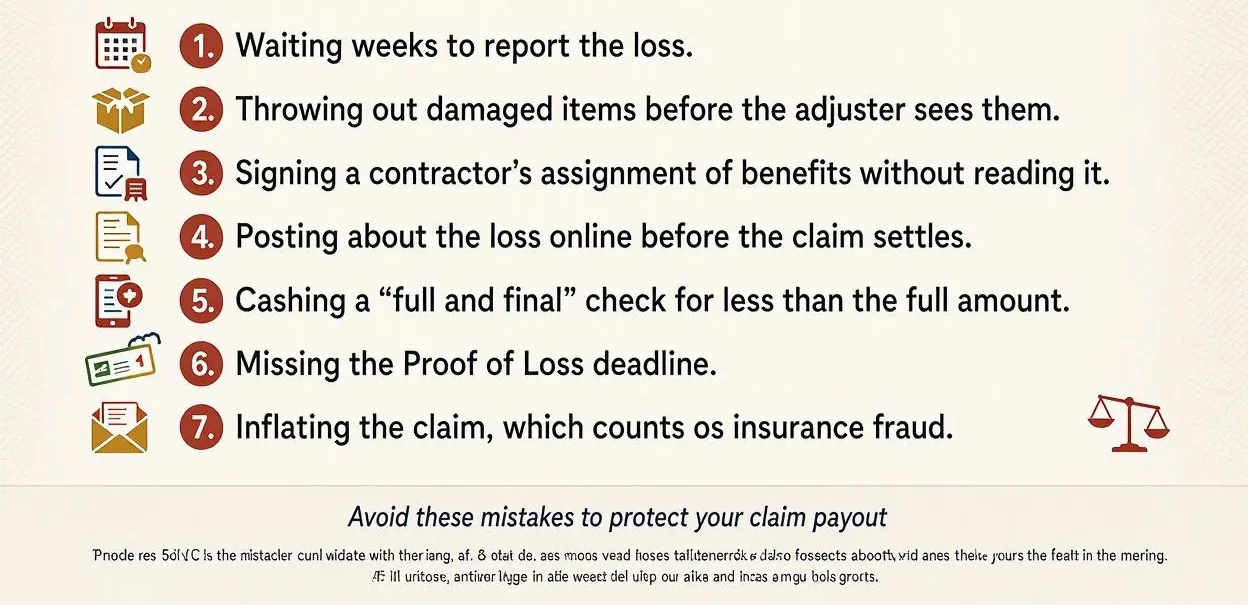
These 7 mistakes cause most avoidable claim reductions and denials.
- Waiting weeks to report the loss.
- Throwing out damaged items before the adjuster sees them.
- Signing a contractor’s assignment of benefits without reading it.
- Posting about the loss online before the claim settles.
- Cashing a “full and final” check for less than the full amount.
- Missing the Proof of Loss deadline.
- Inflating the claim, which counts as insurance fraud in every state.
Final Thoughts on Getting Your Claim Paid
Claims get paid fairly when the policyholder controls the paper trail: written notice, dated photos, independent estimates, and a written record of every promise.
Use these insurance claim tips in order, starting the day of the loss. Most disputes shrink once the insurer sees organized evidence, and the ones that don’t have clear next steps, from appraisal to a state complaint. Keep your claim diary current, watch every deadline, and ask for help early if the numbers stop making sense.
This article is general information, not legal or financial advice. Claim rules vary by state and policy; check with your state Department of Insurance or a licensed professional about your situation.
Frequently Asked Questions

Amanda Brooks
Amanda Brooks leads legal, justice, and community advocacy content at JusticeInTown, drawing on a background in legal research and public policy. She specializes in civil rights, access to justice, and legal awareness, bringing a careful, research-driven approach to complex legal and public-interest topics. Her guides help readers better understand their rights, legal options, and the issues affecting their communities.
Related Posts