

Employee Rights Guide: What Every US Worker Is Owed
Employee rights are legal guarantees that require US employers to pay at least the minimum wage, cover overtime, keep the workplace safe, and make job decisions without discrimination or retaliation.
Federal law sets that floor. States and cities often build well above it, which is why a dishwasher in Seattle earns at least $21.30 an hour while one in Oklahoma City can legally be paid $7.25. Two facts shape your exact protections: where you work and how many people your employer has on payroll. The deadlines section below matters most if a paycheck came up short or a firing felt wrong, because some claims expire in just 30 days.
What Are Employee Rights?
Employee rights are minimum workplace standards set by federal and state law, and no employment contract or company handbook can sign them away.
Twelve federal statutes do most of the work. Each one targets a specific problem, from unpaid overtime to mass layoffs, and each kicks in at a different employer size, so a 10-person bakery owes its staff far fewer federal duties than a 500-person hospital does. State statutes fill the gaps.
| Federal law | Core protection | Employers covered |
| Fair Labor Standards Act (FLSA) | $7.25 minimum wage and 1.5x overtime after 40 hours | Nearly all employers |
| Title VII of the Civil Rights Act | No discrimination by race, color, religion, sex, or national origin | 15+ employees |
| Age Discrimination in Employment Act (ADEA) | No discrimination against workers 40 and older | 20+ employees |
| Americans with Disabilities Act (ADA) | Disability protection and reasonable accommodation | 15+ employees |
| Pregnant Workers Fairness Act (PWFA) | Accommodations for pregnancy-related limitations | 15+ employees |
| Genetic Information Nondiscrimination Act (GINA) | No use of genetic data or family medical history | 15+ employees |
| Equal Pay Act (EPA) | Equal pay for substantially equal work regardless of sex | Nearly all employers |
| Family and Medical Leave Act (FMLA) | 12 weeks of unpaid, job-protected leave | 50+ employees |
| Occupational Safety and Health Act (OSH Act) | A workplace free of recognized serious hazards | Most private employers |
| National Labor Relations Act (NLRA) | Organizing, unionizing, and discussing pay | Most private-sector employers |
| Uniformed Services Employment and Reemployment Rights Act (USERRA) | Reemployment after military service | All employers |
| Worker Adjustment and Retraining Notification (WARN) Act | 60 days’ notice before mass layoffs | 100+ employees |
The stricter rule wins when state and federal law overlap. California’s $16.90 minimum wage, for example, replaces the federal $7.25 for every covered worker in the state.
The 8 Core Federal Employee Rights
Federal law gives US workers 8 core employee rights: fair pay, job-protected leave, equal treatment, reasonable accommodation, a safe workplace, protection from retaliation, collective action, and limited privacy.
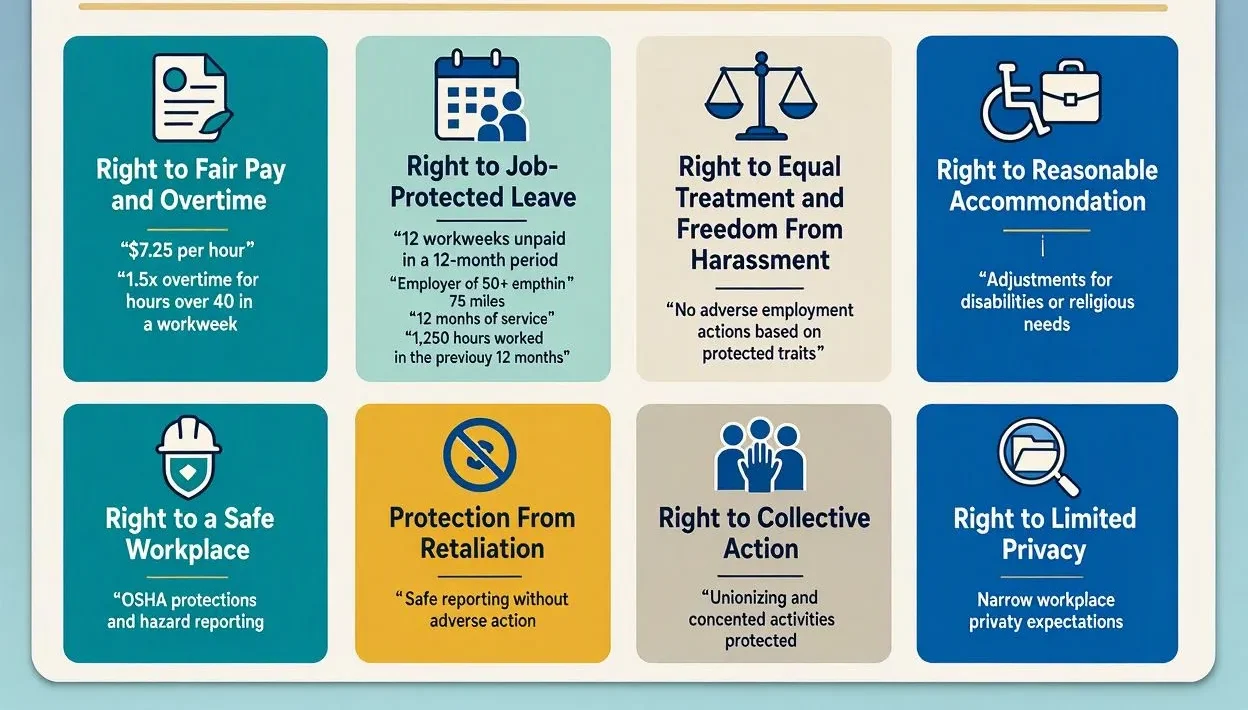
Right to Fair Pay and Overtime
Covered employees earn at least $7.25 per hour and 1.5 times their regular rate for every hour worked over 40 in a single workweek.
That federal minimum hasn’t moved since July 24, 2009, though 30 states and Washington, DC now set higher floors. Overtime is calculated week by week. A warehouse picker who logs 50 hours one week and 30 the next is owed 10 overtime hours, even though the two weeks average out to 40, because averaging across weeks is illegal. Off-the-clock work counts as well. Answering a supervisor’s texts at 9 p.m. or finishing shift paperwork after clocking out adds hours your employer must pay for.
Right to Job-Protected Leave
The Family and Medical Leave Act (FMLA) gives eligible employees 12 workweeks of unpaid, job-protected leave in a 12-month period, with group health coverage kept in place.
Eligibility turns on 3 thresholds:
- An employer with 50 or more employees within 75 miles (121 kilometers) of your worksite
- At least 12 months of service with that employer
- At least 1,250 hours worked in the previous 12 months
Qualifying reasons include the birth or adoption of a child, your own serious health condition, and caring for a spouse, child, or parent with one. Leave for a service member’s serious injury stretches to 26 weeks. Returning employees get their old job back or an equivalent one with the same pay and benefits. Federal law doesn’t require paid sick leave for most private employees, but California guarantees 40 hours (5 days) a year, and more than a dozen other states have their own mandates.
Right to Equal Treatment and Freedom From Harassment
Employers cannot base hiring, pay, promotion, discipline, or firing on race, color, religion, sex, national origin, age 40 and over, disability, or genetic information.
Sex discrimination isn’t limited to men versus women. The Supreme Court’s 2020 ruling in Bostock v. Clayton County brought sexual orientation and gender identity under Title VII, and pregnancy has been covered since the Pregnancy Discrimination Act of 1978. Harassment is its own question. A boss who hints that a promotion depends on a date commits quid pro quo harassment, and one incident is enough. Jokes and slurs work differently: they cross the line once they’re severe or pervasive enough to create a hostile work environment, which a single off-color remark rarely does. Pay gaps have a separate law. Picture two pharmacy techs, one male and one female, filling the same prescriptions on the same shift at the same store. The Equal Pay Act requires identical pay for them unless seniority, merit, production, or some other factor besides sex accounts for the difference.
Right to Reasonable Accommodation
Employers with 15 or more employees must change how a job gets done for a worker with a disability or a pregnancy-related limitation, and their only defense is undue hardship.
Before mid-2023, a pregnant worker whose condition didn’t qualify as a disability under the ADA often had no federal claim at all. The Pregnant Workers Fairness Act (PWFA) closed that gap on June 27, 2023. Now a cashier can ask for a stool or extra bathroom breaks. A warehouse packer can get temporary light duty, and a new mother recovering from a C-section can work remotely for a few weeks. Religion runs on a different track under Title VII. Since Groff v. DeJoy (2023), an employer turning down a Sabbath schedule change or a beard exception has to prove substantial increased costs; minor inconvenience no longer counts. None of this happens automatically. You ask, the employer responds, and both sides talk through options, a back-and-forth the law calls the interactive process.
Right to a Safe Workplace
The Occupational Safety and Health Act (OSH Act) requires employers to keep workplaces free of recognized hazards that cause or are likely to cause death or serious physical harm.
OSHA standards get specific. Fall protection, for instance, is mandatory at 4 feet (1.2 meters) in general industry and 6 feet (1.8 meters) in construction. Workers can file a confidential complaint, request an inspection, and review the employer’s injury logs. Refusing a task is protected only under 4 conditions: the danger is imminent, you asked the employer to fix it, there’s no time for an OSHA inspection, and you acted in good faith. Injuries on the job fall under state workers’ compensation, a no-fault system that pays medical bills and part of lost wages.
Right to Speak Up Without Retaliation
Federal law makes it illegal to punish a worker for reporting a violation or cooperating with an investigation.
Retaliation is the most frequently alleged claim in charges filed with the Equal Employment Opportunity Commission (EEOC). It doesn’t have to be a firing. Cutting someone’s hours after a complaint counts, and so does a transfer to the overnight shift or a sudden string of poor reviews. Beyond discrimination laws, OSHA enforces whistleblower provisions in more than 20 federal statutes, including the Sarbanes-Oxley Act (SOX) for employees of public companies who report fraud.
Right to Organize and Discuss Pay
Section 7 of the National Labor Relations Act (NLRA) protects most private-sector employees who discuss wages with coworkers, form a union, or act together to improve working conditions.
No union is needed for that protection to apply. A pay-secrecy rule in a handbook violates the law for covered workers, and so does firing two cashiers for comparing paychecks in the break room. Supervisors and independent contractors fall outside the NLRA. Agricultural and domestic workers are excluded as well, though several states cover them under their own laws.
Right to Limited Privacy
Workplace privacy rights are narrow: employers can monitor company devices and accounts, but federal law bans most lie detector tests and requires written consent before a background check.
The Employee Polygraph Protection Act bars most private employers from requiring polygraphs. Under the Fair Credit Reporting Act (FCRA), an employer ordering a background report must give a standalone written disclosure and get your signature first. Medical and genetic details you share with an employer must stay confidential under the ADA and GINA. The Fourth Amendment limits searches by government employers only, so private workers rely on state laws like California Penal Code Section 632, which bars recording a confidential conversation without every party’s consent.
Which of These Employee Rights Might Affect What You Do?
The employee rights that matter most depend on how you are paid and where you work, so a tipped server and a salaried analyst face different rules.
Hourly and Tipped Workers
Tipped employees can receive a cash wage as low as $2.13 an hour under federal law, but only when tips bring total pay to at least $7.25. The employer must cover any shortfall. Managers and owners can’t keep any share of employee tips. Seven states (Alaska, California, Minnesota, Montana, Nevada, Oregon, and Washington) ban the tip credit entirely, so servers there earn the full state minimum before tips.
Salaried Employees
A salary alone never cancels overtime. To be exempt, an executive, administrative, or professional employee must earn at least 684perweek(35,568 a year) and pass a duties test. Consider an “assistant manager” paid $40,000 who spends most of each shift stocking shelves and running a register: that worker fails the executive duties test and is owed overtime. Several states set the bar higher, including California at $1,320 per week.
Pregnant and Nursing Employees
The PWFA requires reasonable accommodations for known limitations tied to pregnancy, childbirth, or related conditions. After the birth, the PUMP for Nursing Mothers Act guarantees reasonable break time and a private space other than a bathroom to express breast milk for 1 year.
Remote and Hybrid Employees
Remote workers keep full FLSA protection, so a 15-minute Slack exchange at 8 p.m. counts as paid time for a nonexempt employee. Monitoring rules vary. New York, Connecticut, and Delaware require employers to give notice before electronically monitoring workers. Expense reimbursement differs too: federal law requires it only when work costs push pay below minimum wage, while California Labor Code Section 2802 makes employers reimburse necessary expenses such as a share of home internet and cell phone bills.
Independent Contractors and Gig Workers
Most employee rights apply only to employees, which makes misclassification a common way workers lose them. Your contract’s label doesn’t decide your status. Under the federal economic reality test, courts weigh factors such as control over your schedule, your opportunity for profit or loss, and whether the work is integral to the business. California applies the stricter ABC test, which presumes a worker is an employee unless the company proves otherwise.
Immigrant and Visa Workers
The Wage and Hour Division (WHD) enforces wage laws regardless of a worker’s immigration status. Title VII bars national origin discrimination for everyone. Employers also can’t demand specific documents for Form I-9 verification, since the worker chooses which acceptable documents to present.
Which of the Following Is an Employee Right?
Discussing wages and taking unpaid FMLA leave are federal employee rights, while paid vacation and severance pay are not.
| Situation | Federal right? | What the law says |
| Paid vacation or holidays | No | No federal law requires them; employer policy or contract controls |
| Discussing pay with coworkers | Yes | NLRA Section 7 protects it for most private-sector employees |
| Overtime on a salary | Yes, in many cases | Owed when pay is under $684 per week or job duties fail the exemption test |
| A lunch break | No | Federal law requires none for adults; California and New York mandate meal periods |
| Paid sick days | No | State laws fill the gap, including California’s 40 hours a year |
| Severance pay | No | Owed only under a contract, a company policy, or a WARN Act violation |
| Short paid breaks | Yes, when offered | Breaks of 5 to 20 minutes count as paid work time |
| Refusing dangerous work | Yes, narrowly | Allowed when danger is imminent and OSHA can’t act in time |
| Pumping breast milk at work | Yes | Break time and a private non-bathroom space for 1 year after birth |
A “No” in this table means no federal requirement. Your state may still grant that right.
Can Your Employer Fire You for Any Reason?
No. Employers in 49 states can end employment at will, for any reason or no reason, but they can never fire someone for an illegal reason.
Montana is the exception, since its Wrongful Discharge from Employment Act requires good cause once a probationary period ends. Everywhere else, a termination becomes unlawful when it rests on one of 5 grounds:
- Discrimination based on a protected characteristic
- Retaliation for a complaint, leave request, or other protected activity
- Public-policy violations, such as firing someone for serving on a jury or filing a workers’ compensation claim
- Breach of an employment contract or a handbook promise to fire only for cause
- Bad faith, which about 11 states recognize under an implied covenant of good faith and fair dealing
What Are You Owed After Losing Your Job?
A departing employee is owed final wages, any earned commissions, access to COBRA health coverage, and unemployment benefits for those who qualify.
Final paycheck timing comes from state law. California requires payment immediately upon firing, while many states allow until the next regular payday. Employers with 20 or more employees must offer COBRA continuation coverage for up to 18 months, though you pay up to 102% of the premium. Workers 40 and older get special protection in severance deals: the Older Workers Benefit Protection Act (OWBPA) allows 21 days to review an agreement waiving age claims and 7 days to revoke after signing.
What Changed for Employee Rights in 2026?
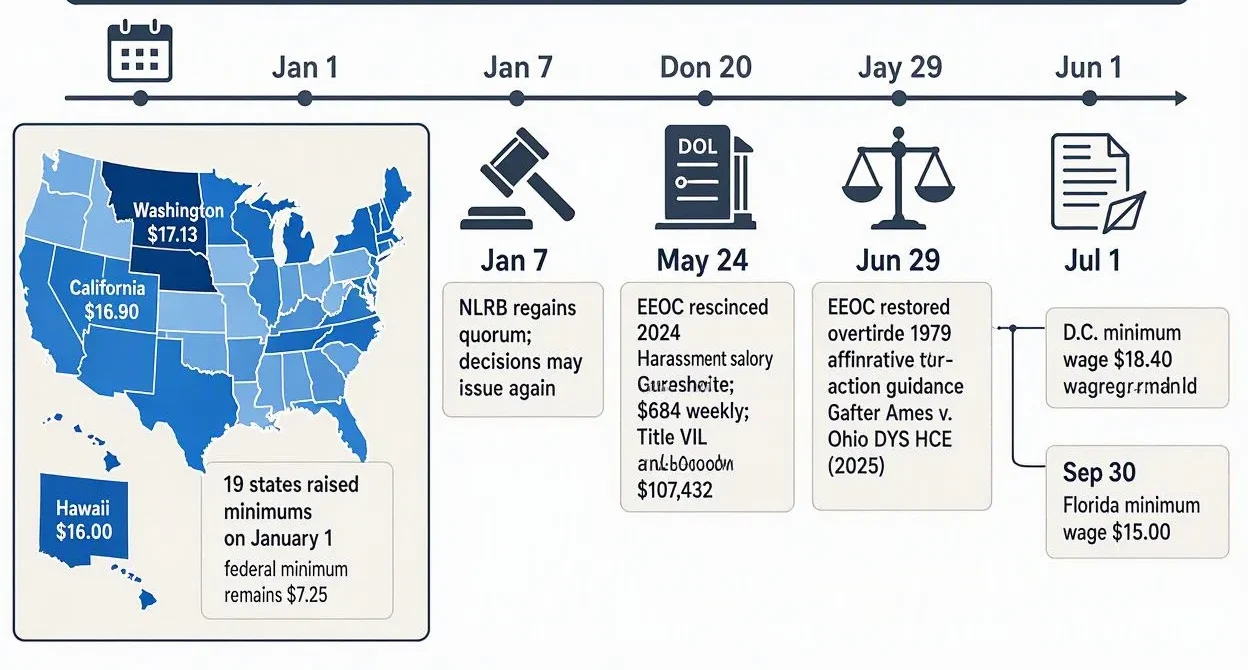
The federal minimum wage stayed at $7.25 in 2026, but 19 states raised their minimums on January 1, and the EEOC withdrew several long-standing guidance documents.
- January 1: Washington state reached $17.13 an hour, the highest statewide minimum, while California rose to $16.90 and Hawaii posted the biggest jump, from $14 to $16.
- January 7: The National Labor Relations Board (NLRB) regained a quorum after nearly a year without one, so it can issue decisions again.
- January 22: The EEOC rescinded its 2024 Enforcement Guidance on Harassment in the Workplace. Title VII and the Bostock ruling still stand, since agency guidance isn’t binding law.
- May 14: The Department of Labor (DOL) formally restored the $684 weekly salary threshold for overtime exemptions and the $107,432 highly compensated employee level, after a Texas federal court vacated the 2024 increase.
- June 29: The EEOC voted 2 to 1 to rescind its 1979 affirmative action guidance, pointing to Ames v. Ohio Department of Youth Services (2025), which held that Title VII protects majority-group employees under the same standard as everyone else.
- July 1: Washington, DC raised its minimum wage to $18.40.
- September 30: Florida’s minimum wage climbed to $15.00.
On the tax side, eligible workers can deduct up to 12,500ofqualifiedovertimepremiumpay(25,000 for joint filers) for tax years 2025 through 2028.
How to File a Complaint Against Your Employer
To file a complaint, document the violation, then submit it to the correct federal or state agency before the filing deadline runs out.
- Record dates and names, and save texts, emails, pay stubs, and schedules in a personal account.
- Report the problem in writing to HR or a manager, especially if company policy requires internal reporting.
- Match your claim to the right agency using the table below.
- File online or by phone: the WHD at 1-866-487-9243 or the EEOC at 1-800-669-4000.
- Consult an employee rights lawyer before signing any release or settlement.
| Type of claim | Where to file | Deadline |
| Discrimination or harassment (Title VII, ADA, ADEA, PWFA, GINA) | EEOC | 180 days, or 300 days where a state or local agency enforces a similar law |
| Lawsuit after an EEOC charge | Federal court | 90 days after the right-to-sue notice |
| Equal pay | EEOC or court | 2 years, or 3 years for willful violations |
| Unpaid minimum wage or overtime | DOL Wage and Hour Division or court | 2 years, or 3 years for willful violations |
| FMLA violation | DOL Wage and Hour Division or court | 2 years, or 3 years for willful violations |
| Unfair labor practice | NLRB | 6 months |
| Safety retaliation (OSH Act Section 11(c)) | OSHA | 30 days |
| Corporate fraud whistleblower (SOX) | OSHA | 180 days |
| Military reemployment (USERRA) | DOL Veterans’ Employment and Training Service or court | No federal deadline |
A missed deadline ends most claims permanently. Before filing, search the WHD’s Workers Owed Wages database, since back pay already collected for you may be waiting there.
When Should You Hire an Employee Rights Attorney?
Hire an employee rights attorney before signing a severance agreement or when an employer’s action has cost you your job or a significant amount of pay.
Four situations call for a lawyer quickly:
- A firing that came soon after a complaint or a request for medical leave
- A severance agreement asking you to waive legal claims
- Unpaid wages or overtime stretching back several months
- An EEOC right-to-sue notice with its 90-day clock running
Government agencies investigate for free, but they can’t represent you, and a private attorney can sue for damages agencies don’t pursue. Under Title VII, compensatory and punitive damages are capped between $50,000 and $300,000 depending on employer size, while back pay sits outside that cap.
How Much Does an Employee Rights Lawyer Cost?
Most employee rights lawyers take discrimination and unpaid-wage cases on contingency, collecting 33% to 40% of the recovery and nothing if the case is lost.
Fee-shifting rules work in your favor. The FLSA and Title VII both let a winning employee recover attorney’s fees from the employer, which is why many lawyers accept smaller wage cases. Severance reviews usually run on a flat fee or an hourly rate instead. Free help exists as well: state legal aid groups such as North Penn Legal Services in Pennsylvania, the National Employment Lawyers Association (NELA) directory, and state bar referral services.
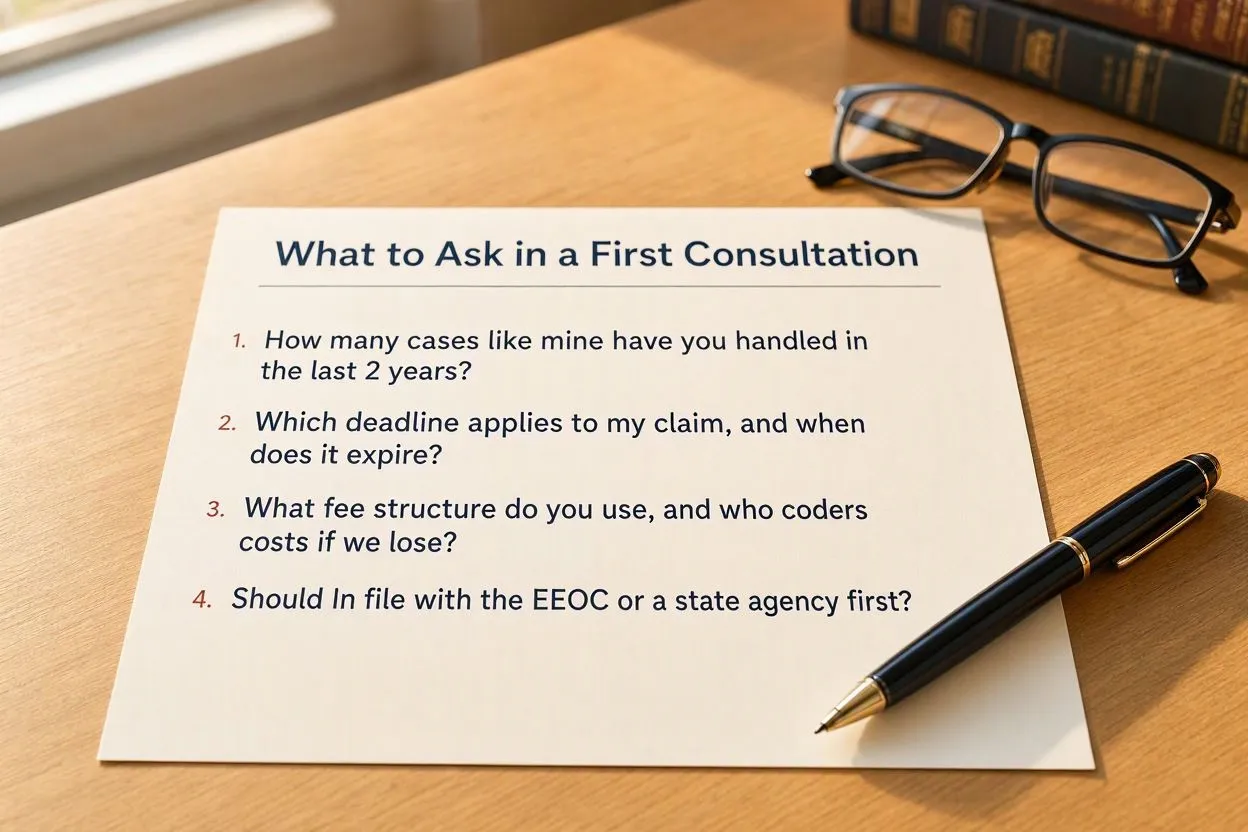
What to Ask in a First Consultation
- How many cases like mine have you handled in the last 2 years?
- Which deadline applies to my claim, and when does it expire?
- What fee structure do you use, and who covers costs if we lose?
- Should I file with the EEOC or a state agency first?
Conclusion
Employee rights protect US workers on pay, leave, safety, and fair treatment, but they work only for people who act on them in time. Start with the two facts that decide most cases: your state and your employer’s headcount. Check the deadline table the moment something goes wrong. Thirty days passes fast. Written records beat memory in every agency investigation, so save your pay stubs and messages now, before you need them. An employee rights attorney costs nothing upfront in most wage and discrimination cases, which makes a consultation a low-risk step when your job or pay is on the line.
FAQs

Amanda Brooks
Amanda Brooks leads legal, justice, and community advocacy content at JusticeInTown, drawing on a background in legal research and public policy. She specializes in civil rights, access to justice, and legal awareness, bringing a careful, research-driven approach to complex legal and public-interest topics. Her guides help readers better understand their rights, legal options, and the issues affecting their communities.
Related Posts