
Cease and Desist Letter for Harassment: Template & Guide
A cease and desist letter for harassment is a written demand telling one specific person to stop all contact with you, sent by certified mail so you hold proof of delivery. It isn’t a court order. What it gives you is a dated record that the harasser was warned, and that record carries real weight later in a police report or a restraining order petition. Below you’ll find the 7 elements every letter needs, a filled-in sample, current USPS mailing costs, and the exact escalation steps for a harasser who ignores the warning.
Safety note: This article is general legal information, not legal advice. Call 911 if you’re in immediate danger. The National Domestic Violence Hotline answers 24/7 at 1-800-799-7233, or text START to 88788.
What Is a Cease and Desist Letter for Harassment?
A cease and desist letter for harassment is a private written notice demanding that one person end a pattern of unwanted contact and stay out of the sender’s life. Anyone can write one. No lawyer, court filing, or notary stamp is required.
The Legal Information Institute (LII) at Cornell Law School defines these letters as non-binding warnings whose main purpose is to serve as evidence in later litigation. That evidentiary role is the whole point. A judge reviewing a protective order petition six months from now will want to see 2 facts on paper: the harasser received a clear warning on a known date, and the conduct kept going anyway.
Harassment in this context covers a wide range of conduct, such as 30 texts in one night after you asked for silence, unannounced visits to your office, posts aimed at you on Instagram, and calls to your mother asking where you live.
Is a Cease and Desist Letter Legally Binding?
No. A cease and desist letter carries no legal penalty on its own, because a private person issues it, not a court. Ignoring one breaks no law.
Courts and government agencies issue cease and desist orders, and those are a separate instrument with fines or arrest attached. Even without enforcement power, the letter does 3 practical jobs:
- Proves notice. The return receipt shows the harasser knew the contact was unwanted, which defeats the “I didn’t know” defense.
- Builds the record. Judges and police officers take a documented pattern more seriously than a verbal complaint.
- Ends many cases outright. Plenty of people back off once they see their own behavior listed by date next to the words “police report.”
When to Send a Cease and Desist Letter for Harassment
Send a cease and desist letter for harassment when one identifiable person keeps contacting you after a clear request to stop and you face no immediate physical threat. Early, nonviolent patterns are where the letter does its best work.
5 Situations Where the Letter Fits
- Repeated calls, texts, or direct messages after a clear “stop” request
- Uninvited visits to your home, gym, or workplace
- Messages to your friends, relatives, or employer meant to pressure you
- Posts or comments targeting you on social media
- Persistent contact from a former partner who won’t accept a breakup
4 Situations That Call for Police First
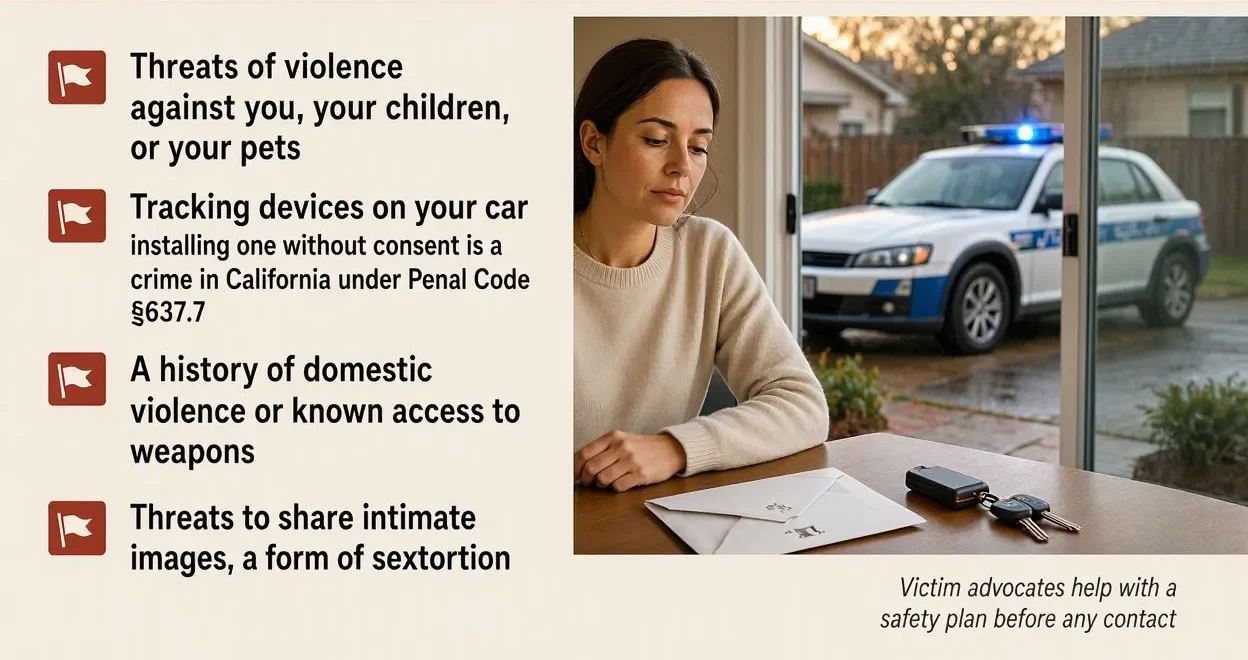
A letter can provoke a volatile person. One attorney answering a reader on JustAnswer warned against sending one to an already unstable ex for exactly that reason, and pointed the reader toward a police report instead. Skip the letter and call law enforcement first when you see any of these 4 red flags:
- Threats of violence against you, your children, or your pets
- Tracking devices on your car (installing one without consent is a crime in California under Penal Code §637.7)
- A history of domestic violence or known access to weapons
- Threats to share intimate images, a form of sextortion
Victim advocates help with a safety plan before any contact goes out. Call the hotline listed in the safety note above, or reach your local domestic violence shelter.
What to Include in a Cease and Desist Letter for Harassment
A strong cease and desist letter for harassment contains 7 elements: identification, dated incidents, an unwanted-contact statement, a no-contact demand, an immediate deadline, lawful consequences, and a reservation of rights.
- Identification. Full names, mailing addresses, and the date. Write “Address Unknown” for an online harasser with no known location.
- Dated incident list. One line per incident with the date, time, and channel. “On August 2, 2026, between 10:15 p.m. and 1:50 a.m., you sent 37 text messages” beats “you text me constantly.”
- Unwanted-contact statement. A single plain sentence saying the contact is unwelcome.
- No-contact demand. Name every channel: phone, text, email, social media, mail, in-person visits, and contact through third parties.
- Immediate deadline. For harassment, “effective immediately” works better than a 10-day countdown, because the contact itself is the harm.
- Lawful consequences. A police report, a protective order petition, or a civil claim. Nothing else belongs here.
- Reservation of rights. One sentence keeping every future claim open.
Keep the finished letter to 1 or 2 pages. Facts persuade judges; adjectives don’t.
Sample Cease and Desist Letter for Harassment
Use the filled-in sample below as a model, replacing every name, date, address, and incident with your own facts. The names are fictional, and the statute matches Ohio, where the sender lives.
Jordan Ellis 1420 Maple Avenue, Columbus, OH 43215 October 5, 2026
VIA USPS CERTIFIED MAIL, RETURN RECEIPT REQUESTED
Taylor Brooks 88 Linden Court, Dublin, OH 43017
Re: Demand to Cease and Desist Harassment and All Contact
Dear Taylor Brooks:
This letter is a formal demand that you immediately stop harassing me and stop all contact with me.
On July 14, 2026, I told you in writing not to contact me. Since then, you have engaged in the following conduct:
- August 2, 2026: You sent 37 text messages between 10:15 p.m. and 1:50 a.m.
- August 19, 2026: You waited beside my car in my employer’s parking lot at 600 Grant Street at 5:30 p.m.
- September 6, 2026: You messaged my sister, Dana Ellis, on Instagram asking for my new address.
- September 28, 2026: You created a new Instagram account and posted 4 photos of my home.
This conduct is unwanted, and it has caused me to fear for my safety.
Effective immediately, you must stop all contact with me by any means, including phone, text, email, social media, mail, in person, and through third parties such as my family, friends, or employer. Do not come to my home or my workplace.
I have kept records of every incident, including screenshots, call logs, and witness names. Any further contact after you receive this letter will lead me to report your conduct to the Columbus Division of Police and to petition the Franklin County Court of Common Pleas for a civil stalking protection order under Ohio Revised Code §2903.214.
Nothing in this letter waives any right, claim, or remedy available to me, all of which I expressly reserve.
Sincerely, Jordan Ellis
Look at what the sample leaves out. There’s no insult in it, no demand for money, and no threat beyond 2 lawful steps.
How to Send a Cease and Desist Letter for Harassment
To send a cease and desist letter for harassment, mail it through USPS Certified Mail with a return receipt and keep a signed copy alongside the mailing receipt. That combination proves both the content and the delivery.
2026 USPS Certified Mail Costs
USPS raised its Certified Mail fee to $5.55 on July 12, 2026. For a 1-ounce (28-gram) letter, which covers a 1 to 3 page letter in a standard #10 envelope, current totals look like this:
| Option | Total cost | What you get |
| Certified Mail only | $6.37 | Tracking and a delivery record |
| Certified Mail + Electronic Return Receipt | $9.28 | Recipient’s signature as a PDF |
| Certified Mail + Green Card (PS Form 3811) | $11.02 | Signed postcard mailed back to you |
The electronic receipt is the smarter buy. It costs $1.74 less than the green card and arrives as a PDF, ready to attach to a court petition.
Hand delivery is a bad idea, since the goal is documentation, not confrontation. A second copy by email adds proof without adding risk. For workplace cases, send a copy to human resources (HR). For online cases, deliver it to the account’s inbox and report the profile to the platform the same day.
How to Document Harassment Before and After the Letter
To document harassment, log every incident within 24 hours with the date, time, channel, and exact words, and back each entry with a file saved off your phone. A spreadsheet works fine:
| Date | Time | Channel | What happened | Evidence file | Witness |
| 08/19/2026 | 5:30 p.m. | In person | Waited by my car at work | Photo_0819.jpg | Coworker M. Ruiz |
Strong logs rely on 4 evidence types:
- Screenshots showing the sender’s number or username alongside the timestamp
- Voicemails exported as audio files instead of left on the phone
- Call logs downloaded from your carrier’s online account
- Photos of property damage with the date preserved in the file metadata
Store everything in 2 places, such as a cloud folder and a USB drive. Phones break.
Can You Record a Harassing Phone Call?
Yes, in most states, as long as you’re a party to the call. Federal law (18 U.S.C. §2511(2)(d)) and the majority of states follow one-party consent. About a dozen states demand consent from everyone on the line, including California (Penal Code §632), Florida (Statute §934.03), Maryland, Massachusetts, Pennsylvania, and Washington. Recording a call illegally in one of those states can turn you into a defendant, and a judge can throw out the recording.
Cease and Desist Letter vs. Restraining Order
A cease and desist letter is a private warning with no enforcement power, while a restraining order is a court order that police enforce with arrest. Most people use the letter first and the order second.
| Factor | Cease and desist letter | Restraining or protective order |
| Who issues it | You or your attorney | A judge |
| Typical cost | About $9.28 to mail | Often $0 to file when stalking or violence is alleged |
| Time to obtain | Same day | Temporary orders often within 1 business day |
| Enforceable by police | No | Yes |
| Penalty for violating | None | Arrest, fines, possible jail |
| Relationship required | No | Not for civil harassment or stalking orders in most states |
| Duration | Not applicable | Up to 5 years for a California civil harassment order |
Names vary by state. California uses the Civil Harassment Restraining Order (CHRO) under Code of Civil Procedure §527.6, with a stay-away distance that commonly reads 100 yards (91 meters). Ohio calls it a Civil Stalking Protection Order (CSPO). Illinois offers a Stalking No Contact Order under 740 ILCS 21, New York issues Orders of Protection, Pennsylvania uses Protection From Abuse (PFA) orders, and Florida grants injunctions for protection against stalking under Statute §784.0485.
Cease and Desist Letters for 5 Common Harassment Scenarios
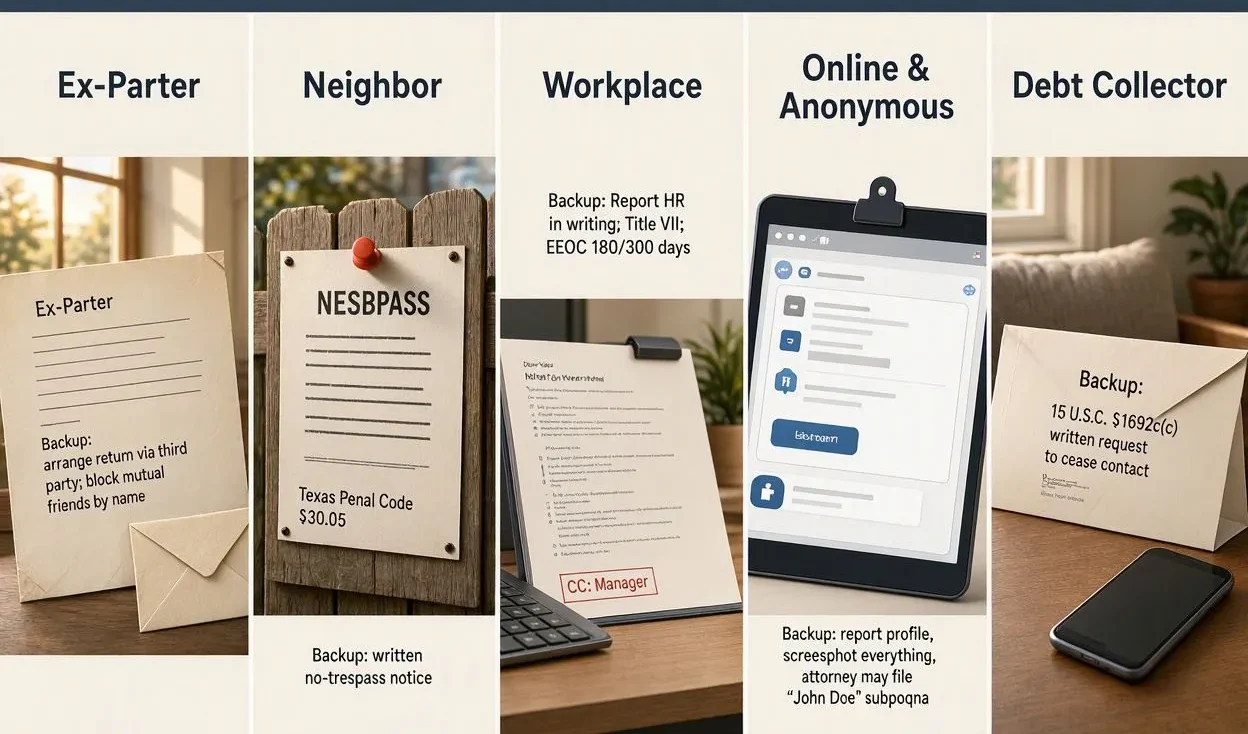
Each type of harasser calls for a different backup channel: a trespass notice for neighbors, HR for coworkers, platform reports for online accounts, and the Fair Debt Collection Practices Act (FDCPA) for debt collectors.
Ex-Partner Harassment
Breakups produce more harassment letters than any other situation. Ban contact through mutual friends by name, since an ex will often route messages through them. Returning belongings? Arrange it through a third party and say so in the letter.
Neighbor Harassment
Pair the letter with a written no-trespass notice. Under Texas Penal Code §30.05, entering property after receiving notice that entry is forbidden counts as criminal trespass, and most states have a similar rule. Keep property line disputes out of the harassment letter entirely.
Workplace Harassment
Report the coworker to HR in writing first, then send the letter with a copy to the harasser’s manager. Harassment based on race, sex, religion, national origin, or another protected trait falls under Title VII of the Civil Rights Act, which covers employers with 15 or more employees. Filing a charge with the Equal Employment Opportunity Commission (EEOC) carries a deadline of 180 days, extended to 300 days in states with their own fair employment agency.
Online and Anonymous Harassment
Online abuse is common. A Pew Research Center survey found that 41% of U.S. adults had experienced online harassment, and 25% had faced severe forms such as stalking or physical threats. Send the letter to the account’s inbox, report the profile, and screenshot everything before it disappears. Anonymous harassers aren’t untouchable: an attorney can file a “John Doe” lawsuit and subpoena the platform for the account holder’s identity.
Debt Collector Harassment
Collectors play by a separate federal rule. Under 15 U.S.C. §1692c(c), a written request to stop contact forces a collector to go quiet, except to confirm it’s ending contact or to announce a specific action such as a lawsuit. The debt still exists, though. Abusive collectors can be reported to the Consumer Financial Protection Bureau (CFPB) at consumerfinance.gov.
Federal and State Harassment Laws to Cite in Your Letter
Cite the single statute that matches the conduct, because a precise citation shows the harasser exactly which line the behavior crosses. One accurate citation beats five loosely related ones.
| Law | What it covers | Penalty |
| 18 U.S.C. §2261A | Stalking across state lines or through electronic communication | Up to 5 years in federal prison |
| 47 U.S.C. §223 | Harassing phone calls and electronic messages | Fines and up to 2 years in prison |
| Texas Penal Code §42.07 | Repeated electronic messages sent to harass or alarm | Class B misdemeanor (up to 180 days in jail) |
| New York Penal Law §240.26 | Harassment in the second degree | Violation (up to 15 days in jail) |
| Ohio Revised Code §2903.211 | Menacing by stalking | First-degree misdemeanor, higher with aggravating factors |
| Florida Statute §784.048 | Stalking and cyberstalking | First-degree misdemeanor; aggravated stalking is a third-degree felony |
| California CCP §527.6 | Civil harassment restraining orders | Court order lasting up to 5 years |
Mention the statute as the basis for a police report. Never offer to skip that report in exchange for money.
What to Do If the Harassment Continues After the Letter
Escalate right after the next incident by reporting it to police and petitioning your local court for a protective order, with the letter and return receipt attached as exhibits. Follow these 5 steps in order:
- Log the new incident the same day, noting that it happened after delivery of the letter.
- File a police report and write down the report number and the officer’s name.
- Petition your county court for a temporary protective order, bringing the letter, the receipt, and your log.
- Notify the harasser’s employer, school, or platform, depending on where the conduct happens.
- Consult an attorney about civil claims, such as intentional infliction of emotional distress (IIED).
Court self-help centers walk people through protective order forms at no charge. Most state judiciary websites list them by county.
Should You Hire an Attorney for a Harassment Cease and Desist Letter?
No, a lawyer is not required for a harassment cease and desist letter, but attorney letterhead pays off when the harasser has a lawyer or the dispute involves an employer. Here’s what each route costs:
| Route | Typical cost |
| Write it yourself | About $9.28 for certified mail with an electronic receipt |
| Online attorney letter service | From $199 per letter |
| Attorney flat fee, simple harassment letter | $125 to $400 |
| Attorney flat fee, national average (all letter types) | $460 |
| Attorney flat fee, California average | $650 |
Budget-friendly help exists too. Legal aid societies and law school clinics draft letters for qualifying residents at little or no cost.
6 Mistakes That Weaken a Harassment Letter
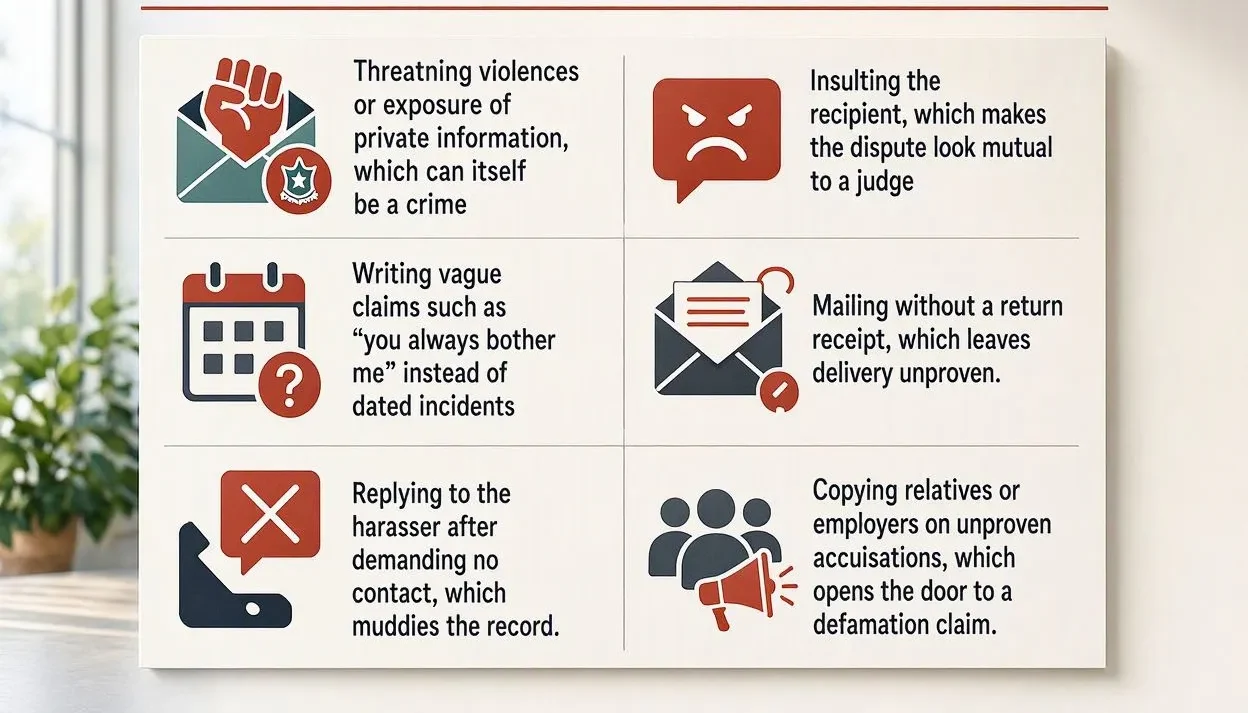
The 6 most damaging mistakes are threats, insults, vague accusations, missing proof of delivery, continued contact, and false statements shared with others. Each one hands the harasser an argument.
- Threatening violence or exposure of private information, which can itself be a crime
- Insulting the recipient, which makes the dispute look mutual to a judge
- Writing vague claims such as “you always bother me” instead of dated incidents
- Mailing without a return receipt, which leaves delivery unproven
- Replying to the harasser after demanding no contact, which muddies the record
- Copying relatives or employers on unproven accusations, which opens the door to a defamation claim
Money demands deserve their own warning. Asking for payment in exchange for not going to police can meet the definition of extortion under state law, including California Penal Code §519.
What to Do If You Receive a Cease and Desist Letter for Harassment
Stop all contact with the sender immediately and speak with an attorney before sending any reply. Any message after delivery becomes evidence against you.
Keep the letter and every past message, since deleting texts after receiving a demand looks like hiding evidence. Some letters are false or retaliatory. An attorney response letter sets the record straight, and more than 30 states have anti-SLAPP laws, such as California CCP §425.16, that allow early dismissal of lawsuits aimed at protected speech.
Conclusion
A cease and desist letter for harassment won’t put anyone in handcuffs. It does something quieter and, in court, more useful: it fixes the date the harasser was told to stop. Write it with dated facts, mail it with an electronic return receipt, and log every incident that follows. Most harassers stop at that point. Those who don’t have just handed you the strongest exhibit in your protective order petition.
Frequently Asked Questions

Amanda Brooks
Amanda Brooks leads legal, justice, and community advocacy content at JusticeInTown, drawing on a background in legal research and public policy. She specializes in civil rights, access to justice, and legal awareness, bringing a careful, research-driven approach to complex legal and public-interest topics. Her guides help readers better understand their rights, legal options, and the issues affecting their communities.
Related Posts