
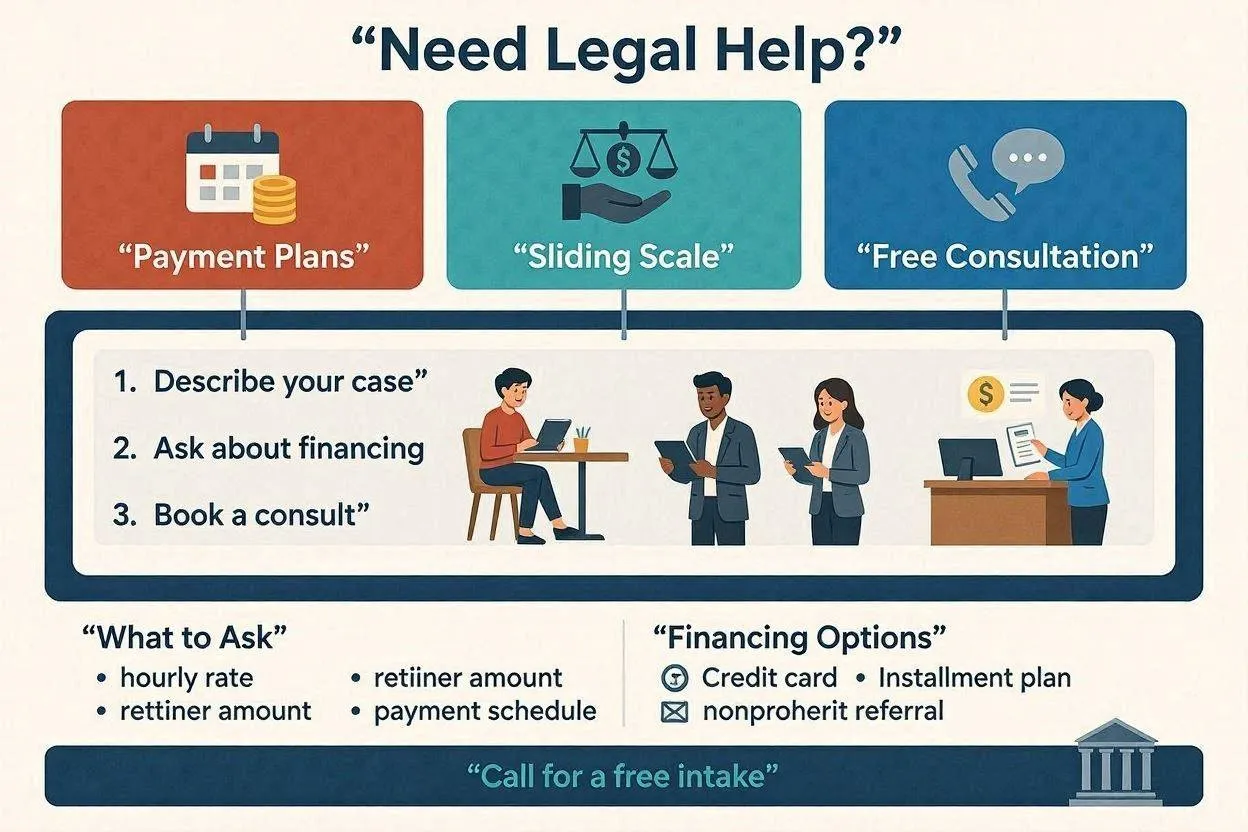
Lawyer Payment Plans: How to Get Legal Help in 2026
Lawyer payment plans let you pay attorney fees in smaller installments over time instead of a large upfront lump sum. Most law firms in the United States offer at least one type of payment plan, and 4 structured plan types cover the majority of legal cases.
Legal fees stop many people from getting the help they need. The average hourly rate for a US attorney runs $150–$500 (approximately £120–£400 GBP equivalent) depending on practice area and state. A full criminal defense case can cost $5,000–$25,000 (approximately $5,000–$25,000 CAD equivalent at near-parity). Payment plans remove that barrier by spreading the cost across weeks or months.
This guide covers the 4 main lawyer payment plan types, how to ask your attorney for one, what risks to watch for, and which plan fits each case type.
What Lawyer Payment Plans Cover in 2026
A lawyer payment plan is a written fee agreement that breaks your total legal bill into scheduled payments. The agreement sets the total amount owed, the payment amount per period, the due dates, and the consequences of a missed payment.
The American Bar Association (ABA) does not prohibit payment plans. However, the ABA requires that all attorney fees remain reasonable regardless of how they are structured. State bar associations add their own rules on top of the ABA guidelines — for example, the Florida Bar provides specific guidance on how attorneys must handle lawyer-client fee disputes and any interest charged on overdue balances.
Every payment plan agreement must include 5 core elements:
- Total fee amount: the complete cost of representation, stated in writing.
- Installment schedule: the exact amount and due date of each payment.
- Accepted payment methods: credit cards, debit cards, eChecks, or bank transfer.
- Late payment policy: the penalty or interest that applies if a payment arrives late.
- Withdrawal clause: the conditions under which your attorney may stop representing you if payments stop.
4 Types of Lawyer Payment Plans Explained
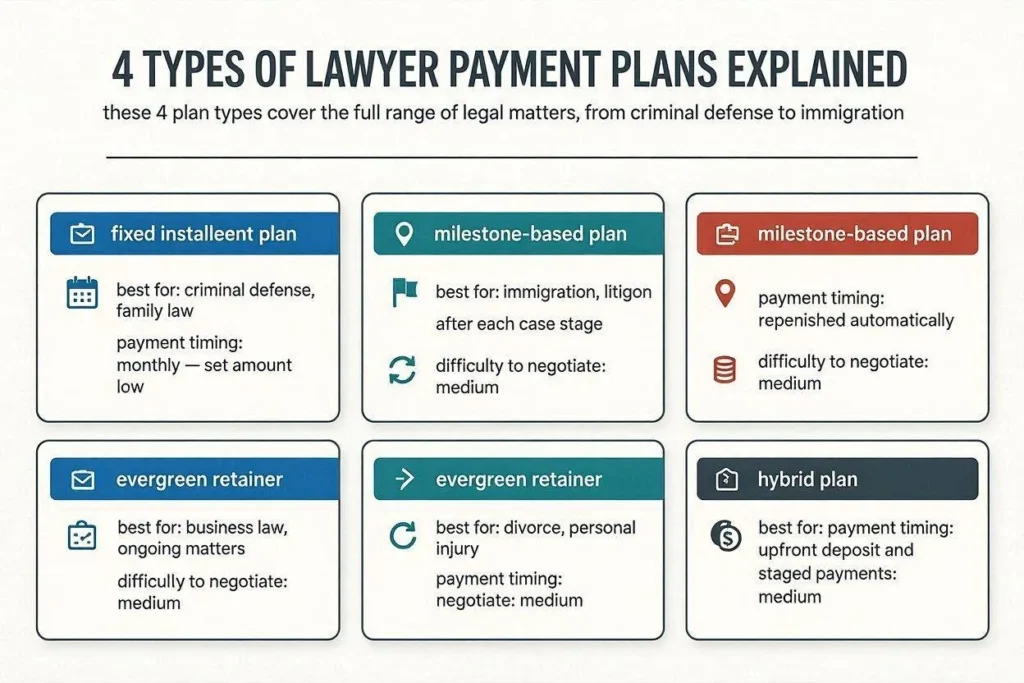
These 4 plan types cover the full range of legal matters, from criminal defense to immigration.
| Plan Type | Best For | Payment Timing | Difficulty to Negotiate |
| Fixed Installment Plan | Criminal defense, family law | Monthly — set amount | Low |
| Milestone-Based Plan | Immigration, litigation | After each case stage | Medium |
| Evergreen Retainer | Business law, ongoing matters | Replenished automatically | Medium |
| Hybrid Plan | Divorce, personal injury | Upfront deposit + monthly | Low to Medium |
How Fixed Installment Plans Work
To use a fixed installment plan, you agree to pay a set dollar amount each month until the total fee is paid. For example, a $6,000 (approximately £4,800 GBP) criminal defense fee becomes 6 payments of $1,000 (approximately £800 GBP) each.
Fixed installment plans are the most common type because the monthly amount stays predictable and attorneys can automate billing through legal billing software such as LawPay or Clio.
This plan works best for: criminal defense cases, family law matters, and uncontested divorces.
How Milestone-Based Payment Plans Work
To use a milestone-based plan, you pay a set amount each time your attorney completes a specific stage of your case. Common milestones include filing the initial petition, attending a hearing, and reaching a settlement.
Immigration attorneys use milestone-based plans most often because immigration cases follow predictable procedural stages — visa application, biometrics, interview, decision — with natural payment checkpoints at each one.
How Evergreen Retainer Plans Work
To use an evergreen retainer, you deposit a set amount into your attorney’s trust account — called an Interest on Lawyers’ Trust Account (IOLTA) — and the attorney draws fees from that balance as work is performed. When the balance drops below a set threshold, you replenish it.
Evergreen retainers work best for ongoing business law matters, employment law cases, or any situation where your legal needs repeat month to month.
How Hybrid Payment Plans Work
A hybrid plan combines an upfront deposit with monthly installments. You pay a smaller retainer at signing — typically 20–30% of the total fee — then pay the remaining balance in monthly amounts.
Divorce attorneys and personal injury lawyers use hybrid plans most often. Divorce clients benefit from a lower initial cost during an already expensive life transition, while attorneys protect cash flow with a guaranteed deposit.
How to Ask a Lawyer for a Payment Plan
To ask your attorney for a payment plan, request the conversation before you sign any fee agreement. Attorneys expect this question — approximately 60% of US clients cite cost as their biggest hesitation when hiring legal representation.
Use this 3-step negotiation script during your first consultation:
- State your situation directly: “My total budget for legal fees is $X per month. Can we structure a payment plan within that limit?”
- Ask about plan types: “Do you offer fixed monthly installments, or do you prefer milestone-based payments for this type of case?”
- Confirm everything in writing: “Can you send me a written fee agreement that includes the payment schedule before I sign?”
Never agree to a payment plan verbally only. A written payment plan agreement protects both you and your attorney. Request the agreement within 24 hours of your first consultation so all terms are on record before representation starts.
Lawyer Payment Plans by Practice Area
Different legal cases match different plan types. Here is how the 4 plan types align with 5 major practice areas.
Criminal Defense Lawyer Payment Plans
Criminal defense attorneys most commonly offer fixed installment plans because criminal cases move quickly and defendants need representation immediately. A standard criminal defense retainer runs $2,500–$10,000 (approximately $2,500–$10,000 CAD). Installment plans split that into 3–6 monthly payments so clients do not delay hiring counsel while gathering the full fee.
Divorce and Family Law Payment Plans
Divorce attorneys offer hybrid plans most often — a smaller upfront retainer of $500–$2,000 (approximately £400–£1,600 GBP) followed by monthly payments. Contested divorces can cost $10,000–$30,000 (approximately £8,000–£24,000 GBP) total, making a payment plan essential for most clients.
Immigration Lawyer Payment Plans
Immigration attorneys structure payments around the 4 major case stages: initial filing, biometrics appointment, interview preparation, and decision. Each stage triggers a payment, so you only pay as your case moves forward.
3 Risks of Lawyer Payment Plans You Must Know
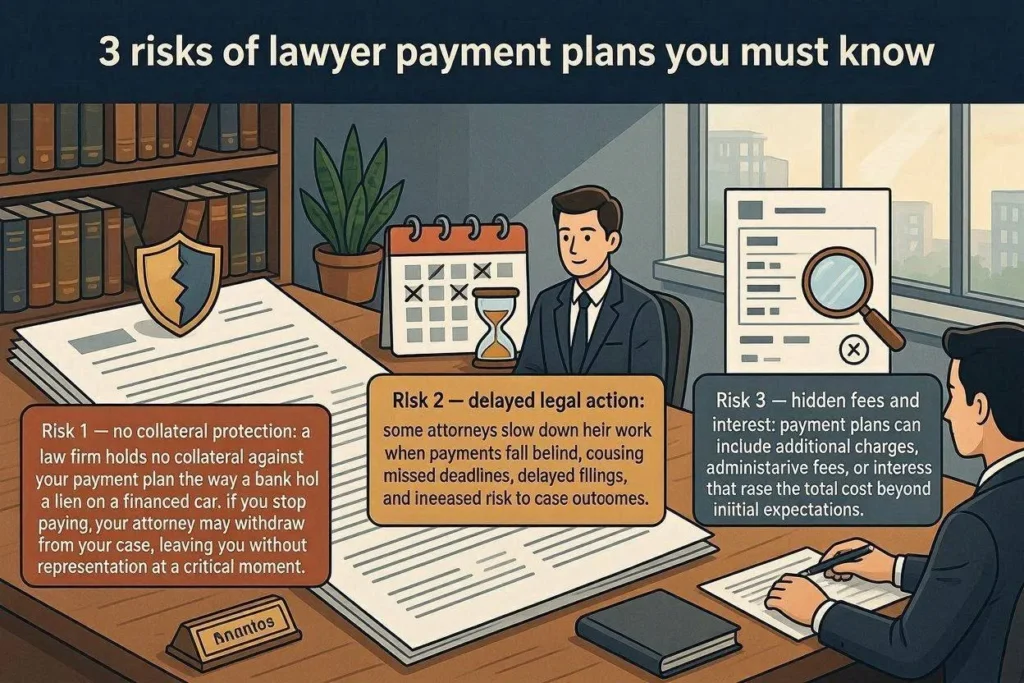
Payment plans benefit clients, but 3 specific risks apply to every plan you sign.
- Risk 1 — No collateral protection: A law firm holds no collateral against your payment plan the way a bank holds a lien on a financed car. If you stop paying, your attorney may withdraw from your case, leaving you without representation at a critical moment.
- Risk 2 — Delayed legal action: Some attorneys slow down their work when payments fall behind. Confirm in your written agreement that your attorney will not withhold legal services based on payment status.
- Risk 3 — Interest charges: Some states allow attorneys to charge interest on overdue balances. Check your state bar’s rules before signing. For example, the Florida Bar sets specific limits on how attorneys apply interest to unpaid fees.
To reduce all 3 risks: read every clause of your payment agreement before signing, confirm your state’s rules on attorney interest charges, and keep a copy of every payment receipt.
Legal Fee Financing vs Lawyer Payment Plans
Legal fee financing and lawyer payment plans are 2 different funding methods. Understanding the difference helps you choose the right option.
A lawyer payment plan is a direct agreement between you and your attorney. No third party is involved. You pay the law firm directly on a schedule the 2 of you agree on.
Legal fee financing involves a third-party lender, such as Affirm (which partners with LawPay), that pays your attorney 100% of the total fee upfront. You then repay the lender in installments, sometimes with interest. This option helps you if your attorney does not offer direct payment plans but you still need installments.
Choose a direct payment plan if: your attorney offers one and the monthly amount fits your budget without interest charges.
Choose legal fee financing if: you need immediate full-fee payment to an attorney who does not offer installments, and you can manage the lender’s repayment terms.
How to Evaluate a Lawyer Payment Plan Before You Sign
To evaluate any payment plan agreement, check these 6 elements before you sign anything.
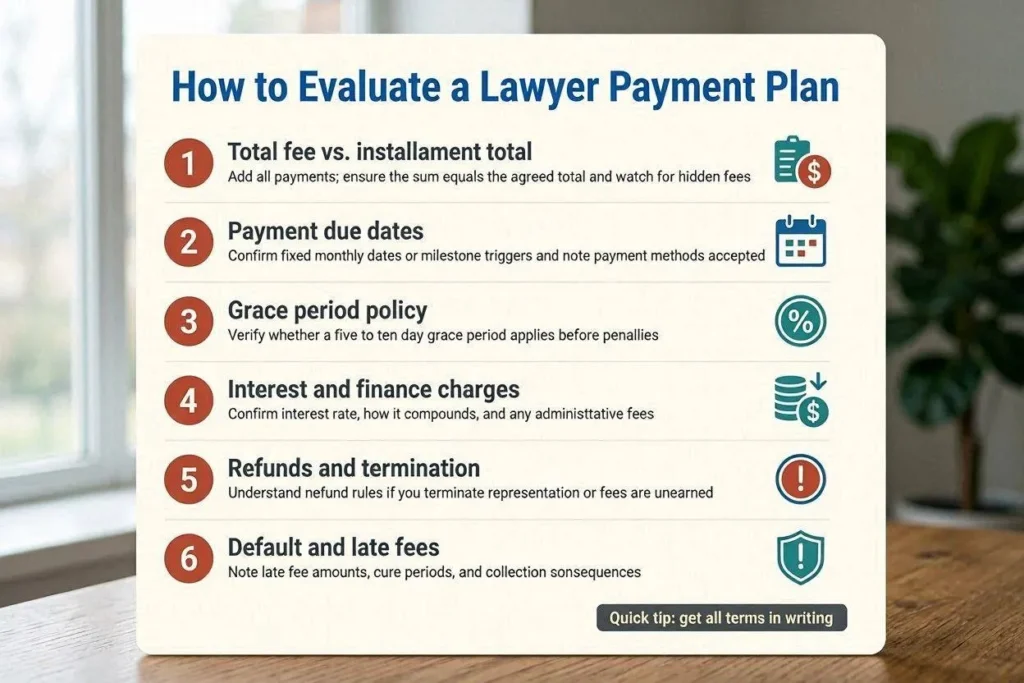
- Total fee vs. installment total: Add up all payments. The sum must match the agreed total fee. Watch for hidden fees added across the installment period.
- Payment due dates: Confirm whether payments are due on a fixed date each month or triggered by case milestones.
- Grace period policy: Ask whether a 5–10 day grace period applies before a late fee triggers.
- Attorney withdrawal clause: Identify exactly how many missed payments allow your attorney to stop representation.
- Interest rate: If your state allows it, confirm the annual percentage rate (APR) applied to overdue balances.
- Refund policy: If your case resolves early, confirm whether unused retainer funds return to you.
Frequently Asked Questions About Lawyer Payment Plans
Do all lawyers offer payment plans?
No. Payment plans are not required by law or bar association rules. Each attorney decides individually whether to offer installment plans. Criminal defense attorneys and family law attorneys offer payment plans most often.
Can I negotiate a lawyer payment plan after I have already signed a fee agreement?
Yes. You can request a modified payment schedule at any point in your case. Approach your attorney in writing, explain your financial situation, and propose a specific revised schedule. Most attorneys prefer to adjust terms rather than lose a client entirely.
Do lawyer payment plans charge interest?
Sometimes. Whether attorneys can charge interest on overdue balances depends on your state’s bar rules. Always ask before signing. If interest applies, request the APR in writing so you can calculate the total cost.
What happens if I miss a payment on a lawyer payment plan?
Your attorney may withdraw from your case if your fee agreement allows it and you miss multiple payments. Most agreements include a grace period of 5–10 days. Contact your attorney immediately if you cannot make a scheduled payment.
Are lawyer payment plans available for immigration cases?
Yes. Immigration attorneys regularly offer milestone-based payment plans tied to the 4 major case stages: filing, biometrics, interview, and decision. This structure matches how immigration cases progress and makes costs predictable for clients.
Conclusion
Lawyer payment plans make quality legal representation accessible to people who cannot pay the full fee upfront. The right plan type depends on your case: fixed installments work best for criminal defense, milestone plans for immigration, hybrid plans for divorce, and evergreen retainers for ongoing business matters.
Ask for a payment plan at your first consultation, get every term in writing, and check your state bar’s rules on fees and interest before you sign.

Amanda Brooks
Amanda Brooks leads legal, justice, and community advocacy content at JusticeInTown, drawing on a background in legal research and public policy. She specializes in civil rights, access to justice, and legal awareness, bringing a careful, research-driven approach to complex legal and public-interest topics. Her guides help readers better understand their rights, legal options, and the issues affecting their communities.
Related Posts