

How to File a Malpractice Claim: 9-Step Legal Guide (2026)
To file a malpractice claim, collect your medical records, consult a malpractice attorney, obtain a medical expert opinion, and file your complaint before your state’s statute of limitations (SOL) expires. Most states give you 1 to 3 years. Miss that deadline and the court dismisses your case — regardless of how strong your evidence is.
This guide covers 9 steps, 4 required legal elements, state-by-state deadlines, and what compensation a successful claim can recover.
Key facts before you file:
• 28.7% of physicians in the USA have faced at least 1 malpractice suit (2024 data)
• Filing deadlines range from 1 year (Kentucky, Louisiana) to 5 years (Maryland)
• Most states require a medical expert to certify the claim before the court accepts it
• Settlements average $100,000 to $500,000 depending on state caps and injury severity
• Most claims settle before trial — a strong evidence file improves your settlement position
What Is Medical Malpractice?
Medical malpractice (MM) occurs when a healthcare provider deviates from the accepted standard of care, causing direct harm to a patient. The 5 most common claim types are misdiagnosis, surgical errors, medication mistakes, birth injuries, and failure to obtain informed consent.
Not every bad medical outcome qualifies. Providers are not required to guarantee results. The law holds them to what a reasonably competent provider in the same specialty and location would have done under the same circumstances.
4 Legal Elements You Must Prove
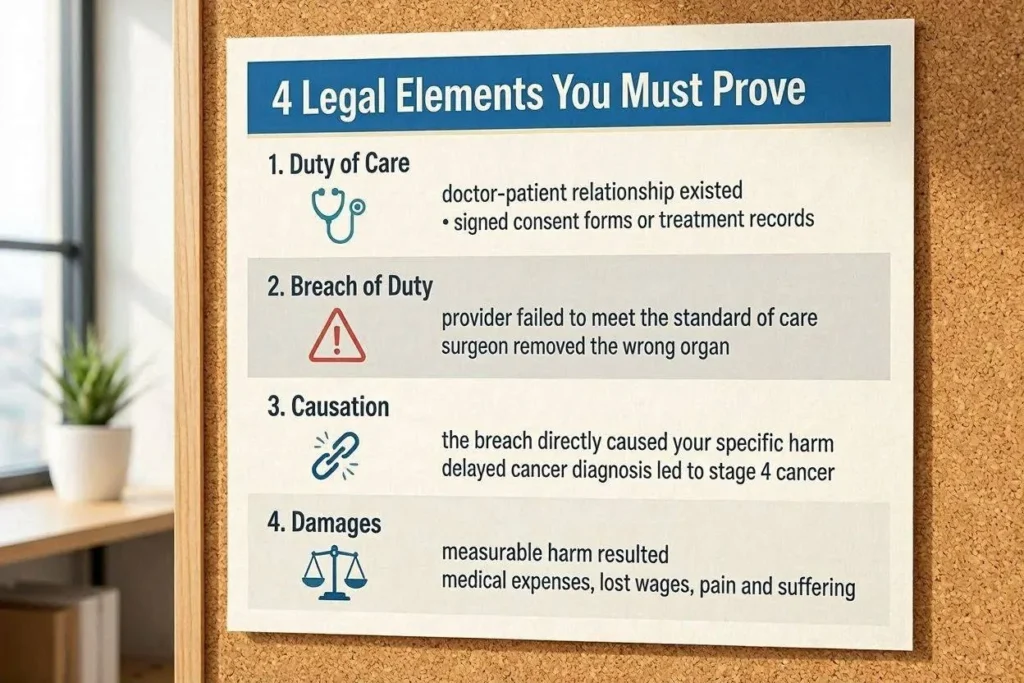
Every malpractice claim requires proof of all 4 elements. Missing even 1 gives the defense grounds to dismiss the case.
| Element | What You Must Show | Example |
|---|---|---|
| 1. Duty of Care | A doctor-patient relationship existed | Signed consent forms or treatment records |
| 2. Breach of Duty | Provider failed to meet the standard of care | Surgeon removed the wrong organ |
| 3. Causation | The breach directly caused your specific harm | Delayed cancer diagnosis led to Stage 4 progression |
| 4. Damages | You suffered measurable losses | Medical bills, lost wages, permanent disability |
How to File a Malpractice Claim: 9 Steps
Step 1 — Recognize the Signs of Malpractice
Start by identifying whether a medical error caused your harm — not just a poor outcome. 4 warning signs that suggest malpractice:
- Your condition worsened despite completing the prescribed treatment
- A second doctor identified an error the first provider made
- You received a diagnosis significantly later than your symptoms warranted
- A procedure was performed without your informed consent
Consult a second physician immediately. A written second opinion strengthens your claim and creates an independent record of the harm.
Step 2 — Request All Medical Records
Request your complete medical records the same day you suspect malpractice. Federal law under HIPAA (Health Insurance Portability and Accountability Act) gives you the right to all records within 30 days of request.
Collect 5 types of documents:
- Treatment notes and physician orders
- Lab results, imaging (X-rays, MRI scans), and pathology reports
- Surgical reports and anesthesia logs
- Medication administration records
- Discharge instructions and follow-up correspondence
Do not wait. Records can be altered, lost, or destroyed over time. Request certified copies and store them in a secure location.
Step 3 — Consult a Medical Malpractice Attorney
Hire a malpractice attorney before taking any other legal step. Most malpractice lawyers work on contingency — meaning no upfront fee. The attorney collects 25%–40% of the final settlement or verdict.
During the first consultation, bring:
- All medical records and imaging
- A written timeline of every appointment, symptom, and instruction received
- Any written communications with the provider — discharge papers, prescription labels, emails
A malpractice attorney evaluates whether your case meets all 4 legal elements before investing time in your claim.
Step 4 — Obtain a Medical Expert Opinion
In approximately half of all US states, a qualified medical expert must review your case and certify it has merit before the court accepts your filing. This requirement is called a certificate of merit (CM) or affidavit of merit.
The expert must practice in the same specialty as the defendant provider. The expert reviews your records and confirms that the standard of care was breached and that the breach caused your specific harm.
States requiring a certificate of merit before filing:
Georgia, Florida, New York, Pennsylvania, California, Maryland, Texas — and approximately 24 others. Check your state’s requirements with your attorney before drafting any complaint.
Step 5 — File a Notice of Intent
Many states require you to notify the healthcare provider of your intent to sue before filing the formal lawsuit. Florida law gives the provider 90 days to respond after receiving the notice.
The notice of intent (NOI) serves 2 purposes:
- Gives the provider an opportunity to investigate and settle early
- Satisfies a pre-suit requirement that prevents immediate court dismissal
Your attorney drafts and delivers the NOI. During this period, gather additional evidence and finalize your expert’s certificate.
Step 6 — File the Formal Complaint

Your attorney files the formal complaint in the appropriate court — typically in the jurisdiction where the malpractice occurred. The complaint must include 3 specific elements:
- A detailed account of the treatment received and how the standard of care was breached
- A direct causal link between the breach and your harm
- The specific damages — medical costs, lost income, pain and suffering — you are seeking
After filing, the defendant must be formally served with a copy of the complaint. The defendant then has 20 to 30 days (varies by state) to file a response.
Step 7 — Complete the Discovery Phase
Discovery is the phase where both sides exchange all evidence, documents, and witness statements. Discovery typically runs 6 to 18 months and includes 3 main processes:
- Interrogatories — written questions both sides must answer under oath
- Depositions — recorded interviews with the defendant, treating physicians, and expert witnesses
- Document requests — exchange of medical records, billing records, and internal facility policies
Your attorney uses discovery to identify every weakness in the defense’s position and build the strongest possible settlement argument.
Step 8 — Negotiate a Settlement
Most malpractice claims resolve during settlement negotiations — before reaching trial. The defendant’s insurer typically initiates a settlement offer after reviewing discovery evidence.
3 factors that increase your settlement value:
- Strong expert testimony with clear documentation of the standard of care breach
- Documented economic damages — medical bills, lost wages, future care costs — with receipts
- Serious or permanent injury, which courts and insurers weigh heavily
Reject the first offer. Insurers start low. Your attorney negotiates to a fair amount based on the full scope of your economic and noneconomic damages.
Step 9 — Proceed to Trial If Necessary
If negotiations fail, your case goes to trial — typically before a jury. The trial follows 5 stages: opening statements, plaintiff’s evidence, defense evidence, closing arguments, and jury verdict.
Prepare for a long process. High-value malpractice trials — particularly those involving birth injuries, surgical errors, or wrongful death — can take 2 to 4 years from filing to verdict.
Your attorney handles all courtroom arguments. Your role is to attend, provide accurate testimony during deposition, and supply any additional documentation requested during trial preparation.
Statute of Limitations by State — Key Deadlines for 2026
The SOL is the filing deadline for your claim. Missing it permanently ends your right to compensation — regardless of how clear the negligence is. Deadlines range from 1 year in Kentucky and Louisiana to 5 years in Maryland.
| State | Filing Deadline | Discovery Rule | Key Notes |
|---|---|---|---|
| California | 1 year from discovery / 3 years from injury | Yes | Shorter window applies; 90-day pre-suit notice required |
| New York | 2 years 6 months (30 months) | Partial | No damage cap; Lavern’s Law extends time for cancer misdiagnosis |
| Florida | 2 years | Yes | 90-day NOI required; cap rules vary by defendant type |
| Texas | 2 years | Yes | Certificate of merit required within 120 days of filing |
| Georgia | 2 years | Yes | Certificate of merit mandatory before lawsuit proceeds |
| Kentucky | 1 year | Yes | 5-year statute of repose is the absolute outer limit |
| Louisiana | 1 year | Yes | Shortest deadline in the USA — act immediately |
| Maryland | 5 years / 3 years from discovery | Yes | Longest standard window in the USA |
| Pennsylvania | 2 years | Yes | Certificate of merit required; no damage cap |
| Colorado | 2 years | Yes | Noneconomic cap: $530,000 (2026); increases annually to 2029 |
Important: Minor and wrongful death exceptions
In most states, the SOL clock pauses (tolls) until a minor reaches age 18. Wrongful death claims carry separate deadlines — often starting from the date of death, not the date of the negligent treatment. Confirm both rules with a local malpractice attorney.
What Compensation Can You Recover?
Successful malpractice claims recover 3 types of damages. Settlements average $100,000 to $500,000. High-severity cases — birth injuries, permanent disability, wrongful death — frequently result in verdicts exceeding $1 million.
| Damage Type | What It Covers | Examples |
|---|---|---|
| Economic Damages | Objectively verifiable financial losses | Medical bills, future care costs, lost wages, lost earning capacity |
| Noneconomic Damages | Subjective, non-financial losses | Pain and suffering, emotional distress, loss of enjoyment of life |
| Punitive Damages | Awarded for gross negligence or intentional misconduct | Rare; requires proof of reckless disregard for patient safety |
28 states cap noneconomic damages. California caps noneconomic damages at $470,000 for personal injury and $650,000 for wrongful death as of January 2026, with annual increases planned through 2033. 22 states — including New York, Pennsylvania, and New Jersey — have no statutory cap.
Can You File a Malpractice Claim Without a Lawyer?

Yes, you can file without a lawyer — but it is not recommended. Medical malpractice is one of the most complex areas of civil litigation. Most claims require expert witnesses, compliance with pre-suit notice requirements, and adherence to state-specific procedural rules that change year to year.
3 practical reasons to hire an attorney:
- Malpractice firms work on contingency — you pay nothing unless you win
- Attorneys know how to counter insurer tactics: low initial offers, causation disputes, and delay strategies
- Expert witness sourcing, discovery management, and court filings require legal infrastructure most individuals do not have
Patients who self-represent in malpractice cases lose at a significantly higher rate than those represented by experienced counsel.
Legal Malpractice vs. Medical Malpractice — Key Differences
Both are malpractice claims, but the process differs in 3 important ways.
| Factor | Medical Malpractice | Legal Malpractice |
|---|---|---|
| Defendant | Doctor, nurse, hospital, clinic | Attorney, law firm |
| Standard | Medical standard of care in the same specialty | Competence standard of a reasonably skilled attorney |
| Key Proof | Expert physician testimony required | Expert attorney testimony required; must show ‘case within a case’ |
| Filing Deadline | 1–5 years depending on state | 1–3 years depending on state |
| Common Causes | Misdiagnosis, surgical error, medication mistake | Missed deadlines, conflicts of interest, incorrect legal advice |
Frequently Asked Questions
How long does a malpractice claim take to resolve?
Most malpractice claims take 1 to 3 years to resolve. Claims that settle early — during the notice of intent phase — close in 6 to 12 months. Cases that go to trial take 2 to 4 years. High-value birth injury and wrongful death cases take the longest due to complex expert testimony requirements.
How much does it cost to file a malpractice claim?
Filing a malpractice claim costs nothing upfront if you hire a contingency-fee attorney. The attorney covers investigation, expert fees, court filing costs, and deposition expenses. If the claim succeeds, the attorney collects 25%–40% of the final award. If the claim fails, you owe nothing.
What evidence is strongest in a malpractice case?
The 3 strongest pieces of evidence are your original medical records, a written opinion from a qualified medical expert, and documented economic losses with receipts. Expert testimony is the most critical — without an expert who can testify to the standard of care breach, most cases fail.
Does the discovery rule extend my filing deadline?
Yes, most states apply the discovery rule — the SOL clock starts when you knew or reasonably should have known about the malpractice, not necessarily on the date of treatment. However, statutes of repose set an absolute outer limit (typically 3 to 10 years) after which no claim can be filed, regardless of when the harm was discovered.
What happens if my state has a damage cap?
A damage cap limits the maximum noneconomic damages you can recover — it does not cap economic damages like medical bills and lost wages. In California, the noneconomic cap is $470,000 for personal injury (2026). In New York, there is no cap — verdicts in birth injury and surgical error cases frequently exceed $1 million. Your attorney will clarify which caps apply to your specific claim.
Conclusion
Filing a malpractice claim has 1 non-negotiable rule: act before the statute of limitations expires. In Louisiana and Kentucky, that window is 1 year. In Maryland, it is 5 years. Every other state falls somewhere in between.
The 4 legal elements — duty, breach, causation, and damages — must all be present. Missing even 1 ends the case. Evidence collection starts with your medical records. Expert testimony validates the breach. A contingency-fee attorney manages the entire process at no upfront cost.
Most claims settle before trial. The stronger your documentation, the stronger your settlement position. Start gathering records today — not tomorrow.

Amanda Brooks
Amanda Brooks leads legal, justice, and community advocacy content at JusticeInTown, drawing on a background in legal research and public policy. She specializes in civil rights, access to justice, and legal awareness, bringing a careful, research-driven approach to complex legal and public-interest topics. Her guides help readers better understand their rights, legal options, and the issues affecting their communities.
Related Posts