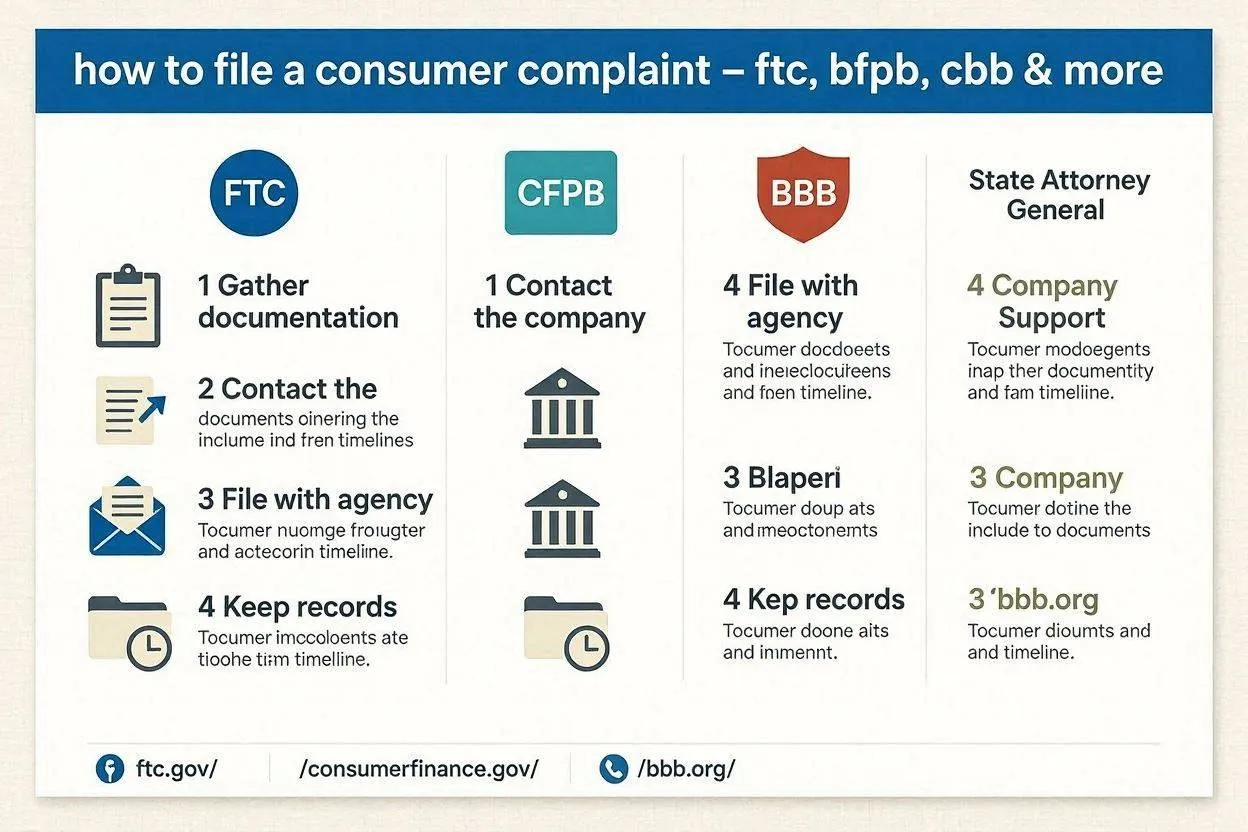
How to File a Consumer Complaint – FTC, CFPB, BBB & More
Filing a consumer complaint gets you results — if you file with the right agency. Most people contact the wrong office first, wait weeks, and hear nothing back.
This guide shows exactly which agency handles your issue, how to file in under 20 minutes, and how to escalate when companies ignore you. Whether you are disputing a bank charge, reporting a scam, fighting a telecom bill, or dealing with a defective product, there is a specific government body with real power to force a response.
Pro Tip: A CFPB complaint forces a bank to respond in 15 days. An FCC complaint makes your telecom provider’s executive team handle your case directly. Use the right tool.
What Is a Consumer Complaint?
A consumer complaint is a formal report you file with a government agency or third-party organization when a company treats you unfairly, illegally, or deceptively. Filing creates an official record, triggers a mandatory company response, and contributes to enforcement data regulators use to sue bad actors.
The 4 outcomes a complaint can produce:
- The company refunds, fixes, or acknowledges your issue
- A regulator investigates and takes enforcement action
- Your complaint data contributes to class-action lawsuits or FTC fines
- A public complaint record warns future customers
Step 1: Gather Your Documentation First
Collect these 6 items before you file anything:
- Receipts, invoices, or order confirmations showing the transaction
- Screenshots of the website, app, or advertisement that misled you
- Bank or credit card statements showing unauthorized charges
- Emails, chat logs, or letters from the company
- Serial or model numbers of defective products
- Names of customer service representatives you spoke with and the dates
Create a one-paragraph timeline of events in plain language. State what happened, on which dates, and what the company said or did. This summary goes directly into every complaint form.
Critical Rule: Never submit only one complaint method. File with the company first, then with the right agency. Document every interaction — it strengthens every escalation step that follows.
Step 2: Contact the Company Directly
Contact the company’s customer service team first. Yes — even if you are furious. Regulators want to see you tried this first, and 60% of complaints are resolved at this stage.
How to contact the company effectively:
- Call or chat customer service and document the agent’s name, ID, and the outcome
- Send a formal complaint email to the company’s corporate office or consumer affairs department
- Write a certified complaint letter so you have proof of delivery
- State exactly what you want: a refund, a replacement, an account correction, or a written apology
- Give the company a reasonable deadline — 7 to 14 business days is standard
Keep your tone professional. The person reading your complaint is not the one who wronged you, and an aggressive tone reduces your chances of resolution.
Step 3: Choose the Right Agency for Your Complaint Type
This is the step most people skip. Filing with the wrong agency delays your case by weeks. Match your issue to the correct office below.
Financial Products & Services → CFPB
The Consumer Financial Protection Bureau (CFPB) handles complaints about banks, credit unions, credit card issuers, mortgage lenders, debt collectors, student loan servicers, payday lenders, and credit reporting agencies like Equifax, Experian, and TransUnion.
File at: consumerfinance.gov/complaint or call 1-855-411-2372
What happens after you file with CFPB:
- CFPB forwards your complaint to the company within 15 days
- The company must respond within 15 days and close the complaint within 60 days
- 98% of companies respond on time according to CFPB data
- You receive updates by email and can dispute an unsatisfactory response
Immigrant-Specific Note: If you have been denied a financial product or charged discriminatory fees, the CFPB handles fair lending complaints under the Equal Credit Opportunity Act (ECOA).
Scams, Fraud & Deceptive Advertising → FTC
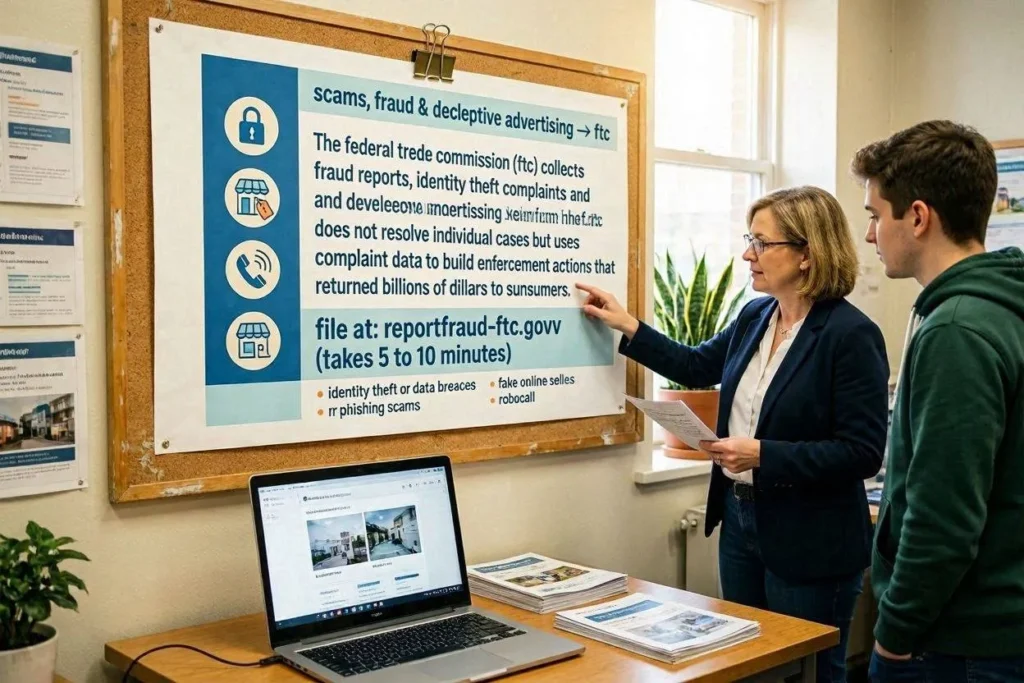
The Federal Trade Commission (FTC) collects fraud reports, identity theft complaints, and deceptive advertising claims. The FTC does not resolve individual cases but uses complaint data to build enforcement actions that have returned billions of dollars to consumers.
File at: ReportFraud.ftc.gov (takes 5 to 10 minutes)
Report to FTC if you experienced:
- Identity theft or data breaches
- Fake online sellers or phishing scams
- Robocalls or Do Not Call Registry violations
- Misleading advertisements or false product claims
- Pyramid schemes or multi-level marketing fraud
Phone, Internet & Cable Issues → FCC
The Federal Communications Commission (FCC) handles disputes with phone companies, internet service providers (ISPs), cable providers, and wireless carriers including Verizon, AT&T, Comcast, and T-Mobile.
File at: consumercomplaints.fcc.gov
The FCC sends your complaint directly to the provider, which must respond in writing within 30 days. Major telecom companies have dedicated FCC complaint resolution teams empowered to solve issues that front-line support cannot.
The FCC handles 5 complaint categories:
- Phone billing disputes, coverage gaps, or number porting issues
- Internet service speed, billing, or data cap violations
- Cable TV billing or service complaints
- Unwanted calls, robocalls, and text message spam
- Unauthorized charges added to your phone bill (known as cramming)
General Business Disputes → Better Business Bureau (BBB)
The Better Business Bureau (BBB) is a nonprofit network that mediates disputes between consumers and businesses. The BBB publishes complaint records publicly, which gives companies a strong incentive to respond.
File at: bbb.org/consumer-complaints/file-a-complaint
The BBB works best for local businesses, retail disputes, home contractors, and auto dealers. It is not a government agency and cannot enforce penalties, but a public BBB complaint influences a company’s reputation rating and often prompts fast resolution.
State-Level Scams & Business Violations → State Attorney General
Your State Attorney General (AG) enforces state consumer protection laws and can sue companies, obtain restitution, and issue injunctions. State AGs take action on complaints about local businesses, price gouging, housing fraud, and issues that affect many consumers in your state.
Find your state AG at naag.org. Most states have an online complaint form.
File with your State AG for:
- Price gouging during emergencies
- Deceptive contractors or home repair scams
- Landlord violations and security deposit theft
- Local business fraud and false advertising
- Insurance claim denials or agent misconduct
Product Safety Defects → CPSC
The Consumer Product Safety Commission (CPSC) handles defective products that cause or risk injury. This covers toys, appliances, furniture, electronics, and other household goods.
File at: SaferProducts.gov. Reports are published in a public database accessible to manufacturers and other consumers.
Step 4: How to Write a Winning Complaint
A strong complaint has 5 parts:
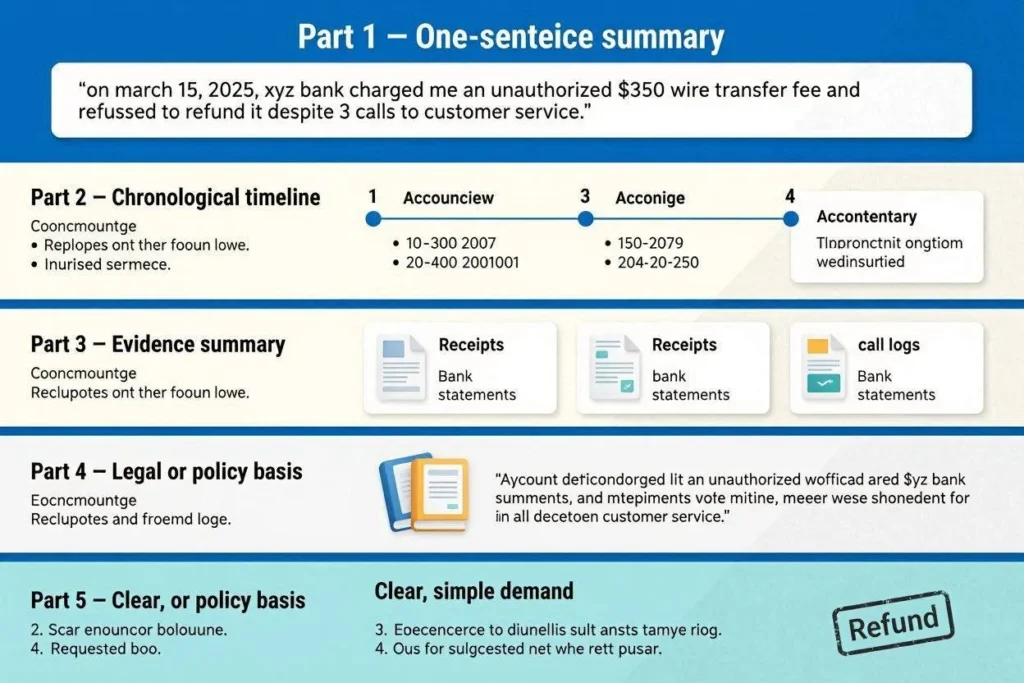
Part 1 — One-sentence summary: State the problem and what you want in a single sentence. Example: ‘On March 15, 2025, XYZ Bank charged me an unauthorized $350 wire transfer fee and refused to refund it despite 3 calls to customer service.’
Part 2 — Chronological timeline: List key dates and facts in order. Include amounts, account numbers, and representative names.
Part 3 — Evidence summary: State what documents you are attaching and why they are relevant.
Part 4 — Desired resolution: Be specific. State the exact dollar amount you want refunded, the specific account correction needed, or the precise action you expect.
Part 5 — Deadline: Give the company or agency a reasonable response window — 15 business days is standard.
Tone Matters: Write calmly and factually. Agencies process thousands of complaints. A concise, well-organized complaint gets faster action than an emotional one.
Step 5: Escalate When Companies Don’t Respond
If the company’s response does not resolve your issue, escalate in this order:
- Dispute the company’s response through the agency portal (CFPB and FCC both allow this)
- File with a second agency — for financial issues, file with both CFPB and your State AG simultaneously
- Contact your state’s consumer protection office for local mediation
- File in small claims court if the amount is under your state’s threshold (typically $2,500 to $10,000 depending on the state)
- Consult a consumer protection attorney — many work on contingency for FDCPA (Fair Debt Collection Practices Act) cases
Which Complaint Agency Should You Use? Quick Reference Guide
| Your Issue | File With | Website | Response Time |
| Bank, credit card, loan, debt collector | CFPB | consumerfinance.gov/complaint | 15–60 days |
| Scam, fraud, identity theft | FTC | ReportFraud.ftc.gov | No individual response |
| Phone, internet, cable billing | FCC | consumercomplaints.fcc.gov | 30 days |
| Local business, contractor | BBB | bbb.org | Varies |
| Price gouging, state law violations | State AG | naag.org (find your state) | Varies |
| Dangerous/defective product | CPSC | SaferProducts.gov | Published in DB |
Consumer Complaints for Immigrants: What You Need to Know
Immigrants in the U.S. have the same consumer protection rights as citizens. Federal consumer law does not require citizenship or permanent residency to file a complaint.
4 protections that apply regardless of immigration status:
- The CFPB accepts complaints from all U.S. consumers — no citizenship required
- The FTC’s ReportFraud.ftc.gov accepts reports in Spanish and other languages
- The Fair Housing Act (FHA) prohibits discrimination in housing based on national origin
- The Equal Credit Opportunity Act (ECOA) prohibits lenders from denying credit based on national origin
Common scams targeting immigrants include:
- Notarios or unauthorized ‘immigration consultants’ charging for services they cannot legally provide
- Fraudulent job offers requiring upfront fees
- Fake government websites collecting personal and payment information
- Landlords violating tenant rights because of immigration status
If you were scammed by a fake immigration consultant or notario, file with both the FTC at ReportFraud.ftc.gov and your State Attorney General. Many states have laws specifically targeting unauthorized immigration practice.
How Long Does a Consumer Complaint Take?
Timelines vary by agency:
- CFPB: Companies must respond within 15 days and close complaints within 60 days
- FCC: Telecom providers must respond in writing within 30 days
- BBB: Most businesses respond within 30 days; some faster
- State AG: Ranges from 30 days to several months depending on case complexity
- FTC: No individual response — but complaint data drives enforcement actions
5 Mistakes That Kill Consumer Complaints
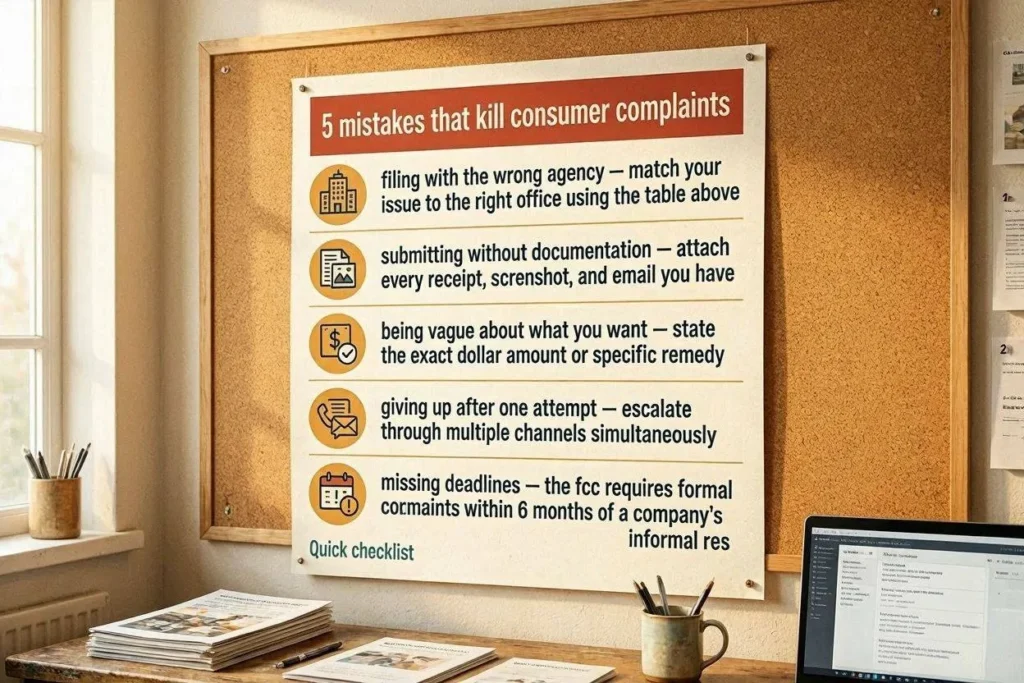
- Filing with the wrong agency — match your issue to the right office using the table above
- Submitting without documentation — attach every receipt, screenshot, and email you have
- Being vague about what you want — state the exact dollar amount or specific remedy
- Giving up after one attempt — escalate through multiple channels simultaneously
- Missing deadlines — the FCC requires formal complaints within 6 months of a company’s informal response
Conclusion
Filing a consumer complaint takes 10 to 20 minutes and creates legal pressure companies cannot ignore. The CFPB forces financial companies to respond in 15 days. The FCC reaches telecom executive teams directly. The State AG can sue on your behalf.
The key is matching your complaint to the right agency, documenting everything, and filing with multiple channels when one response falls short.
Start with the company. Escalate to the agency. Repeat if needed. Your consumer rights exist — use them.
Frequently Asked Questions

Amanda Brooks
Amanda Brooks leads JusticeInTown’s legal, justice, and community advocacy content division. She holds a background in legal research and public policy and specializes in topics related to civil rights, access to justice, legal awareness, and community issues. With years of experience researching legal and social justice topics, Amanda brings a careful, research-driven approach to complex legal information and public-interest issues. She is the primary author of JusticeInTown’s legal guides, justice-related resources, and community-focused content, helping readers better understand their rights, legal options, and the issues affecting their communities.
Related Posts