

How to File a Defamation Case: Step-by-Step Legal Guide (2026)
Defamation destroys reputations, kills careers, and costs real money. False statements spread online within minutes, reaching thousands of people before you even realize the damage. Filing a defamation lawsuit is how you stop the bleeding and recover what you lost.
This guide covers all 8 steps — from checking whether your case qualifies to winning damages in court.
What Is Defamation? (Libel vs. Slander)
Defamation is a false statement of fact, made about a person, communicated to at least one third party, that causes measurable harm. It splits into 2 types:
- Libel — Written or published defamation (social media posts, news articles, emails, online reviews). Libel leaves a clear evidentiary trail, making cases easier to prove.
- Slander — Spoken defamation (verbal statements in meetings, phone calls, broadcasts). Slander requires witness testimony, which makes cases harder to win.
Important: Opinion is NOT defamation. A court distinguishes between provable false facts and subjective commentary. Saying someone is ‘a bad person’ is opinion. Saying someone ‘stole $50,000 from their employer’ is a statement of fact — and provably false statements of fact are actionable.
4 Legal Elements You Must Prove to Win
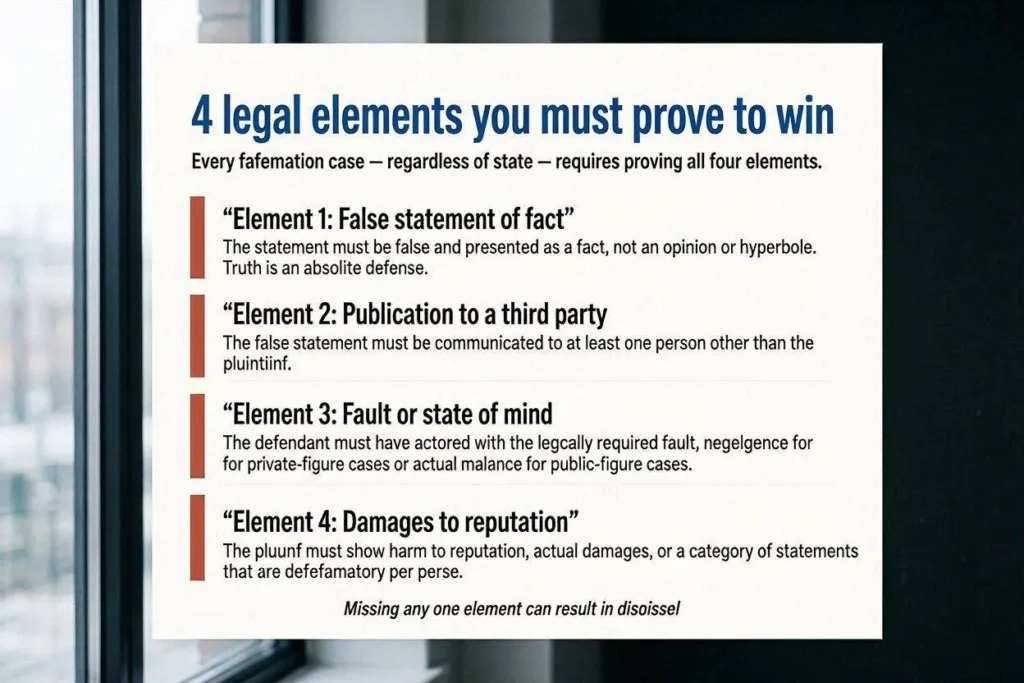
Every defamation case — regardless of state — requires proving all 4 of these elements. Missing even one gets your case dismissed.
Element 1: False Statement of Fact
The statement must be false and presented as a fact, not an opinion or hyperbole. Truth is an absolute defense — if the statement is true, no defamation occurred.
Element 2: Publication to a Third Party
The false statement must be communicated to at least 1 person other than you. A private message sent only to you does not qualify. Posting online, emailing colleagues, or announcing in a meeting all satisfy this element.
Element 3: Fault (Negligence or Actual Malice)
The fault standard depends on your status:
- Private individuals must prove the defendant acted negligently — they failed to verify the truth before publishing.
- Public figures (celebrities, politicians, executives) must prove actual malice — the defendant knew the statement was false or acted with reckless disregard for the truth. This is a significantly higher bar.
Element 4: Harm to Reputation
You must show the false statement caused measurable damage — job loss, lost clients, business damage, social ostracism, or emotional distress. Courts cannot compensate you for hurt feelings alone.
Exception — Defamation Per Se: When a statement accuses someone of a crime, an infectious disease, sexual misconduct, or professional unfitness, courts presume harm. You do NOT need to prove actual damages in per se cases.
8 Steps to File a Defamation Case
Step 1: Confirm You Have a Valid Claim
Run through all 4 elements above. Ask yourself:
- Was the statement provably false — not just unflattering?
- Did a third party see, hear, or read it?
- Can you show real harm — lost income, lost contracts, job termination?
- Is it within the statute of limitations (typically 1–2 years from publication)?
If the answer to all 4 is yes, you likely have a valid defamation claim.
Step 2: Gather and Preserve Evidence Immediately
Defamatory content — especially online — disappears fast. Collect everything now:
- Screenshot every post, comment, review, and article. Capture the URL, date, author name, and full context.
- Save webpage archives using the Wayback Machine (web.archive.org) or HTTrack.
- Download email headers and message metadata, not just the text.
- Print hard copies of newspaper, magazine, or printed publications.
- Record verbal statements with witnesses who can confirm what they heard.
- Document financial damages — pay stubs, invoices, terminated contracts, bank statements, tax records.
- Compile a witness list of people who saw or heard the defamatory statement.
Pro Tip: Do NOT collect written witness statements yet. Once litigation begins, those documents become discoverable by the opposing party. Let your attorney advise on timing.
Step 3: Consult a Defamation Attorney
Defamation law is complex. Before doing anything else, consult a lawyer who specializes in defamation or reputation law.
A good defamation attorney will:
- Assess the strength of your claim honestly.
- Identify additional causes of action — intentional infliction of emotional distress, invasion of privacy, interference with business, or breach of contract.
- Advise on the statute of limitations deadline specific to your state.
- Calculate realistic damages.
- Warn you about the Streisand Effect — cases that attract more attention than the original defamation.
You can technically file pro se (without an attorney), but defamation cases involve complex legal standards. Self-representation significantly reduces your odds of success.
Step 4: Send a Cease and Desist (Demand) Letter
Before filing in court, most defamation cases start with a formal demand letter. The letter:
- Puts the defendant on legal notice.
- Demands retraction, removal of content, or monetary compensation.
- Sets a clear deadline for response (typically 10–30 days).
- Creates a documented record of your attempt to resolve the matter.
Many cases settle at this stage — saving months of litigation and thousands in legal fees. If the defendant ignores the letter or refuses, you move to court.
Note: Some states have retraction statutes. If the defendant issues a timely and adequate retraction, it may reduce or eliminate their damage liability. Your attorney can advise whether to demand a retraction as part of the letter.
Step 5: Choose the Right Court and Jurisdiction
Picking the wrong court wastes time and money. Your 3 main options:
- Defendant’s home state or county — where the defendant lives or operates a business.
- Location of publication — for online defamation, any location where the content was accessed and caused harm, including your own state.
- Small claims court — only for low-damage cases (usually under $10,000–$25,000 depending on state). No attorney required, but damages are capped.
Jurisdiction matters because defamation laws, damages rules, and statutes of limitations vary significantly by state. Some states are far more plaintiff-friendly than others.
Step 6: Draft and File the Formal Complaint
The complaint is the document that officially starts your lawsuit. It must include:
- The full name and address of both parties.
- A clear statement of facts — when, where, and how the defamation occurred.
- The specific defamatory statements, quoted verbatim.
- All legal causes of action (defamation plus any additional claims).
- The damages you are seeking.
File the complaint with the court clerk and pay the filing fee. Filing fees typically run $225–$450 depending on the court. If you cannot afford the fee, request a fee waiver form.
After filing, make at least 2 copies — one for your records, one for serving the defendant.
Step 7: Serve the Defendant
The defendant must be officially served with the complaint and a court summons. Service rules vary by state, but generally you can serve:
- By a process server or sheriff’s deputy.
- By certified mail with return receipt (in states that allow this method).
- By publication, if the defendant cannot be located after a diligent search.
For anonymous online defamation, you may need to file a ‘John Doe’ lawsuit first, then subpoena the platform (Google, Meta, X/Twitter) to identify the poster.
Step 8: Navigate Discovery, Settlement, or Trial
After filing, the case enters the litigation phase:
- Discovery — Both sides exchange evidence. Your attorney takes depositions, requests documents, and may hire expert witnesses to calculate damages or testify about reputational harm.
- Negotiation and mediation — Most defamation lawsuits (statistically over 90%) settle before trial through negotiation or formal mediation.
- Trial — If no settlement is reached, a judge or jury hears the evidence and decides liability and damages.
- Judgment — The court awards damages or dismisses the case.
- Appeal — Either party can appeal if they believe a legal error occurred.
Timeline: Most defamation lawsuits take 6 months to 3 years to resolve. Online cases with anonymous defendants or complex evidence take the longest.
3 Types of Damages You Can Recover
A successful defamation case can result in 3 categories of monetary damages:
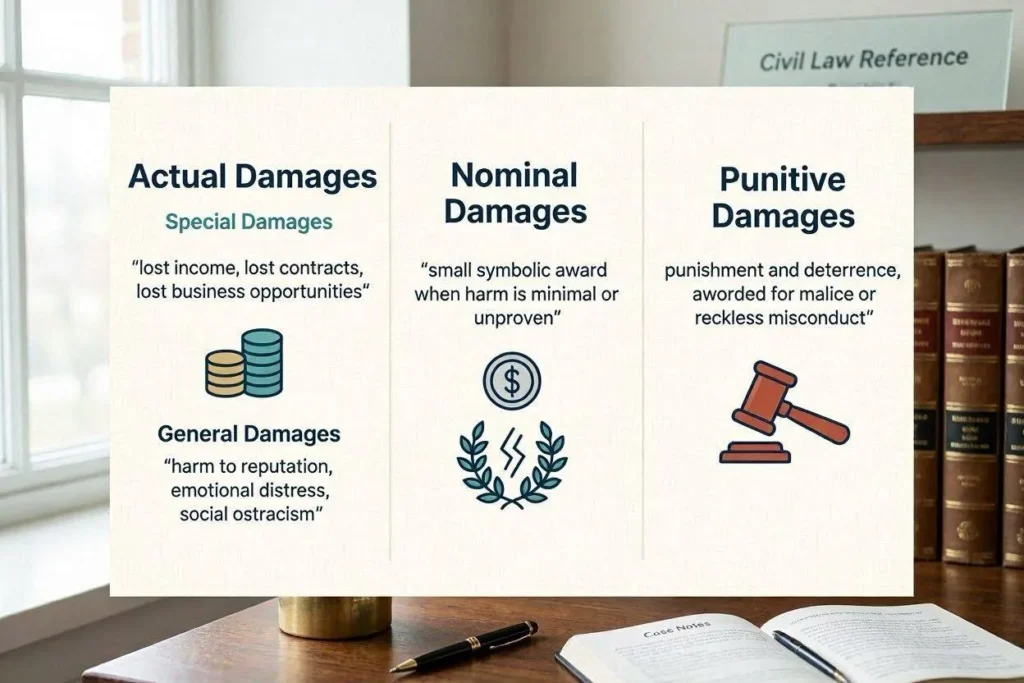
- Actual damages — Compensate for specific, provable losses. These split into: (a) Special damages — lost income, lost contracts, lost business opportunities, calculated with financial records; (b) General damages — harm to reputation, emotional distress, mental anguish, social ostracism — these are harder to quantify but fully recoverable.
- Nominal damages — Small symbolic awards when defamation is proven but actual harm cannot be precisely calculated.
- Punitive damages — Extra damages awarded to punish the defendant for particularly malicious or reckless conduct. Available in most states when actual malice is proven.
Statute of Limitations: Don’t Miss Your Deadline
The statute of limitations for defamation sets the legal deadline to file your lawsuit. Miss it and the court dismisses your case — permanently.
- Most states: 1 year from the date of publication (the single publication rule).
- Some states (e.g., Arkansas for libel): up to 3 years.
- The clock starts on the date the statement was first published or spoken — not when you discovered it.
3 exceptions that may extend your deadline:
- Discovery rule — Some states start the clock from when you reasonably discovered or should have discovered the defamation.
- Unknown defendant — The clock may pause (toll) until you identify the anonymous poster through a subpoena.
- Victim is a minor — The deadline is typically tolled until the minor reaches age 18.
Critical: Act immediately. Evidence disappears, websites get deleted, and witnesses forget details. Consulting an attorney within weeks of discovering defamation protects your claim.
Common Defenses the Defendant Will Use
Expect the defendant to raise one or more of these defenses:
- Truth — The single strongest defense. If the statement is true, no defamation occurred, period.
- Opinion — Statements clearly framed as personal opinion are protected. Courts look at the full context to determine what a reasonable person would interpret as fact vs. opinion.
- Privilege — Statements made in court, legislative proceedings, or certain employment contexts carry absolute or qualified privilege.
- Consent — If you previously approved or authorized the publication, the defamation claim fails.
- Retraction — A prompt, adequate retraction may reduce or eliminate damages in retraction-statute states.
Online Defamation: Special Considerations
Online defamation cases involve unique challenges not present in traditional libel or slander cases:
- Anonymous defendants — Most online defamers post under fake names. You need a ‘John Doe’ lawsuit and a court subpoena to force the platform to reveal the user’s identity and IP address.
- Jurisdiction complexity — A post can be read in every state and country simultaneously. Choosing the right jurisdiction is strategic.
- Content removal — Even before filing suit, request removal from the platform directly. Many platforms comply with legally valid takedown requests. Removal limits ongoing reputational damage.
- Section 230 immunity — Platforms like Google, Facebook, and Yelp are generally immune from defamation liability for third-party content. You must sue the original poster, not the platform.
- Evidence preservation — Use web archiving tools immediately. Online content can be deleted within hours of a lawsuit being filed.
Before You File: 4 Alternatives to Litigation
Defamation lawsuits are expensive, time-consuming, and emotionally draining. Consider these alternatives first:
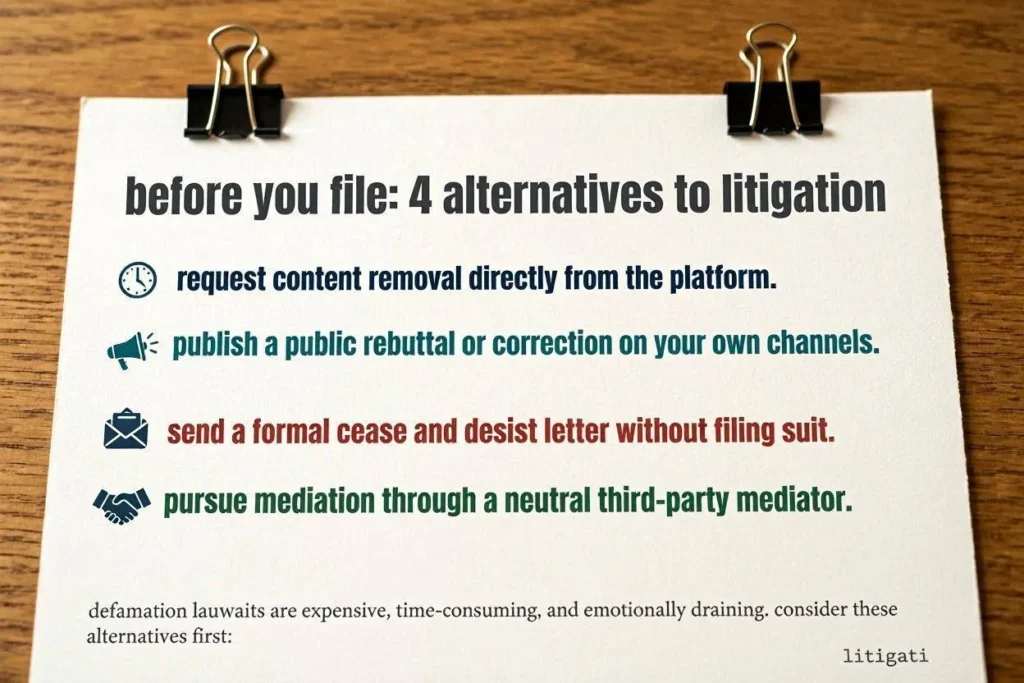
- Request content removal directly from the platform.
- Publish a public rebuttal or correction on your own channels.
- Send a formal cease and desist letter without filing suit.
- Pursue mediation through a neutral third-party mediator.
If these alternatives fail — or if the defamation caused severe financial harm — litigation is the right path.
Conclusion
Defamation causes real, measurable harm. Filing a case requires proving 4 elements, acting before the statute of limitations expires, collecting solid evidence, and working with an experienced attorney. Most cases settle without going to trial — but having a strong complaint filed gives you the leverage to reach a fair settlement.
Start with evidence preservation and a legal consultation. Both are free or low-cost — and both protect your ability to file before deadlines close your window.
Frequently Asked Questions

Amanda Brooks
Amanda Brooks leads JusticeInTown’s legal, justice, and community advocacy content division. She holds a background in legal research and public policy and specializes in topics related to civil rights, access to justice, legal awareness, and community issues. With years of experience researching legal and social justice topics, Amanda brings a careful, research-driven approach to complex legal information and public-interest issues. She is the primary author of JusticeInTown’s legal guides, justice-related resources, and community-focused content, helping readers better understand their rights, legal options, and the issues affecting their communities.
Related Posts