
How Long Does a Green Card Take? Processing Times by Category
Green cards take anywhere from 8 months to more than 12 years. Where you land on that range depends on your category, your country of birth, and whether you’re filing from inside the U.S. or working through a consulate abroad. Family members of U.S. citizens often get through in under two years. Workers from India or China, filing under the exact same employment category as someone from, say, Portugal, can wait a decade or more. The single biggest factor separating those two outcomes is visa category, full stop.
This article walks through USCIS timelines by category and form type, and digs into the specific bottlenecks that quietly add months (sometimes years) to cases that looked routine on paper.
How long does a green card take on average?
Most applicants wait somewhere between 8 and 24 months. Employment-based cases tied to a backlogged country are the exception, and they can stretch well past a decade. USCIS reports that Form I-485 (Application to Register Permanent Residence or Adjust Status) typically takes 7 to 33 months to process. That wide range exists because two very different systems run side by side: domestic adjustment of status for people already in the U.S., and consular processing for everyone applying from outside the country.
Consular cases move through the National Visa Center before landing at an embassy or consulate for an interview. Domestic cases skip that step, but they add a biometrics appointment and, in most categories, an in-person interview at a local field office. Once a visa number opens up and background checks clear, USCIS says permanent residents get their card within 90 days of entering the country or paying the immigrant visa fee, whichever happens later.
What are the eligibility categories for a green card?
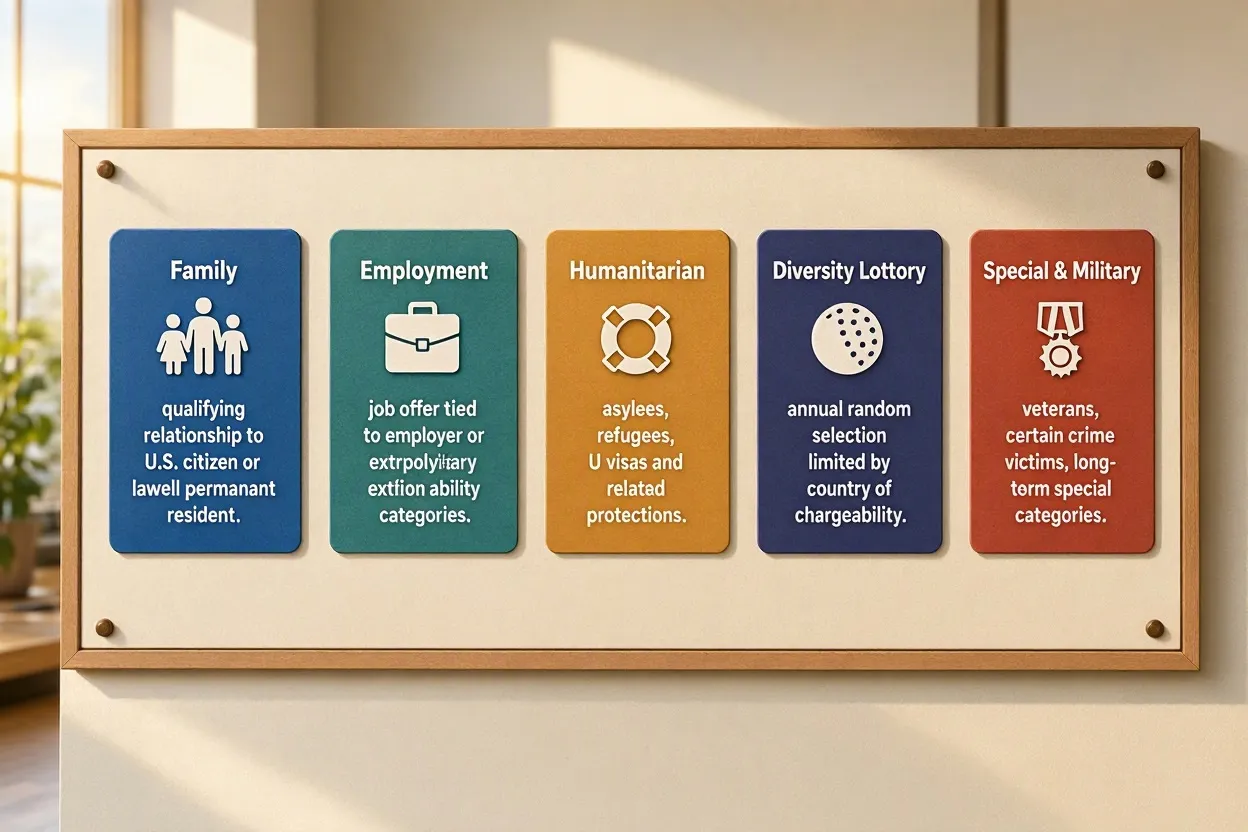
Green card eligibility breaks into five main paths, and which one you fall under is what actually drives your timeline. Family, employment, humanitarian protection, the diversity lottery, and a small set of special categories (military service members, certain crime victims, and long-term residents of specific status types) each run under separate rules for visa number availability. A spouse of a U.S. citizen and a software engineer from India can file nearly identical paperwork and still land ten years apart.
- Family sponsorship: requires a qualifying relationship to a U.S. citizen or existing green card holder
- Employment sponsorship: requires a job offer tied to a specific employer, or extraordinary ability that skips sponsorship entirely (EB-1)
- Humanitarian paths: cover asylees, refugees, and applicants under programs like U visas for crime victims
- Diversity lottery: about 55,000 applicants selected annually by random drawing, limited to countries with historically low U.S. immigration rates
- Military service pathway: veterans may qualify for an expedited naturalization track that skips several green card steps entirely, a category none of the other four paths cover
- Category selection matters: filing under the wrong category, EB-3 instead of EB-2, say, can add or cut years depending on how backlogged that category and country combination happens to be that quarter
How long does a green card take by category?
Here’s how those timelines actually break down in practice.
Family-based green card processing time
Immediate relatives of U.S. citizens (spouses, unmarried children under 21, and parents) wait 12 to 18 months. There’s no annual cap on visa numbers for this group, so once USCIS approves the petition, the case moves straight into processing with no line to stand in.
Preference categories work very differently. Take F4, which covers siblings of U.S. citizens: as of the August 2026 Visa Bulletin, F4 priority dates for Mexico and the Philippines remain effectively frozen where they’ve sat for years, meaning applicants from those two countries are looking at waits well past 20 years. A sibling from Germany or South Africa filing under that same category faces a noticeably shorter line, since F4 for the “Rest of World” column has continued moving forward each month. Because these cutoff dates shift monthly, check the current Visa Bulletin at travel.state.gov for the exact figure that applies to a specific priority date.
Employment-based green card processing time (EB-1, EB-2, EB-3)
EB-1 cases move in 8 to 14 months for most countries. EB-2 and EB-3 cases from India or China can take 8 to 12 years for the identical job, at the identical company. EB-1 is reserved for people with extraordinary ability, outstanding researchers, and multinational executives, and it skips the PERM labor certification step that EB-2 and EB-3 require. That one difference alone shaves 12 to 18 months off the front of the process.
EB-2 and EB-3 start with PERM labor certification, which the Department of Labor was taking 14 to 18 months to process as of early 2026 (check the DOL’s current processing-time report, since this figure moves). Once PERM clears, the employer files Form I-140, then Form I-485. For applicants from countries without a backlog, those two stages combined add another 12 to 18 months. So a developer born in Canada might wrap up the entire process in under three years. A developer born in India, same job, same employer, can be looking at 8 to 12 years, purely because of per-country visa caps.
Marriage-based green card timeline
A marriage-based green card takes 12 to 22 months for a spouse living in the U.S., a bit longer for a spouse applying from abroad. Domestic cases go through adjustment of status: Form I-130, biometrics, and an interview at the local field office. Married less than two years at approval? You’ll get a conditional two-year card and have to file Form I-751 later to remove the conditions before it expires.
Spouses applying from outside the country go through consular processing instead. The National Visa Center collects documents and schedules the embassy interview, which typically adds 2 to 6 months over a domestic filing. Most of that delay just comes down to staffing at each embassy.
Asylum and refugee green card timeline
Asylees and refugees have to wait at least a year after their status is granted before they can even file for a green card, and the I-485 stage itself is running 20 to 32 months right now. Congress set that one-year wait by statute, so no lawyer or paperwork shortens it. Once the year passes, an asylee in Chicago and one in Miami hit the same backlog, since asylum cases aren’t subject to the per-country caps that slow down family and employment categories.
Diversity visa lottery green card timeline
Diversity Visa winners get roughly 12 months, start to finish, from selection notification to visa issuance. The program runs on a hard fiscal-year deadline. Miss the September 30 cutoff for your selection year, and you lose eligibility entirely, no matter how far along the case is. About 55,000 diversity visas go out each year to applicants from countries with historically low U.S. immigration rates, which makes the DV lottery the one major category where speed, not backlog, is the real risk.
How does the Visa Bulletin affect green card wait times?
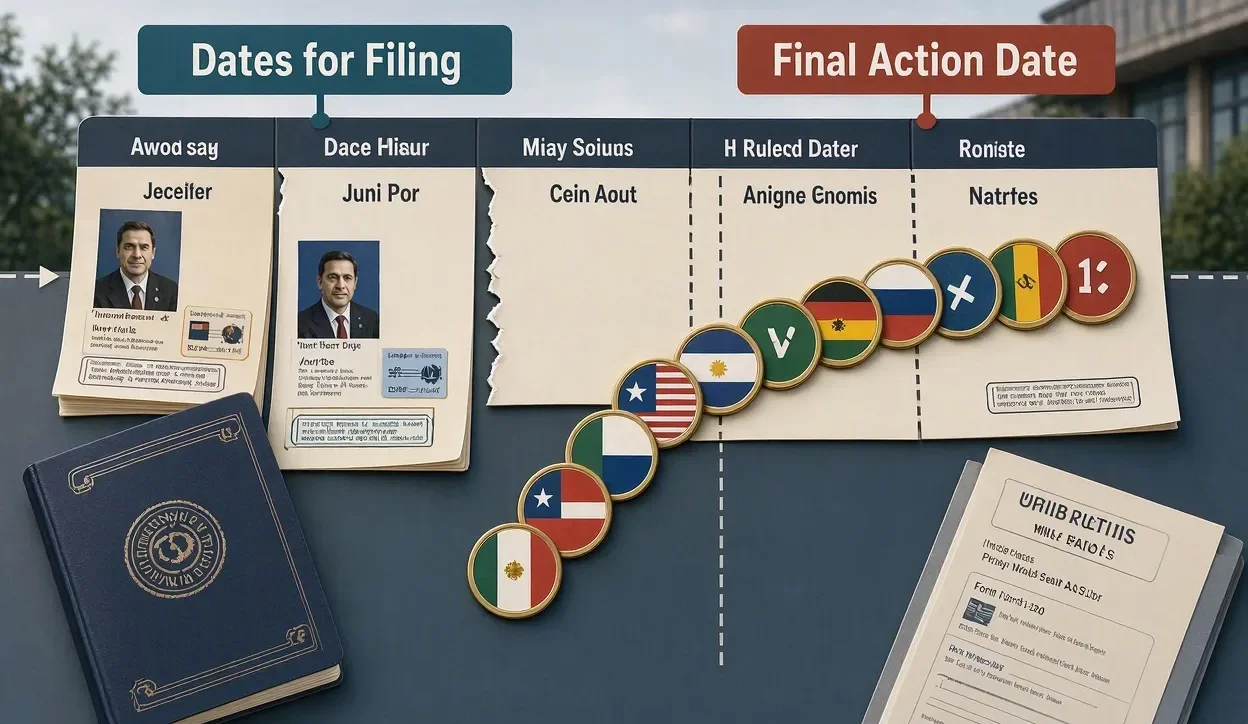
The State Department’s monthly Visa Bulletin decides when a visa number opens up, and it directly controls how long preference-category applicants wait before they can file the final stage of their case. Two dates matter here: the Final Action Date, which controls when USCIS can actually approve a green card, and the Dates for Filing, which control when someone can submit Form I-485 in the first place.
Every applicant gets a Priority Date the moment their initial petition, Form I-130 or I-140, gets filed. That date becomes their spot in line. As the F4 Philippines example above shows, a priority date can sit for two decades or more before it turns “current,” since the Visa Bulletin only allows a fixed number of visas per category and per country each fiscal year.
Immediate relatives never touch the Visa Bulletin at all, since that category has no annual cap. That structural difference is why a citizen’s spouse and a citizen’s adult sibling can file petitions on the same exact day and finish 18 years apart.
USCIS processing time by form type
Processing time varies by form, and most applicants file several at once through concurrent filing. Here’s what typical ranges looked like as of mid-2026 for the forms tied most directly to permanent residence, per USCIS’s published processing-time data. USCIS updates these figures regularly, so confirm the current numbers at uscis.gov/processing-times before relying on them for planning.
| Form | Purpose | Typical Processing Time |
| I-130 | Petition for Alien Relative | 12–16 months |
| I-485 | Adjustment of Status | 8–14 months |
| I-140 | Immigrant Petition for Alien Worker | 6–10 months |
| I-765 | Application for Employment Authorization (work permit) | 3–6 months |
| I-131 | Application for Travel Document | 6–11 months |
| I-90 | Application to Replace Permanent Resident Card | 8–12 months |
Concurrent filing lets an applicant submit Form I-765 and Form I-131 alongside I-485, so the work permit and travel document often show up before the green card interview even gets scheduled. A construction project manager waiting on an EB-3 petition, for instance, can legally work and travel internationally on those interim documents while I-485 keeps processing in the background.
What slows down green card processing?
Three things account for most delays: a request for evidence, the applicant’s field office, and background or security checks that fall outside routine processing. Each can add months to a case that looked clean on paper.
Request for Evidence (RFE)
An RFE adds an average of 90 to 120 days. USCIS issues one when a document is missing, inconsistent, or just not enough to prove eligibility, a tax return that doesn’t match the income on Form I-864, for example, or a marriage certificate submitted without the required translation. The clock stops until the applicant responds, and USCIS typically gives 30 to 90 days to reply, depending on what’s being requested.
Field office location
This alone can tack on 6 months or more. USCIS runs more than 80 field offices, and interview backlogs vary sharply between them. Someone adjusting status through the New York City office might wait 6 months longer for an interview than someone filing identical paperwork through a smaller office in Des Moines, purely down to staffing and local case volume.
Background and security checks
Most clear within days. But applicants with common names or ties to countries under heightened security review can face 6 to 12 months of additional silence while USCIS runs a manual name check. This step runs independently of everything else, so someone can pass every interview question and still sit waiting for months while the security review finishes on its own timeline.
How long does it take to receive the green card after approval?
The card typically shows up 3 to 4 weeks after approval, though the printing itself only takes 10 to 14 days once USCIS updates the case status to “Card Is Being Produced.” USCIS mails it through USPS, and most applicants get a paper welcome notice a few days before the card arrives. Approved on a Tuesday? Expect the physical card in the mailbox within a month, assuming no address change or mail-forwarding hiccup gets in the way.
Entrants who used an immigrant visa to enter the U.S. follow a slightly different clock: USCIS states these cases get the card within 90 days of entry, or within 90 days of paying the immigrant fee if that payment happens after arrival.
How long does green card renewal take?
Renewal through Form I-90 currently takes 8 to 12 months. Standard 10-year cards need renewing before they expire; conditional 2-year cards go through a separate process (Form I-751) to remove conditions rather than a standard renewal. Once USCIS receives the I-90 filing, it issues a receipt notice that automatically extends the current card’s validity for 24 months, which covers almost any renewal delay without interrupting the ability to work or travel.
How to check your green card case status
Checking your status takes less than 5 minutes through the USCIS online tracker at egov.uscis.gov. Enter the 13-character receipt number from your filing notice, and you’ll see real-time updates on where things stand. USCIS also offers “personalized” processing-time estimates through the same portal, weighed against an individual case’s filing date and current office-specific data rather than the published national ranges, though the agency itself calls these best-guess figures, not guarantees.
Do you need an immigration lawyer to speed up the process?
No. A lawyer can’t make USCIS move faster, but a good one can cut the risk of delays caused by incomplete filings or avoidable RFEs. Premium Processing is the one legitimate expedite option, and it only applies to certain employment-based petitions like Form I-140, guaranteeing a 15-calendar-day response for an extra government fee. Family-based and marriage-based cases have no equivalent, so for those categories, speed comes down almost entirely to filing something complete and error-free the first time around.
Submit Form I-485 without a joint sponsor affidavit, and you’ve all but guaranteed an RFE, adding 3 to 4 months before you ever see an interview date. A lawyer who reviews the filing beforehand catches that kind of gap before USCIS does.
- Marriage-based case attorney fees: typically $1,500 to $4,000
- USCIS filing fees (marriage-based): roughly $1,760 total for the combined I-130 and I-485 package
- Employment-based case costs: $5,000 to $10,000 in combined attorney and filing fees, driven largely by the documentation PERM requires to prove no qualified U.S. worker was available
- Self-filing risk: an RFE adds 90 to 120 days, and can mean extra legal fees down the line to fix what wasn’t caught the first time
Can you work while waiting for a green card?
Yes, as long as you hold separate work authorization. Form I-765 grants that, commonly called an EAD, and most applicants file it alongside I-485 through concurrent filing. USCIS is currently issuing EAD cards in 3 to 6 months.
No EAD means no legal work, no matter how far the green card case has progressed. A marketing coordinator on an employer-sponsored EB-2 petition can keep working under existing H-1B status while the case processes in the background. An asylee with no other valid work authorization has to wait for the EAD to arrive before starting a job, even once the one-year asylum waiting period has already passed.
Conclusion
Green card processing time comes down to category first, country of birth second, and paperwork accuracy third. An immediate relative of a U.S. citizen can be holding a card within 18 months. An employment-based applicant born in India or China, filing under the same visa classification, may still be waiting past the decade mark. Checking your status directly through the USCIS receipt-number tracker is really the only way to get a number specific to your own filing rather than a published national average.
FAQs

Amanda Brooks
Amanda Brooks leads legal, justice, and community advocacy content at JusticeInTown, drawing on a background in legal research and public policy. She specializes in civil rights, access to justice, and legal awareness, bringing a careful, research-driven approach to complex legal and public-interest topics. Her guides help readers better understand their rights, legal options, and the issues affecting their communities.
Related Posts