

Personal Injury Claim Process: A Step-by-Step Legal Guide
A car accident, a slip on a wet floor, a defective product. The injury itself takes seconds. What follows doesn’t. The personal injury claim process can stretch across months or years, and most people walking into it have never done this before.
This guide breaks the process into its real stages, from the first doctor’s visit through a possible trial, with the numbers, deadlines, and terminology attorneys use every day.
What Is a Personal Injury Claim?
A personal injury claim is a legal request for compensation filed by someone injured due to another party’s negligence, recklessness, or intentional conduct. It rests on three elements: liability, fault, and damages. A claimant has to connect all three, showing the defendant owed a duty of care, breached it, and caused measurable harm as a result.
Car accidents make up the largest share of personal injury claims. Premises liability cases (slip-and-fall, dog bites), medical malpractice, and product liability round out most of the rest. The facts differ wildly from case to case, but the procedural skeleton stays roughly the same across categories.
How Long Does the Process Take?
Typically 3 months to 2 years, depending on whether the case settles before a lawsuit or heads into litigation. A straightforward case with minor injuries, clear liability, and a cooperative insurer can close in 90 days. A contested case involving disputed fault or catastrophic injuries can run 18 to 24 months or longer once discovery and trial scheduling enter the picture.
Settlement funds usually arrive 2 to 6 weeks after both sides sign. That gap covers paperwork, lien resolution, and the insurer actually cutting the check. If someone quotes you a faster timeline for a disputed case, be skeptical.
Step 1: Get Medical Treatment First
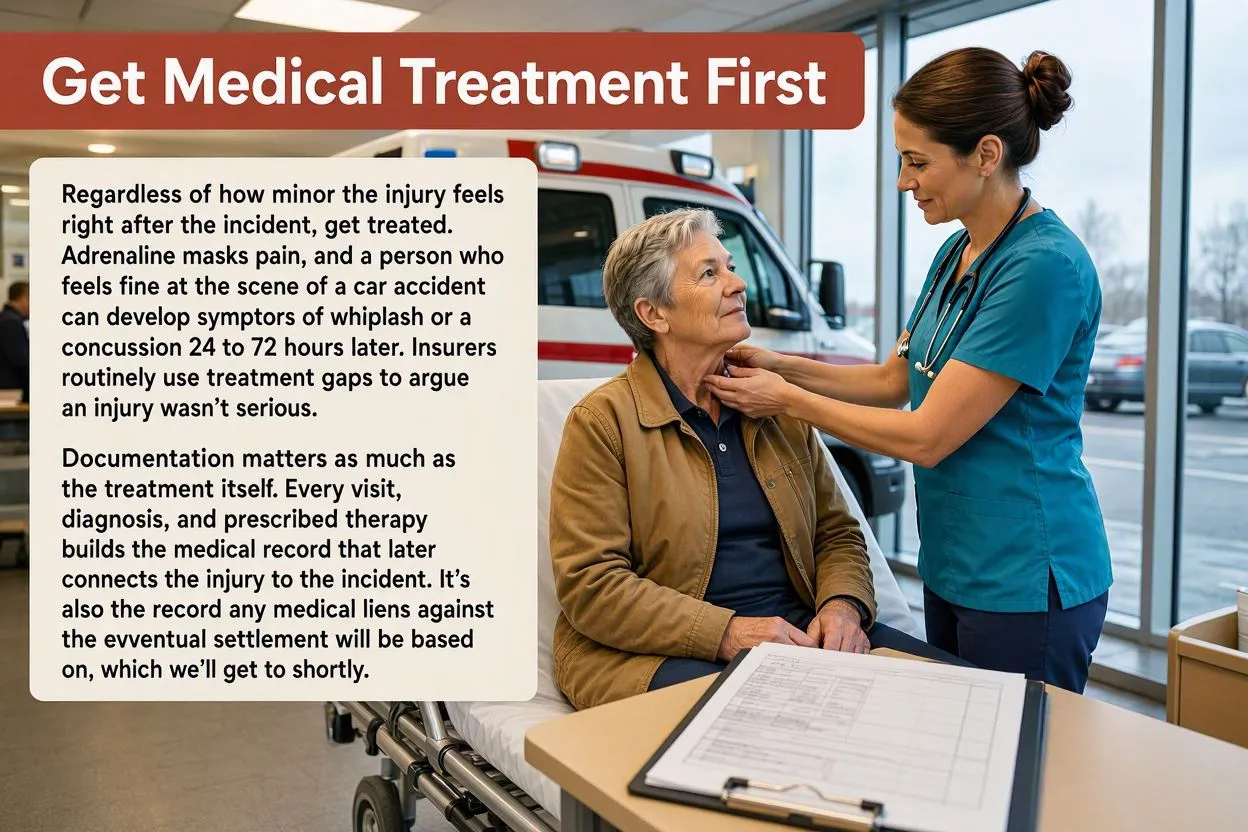
Regardless of how minor the injury feels right after the incident, get treated. Adrenaline masks pain, and a person who feels fine at the scene of a car accident can develop symptoms of whiplash or a concussion 24 to 72 hours later. Insurers routinely use treatment gaps to argue an injury wasn’t serious.
Documentation matters as much as the treatment itself. Every visit, diagnosis, and prescribed therapy builds the medical record that later connects the injury to the incident. It’s also the record any medical liens against the eventual settlement will be based on, which we’ll get to shortly.
Step 2: Consult a Personal Injury Attorney
Ideally within days of the incident, not weeks. Early legal involvement protects evidence before it disappears: witness memories fade, surveillance footage gets overwritten, physical evidence at the scene gets cleaned up or repaired.
Most personal injury attorneys work on contingency. The client pays nothing upfront, and the attorney collects a percentage, commonly 33% to 40%, only if the case succeeds. A free consultation typically covers the accident timeline, the injuries sustained, and an initial read on liability. Small cases with minor injuries and undisputed fault sometimes get resolved without an attorney. Anything involving ongoing treatment, disputed liability, or a low settlement offer usually doesn’t.
Step 3: Investigation and Evidence Gathering
This is the stage where an attorney builds the factual case connecting the defendant’s conduct to the claimant’s injuries. Evidence typically comes from police reports, photos or footage of the scene, witness statements, medical records, and, in more complex cases, expert opinions from accident reconstructionists or medical specialists.
A slip-and-fall case shows how this works in practice. Say a grocery store failed to post a wet-floor sign for 47 minutes after a spill, and internal timestamped logs prove it. That single detail can establish negligence more effectively than any amount of testimony about the fall itself.
Step 4: Filing the Claim With the Insurance Company
Filing the claim means formally notifying the at-fault party’s insurer of the intent to seek compensation. This opens a claim file and triggers a claim number, the reference point for every communication that follows. Insurers typically acknowledge a new claim within 10 to 15 business days and assign an adjuster to investigate.
Adjusters work for the insurance company, not the claimant. Their incentive runs toward minimizing payouts. An unrepresented claimant who accepts an early settlement offer often signs away the right to seek more compensation later, even if symptoms get worse after signing.
What Is an Independent Medical Examination (IME)?
Around this stage, the insurer may request an Independent Medical Examination, a physical evaluation performed by a doctor of the insurer’s choosing, not the claimant’s own physician. Insurers use it to verify the extent of an injury, particularly in claims involving ongoing treatment or high-dollar demands. The exam itself usually runs 30 to 60 minutes, but the resulting report can stretch to 10 or 20 pages and carries real weight in negotiations.
A claimant generally can’t refuse a reasonably requested IME without risking a reduction or denial of benefits, especially under first-party coverage like PIP. Since the examining doctor works for the insurer, having an attorney involved at this stage matters: they can request the full report, push back on conclusions that aren’t well supported, and bring in an independent expert if needed.
Step 5: The Demand Letter and Negotiation
A demand letter is a formal written request sent to the insurer outlining the injury, the evidence, and the compensation amount sought. It typically includes the accident facts, a summary of medical treatment, an itemized breakdown of damages, and a specific dollar figure. Damages generally fall into a few buckets: medical and rehabilitation expenses (past and future), lost wages and diminished earning capacity, property damage, pain and suffering, emotional distress, and, in cases of gross negligence, punitive damages.
Once the insurer receives the letter, negotiation begins. It’s a back-and-forth of offers and counteroffers that can last anywhere from 2 weeks to several months. Insurers commonly open well below the demanded amount, expecting negotiation to close the gap. A claim resolves through settlement, or it moves toward litigation if the two sides can’t agree.
One thing worth flagging here: a settlement figure isn’t take-home money. Medical liens (the legal right of a hospital, health insurer, or Medicare to repayment out of the settlement) and subrogation claims from a health insurer that already covered treatment costs get paid first. A $50,000 settlement with $15,000 in outstanding liens leaves $35,000 before attorney fees and costs even come off the top. Attorneys frequently negotiate lien amounts down, sometimes by 10% to 40%, particularly when total damages exceed available policy limits. Treating the settlement check as pure profit is one of the most common and costly mistakes claimants make.
Step 6: Filing a Lawsuit and the Discovery Phase
If negotiation fails, the next step is filing a lawsuit, starting with a complaint in the appropriate court laying out a prima facie case: the factual allegations establishing how the defendant’s negligence caused the injury. Once filed, the plaintiff’s attorney receives a summons to serve on the defendant. Response deadlines vary by state, typically 20 to 30 days. In Washington, D.C., for instance, defendants get 30 days to respond after being served.
After the defendant answers, the case enters discovery, where both sides exchange evidence under court rules. Discovery breaks into three main tools:
Interrogatories
Written questions one party sends the other, answered under oath. Courts typically cap the number per side at 25 to 35, depending on jurisdiction.
Document Production
Each side turns over relevant records: medical files, financial statements, insurance policies, electronic communications. Modern discovery increasingly involves eDiscovery, meaning emails, texts, and social media posts too. A single Instagram photo showing a claimant lifting weights during a supposed back-injury recovery has derailed more than one six-figure settlement demand.
Depositions
Sworn, recorded testimony given outside the courtroom, usually at an attorney’s office, with a court reporter transcribing every word. Depositions typically run 2 to 6 hours and serve to lock a witness into their account, gather case-relevant facts, and give each side a preview of how the other will argue at trial.
Step 7: Mediation or Settlement Conference
Mediation is a structured negotiation session where a neutral third party helps both sides find a resolution before trial. Courts often order it because litigation eats up limited judicial resources, and the large majority of personal injury lawsuits settle before a jury ever hears them.
A mediator doesn’t decide the case. They facilitate communication and reality-check each side’s expectations. If mediation works, the resulting agreement binds both parties. If it doesn’t, the case moves toward trial, though settlement talk often continues right up until opening statements.
Step 8: Trial and Verdict
A personal injury trial follows a fixed sequence: jury selection, opening statements, witness testimony and cross-examination, closing arguments, jury instructions, and a verdict.
The plaintiff’s attorney presents first, carrying the burden of proving liability by a preponderance of the evidence, meaning more likely true than not. Trials typically last 3 to 10 days for standard cases, though catastrophic injury or medical malpractice trials can run several weeks. Either side can appeal an unfavorable verdict, which starts a separate and often lengthy process of its own.
What Determines the Value of a Claim?
Medical costs, lost income, injury permanence, and the strength of the liability evidence. There’s no fixed formula. Comparative negligence changes the math directly in most states: a claimant found 20% at fault in a state using modified comparative negligence sees their compensation cut by that same 20%.
A handful of jurisdictions, Washington, D.C., Alabama, Maryland, North Carolina, and Virginia, follow pure contributory negligence instead, where being even 1% at fault can bar recovery entirely. It’s a much stricter standard than most of the country uses. Because state legislatures revisit these rules from time to time, confirm current law with a local attorney before relying on this list for anything real.
Do You Need an Attorney?

Not legally, no. But claimants without one typically recover less than those who have representation. Minor cases (a single urgent-care visit, an at-fault party who admits liability with damages under a few thousand dollars) sometimes resolve fine without a lawyer.
Ongoing medical treatment, disputed liability, or catastrophic injury changes that math. And since contingency fees only apply if the case wins, there’s no upfront financial risk to at least talking to someone.
What Is the Statute of Limitations?
Anywhere from 1 to 6 years depending on the state, with 2 years being the most common. The clock generally starts on the date of injury, though some states apply a “discovery rule” that starts the deadline when the injury was reasonably discovered, which matters in cases like undiagnosed internal injuries or medical malpractice.
Miss the deadline and the claim is barred permanently, no matter how strong the evidence is. Claims against government entities carry separate, often shorter notice requirements, sometimes as little as 90 days to file an administrative claim. These deadlines shift over time, so confirm the current one with an attorney rather than leaning on a general estimate like this.
First-Party vs. Third-Party Claims
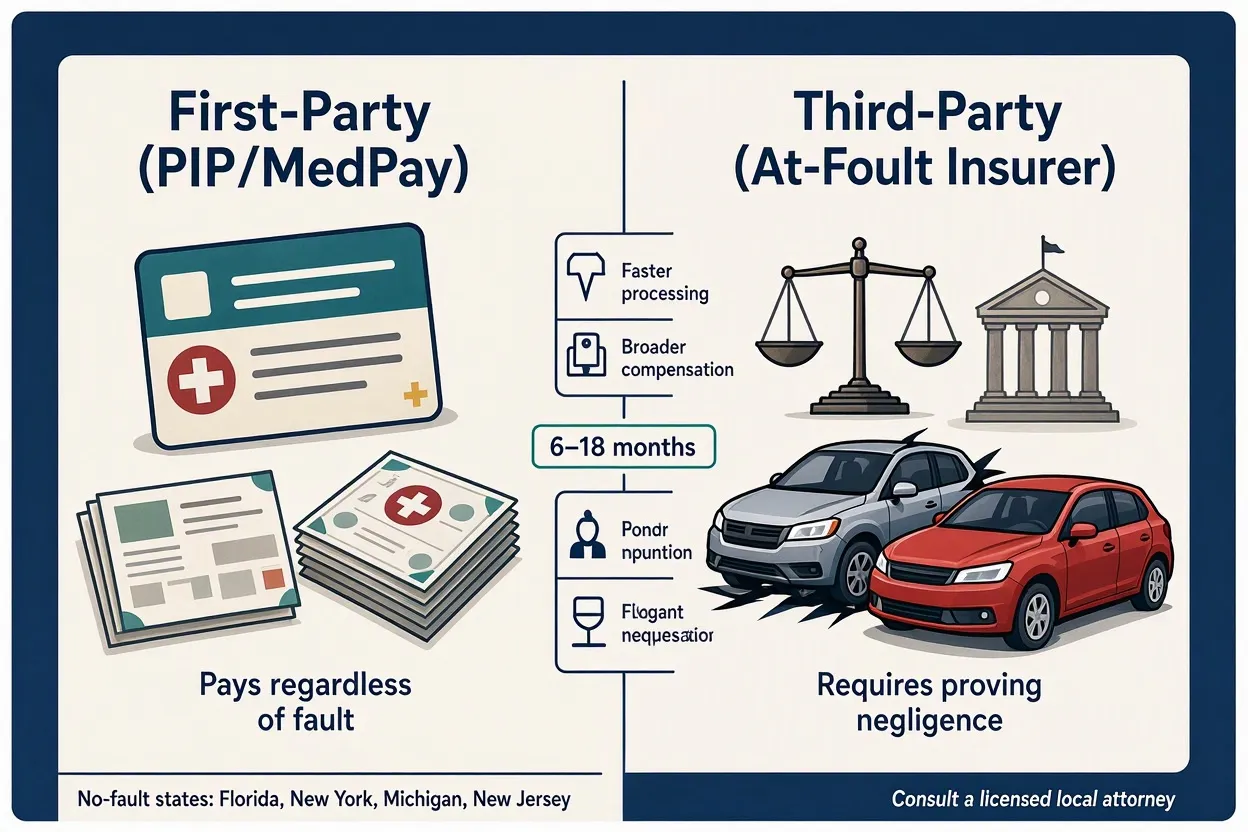
A first-party claim is filed against a claimant’s own insurance policy. A third-party claim is filed against the at-fault party’s insurer. Personal Injury Protection (PIP) and Medical Payments coverage (MedPay) are first-party coverage: they pay out regardless of fault, up to policy limits, and process faster since no fault determination is required.
Third-party claims require proving the other party’s negligence, which takes longer but opens the door to broader compensation, including pain and suffering. Many cases involve both: a first-party PIP claim covers immediate medical bills while a third-party claim against the at-fault driver’s insurer resolves separately, sometimes over the following 6 to 18 months.
No-fault states, including Florida, New York, Michigan, and New Jersey, require drivers to carry PIP, and claimants there typically file a first-party claim before pursuing anything third-party. Fault-based states don’t mandate PIP at all, which pushes claimants straight into third-party negotiation from the outset. As with the negligence rules above, check current state requirements with a licensed local attorney before relying on this.
Conclusion
Treatment, attorney, evidence, claim, negotiation, and if talks break down, litigation through discovery, mediation, and possibly trial. That’s the whole arc. Claimants who document injuries early, understand their state’s negligence rules, and keep first-party and third-party coverage straight tend to walk into negotiation from a much stronger position than the ones working off guesswork.
FAQs

Amanda Brooks
Amanda Brooks leads legal, justice, and community advocacy content at JusticeInTown, drawing on a background in legal research and public policy. She specializes in civil rights, access to justice, and legal awareness, bringing a careful, research-driven approach to complex legal and public-interest topics. Her guides help readers better understand their rights, legal options, and the issues affecting their communities.
Related Posts