
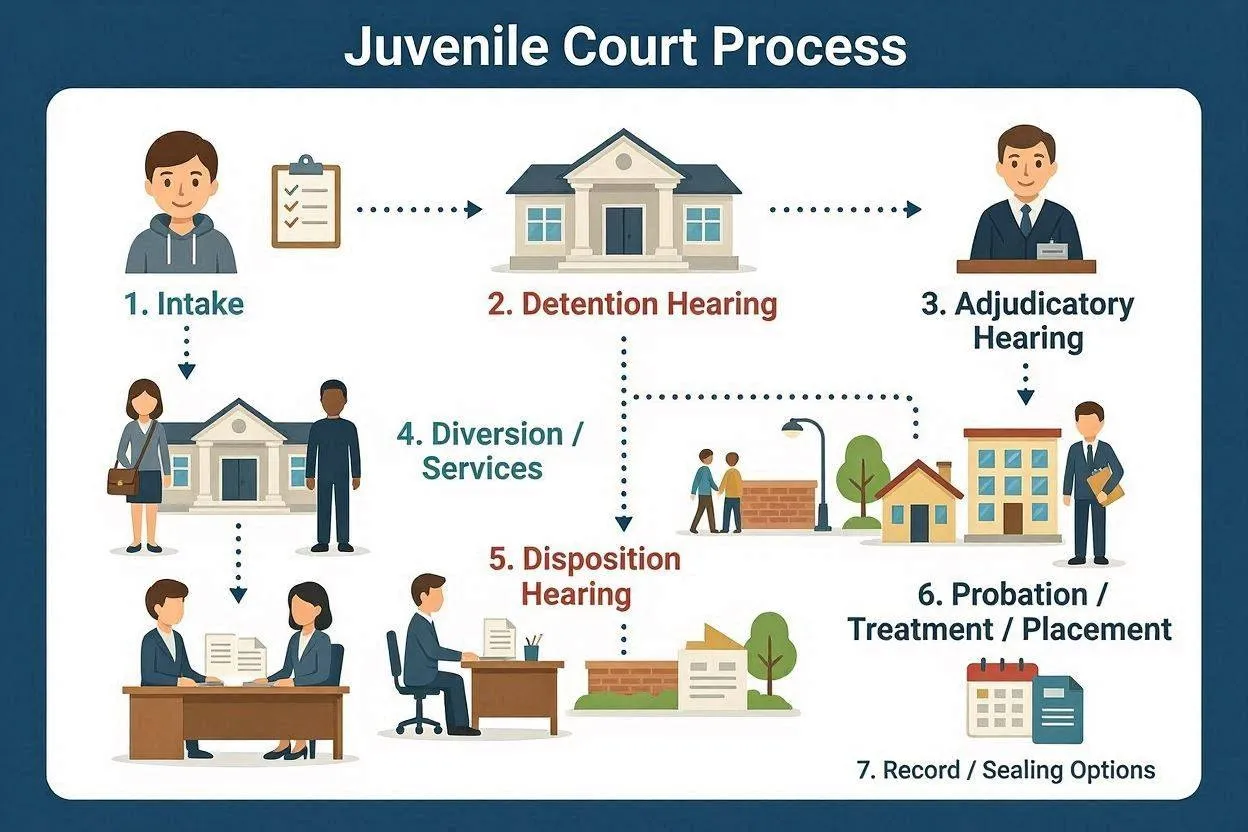
Juvenile Court Process Explained: 9 Steps Guide (2026)
The juvenile court process runs through 9 defined stages — from arrest to aftercare — and every stage carries a separate decision point that shapes your child’s future. Most cases resolve before trial: 46% of all juvenile referrals are handled informally, according to the Office of Juvenile Justice and Delinquency Prevention (OJJDP). The earlier you understand each stage, the earlier you can take action.
This guide breaks down every stage of the juvenile court process in plain language — who acts, what gets decided, and what you can do as a parent.
What Is the Juvenile Court Process?
The juvenile court process is a separate legal system for people under 18 accused of criminal acts or status offenses. The system prioritizes rehabilitation over punishment. A delinquent offense is an act that would be a crime for an adult — examples include assault, theft, or drug possession. A status offense is an act that is only illegal because of the offender’s age — examples include truancy, underage drinking, running away from home, and curfew violations.
Juvenile court operates under different terminology than adult criminal court. There is no “trial” — it is called an adjudicatory hearing. There is no “conviction” — the judge issues a delinquency finding. There is no “sentencing” — the judge holds a disposition hearing.
As of 2026, 24 states have no minimum age for arrest. The remaining 26 states set minimum ages ranging from 7 to 13 years old. The only binding federal law is the 2005 Supreme Court ruling in Roper v. Simmons (543 U.S. 551), which prohibits the death penalty for any offense committed under age 18.
How Does the Juvenile Court Process Start?
The juvenile court process starts with a referral to the system — most often from law enforcement. 29% of all youth arrests are referred directly to juvenile court; 25% are handled within the police department and then released, per OJJDP 2019 data. Other referrals come from school officials, probation officers, parents, or social workers.
After a referral, an intake officer reviews the facts of the case to determine if there is enough evidence to move forward. The intake officer checks the evidence, interviews the youth, and contacts the victim. Under 46% of all cases referred to juvenile court intake are handled informally — meaning most are dismissed or resolved without a formal petition.
How Intake Officers Decide What Happens Next
To decide the case outcome, an intake officer uses 3 main criteria: (1) strength of evidence, (2) severity of the offense, and (3) the youth’s prior record. A first-time, minor offense with strong parental support typically leads to an informal resolution. A repeat offense or a violent felony sends the case toward formal processing. The intake officer also reviews school records, family circumstances, and victim statements before making a recommendation.
How Diversion Works as an Alternative to Court
To qualify for diversion, a youth must admit to committing the act and agree to specific program conditions. Diversion — also called restorative justice — removes the youth from the formal court system. Roughly 50% of juvenile cases nationwide go through diversion. Conditions include victim restitution, mandatory school attendance, drug counseling, community service, or a curfew. The agreement is set in writing and called a consent decree. A youth who completes the diversion program has the juvenile record sealed with no further action. Diversion is not available for repeat offenders or violent felony charges in most states.
What Happens at a Juvenile Detention Hearing?
The detention hearing is the youth’s first appearance before a judge and must occur within 24 hours of arrest in all states. Unlike adult court, juvenile courts do not set bail. The judge decides one question: should the youth remain in the juvenile detention center (JDC) pending the next hearing, or go home?
The judge considers 4 factors: (1) risk to public safety, (2) risk that the youth will not appear at the next hearing, (3) the nature of the offense, and (4) the home environment. Release conditions can include an electronic monitoring anklet, a strict curfew enforced by a Juvenile Probation Officer (JPO), mandatory school attendance, and parental custody with daily check-ins. About 26% of delinquency cases referred to juvenile court involved detention in 2019, per OJJDP data.
Quick-Reference: All 9 Juvenile Court Process Stages
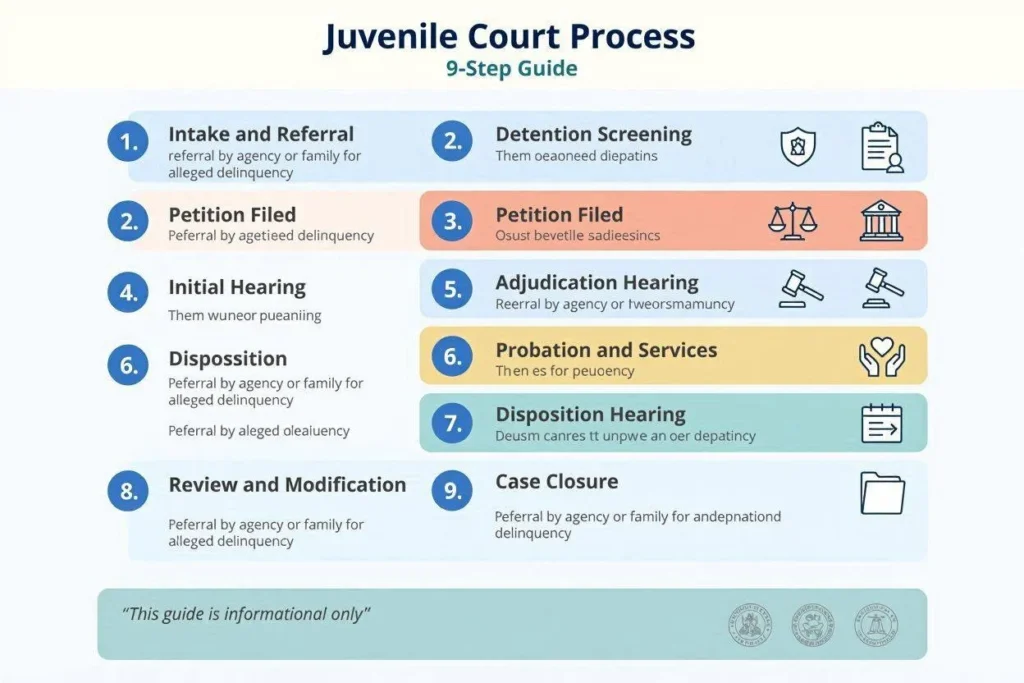
The table below covers every stage, who takes action, typical timing, and difficulty level for the family involved.
| Stage | Action Required | Typical Timing | Who Acts | Difficulty |
|---|---|---|---|---|
| Arrest / Referral | Police contact or school referral | Day 0 | Law enforcement | Low |
| Intake Review | Probation officer reviews evidence | Day 0–2 | Probation officer | Low |
| Detention Hearing | Judge decides custody status | Within 24 hrs | Judge | Medium |
| Diversion Decision | DA or intake officer approves exit | Days 1–5 | DA / Intake officer | Medium |
| Petition Filed | Formal charges submitted to court | Days 3–10 | District Attorney | High |
| Adjudicatory Hearing | Judge hears evidence, issues ruling | Weeks 2–6 | Judge + attorneys | High |
| Transfer Hearing | Judge decides adult court transfer | Weeks 2–6 | Judge | Very High |
| Disposition Hearing | Judge sets sentence / program | Days 7–21 post | Judge | High |
| Aftercare / Parole | Youth follows court conditions | Months–years | Probation + youth | Ongoing |
How Adjudication Differs from an Adult Trial
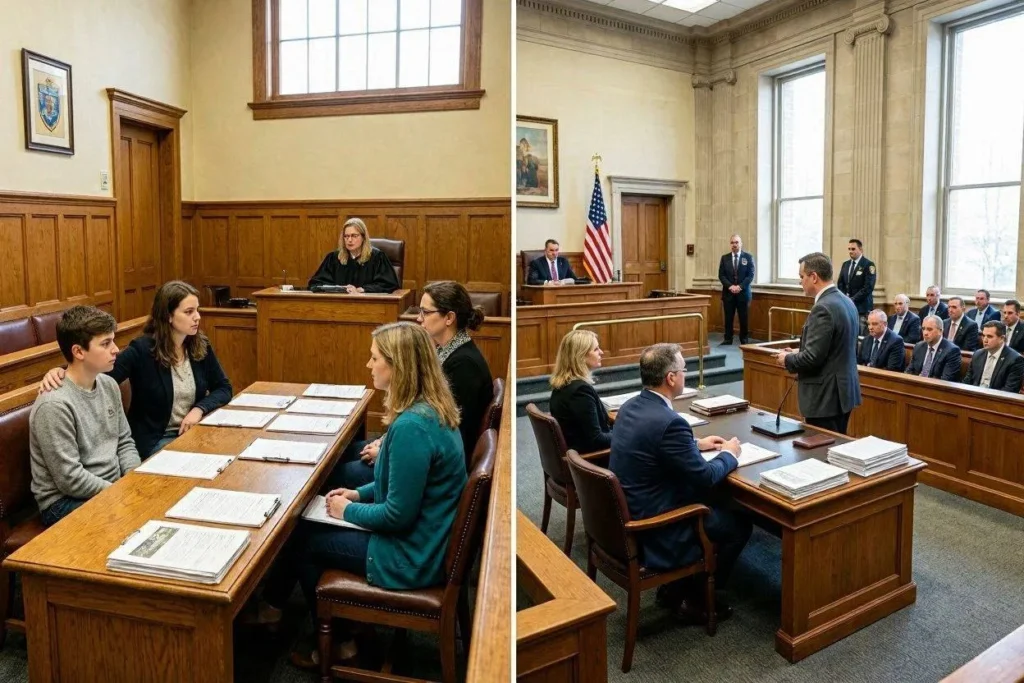
Adjudication is the juvenile equivalent of a trial, but a judge decides the outcome — not a jury. The District Attorney must prove the charge beyond a reasonable doubt. The youth’s attorney presents a defense. The judge issues a delinquency finding (guilty) or dismisses the charges. There is no jury in juvenile court — this is one of the most significant differences from adult criminal proceedings.
Before the adjudicatory hearing begins, a petition must be filed by the District Attorney’s Office or the Juvenile Probation Department. The petition is the formal charging document. The petition names the alleged offense, the relevant statute number, and the date of the act. 2 types of petitions exist: a 601 petition covers status offenses; a 602 petition covers acts that would be criminal for a person of any age.
What Rights Does a Juvenile Have During Adjudication?
A juvenile holds 5 core rights during adjudication: (1) right to an attorney, (2) right to notice of charges, (3) right to confront and cross-examine witnesses, (4) right to remain silent, and (5) protection from self-incrimination. These rights apply at every hearing. Importantly, juvenile court records are confidential — only specific parties and their lawyers can access the file. A judge can order access in limited circumstances.
How a Transfer Hearing Moves a Case to Adult Court
To transfer a juvenile case to adult criminal court, the District Attorney files a transfer petition for youth at least 14 years old charged with a serious felony. 3 transfer pathways exist: mandatory certification, prosecutorial discretionary certification, and judicial transfer. Mandatory certification applies when probable cause is found for specified violent crimes — the transfer is automatic and not appealable. Prosecutorial discretionary certification applies to violent felonies not covered by mandatory rules. Judicial transfer requires a judge to review the youth’s age, offense severity, and likelihood of rehabilitation before making a decision.
A juvenile tried as an adult faces adult sentences, including prison time. Some states allow a blended sentence — the youth begins the sentence at a juvenile facility and later transitions to an adult correctional facility.
What Happens at a Juvenile Disposition Hearing?
The disposition hearing is the juvenile court’s equivalent of a sentencing hearing and follows the adjudicatory hearing. The judge reviews a predisposition report — prepared by a Juvenile Probation Officer — that covers the youth’s background, school record, family situation, and the offense details. The JPO includes a sentencing recommendation in the report.
Judges have 9 disposition options available:
- Dismiss charges entirely
- Order a fine or victim restitution
- Impose a curfew
- Suspend the youth’s driver’s license
- Place the youth on supervised probation with specific conditions
- Order mandatory counseling, drug treatment, or community service
- Require school attendance programs
- Place the youth in a group home or probation ranch for a set period
- Commit the youth to the Division of Juvenile Justice (DJJ) for a determinate or indeterminate period
Probation in juvenile court has no fixed end date — unlike adult probation. The court sets conditions and reviews compliance. Probation ends when the judge is satisfied the youth has addressed the offense and built a plan to avoid reoffending. Juvenile court jurisdiction typically ends at age 19, though some states extend it to age 21 in serious cases.
Following release from a residential placement, the youth enters aftercare — the juvenile equivalent of adult parole. A probation officer supervises the youth during aftercare. Violating aftercare conditions can result in recommitment to the same facility or transfer to a different one.
How Juvenile Records Are Sealed or Expunged
Juvenile records are not automatically sealed in every state. Sealing prevents public access to the record. Expungement destroys the record entirely. The process and eligibility requirements differ in all 50 states.
States that allow automatic sealing typically trigger the process at 3 events:
- The youth’s 18th birthday
- Completion of the probation term
- Release from a juvenile residential facility
Courts consider 3 main factors in expungement decisions: good behavior during the supervision period, completion of all court-ordered conditions, and absence of new criminal charges. In Washington state, for example, a sealing hearing is automatically scheduled at disposition. A record that is sealed means a background check run by an employer or college will not show the juvenile offense.
Parents should request an expungement hearing as soon as the youth turns 18 and meets the eligibility requirements in their state. Missing this window can leave the record accessible for years longer than necessary.
5 Things Parents Must Do at Every Stage of the Juvenile Court Process
These 5 actions protect your child’s rights and improve the case outcome at every stage:
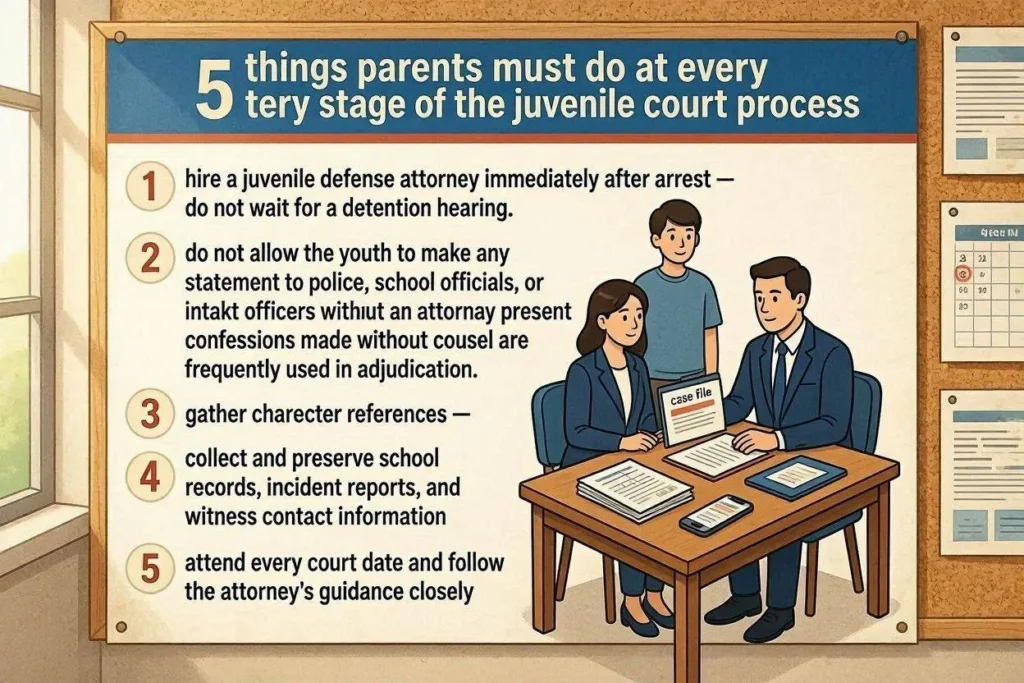
- Hire a juvenile defense attorney immediately after arrest — do not wait for a detention hearing.
- Do not allow the youth to make any statement to police, school officials, or intake officers without an attorney present — confessions made without counsel are frequently used in adjudication.
- Gather character references — teachers, coaches, counselors — before the disposition hearing; these form a mitigation packet that attorneys present to the judge.
- Verify the dye-lot number on every court document — confirm every petition number, statute reference, and hearing date matches the official court record.
- Request a copy of the predisposition report from the JPO before the disposition hearing to review the sentencing recommendation and prepare a rebuttal.
Frequently Asked Questions About the Juvenile Court Process
Does a juvenile get a jury trial?
No. Juvenile court adjudication hearings are decided by a judge, not a jury. The District Attorney must still prove the charge beyond a reasonable doubt.
Can a juvenile be tried as an adult?
Yes. A youth 14 years old or older charged with a serious felony can be transferred to adult criminal court through 3 pathways: mandatory certification, prosecutorial discretionary certification, or judicial transfer.
How long does the juvenile court process take?
Most cases resolve within 6 to 12 weeks from referral to disposition. Cases involving a transfer hearing or serious felony charges can extend to 6 months or longer.
Is a juvenile record permanent?
No. A juvenile record can be sealed or expunged once the youth meets age and conduct requirements — typically at age 18 and after completing all court conditions. Requirements differ by state.
What is the difference between a delinquent offense and a status offense?
A delinquent offense is an act that would be criminal for a person of any age — examples include assault, theft, and drug possession. A status offense is only illegal because of the offender’s age — examples include truancy, curfew violations, and underage drinking.
Get Legal Help for the Juvenile Court Process Now
The juvenile court process moves fast. A detention hearing happens within 24 hours of arrest. Statements made to police before an attorney arrives can be used at adjudication. Every day without legal counsel is a day the prosecution builds its case.
If your child faces a juvenile court hearing, contact a licensed criminal defense attorney today at JusticeInTown.com. Get a free case review, understand your child’s rights at every stage, and walk into every hearing prepared.

Amanda Brooks
Amanda Brooks leads legal, justice, and community advocacy content at JusticeInTown, drawing on a background in legal research and public policy. She specializes in civil rights, access to justice, and legal awareness, bringing a careful, research-driven approach to complex legal and public-interest topics. Her guides help readers better understand their rights, legal options, and the issues affecting their communities.
Related Posts