How to Apply for US Citizenship in 2026 — Complete Naturalization Guide
To apply for US citizenship, file Form N-400 (Application for Naturalization) online at uscis.gov or by mail, pay the filing fee, attend a biometrics appointment, pass the English and civics tests at your interview, then take the Oath of Allegiance. The full process takes 6 to 14 months depending on your USCIS field office.
This guide covers every step of the 2026 naturalization process — eligibility requirements, documents, the updated civics test, processing times by field office, fees, and 7 common mistakes that cause delays or denials.
1. Check Your Eligibility Before Filing
Submitting Form N-400 before you meet every requirement results in automatic denial. Confirm all 7 eligibility criteria before you file.
7 Eligibility Requirements for US Citizenship in 2026
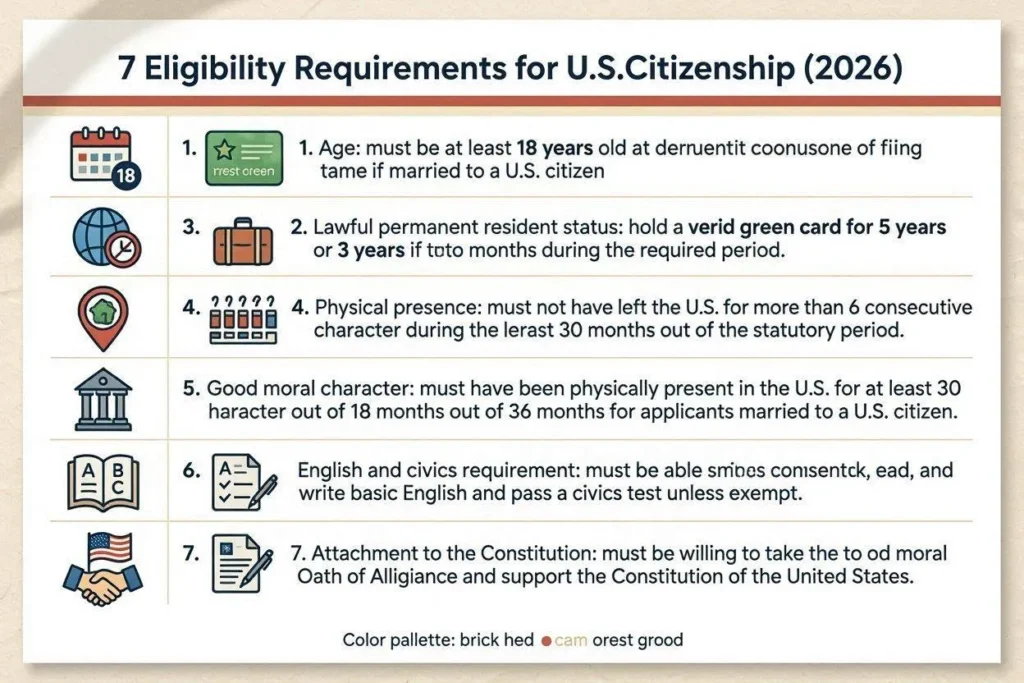
- Age: Must be at least 18 years old at the time of filing
- Lawful Permanent Resident (LPR) status: Hold a valid Green Card for 5 years (or 3 years if married to a US citizen)
- Continuous residence: Must not have left the US for more than 6 consecutive months during the required period
- Physical presence: Must have been physically present in the US for at least 30 months out of the last 60 months (18 months out of 36 months for the 3-year path)
- Good moral character: Clean criminal record for the statutory period — unpaid taxes, DUI convictions, false statements on immigration forms, or illegal voting can bar citizenship
- English proficiency: Ability to read, write, and speak basic English (exemptions apply for applicants age 50+ with 20 years as LPR, or age 55+ with 15 years as LPR)
- Civics knowledge: Pass the 2025 updated civics test with 128 questions — you must answer at least 12 out of 20 questions correctly
Residency Paths: 5-Year vs 3-Year Rule
| Eligibility Path | Green Card Requirement | Physical Presence | Can File Early |
|---|---|---|---|
| Standard (most applicants) | 5 years as LPR | 30 months in last 60 | 90 days before 5-year mark |
| Married to US citizen | 3 years as LPR + must stay married | 18 months in last 36 | 90 days before 3-year mark |
| US military service (active duty) | No LPR time required in some cases | Varies by service | Contact USCIS for details |
| Military veteran (1 year+ service) | 1 year as LPR | No minimum | After honorable discharge |
2. Gather Your Required Documents
Missing or incorrect documents are the top reason USCIS delays N-400 applications. Collect all 9 document categories before starting your form.
9 Required Documents for Form N-400
- Green Card (Form I-551): Front and back copy
- Government-issued photo ID: State driver’s license or passport
- Passport copies: All passports used in the past 5 years (or 3 years)
- Tax transcripts: IRS transcripts for the past 5 years (3 years for the spouse path) — available free at irs.gov
- Marriage/divorce certificates: Required if your eligibility is based on marriage to a US citizen, or if you have been divorced
- Court dispositions: Certified copies for any arrest, charge, or conviction — even dismissed cases and minor traffic offenses
- Selective Service registration: Required for male applicants who lived in the US between ages 18 and 26
- 2 passport-style photographs: 2×2 inches (51×51 mm), taken within the past 30 days
- Foreign language translations: Certified English translations for every document not in English
3. Complete and File Form N-400
Form N-400 is the official Application for Naturalization. USCIS accepts only the 01/20/2025 edition — using an older downloaded version causes automatic rejection.
2 Ways to File Form N-400
- Online (recommended): File at myaccount.uscis.gov — costs $710, processes faster, and lets you track your case in real time. You must create a free USCIS online account first.
- By mail (paper): Download Form N-400 from uscis.gov, complete it, and mail with supporting documents and a check or money order for $760 payable to ‘U.S. Department of Homeland Security’. Do not abbreviate the name.
N-400 Filing Fees in 2026
| Applicant Type | Online Fee | Paper Fee | Biometrics Included |
|---|---|---|---|
| Most adult applicants (18–74) | $710 | $760 | Yes |
| Applicants age 75 or older | $710 | $760 | Waived — no biometrics required |
| Reduced fee (income-based) | $380 | $380 | Yes |
| Fee waiver (Form I-912) | $0 | $0 | Yes |
| US military members | $0 | $0 | Yes |
Note: If you request a fee waiver or reduced fee, you cannot file online. Submit a paper Form N-400 with completed Form I-912 (Request for Fee Waiver) and supporting income documentation.
7 Common N-400 Form Mistakes to Avoid
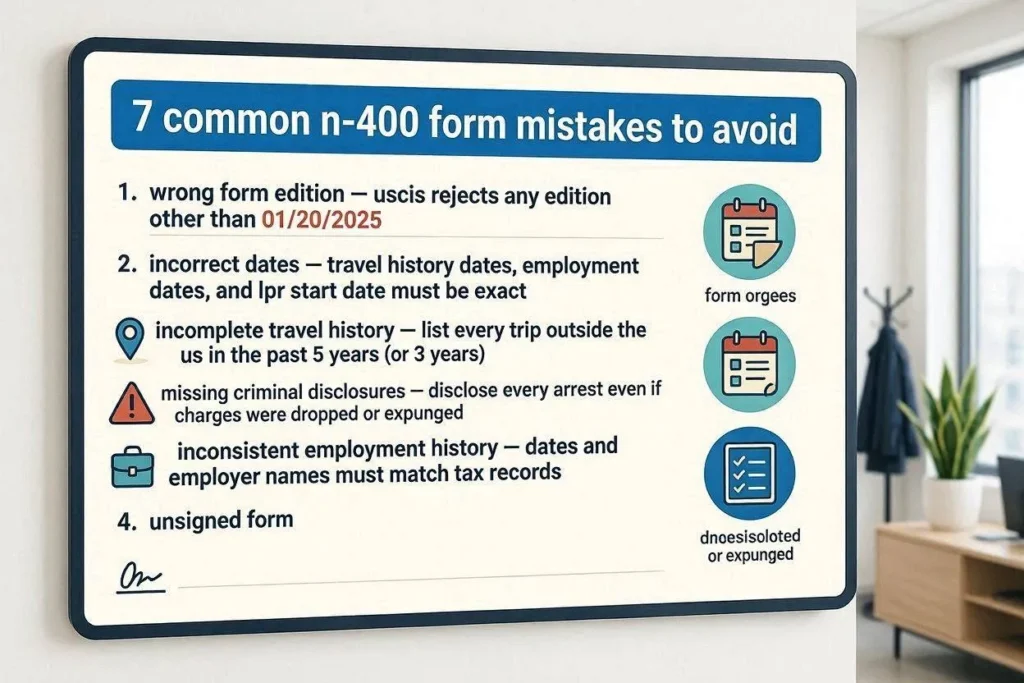
- Wrong form edition — USCIS rejects any edition other than 01/20/2025
- Incorrect dates — travel history dates, employment dates, and LPR start date must be exact
- Incomplete travel history — list every trip outside the US in the past 5 years (or 3 years)
- Missing criminal disclosures — disclose every arrest even if charges were dropped or expunged
- Inconsistent employment history — dates and employer names must match tax records
- Unsigned form — USCIS rejects unsigned applications without review
- Wrong mailing address — use the correct USCIS Direct Filing Address for your state, not a general USCIS address
4. Attend Your Biometrics Appointment
After USCIS receives your N-400, the agency sends a biometrics appointment notice within 3 to 8 weeks. The appointment takes place at a USCIS Application Support Center (ASC) near your home address.
What Happens at the Biometrics Appointment
- USCIS staff collect your fingerprints, photograph, and signature
- The FBI runs a criminal background check using your fingerprints
- USCIS may use the photograph taken at the ASC on your Certificate of Naturalization — dress appropriately
- The appointment lasts 15 to 30 minutes
- Rescheduling adds weeks to your processing time — attend on the scheduled date
5. Prepare for the Naturalization Interview and Tests
The USCIS naturalization interview covers 3 things: review of your N-400 application, the English language test, and the civics test. Most interviews last under 30 minutes for prepared applicants.
The 2025 Updated Civics Test — What Changed
Applicants who filed Form N-400 on or after October 20, 2025 take the new 2025 civics test. Applicants who filed before October 20, 2025 take the original 2008 test.
| 2008 Civics Test | 2025 Civics Test (Current) | |
|---|---|---|
| Total question pool | 100 questions | 128 questions |
| Questions asked at interview | 10 questions | Up to 20 questions |
| Passing score | 6 correct out of 10 | 12 correct out of 20 |
| Focus | Fact memorization | History and government understanding |
| Retake if failed | 60–90 days later | 60–90 days later |
English Language Test — 3 Components
- Reading: Read 1 sentence in English correctly out of up to 3 attempts
- Writing: Write 1 sentence in English correctly out of up to 3 attempts
- Speaking: Demonstrate ability to speak and understand basic English during the interview
English Test Exemptions
- Age 50+ with 20 years as a Lawful Permanent Resident (LPR) — known as the ’50/20 exemption’
- Age 55+ with 15 years as LPR — known as the ’55/15 exemption’
- Applicants with qualifying physical or developmental disabilities — file Form N-648 (Medical Certification for Disability Exceptions)
What to Bring to Your USCIS Interview
- Appointment notice
- Government-issued photo ID
- Green Card (or Form I-797C receipt notice if Green Card has expired)
- Originals of every document submitted with your N-400
- Any documents specifically requested in your interview notice
- Passport(s) from the past 5 years
3 Possible Interview Outcomes:
Approved: USCIS approves your application — oath ceremony scheduled within 1 to 4 weeks
Continued: Additional evidence needed, English or civics test failed — retest scheduled 60 to 90 days later
Denied: Application does not meet eligibility requirements — USCIS issues written denial with reason; appeal is possible
6. Take the Oath of Allegiance
After USCIS approves your N-400 application, the agency schedules your Oath of Allegiance ceremony. The oath ceremony is the final step — you become a US citizen the moment you take the oath.
What Happens at the Oath Ceremony
- USCIS sends notice N-445 (Notice of Naturalization Oath Ceremony) with your ceremony date
- Surrender your Green Card at the ceremony — you no longer need it after taking the oath
- Take the Oath of Allegiance to the United States Constitution
- Receive your Certificate of Naturalization immediately after the oath
- Review your Certificate of Naturalization for errors before leaving the ceremony site — report any errors to the USCIS officer on site before leaving
Oath ceremonies occur within 1 to 4 weeks after approval. Some USCIS field offices offer same-day administrative oath ceremonies immediately after the interview. Judicial ceremonies at federal courthouses may be less frequent — monthly or quarterly at some locations.
N-400 Processing Times by USCIS Field Office (June 2026)
The national average N-400 processing time is 7.9 months as of June 2026. Processing times vary dramatically by field office — the difference between the fastest and slowest offices reaches nearly 10 months.
| USCIS Field Office | Estimated Processing Time | Volume |
|---|---|---|
| Cincinnati, OH | ~3 months | Lower volume |
| Charleston, SC | ~4 months | Lower volume |
| Memphis, TN | ~4–5 months | Lower volume |
| Boston, MA | ~6–7 months | Moderate volume |
| Chicago, IL | ~7–9 months | High volume |
| Los Angeles, CA | ~9–11 months | Very high volume |
| Miami, FL | ~10–12 months | Very high volume |
| New York, NY | ~11–13 months | Very high volume |
| Harlingen, TX | ~13 months | High volume |
Source: USCIS field office processing time data, June 2026. Always verify current estimates at egov.uscis.gov/processing-times before filing.
7 Steps to Apply for US Citizenship — Full Timeline
| Step | Action | Estimated Timeline |
|---|---|---|
| 1 | Confirm eligibility — check LPR date, physical presence days, travel history, criminal record | Before filing |
| 2 | Gather documents — Green Card, ID, tax transcripts, court records, passports, photos | 2–4 weeks |
| 3 | Complete Form N-400 (01/20/2025 edition) — file online ($710) or by mail ($760) | 1–2 weeks |
| 4 | Receive receipt notice (Form I-797C) — confirms USCIS accepted your application | 2–4 weeks after filing |
| 5 | Attend biometrics appointment at USCIS ASC — fingerprints, photo, signature collected | 3–8 weeks after filing |
| 6 | Attend naturalization interview — USCIS reviews N-400, administers English and civics tests | 4–13 months after filing |
| 7 | Take Oath of Allegiance — surrender Green Card, receive Certificate of Naturalization | 1–4 weeks after approval |
7 Mistakes That Cause N-400 Delays or Denials
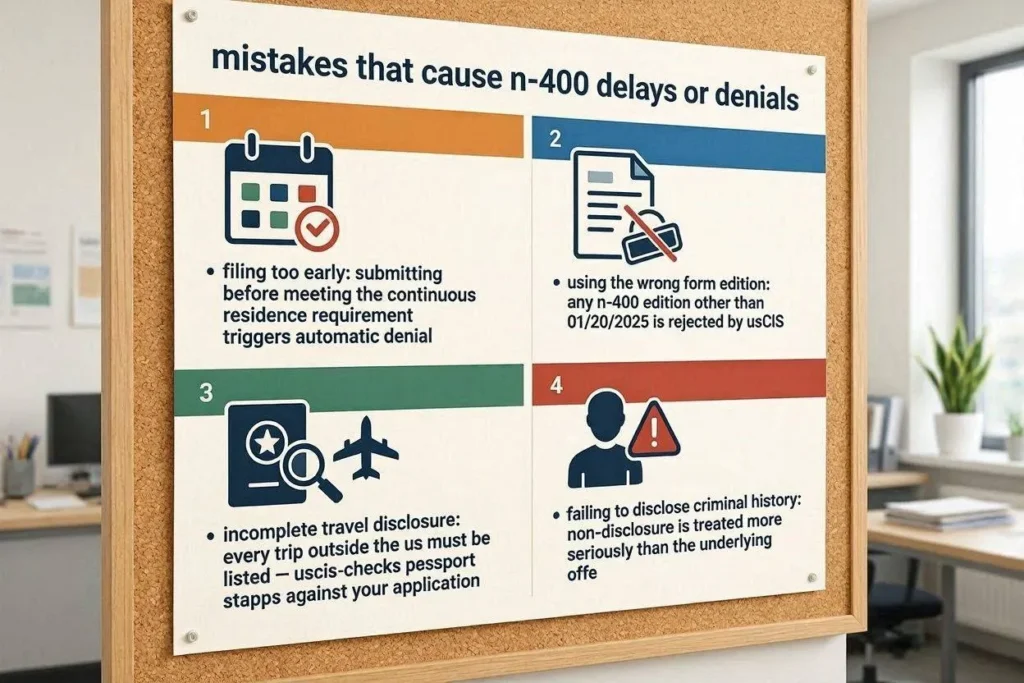
- Filing too early: Submitting before meeting the continuous residence requirement triggers automatic denial
- Using the wrong form edition: Any N-400 edition other than 01/20/2025 is rejected by USCIS
- Incomplete travel disclosure: Every trip outside the US must be listed — USCIS cross-checks passport stamps against your application
- Failing to disclose criminal history: Non-disclosure is treated more seriously than the underlying offense — always disclose even minor violations
- Incorrect mailing address: Filing to the wrong USCIS Direct Filing Address routes your case incorrectly and adds weeks
- Missing the biometrics appointment: Failure to appear or reschedule on time pauses your application
- Studying outdated civics materials: The 2025 civics test has 128 questions — applicants using 100-question study materials are underprepared
Conclusion
Applying for US citizenship in 2026 is a straightforward process if you follow the right steps in the right order. Confirm your eligibility, gather your documents, file Form N-400 using the current 01/20/2025 edition, and prepare seriously for the updated 128-question civics test. The entire journey from filing to oath ceremony takes 6 to 14 months depending on your USCIS field office — but every month you delay is a month added to the end of that timeline.
The path to citizenship is one of the most significant legal steps you will take. Mistakes on your N-400, missed appointments, or undisclosed criminal history can set you back by months or cost you the application entirely. If your case is straightforward — 5-year LPR path, clean record, no extended foreign travel — you can file confidently on your own at myaccount.uscis.gov for $710. If your case involves any complexity, consult an immigration attorney before filing. Either way, the sooner you file, the sooner you take the Oath of Allegiance and receive your Certificate of Naturalization.
Frequently Asked Questions

Amanda Brooks
Amanda Brooks leads JusticeInTown’s legal, justice, and community advocacy content division. She holds a background in legal research and public policy and specializes in topics related to civil rights, access to justice, legal awareness, and community issues. With years of experience researching legal and social justice topics, Amanda brings a careful, research-driven approach to complex legal information and public-interest issues. She is the primary author of JusticeInTown’s legal guides, justice-related resources, and community-focused content, helping readers better understand their rights, legal options, and the issues affecting their communities.
Related Posts