How Does Bail Work in the United States? Complete Guide (2026)
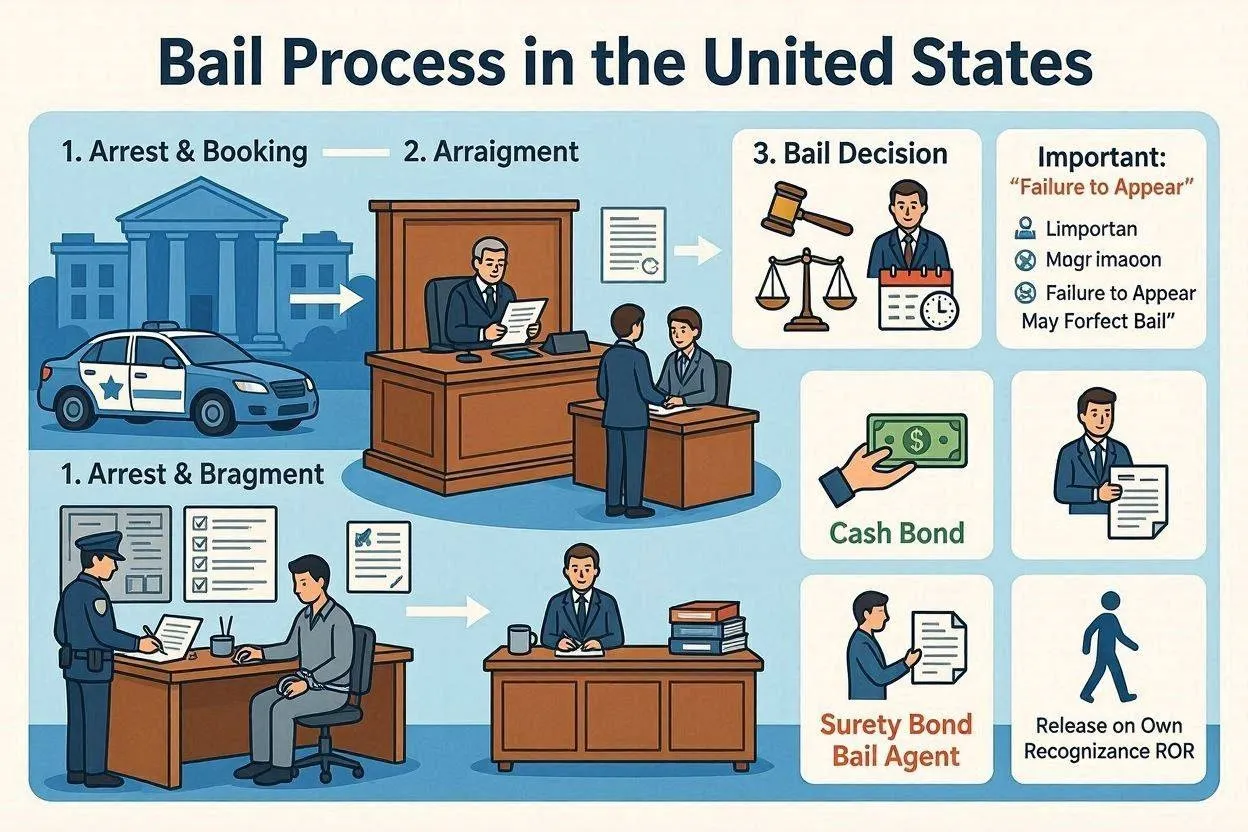
Bail is a financial guarantee that lets a defendant leave jail before trial. A judge sets a dollar amount. The defendant pays it — or arranges a bail bond — and goes home until the case resolves. If the defendant shows up for every hearing, the court returns the money. If the defendant fails to appear, the court keeps it and issues an arrest warrant.
Nearly 500,000 people sit in U.S. jails on any given day without a conviction. Most are there because they cannot afford bail, not because a judge decided they are dangerous. Understanding how bail works — the hearing, the types, the costs, and the consequences — gives defendants and families a real chance to act quickly and effectively.
What Bail Is — and What It Is Not
Bail is not a fine. It is not punishment. The Eighth Amendment to the U.S. Constitution bars excessive bail, and the legal purpose of bail is narrow: ensure the defendant appears in court.
The Supreme Court established in Stack v. Boyle (1951) that bail must be set at an amount sufficient to guarantee court appearance — not a dollar more. Setting bail so high that no one can pay it functions as pretrial detention, which requires a separate legal standard.
Bail decisions happen fast. Federal rules require a bail hearing within 48 hours of arrest. Many jurisdictions hold the hearing within 24 hours. At that hearing, the defendant is still legally innocent — the case has not been tried, no verdict has been reached.
6 Types of Bail in the United States
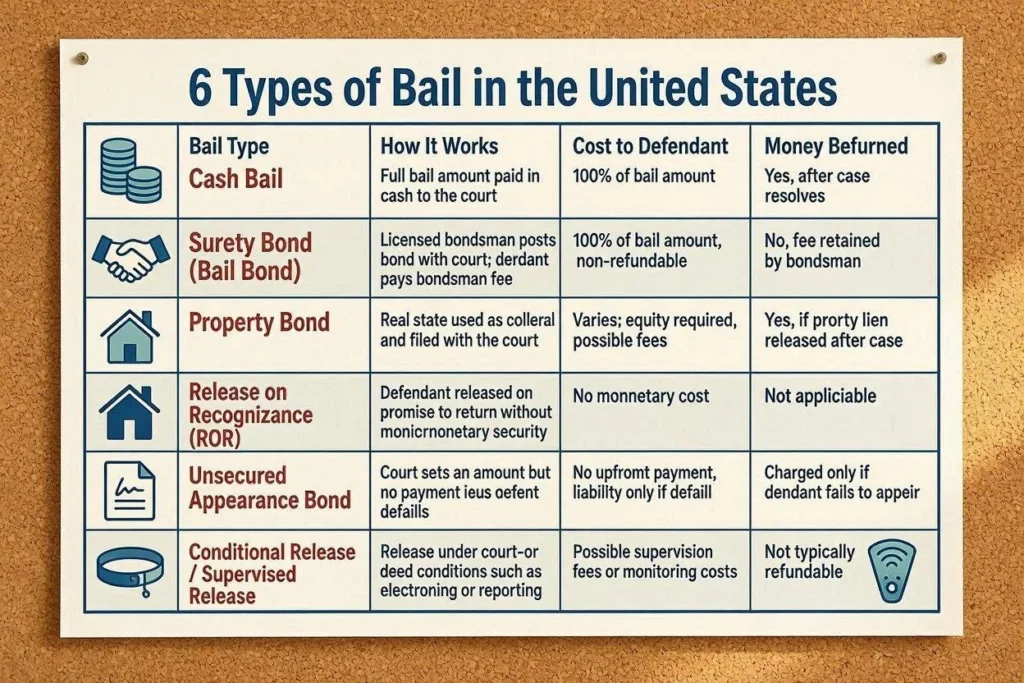
Judges have 6 release options. Which one applies depends on the charge, the defendant’s history, and the court’s assessment of risk.
| Bail Type | How It Works | Cost to Defendant | Money Returned? |
| Cash Bail | Full bail amount paid in cash to the court | 100% of bail amount | Yes, after case resolves |
| Surety Bond (Bail Bond) | Bondsman pays court; defendant pays bondsman 10% | 10% of bail — non-refundable | No — fee kept by bondsman |
| Property Bond | Real estate used as collateral equal to bail amount | No cash upfront | Property released after case |
| Own Recognizance (O.R.) | Released on written promise to appear — no money | $0 | N/A — nothing paid |
| Unsecured Bond | Defendant signs agreement to pay if they miss court | $0 upfront | N/A — only owe if absent |
| Citation Release | Police issue a ticket; no jail, no bail hearing | $0 | N/A — no custody |
The Bail Hearing — What Happens in Court
The bail hearing — also called an initial appearance or arraignment — is the first time a defendant appears before a judge after arrest. It typically lasts 10 to 30 minutes. The prosecutor presents the case for detention or high bail. The defense argues for release or lower bail. The judge decides.
Judges weigh 7 factors when setting bail:
- Severity of the charge — violent felonies trigger higher bail than misdemeanors.
- Criminal history — prior convictions and prior failures to appear increase bail amounts.
- Flight risk — ties to the community, employment, family, and length of local residence all reduce flight risk.
- Public safety — the Bail Reform Act (18 U.S.C. § 3142) allows federal courts to detain defendants when no conditions will protect the community.
- Financial resources — some states require judges to consider whether the defendant can actually afford bail, to avoid detention by default.
- Ties to the community — homeownership, steady employment, family in the area, and community involvement reduce bail amounts.
- Nature of the alleged offense — drug trafficking, terrorism, and repeat violent offenses carry a presumption toward detention in federal court.
How Bail Amounts Are Set — and What They Actually Cost
Most courts use a bail schedule — a chart that assigns a recommended dollar amount to each offense type. A judge can deviate from the schedule based on the 7 factors above.
| Offense Type | Typical Bail Range | Bail Bond Cost (10%) | Median US Income Context |
| Minor misdemeanor | $500 – $2,500 | $50 – $250 | Manageable for most |
| DUI / drug possession | $2,500 – $10,000 | $250 – $1,000 | Difficult for low income |
| Felony assault | $10,000 – $50,000 | $1,000 – $5,000 | Unaffordable for many |
| Armed robbery | $50,000 – $150,000 | $5,000 – $15,000 | Unaffordable for most |
| Homicide | $250,000 – $1M+ | $25,000 – $100,000+ | Unaffordable for nearly all |
| Federal drug trafficking | Denial or $500,000+ | $50,000+ | Effectively detention |
The median bail bond in the U.S. is $10,000 — roughly 8 months of income for the average detained person. The bail bond industry generates approximately $2 billion annually, almost entirely from non-refundable fees paid by working-class families.
How Bail Bonds Work — The Bondsman’s Role
A bail bondsman (surety agent) posts the full bail amount to the court on the defendant’s behalf. The defendant pays the bondsman a non-refundable fee — typically 10% of the bail amount, though it ranges from 10% to 15% depending on state regulation.
The math on a $50,000 bail:
- Cash bail option: Defendant pays $50,000 to court. Court returns $50,000 after the case resolves.
- Bail bond option: Defendant pays bondsman $5,000 (10%). Bondsman posts $50,000 to court. Defendant never gets the $5,000 back — regardless of verdict.
- Cannot afford either: Defendant stays in jail until trial.
Bondsmen require collateral in most cases — a house, car, or other asset that the bondsman can seize if the defendant fails to appear. Family members who co-sign a bail bond become financially liable if the defendant skips court.
Bounty Hunters — What They Can and Cannot Do
When a defendant skips bail, the bondsman loses the full amount posted to the court. To recover it, bondsmen hire bounty hunters (bail enforcement agents) to locate and return the defendant.
Bounty hunters operate with broad legal authority in most states:
- They can enter a defendant’s home without a warrant in most jurisdictions.
- They can cross state lines to apprehend a defendant.
- They can physically restrain and transport the defendant back to the original jurisdiction.
- They typically have 90 to 180 days to return the defendant before the bond is forfeited.
Bounty hunters face minimal federal regulation. State rules vary widely — some states require licensing and training, others impose almost none. This lack of oversight has caused documented cases of wrong-address apprehensions, injuries to uninvolved people, and excessive force.
3 states — Illinois, Kentucky, and Oregon — prohibit commercial bail bonds and bounty hunters entirely. Wisconsin prohibits bounty hunting specifically. In those states, pretrial release is managed through court-run systems.
Release Conditions — What Judges Attach to Bail
Bail is rarely unconditional. Judges attach release conditions in 9 common categories:
- No contact with alleged victims or witnesses
- Travel restrictions — surrender passport, stay within state or county
- Regular check-ins with a pretrial services officer
- Electronic monitoring — GPS ankle bracelet
- Drug or alcohol testing and treatment
- Curfew — return home by a set time each night
- Employment or school enrollment requirement
- Surrender of firearms
- No commission of any new criminal offense
Violating any release condition triggers immediate bail revocation. The defendant goes back to jail, the bail money is forfeited in most cases, and the judge sets new — typically much higher — bail for the remaining pretrial period.
What Happens If You Skip Bail — 4 Consequences
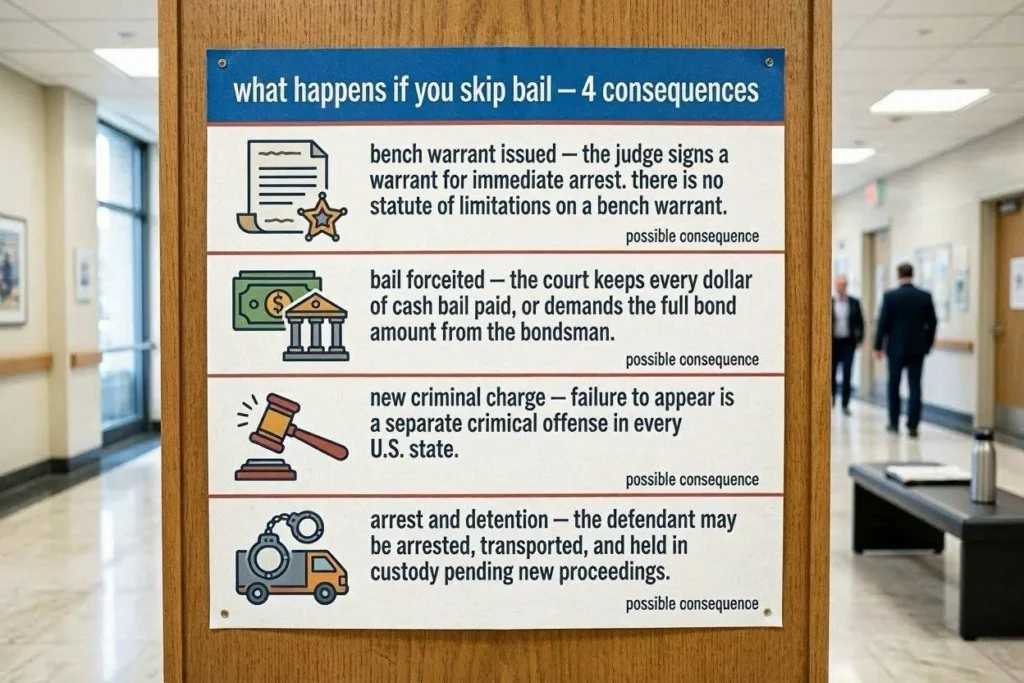
Failing to appear (FTA) in court after posting bail triggers 4 automatic consequences:
- Bench warrant issued — the judge signs a warrant for immediate arrest. There is no statute of limitations on a bench warrant.
- Bail forfeited — the court keeps every dollar of cash bail paid, or demands the full bond amount from the bondsman.
- New criminal charge — failure to appear is a separate criminal offense in every U.S. state. Misdemeanor FTA adds 1 year. Felony FTA adds 1 to 5 years to potential sentence.
- Bounty hunter deployed — if a bondsman paid bail, bounty hunters are authorized to locate and return the defendant across state lines.
Courts allow 30 to 180 days for a defendant to re-appear and explain the absence before permanently forfeiting bail. A death in the family, medical emergency, or documented confusion about court dates can sometimes reverse forfeiture — but only if addressed quickly and with evidence.
Federal Bail — How It Differs from State Bail
Federal bail operates under the Bail Reform Act of 1984 (18 U.S.C. §§ 3141–3143). The federal system differs from state bail in 5 key ways:
| Factor | Federal Bail | State Bail |
| Hearing timeline | Without unnecessary delay (usually 24–48 hours) | 24–48 hours, varies by state |
| Presumption | Release unless detention justified | Varies — some states presume detention for serious charges |
| Preventive detention | Allowed under Bail Reform Act (United States v. Salerno, 1987) | Allowed in most states for violent charges |
| Bail schedules | No standard schedule — judge sets individually | Most states use bail schedules as starting point |
| Bondsmen | Not used in federal system | Common in most state systems |
The Supreme Court upheld preventive detention in United States v. Salerno (1987), ruling that Congress can authorize pretrial detention to protect public safety without violating the Due Process Clause or the Eighth Amendment. Federal prosecutors use this authority most frequently in terrorism cases, drug trafficking, and situations where witnesses have been threatened.
Bail Reform in 2026 — Which States Have Changed the System
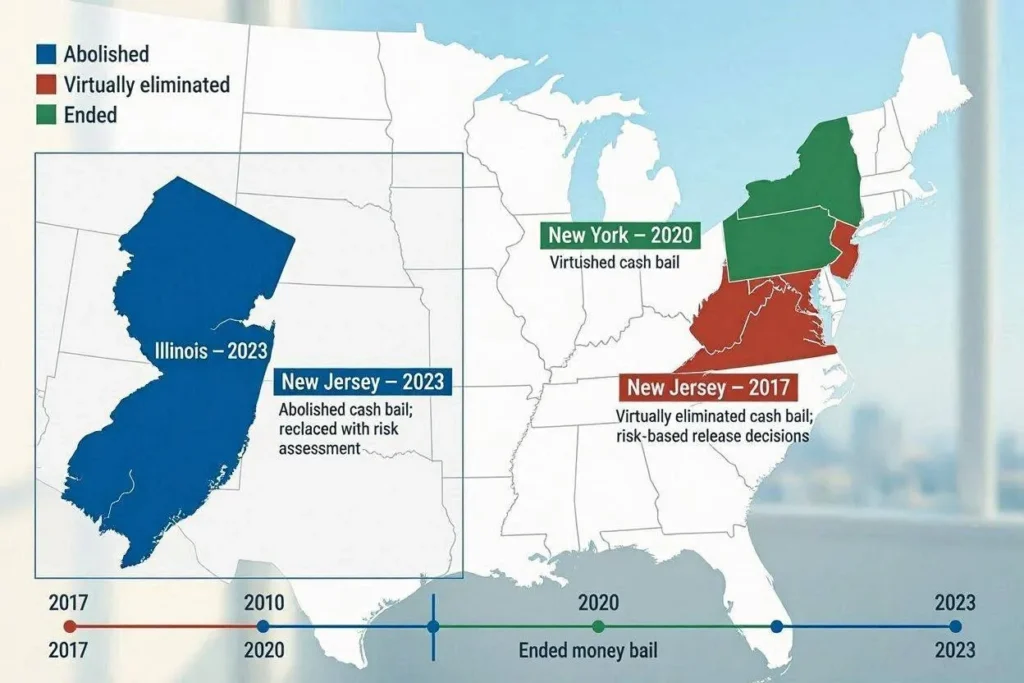
The U.S. bail system is under significant reform pressure. 5 major reforms have reshaped pretrial release since 2017:
| State | Reform | Year | What Changed |
| Illinois | Pretrial Fairness Act | 2023 | First state to abolish money bail entirely — replaced with risk assessment |
| New Jersey | Bail Reform Law | 2017 | Virtually eliminated cash bail — replaced with risk-based release decisions |
| New York | Bail Elimination Law | 2020 | Ended money bail for most misdemeanors and nonviolent felonies |
| California | Supreme Court ruling | 2021 | Ruled that detaining someone solely because they cannot afford bail is unconstitutional |
| Washington D.C. | No cash bail (decades) | Ongoing | D.C. has operated without cash bail for decades — uses pretrial services system |
Research consistently shows that bail reform does not increase crime rates or court no-show rates. A 2023 analysis of New Jersey’s reform found court appearance rates remained stable after eliminating cash bail, while the jail population dropped by 44%.
Can Bail Be Denied Entirely?
Yes — in 4 circumstances, a judge can deny bail completely:
- Capital offenses (murder charges where death penalty applies) — most states allow denial for capital charges.
- Violent felonies with evidence of danger to the community — under the Bail Reform Act, federal judges can detain defendants when the government proves by clear and convincing evidence that no conditions will protect the public.
- Serious flight risk — if the defendant has prior failures to appear, foreign ties with no local community connection, or is a non-citizen facing deportation with motive to flee.
- Probation or parole violation — defendants already on supervision who pick up new charges can be held without bail pending a violation hearing.
Preventive detention hearings require the government to meet a higher standard than a standard bail hearing. The defendant has the right to counsel, to present evidence, and to cross-examine government witnesses.
FAQs

Amanda Brooks
Amanda Brooks leads JusticeInTown’s legal, justice, and community advocacy content division. She holds a background in legal research and public policy and specializes in topics related to civil rights, access to justice, legal awareness, and community issues. With years of experience researching legal and social justice topics, Amanda brings a careful, research-driven approach to complex legal information and public-interest issues. She is the primary author of JusticeInTown’s legal guides, justice-related resources, and community-focused content, helping readers better understand their rights, legal options, and the issues affecting their communities.
Related Posts