
How to File Child Support in 2026: Step-by-Step Guide
To file child support, open a case with your state child support agency or file a petition directly with family court. You complete an application, provide details about both parents, and submit proof of income.
This guide breaks the process into 9 clear steps, with exact timelines and named forms. You will also see how immigration status, a missing Social Security number, or a parent living abroad changes your filing path. Every step below applies whether you receive support or pay it.
Learning how to file child support correctly the first time prevents delays, rejected paperwork, and repeat court visits. Each state runs its own child support agency, but the core filing steps stay consistent across all 50 states. This guide uses examples from California, Texas, Illinois, and Florida to show how the process plays out in practice.
What Does It Mean to File Child Support?
Filing child support means asking a court or state agency to order one parent to pay money for a child’s care. The custodial parent, the parent the child lives with most of the time, usually files the case. The noncustodial parent, the parent who lives apart from the child, becomes responsible for the ordered payment.
A child support order covers 3 core costs: basic living expenses, health insurance, and childcare. Courts calculate the amount using state guidelines that weigh income, parenting time, and the number of children. Once a judge signs the order, it becomes legally enforceable through wage garnishment, license suspension, or other collection tools.
Some states open a child support case through a state agency, while others require a direct petition filed with family court. Agency cases involve a caseworker who manages locating the other parent, calculating payments, and enforcing the order. Court-only cases place more responsibility on you to file paperwork, schedule hearings, and request enforcement when payments stop.
Who Can File for Child Support?
Either parent, a legal guardian, or a grandparent raising a child can file for child support. A state agency can also open a case automatically if a parent receives public assistance such as cash aid. You do not need to be divorced or married to the other parent to qualify.
Stepparents and foster parents generally cannot file for child support unless they hold legal guardianship of the child. A grandparent raising a grandchild full-time qualifies as a caretaker under most state child support guidelines. Contact your local child support agency directly if your situation falls outside the standard parent-to-parent case type.
What You Need Before You File
Before you file, gather 5 categories of information: your contact details, the other parent’s contact details, your child’s birth certificate, income records, and any existing custody order. Pay stubs, tax returns, and employer names speed up the income calculation. A Social Security number for both parents helps the agency locate records faster.
How to File Child Support Online in 2026
To file child support online, visit your state child support agency’s website and complete the digital application. Most states process online applications within 1 to 5 business days. You create an account, enter your information, and upload supporting documents directly through the portal.
Online filing saves 7 to 10 days compared to mailing a paper form. States such as California, Texas, Illinois, and Florida all offer free online enrollment through their Department of Child Support Services. You receive a case number by email once the agency confirms your submission.
Keep 3 documents ready before you start the online form: a government-issued photo ID, your child’s birth certificate, and 2 recent pay stubs. The online portal saves your progress for 30 to 60 days in most states, so you can return later if needed. Submit clear, legible scans or photos, since blurry uploads add 3 to 5 days of processing delay.
How to File Child Support Without the Other Parent’s Address?
To file child support without an address, request a parent locate service through your state child support agency. The agency searches 4 data sources: employer records, tax filings, motor vehicle registries, and credit bureau reports. This locate process typically takes 30 to 60 days to return a result.
Provide every detail you have about the other parent, including a last known city, employer name, or relative’s contact. A court cannot issue a support order until the agency confirms the other parent’s location or employer. Cases with limited information take longer, often 60 to 90 days before service is possible.
Parent locate services check 4 additional sources when standard records fail: military enlistment databases, professional licensing boards, postal forwarding records, and prison records. Some states partner with the Federal Parent Locator Service for cases crossing state lines. Update the agency immediately if you learn new contact information, since this can cut the search timeline by 30 days or more.
How Does Establishing Paternity Affect Your Child Support Case?
Establishing paternity confirms the legal father before a court orders child support payments. Unmarried parents must complete this step, while married parents are usually presumed to be legal parents already. Paternity, the legal determination of a child’s biological father, creates both rights and payment obligations.
A father without legal paternity cannot request custody or visitation rights, even while paying informal support. Establishing paternity also opens access to the child’s medical history, Social Security benefits, and inheritance rights. Skip this step only if both parents were married at the time of the child’s birth, since most states presume paternity automatically in that case.
How to Establish Paternity Through a Voluntary Form
To establish paternity voluntarily, both parents sign a Declaration of Parentage form, often at the hospital after birth. This signed form carries the same legal weight as a court order in most states. Processing takes 1 to 3 days once both signatures are notarized or witnessed.
How to Establish Paternity Through DNA Testing
To establish paternity through DNA testing, request a test through your state child support agency or family court. Lab results typically return in 5 to 10 business days after sample collection. A result showing 99% probability or higher legally confirms the father in most states.
How Much Will Child Support Cost You to File?
Filing fees for child support range from $0 to $50, depending on your state and whether an agency or attorney handles the case. State child support agencies process applications for free in 38 states as of 2026. Private attorney filings add $150 to $500 in legal fees for petition preparation alone.
Bold fact: agency-assisted filing costs $0 to $25 in most states, while a contested court case can run $1,000 to $5,000 in legal fees. Low-income parents can request a fee waiver from the court clerk if the standard filing cost creates hardship.
Additional costs can appear during the process, including $50 to $200 for DNA paternity testing and $20 to $75 for process server fees. Modification requests filed later usually cost less than the original filing, often $0 to $35 through the same agency. Budget an extra $100 to $300 for unexpected costs if your case involves locating a parent across state lines.
How to File Child Support as an Immigrant or Non-Citizen Parent?
To file child support as a non-citizen, use your Individual Taxpayer Identification Number (ITIN) in place of a Social Security number. Immigration status does not block a parent’s right to request or pay child support. Courts process cases for green card holders, visa holders, and undocumented parents under the same state guidelines.
A custodial parent’s immigration status never reduces a child’s right to financial support from both parents. Income earned in cash or through informal work still counts toward the child support calculation. Bring pay records, a lease, or a notarized income statement if you lack standard pay stubs.
Filing a child support case does not trigger an automatic immigration status check or report to federal immigration authorities. Family courts and child support agencies handle financial matters separately from immigration enforcement systems. Parents on a work visa, a student visa, or asylum status all retain the same filing rights as citizens.
How to File Child Support When the Other Parent Lives Abroad
To file child support against a parent living abroad, contact your state’s International Child Support Enforcement office. The United States holds reciprocal enforcement agreements with 30 or more countries, including Canada, Mexico, and the United Kingdom. Cross-border cases typically take 90 to 180 days to establish an enforceable order.
How Long Does It Take to Get a Child Support Order?
A child support order typically takes 30 to 120 days from filing to final judgment. Uncontested cases with full cooperation from both parents often finish within 30 to 45 days. Contested cases involving paternity disputes or hidden income can stretch past 6 months.
The timeline depends on 3 factors: how quickly the other parent is located, whether paternity needs testing, and court scheduling backlogs. Courts in high-volume counties such as Los Angeles or Cook County often add 2 to 4 weeks to standard processing times.
Track your case progress through 4 stages: application review, parent location, service of process, and final hearing. Most agencies provide online case status updates within 24 to 48 hours of any change. Missing a scheduled hearing can delay your case by 30 to 60 days, so confirm your hearing date as soon as the court assigns it.
Child Support Filing Quick-Reference Table
The table below lists 9 tasks in the child support filing process, their typical timing, the method used, and the difficulty level.
| Task | Timing | Method | Difficulty |
|---|---|---|---|
| Open a child support case | Day 1 | Online application or county office | Easy |
| Locate the other parent | 1-30 days | State locate services | Moderate |
| Establish paternity | 1-60 days | Voluntary form or DNA test | Moderate |
| Calculate support amount | Day 1 | State child support calculator | Easy |
| File the petition | 1-14 days | Family court clerk filing | Easy |
| Serve the other parent | 14-90 days | Process server or sheriff | Moderate |
| Attend the hearing | 30-120 days | Family court appearance | Moderate |
| Set up income withholding | After order | Employer payroll deduction | Easy |
| Request a modification | Anytime after order | New petition with updated income | Moderate |
How to Modify a Child Support Order After It’s Approved?
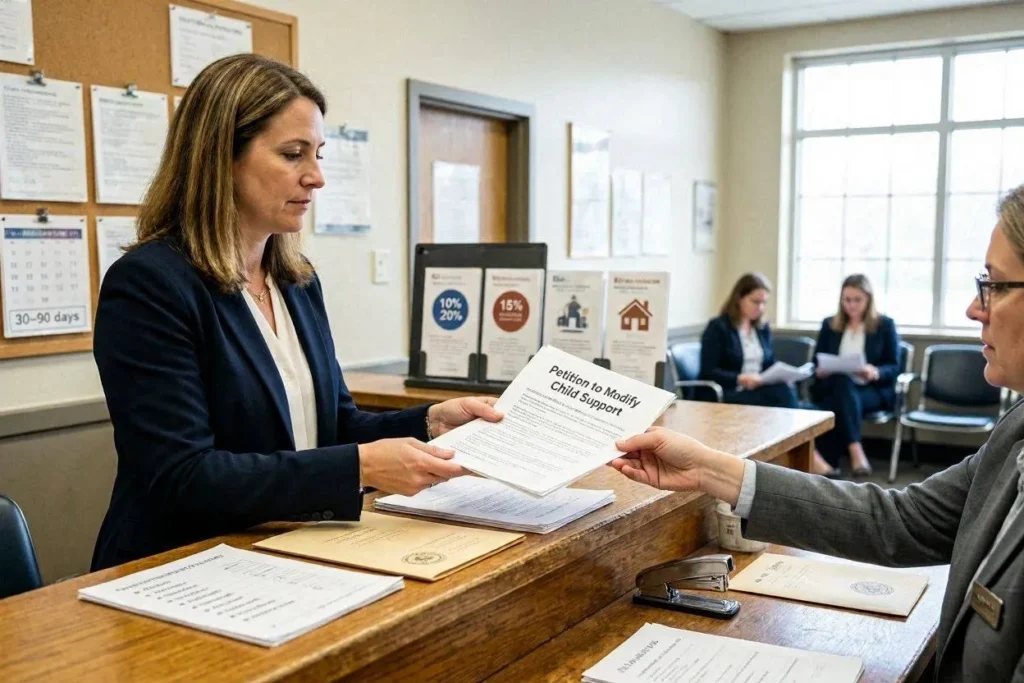
To modify a child support order, file a new petition showing a substantial change in income, custody, or expenses. Most states require a 10% to 20% income change before approving a modification request. Courts review modification requests in 30 to 90 days, similar to the original filing timeline.
- Job loss or income drop of 15% or more
- A new child added to either parent’s household
- A change in custody or parenting time schedule
- A serious medical condition affecting either parent or child
File the modification petition with the same court or agency that issued the original order. Bring updated pay stubs, tax returns, or a termination letter to support your requested change. A judge reviews both parents’ current income before approving any increase or decrease to the existing amount.
Start Your Child Support Case Today
Filing child support protects your child’s right to financial stability from both parents. The process moves through 9 clear steps: gathering documents, locating the other parent, establishing paternity, and securing a court order. Immigrant parents face the same path, using an ITIN instead of a Social Security number where needed.
Review the quick-reference table above before your first appointment to know what to expect at each stage. Keep copies of every form, receipt, and court notice in 1 organized folder throughout the process. Acting early on locating the other parent and gathering income records keeps your child support case moving without unnecessary delays.
Visit immigrationwin.com for guidance on family law matters that intersect with immigration status, including child support, custody, and visa-related family cases. Our team helps parents understand both their immigration rights and their family law obligations in one place.
Frequently Asked Questions About Filing Child Support

Amanda Brooks
Amanda Brooks leads JusticeInTown’s legal, justice, and community advocacy content division. She holds a background in legal research and public policy and specializes in topics related to civil rights, access to justice, legal awareness, and community issues. With years of experience researching legal and social justice topics, Amanda brings a careful, research-driven approach to complex legal information and public-interest issues. She is the primary author of JusticeInTown’s legal guides, justice-related resources, and community-focused content, helping readers better understand their rights, legal options, and the issues affecting their communities.
Related Posts