
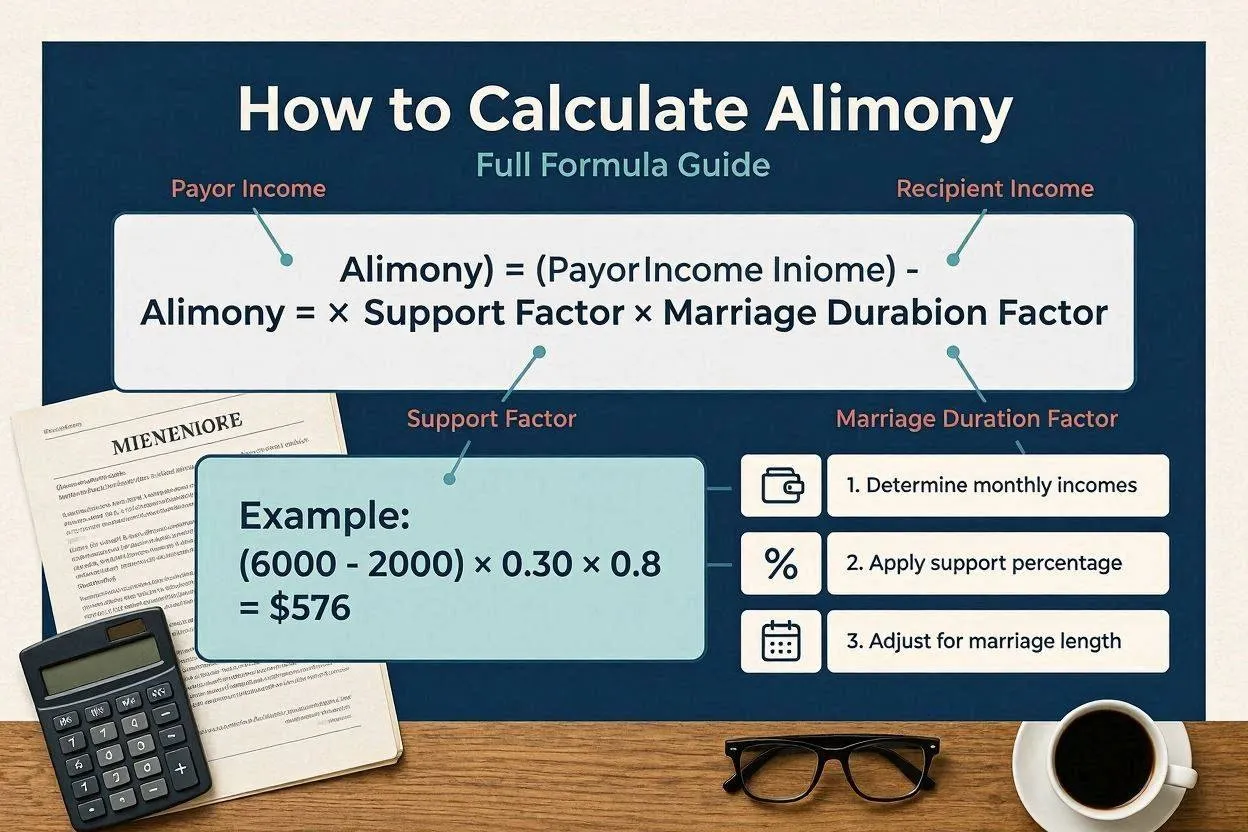
How to Calculate Alimony in 2026: Full Formula Guide
To calculate alimony, courts subtract a set percentage of the lower-earning spouse’s income from a set percentage of the higher-earning spouse’s income. Most guideline formulas use 30% of the payer’s gross income minus 20% of the recipient’s gross income as a starting estimate.
This guide walks through the exact formulas family courts and attorneys use in 2026. You will see a worked math example, a state-by-state formula table, and the 7 factors that change your final number. Use these steps to build a realistic alimony estimate before you walk into court.
Knowing how to calculate alimony before mediation saves both spouses time and legal fees. Attorneys often quote $300 to $500 (€276 to €460) per hour for financial discovery work. A clear self-calculated estimate shortens that discovery phase and reduces the number of billed hours.
What Is Alimony and How to Calculate Alimony Correctly?
Alimony, also called spousal support or spousal maintenance, is a court-ordered payment from one spouse to the other after divorce. The payment compensates the lower-earning spouse for financial sacrifices made during the marriage.
A judge sets alimony using 2 main inputs: the income gap between spouses and the length of the marriage. Courts in Texas, Colorado, and Illinois apply statutory guideline formulas to these inputs. Courts in North Carolina and Florida instead weigh multiple factors without a fixed formula.
Calculating alimony correctly requires you to know whether your state uses gross income or net income. Gross income means total earnings before tax deductions. Net income means take-home pay after taxes, health insurance, and retirement contributions.
Alimony differs from child support in both purpose and calculation method. Child support uses a fixed table based on the number of children and each parent’s income. Alimony instead uses a percentage-based formula tied directly to the income gap between 2 spouses.
How to Calculate Alimony Using the Guideline Formula?

To calculate alimony using the guideline formula, multiply the payer’s income by 30% and the recipient’s income by 20%, then subtract the second number from the first. This method, created by the American Academy of Matrimonial Lawyers (AAML), guides attorneys in over 20 states.
The 30/20 guideline formula reads as follows: Alimony equals 30% of the payer’s gross annual income minus 20% of the recipient’s gross annual income. Some states swap this for a 33.3/25 formula based on monthly net income instead of yearly gross income.
Family law attorneys treat this formula as a negotiation starting point, not a final answer. Mediators use the same number to anchor settlement talks between both spouses. Judges in states without a statutory formula still reference this guideline informally during hearings.
How to Apply the 30/20 Alimony Formula
To apply the 30/20 alimony formula, start with each spouse’s gross annual income figure. Multiply the payer’s income by 0.30 to get the first number. Multiply the recipient’s income by 0.20 to get the second number, then subtract.
How to Apply the 33.3/25 Monthly Formula
To apply the 33.3/25 monthly formula, use net monthly income instead of yearly gross income. Multiply the payer’s net monthly income by 0.333. Multiply the recipient’s net monthly income by 0.25, then subtract the second result from the first.
How to Calculate Alimony With a Real Income Example?

To calculate alimony with a real example, plug 2 actual incomes into the guideline formula. Assume the payer earns $180,000 (€166,000) per year and the recipient earns $24,000 (€22,100) per year.
Step 1: Multiply $180,000 (€166,000) by 30%, which equals $54,000 (€49,800).
Step 2: Multiply $24,000 (€22,100) by 20%, which equals $4,800 (€4,420).
Step 3: Subtract $4,800 (€4,420) from $54,000 (€49,800), which equals $49,200 (€45,380) per year.
Step 4: Divide $49,200 (€45,380) by 12 months, which equals $4,100 (€3,780) per month.
This final number represents only a starting estimate. A judge can adjust this figure up or down based on marriage length, health conditions, and earning capacity.
Which Factors Change How Courts Calculate Alimony?
Courts adjust the guideline alimony number using 7 factors: marriage length, age, health, earning capacity, standard of living, child custody, and marital misconduct. Marriage length carries the heaviest weight in most states. A marriage under 5 years rarely produces long-term alimony in any jurisdiction.
Marriages of 0 to 5 years usually result in temporary support lasting under 2 years. Marriages of 5 to 15 years often produce support lasting half the marriage length. Marriages over 20 years frequently produce permanent or indefinite alimony in states like Florida.
Earning capacity differs from current income in every state’s calculation method. A judge can impute income to a spouse who voluntarily works below their skill level. This adjustment raises the calculated alimony obligation even when actual paychecks show a lower number.
Health conditions also shift the final calculated number significantly. A spouse with a documented disability often receives extended or permanent support regardless of marriage length. Medical records and a physician’s statement typically support this type of adjustment request in court.
How Does Alimony Calculation Differ by State?
Alimony calculation differs by state because each legislature sets its own formula, cap, and factor list. Illinois, Texas, and Pennsylvania apply statutory formulas with defined caps. North Carolina and Florida apply factor-based discretion instead of a fixed equation.
| State | Formula Type | Income Cap |
| Illinois | 33.3% of payer’s net minus 25% of receiver’s net | Recipient total capped at 40% combined net income |
| Florida | 30% of payer’s gross minus 20% of receiver’s gross | No statutory formula; guideline only |
| Texas | Statutory duration and dollar limits apply | Capped near $5,000 (€4,600) monthly or 20% of income |
| North Carolina | No fixed formula; 16 statutory factors weighed | No cap; judge discretion controls amount |
Texas caps spousal maintenance near $5,000 (€4,600) per month or 20% of the payer’s average monthly income, whichever amount is lower. Illinois caps the recipient’s total income, including alimony, at 40% of the combined net income of both spouses. Florida and North Carolina set no fixed dollar cap at all.
Moving between states during a divorce can change your calculated alimony substantially. Courts generally apply the law of the state where the divorce petition gets filed. Confirm residency requirements, which typically range from 6 months to 1 year, before filing in a new state.
How to Calculate Temporary Alimony During Divorce Proceedings?
To calculate temporary alimony during divorce proceedings, apply the same guideline formula using current income figures. Temporary alimony, also called pendente lite support, covers expenses while the divorce case remains open. Pennsylvania courts apply a fixed formula for this temporary period specifically.
Temporary alimony differs from final alimony in 3 ways: duration, evidence required, and adjustment frequency. A judge sets temporary alimony quickly using basic pay stubs and tax returns. Final alimony requires a full financial disclosure process, including discovery and expert testimony in contested cases.
Quick-Reference Table: How to Calculate Alimony Step by Step
| Task | Best Timing | Method | Difficulty |
| Gather both spouses’ income | Before filing | Pay stubs and tax returns | Easy |
| Apply the guideline formula | During mediation | 30/20 or 33/25 formula | Moderate |
| Check your state’s income cap | Before final number | State statute or court site | Moderate |
| Adjust for marriage length | During negotiation | State duration chart | Moderate |
| Confirm net vs gross rules | Before submitting figures | State family law code | Hard |
| Review with a family attorney | Before court filing | Paid consultation | Easy |
How to Calculate Alimony When Both Spouses Work?
To calculate alimony when both spouses work, apply the guideline formula to each spouse’s actual reported income. The formula still produces a positive number whenever the income gap exceeds the state’s threshold percentage. A small income gap often produces $0 in calculated alimony.
Self-employed spouses complicate this calculation significantly. Courts review 2 to 3 years of tax returns, business bank statements, and profit-and-loss reports to verify true income. A forensic accountant sometimes joins the case when one spouse owns a business or receives irregular bonus income.
Investment income, rental income, and stock dividends also count toward the calculation in most states. Courts average this variable income across 24 to 36 months to smooth out yearly fluctuations. Skipping this averaging step produces an inaccurate alimony estimate for either spouse.
What Common Mistakes Affect Alimony Calculations?

Common mistakes that affect alimony calculations include using net income instead of gross income, ignoring state caps, and skipping recent bonus income. Spouses also forget to update calculations after a job change or a new custody schedule. Each mistake can shift the final monthly number by hundreds of dollars.
Mixing up gross and net income causes the most frequent calculation error. Always confirm which income type your state statute requires before running any formula. Submitting the wrong income type to a judge can delay your case by 2 to 4 weeks.
Failing to update the calculation after a major life event ranks as the second most common mistake. A job loss, remarriage, or new child can each trigger a modification request. File a modification petition within 30 days of any major income change to protect your case timeline.
How Do Taxes Affect Calculated Alimony Payments?
Taxes affect calculated alimony payments differently depending on your divorce date. Divorces finalized after December 31, 2018 follow federal rules where the payer cannot deduct alimony and the recipient does not report it as taxable income. Divorces finalized before that date still follow the older deductible-taxable structure.
This tax shift effectively increases the real cost of alimony for the paying spouse under current law. A payer who previously deducted $50,000 (€46,000) in alimony from taxable income now loses that deduction entirely. Some attorneys factor this hidden cost increase into settlement negotiations directly.
State tax treatment can still differ from federal tax treatment in select jurisdictions. Confirm your specific state’s tax code before finalizing any calculated alimony figure. A certified public accountant can verify the exact after-tax impact on both spouses.
Final Steps After You Calculate Alimony
Calculating alimony gives you a starting number, not a guaranteed court order. Gather 2 to 3 years of pay stubs, tax returns, and expense records before your first hearing. Bring your calculated estimate to a licensed family law attorney for a final accuracy check.
A guideline formula answers the basic question of “how much,” but a judge still controls the final number. Review your state’s exact statute, confirm your income type, and adjust for marriage length before you finalize any figure. Speak with a licensed family law attorney before you submit financial figures to a family court.
Mastering how to calculate alimony puts you in control of your own divorce negotiation. A clear, verified number prevents costly surprises during mediation or trial. Keep your income documents organized, your formula correct, and your final figure confirmed by a professional before signing any agreement.
Frequently Asked Questions About How to Calculate Alimony

Amanda Brooks
Amanda Brooks leads JusticeInTown’s legal, justice, and community advocacy content division. She holds a background in legal research and public policy and specializes in topics related to civil rights, access to justice, legal awareness, and community issues. With years of experience researching legal and social justice topics, Amanda brings a careful, research-driven approach to complex legal information and public-interest issues. She is the primary author of JusticeInTown’s legal guides, justice-related resources, and community-focused content, helping readers better understand their rights, legal options, and the issues affecting their communities.
Related Posts