
How to Write a Legal Will in 2026: Step-by-Step Guide
To write a legal will, you list your assets, name an executor, choose beneficiaries, and sign the document in front of 2 witnesses. A legal will only becomes valid once it meets your state’s signing and witnessing requirements.
You can complete a legal will in 3 ways: with an estate planning attorney, through an online will-making service, or by writing it yourself using a state-approved template. Each method produces a legally binding document if you follow your state’s exact rules.
What Is a Legal Will?
A legal will is a written document that states how you want your assets distributed after you die.
Courts call the person who creates a will the testator. The testator names a personal representative, called an executor, to carry out the instructions. Common assets named in a will include real estate, bank accounts, vehicles, and retirement accounts. A will becomes legally enforceable only after the testator signs it and 2 qualified witnesses sign as well.
A will differs from a living will and a trust. A living will states your medical wishes while you are alive but unable to communicate, covering decisions such as life support. A trust transfers assets to beneficiaries without passing through probate court, often closing faster than a will-based estate. Most testators use a will as the foundation document and add a trust later if their estate grows complex enough to justify the added cost.
How to Write a Legal Will in 8 Steps
To write a legal will, follow these 8 steps in order. Skipping a step risks an invalid document.
Most people complete these 8 steps within 1 to 2 weeks when using an online service, or within 30 to 45 days when working through an attorney’s full intake process. Gather account statements, property deeds, and insurance policies before you start, since incomplete asset lists cause the most delays during drafting.
- List your assets: record real estate, bank accounts, vehicles, jewelry, and digital assets such as cryptocurrency or online accounts.
- Choose your beneficiaries: name the people or organizations who receive each asset, using full legal names.
- Select an executor: appoint 1 trustworthy adult to manage your estate and follow your instructions.
- Name a guardian: designate a guardian for any children under 18 years old (legal minors).
- Draft the document: write or type your will using a state-specific template or attorney-drafted form.
- Sign in front of witnesses: sign your will with 2 witnesses present who are not beneficiaries.
- Add a self-proving affidavit: notarize this optional document to speed up probate court review.
- Store the will safely: place the signed will in a fireproof safe or with your attorney, and tell your executor its location.
How to Choose an Executor
To choose an executor, pick 1 adult you trust to manage finances and follow legal instructions accurately.
Many testators choose a spouse, adult child, or close friend. Banks and trust companies also serve as professional executors for a fee. Name a backup executor in case your first choice cannot serve when the time comes.
Most states disqualify minors and convicted felons from serving as executor. An executor’s duties include filing the will with probate court, paying outstanding debts, and distributing assets to named beneficiaries within the timeline your state sets, often 9 to 12 months.
How to Name a Guardian for Minor Children
To name a guardian, select 1 adult who shares your parenting values and lives within a stable household.
A guardian takes physical and financial responsibility for your children if you and the other parent both die. Always ask the person directly before naming them, since courts expect a willing guardian to accept the role.
How to Sign a Will With Witnesses
To sign a will, sign the document in the physical presence of 2 adult witnesses who then sign immediately after you.
Witnesses cannot be named beneficiaries in most states, since this conflict of interest can void their gift or the entire will. Some states, including Nevada and Colorado, accept video-recorded remote witnessing under specific conditions.
Choose witnesses who are easy to locate years later, since probate court may need to confirm their signatures. Neighbors, coworkers, or staff at an attorney’s office often serve as reliable witnesses. Avoid choosing witnesses who plan to move out of state soon after the signing.
3 Methods to Write a Legal Will
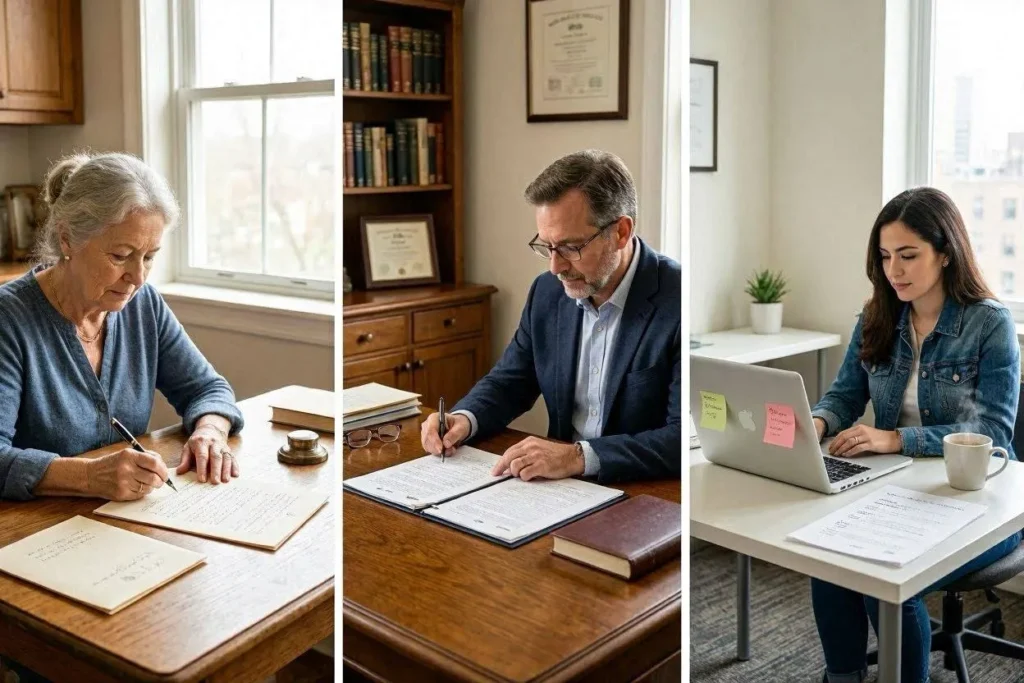
You can create a legal will through 3 distinct methods, each with different costs and complexity.
Estate size, family structure, and budget determine which method fits your situation best. A single adult with 1 bank account and no children typically needs only a simple template. A married parent with property in 2 states or a family business benefits from attorney review to avoid conflicting asset titling rules.
- Estate planning attorney: costs $300 to $1,200 and suits complex estates, blended families, or business ownership.
- Online will-making service: costs $0 to $200 and suits simple estates with clear beneficiaries, using platforms such as Trust & Will or FreeWill.
- DIY template or handwritten will: costs $0 to $50 and carries the highest risk of legal errors without professional review.
A handwritten will, called a holographic will, remains valid in 26 US states without witnesses, but courts scrutinize these documents more closely than typed wills.
States that recognize holographic wills require the entire document to be in the testator’s own handwriting, not typed and then signed. California, Texas, and Virginia all accept holographic wills under these conditions. A typed will signed before 2 witnesses remains the safer choice across every state, since courts contest holographic wills more often than formally witnessed documents.
Will Writing Quick-Reference Table
| Task | Typical Timing | Method | Difficulty |
| List assets and beneficiaries | 1-2 hours | Self-prepared worksheet | Easy |
| Choose executor and guardian | 1-3 days | Family discussion | Moderate |
| Draft the will document | 30 min – 2 weeks | Online service or attorney | Easy to Moderate |
| Sign with 2 witnesses | 15-30 minutes | In-person signing | Easy |
| Notarize self-proving affidavit | 15-20 minutes | Notary public visit | Easy |
| Store will securely | 1 day | Fireproof safe or attorney office | Easy |
Legal Requirements for a Valid Will by State
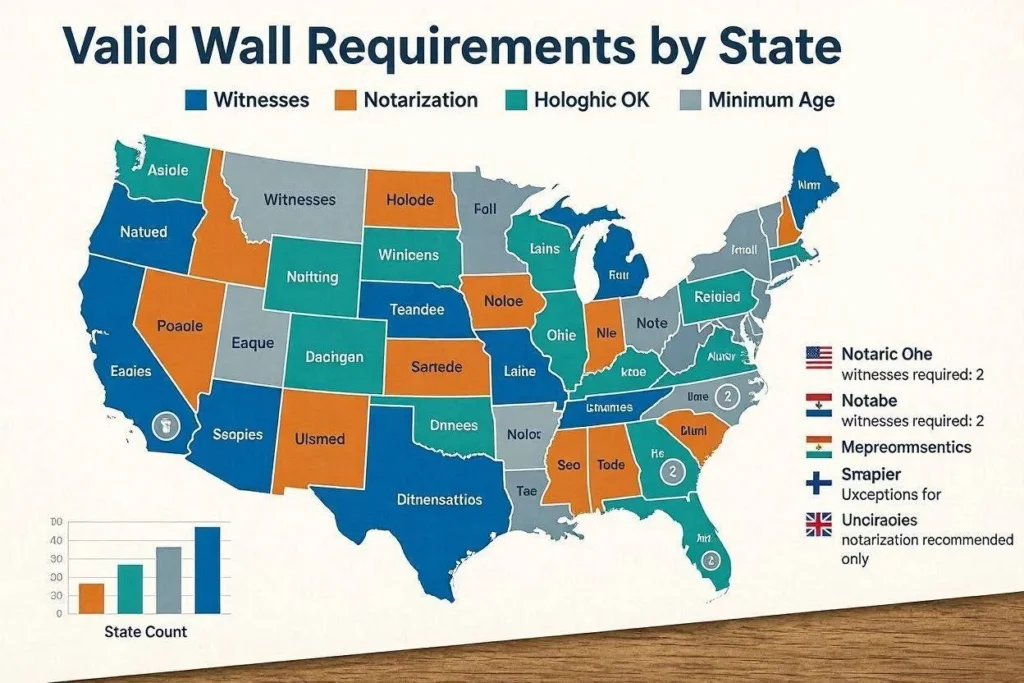
Every US state requires the testator to be 18 years or older and of sound mind when signing a will.
Most states require 2 witnesses present at signing, though Vermont requires 3. Louisiana follows civil law rules that differ from the other 49 states, requiring stricter notarial formalities. Always confirm your specific state’s witness and notary rules before finalizing your document, since requirements change with new legislation.
A will written in 1 state generally remains valid if you move to another state, since most states honor wills executed correctly under prior state law. Update your will after a cross-state move regardless, since asset titling rules and spousal inheritance protections vary by jurisdiction. Community property states, including California, Texas, and Arizona, apply different default ownership rules to assets acquired during marriage than the remaining 41 states.
What Happens Without a Legal Will?
Without a legal will, your state’s intestate succession laws decide who receives your assets.
A probate court follows a fixed order, typically giving priority to a spouse, then children, then parents, and then siblings. Unmarried partners and close friends receive nothing under intestate succession, regardless of your actual wishes. Courts also appoint a guardian for minor children without your input if no will names one.
Intestate succession can take 12 to 24 months longer than a will-based probate process, since courts must locate and verify every eligible heir. Legal fees during intestate proceedings often run 2 to 3 times higher than fees for a contested will, since attorneys must research family trees and notify distant relatives. Blended families face the highest risk under intestacy, since stepchildren typically receive nothing unless legally adopted.
Writing a Will as an Immigrant or Non-Citizen
Non-citizens and immigrants can write a legal will in the United States using the same state rules that apply to citizens.
A will written in the US only controls assets located within the US unless you coordinate it with a will in your home country. Assets held abroad, such as foreign bank accounts or property, typically require a separate will that follows that country’s inheritance laws. Green card holders and visa holders should name a US-based executor to simplify probate court proceedings. Couples with mixed citizenship status should list each spouse’s nationality and immigration status clearly, since this affects spousal inheritance rights in several states.
Work with an attorney experienced in cross-border estate planning if you hold citizenship in 2 countries or own property overseas. Inconsistent wills across countries can trigger conflicting probate claims, delaying asset transfer to your beneficiaries by months or years. Update both wills together whenever you revise 1, since outdated language in either document can create legal contradictions during probate.
5 Mistakes to Avoid When Writing a Legal Will
These 5 mistakes cause more will contests and probate delays than any other drafting errors.
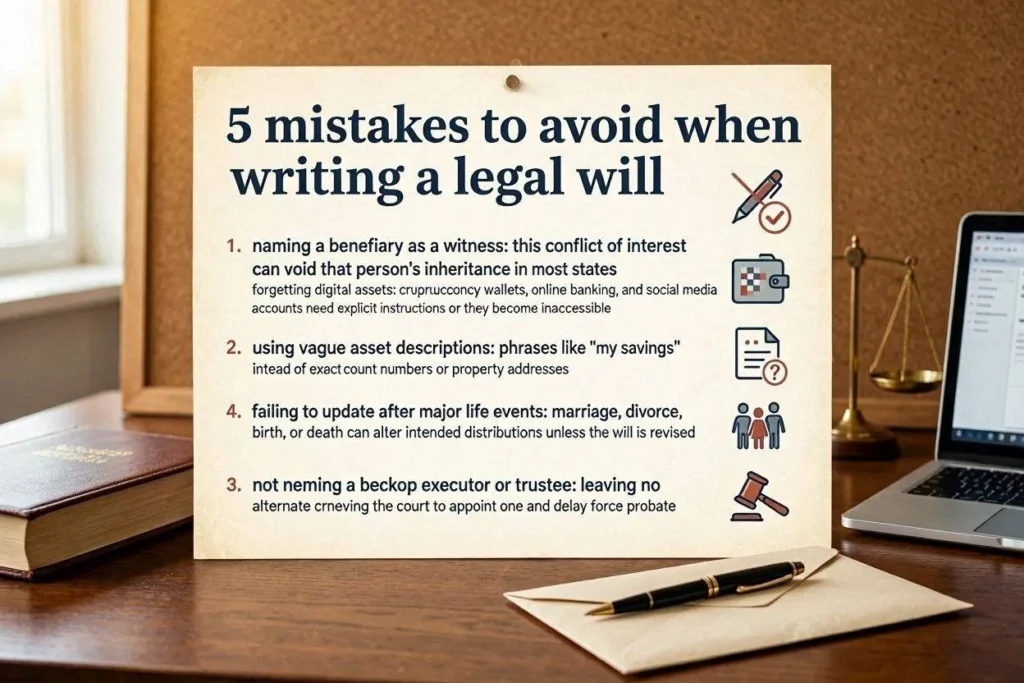
- Naming a beneficiary as a witness: this conflict of interest can void that person’s inheritance in most states.
- Forgetting digital assets: cryptocurrency wallets, online banking, and social media accounts need explicit instructions or they become inaccessible.
- Using vague asset descriptions: phrases like “my savings” instead of exact account numbers create disputes among beneficiaries.
- Skipping a backup executor: courts appoint a stranger as administrator if your first and only executor cannot serve.
- Storing the will where no one can find it: an unfound will functions as no will at all, triggering intestate succession by default.
Conclusion
A legal will protects your family and directs your assets exactly as you intend. Writing 1 today, using any of the 3 methods above, prevents your state’s intestate succession laws from making these decisions instead. Start with your asset list, name your executor, and sign in front of 2 witnesses to make your will legally binding.
Frequently Asked Questions

Amanda Brooks
Amanda Brooks leads JusticeInTown’s legal, justice, and community advocacy content division. She holds a background in legal research and public policy and specializes in topics related to civil rights, access to justice, legal awareness, and community issues. With years of experience researching legal and social justice topics, Amanda brings a careful, research-driven approach to complex legal information and public-interest issues. She is the primary author of JusticeInTown’s legal guides, justice-related resources, and community-focused content, helping readers better understand their rights, legal options, and the issues affecting their communities.
Related Posts