
Power of Attorney Lawyer: What You Need to Know (2026)
A power of attorney [POA] lawyer drafts, reviews, and executes legal documents that let a trusted person manage your finances or healthcare when you cannot act for yourself.
You need a POA lawyer because a poorly drafted document gets rejected by banks, hospitals, and courts — leaving your family without legal authority at the worst possible time.
What a Power of Attorney Lawyer Actually Does
A POA lawyer performs 5 specific tasks for you.
- Drafts a legally valid POA document tailored to your state’s statutes, such as the Texas Estates Code or Florida’s Chapter 709
- Reviews your existing documents to identify gaps or outdated language
- Counsels you on which type of POA fits your situation
- Oversees the execution process — signing, witnessing, and notarization
- Notifies financial institutions and healthcare providers of the document’s validity
Hiring an attorney differs from using an online form. The Consumer Financial Protection Bureau warns that banks frequently reject generic POA forms that don’t meet their internal compliance standards. A lawyer drafts documents that pass those institutional reviews.
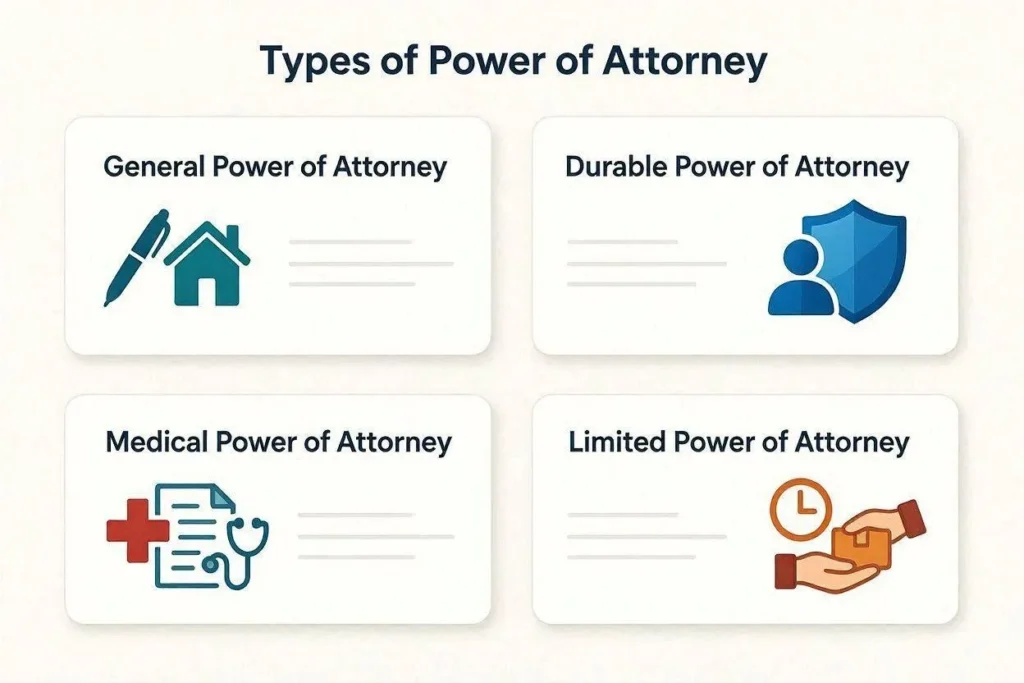
The 4 Types of Power of Attorney a Lawyer Can Draft for You in 2026
1. Durable Financial Power of Attorney
To protect your finances through incapacity, a durable financial POA is the most critical document an estate planning attorney drafts.
A durable financial power of attorney [DFPOA] remains valid after you become incapacitated. A non-durable POA terminates the moment you lose mental capacity. The word “durable” must appear in the document or it loses effect when you need it most.
A DFPOA authorizes your agent — also called an attorney-in-fact — to perform tasks including:
- Pay mortgages, utility bills, and credit card balances
- Sign and deposit checks into your bank accounts
- Manage investments, retirement accounts, and business interests
- File federal and state tax returns on your behalf
- Apply for government benefits, such as Medicaid, Social Security, or Veterans Administration programs
2. Healthcare Power of Attorney
To control your medical decisions during incapacity, a healthcare power of attorney appoints a healthcare proxy to direct your treatment.
A healthcare POA differs from a living will. A living will applies only to end-of-life situations when death is imminent. A healthcare POA covers any period of incapacity — including recovery from surgery, a coma, or a temporary medical crisis. Your agent works with doctors, hospitals, and specialists to follow your stated preferences.
Your POA lawyer adds a HIPAA [Health Insurance Portability and Accountability Act] release to the document. Without this release, medical providers legally cannot share your records with your agent — even if the healthcare POA is valid.
3. Limited Power of Attorney
To authorize a single transaction, a limited POA restricts your agent’s authority to one defined task.
Common uses include real estate closings, vehicle title transfers, and signing contracts during overseas travel. The limited POA expires automatically once the named transaction completes. Lawyers draft this type when you need temporary, narrow authority rather than broad ongoing powers.
4. Springing Power of Attorney
To activate authority only upon a specific event, a springing POA stays dormant until a defined trigger — typically a physician’s written certification of your incapacity.
A springing POA requires your agent to present a doctor’s letter confirming incapacity before any institution honors the document. This adds a verification layer but also creates a delay. Your attorney helps you decide whether a durable or springing structure better fits your situation.
Power of Attorney Lawyer Task Quick-Reference Table
Use this table to identify which actions require an attorney and when to act.
| POA Task | When to Act | Method | Difficulty |
| Draft financial POA | Before incapacity or illness | Hire a POA lawyer | Low with attorney |
| Draft healthcare POA | Before surgery or aging | Hire an estate attorney | Low with attorney |
| Execute and notarize | Same day as signing | Notary public required | Low |
| Deliver to agent | Right after signing | In-person handoff or attorney hold | Very Low |
| Notify financial institutions | Within 30 days of execution | Certified mail copies | Moderate |
| Revoke existing POA | Any time while competent | Written revocation + notary | Moderate |
| Update after life change | Marriage, divorce, move | New document via lawyer | Low with attorney |
Why You Need a Power of Attorney Lawyer — Not a DIY Form
Free online POA forms fail for 3 documented reasons.
- Banks reject generic documents. Financial institutions including JPMorgan Chase and Wells Fargo maintain internal compliance checklists. A document that omits specific language those institutions require gets turned away at the counter, leaving your agent without access to your accounts.
- State laws differ significantly. New York requires 2 witnesses and a notary. Florida requires 2 witnesses and a notary but adds specific signing procedures under Chapter 709. Texas has a statutory form in the Texas Estates Code. An attorney licensed in your state knows the exact requirements.
- Poorly drafted documents create tax liability. Your attorney-in-fact can make gifts on your behalf. Without specific language limiting gift authority, your agent could inadvertently trigger estate tax consequences. A POA lawyer inserts gift-restriction language that prevents this.
Without a POA, your family faces a court-appointed conservatorship. In Montgomery County, Tennessee, conservatorship petition filing fees alone exceed $300 — with total legal costs often reaching thousands of dollars. That process also takes weeks or months, leaving your affairs unmanaged in the meantime.
To find a qualified attorney for your situation, visit our find a lawyer directory and connect with a licensed POA attorney in your state.
How to Choose the Right Agent for Your Power of Attorney

What an Agent Must Be Able to Do
To choose an agent, select a person who meets all 4 of these requirements.
- Must be at least 18 years old and legally competent in your state
- Must understand and respect your specific financial and healthcare preferences
- Must handle financial records, deadlines, and institutional correspondence without error
- Must remain available — agents who live out of state or carry unpredictable schedules create response delays when institutions need immediate answers
You name a primary agent and at least 1 successor agent. A successor agent steps in if your primary agent dies, becomes incapacitated, or declines the role. Your POA lawyer writes the succession clause into the document so the transition happens without court involvement.
Naming Multiple Agents: The Co-Agent Structure
You can grant POA to 2 or more agents simultaneously. Co-agents provide a checks-and-balances system — neither agent can act unilaterally. This structure works well for adult siblings managing a parent’s estate together.
The drawback: co-agents must both sign every document. That requirement creates delays in emergencies. Your attorney weighs this tradeoff with you before recommending a structure.
How to Revoke a Power of Attorney with a Lawyer’s Help
To revoke a POA, you must be mentally competent at the time of revocation. Revocation requires 5 steps.
- Draft a written revocation notice identifying yourself, the original POA date, the agent named, and the specific powers you are canceling
- Sign the revocation before a notary public with the same formality as the original document
- Deliver a certified copy to your agent by certified mail with return receipt
- Send certified copies to every financial institution, bank, and healthcare provider that holds the original document on file
- Contact your POA lawyer to update or replace the document with a current version that reflects your revised wishes
Courts do not automatically receive POA revocations unless the original document was filed with a court. Your attorney confirms whether your jurisdiction requires a court filing.
Learn the full process for working with legal professionals by reading our guide on how to find a good lawyer, which covers verification steps, fee structures, and red flags to avoid.
How Much Does a Power of Attorney Lawyer Cost in 2026
POA lawyer fees follow 2 pricing structures: flat fee and hourly billing.
Flat Fee Pricing for POA Documents
Most estate planning attorneys charge a flat fee of $200 to $500 (£160–£400) for a standalone POA document. A bundled estate plan including a will, durable POA, healthcare POA, and advance directive typically costs $1,500 to $3,000 (£1,200–£2,400) depending on complexity and state.
Hourly Rates for Complex POA Work
Attorneys in metropolitan areas such as New York, Los Angeles, and Chicago charge $300 to $500 per hour (£240–£400). Rural and mid-market attorneys charge $150 to $250 per hour (£120–£200). Complex documents — those involving business succession, Medicaid planning, or cross-state validity — require more hours and cost more.
A single standalone durable POA takes most attorneys 1 to 2 hours to draft, review, and execute. You pay the flat fee regardless of actual hours spent.
When a Power of Attorney Lawyer Needs to Update Your Documents

A POA becomes outdated in 5 specific situations. Review the document with your attorney every 3 to 5 years and immediately after any of these events.
- Marriage or divorce: your former spouse may still be named as agent if the document is not updated
- Death or incapacity of your named agent: your successor clause activates, but a new primary agent needs formal designation
- Moving to a new state: your current document remains valid in most states, but updating it to meet your new state’s statutory language removes any ambiguity
- Major change in assets: a new business acquisition, real estate purchase, or large inheritance may require broader or more specific agent authority
- Change in relationship with your agent: if trust breaks down, revocation and replacement are necessary immediately
You can explore all legal services that intersect with estate planning — including wills, probate, and asset protection — through our will and estate services practice area page.
Work with a Power of Attorney Lawyer to Protect What Matters Most
A POA lawyer drafts documents that banks accept, courts recognize, and agents can act on without delay. You choose your agent, define the scope of authority, and decide when it activates — a properly drafted document gives you full control over those decisions.
A family without a valid POA faces conservatorship court filings, frozen bank accounts, and delayed medical decisions — all preventable with a single document drafted by the right attorney.
Frequently Asked Questions About Hiring a Power of Attorney Lawyer

Amanda Brooks
Amanda Brooks leads JusticeInTown’s legal, justice, and community advocacy content division. She holds a background in legal research and public policy and specializes in topics related to civil rights, access to justice, legal awareness, and community issues. With years of experience researching legal and social justice topics, Amanda brings a careful, research-driven approach to complex legal information and public-interest issues. She is the primary author of JusticeInTown’s legal guides, justice-related resources, and community-focused content, helping readers better understand their rights, legal options, and the issues affecting their communities.
Related Posts