How to Draft Legal Documents: Complete Step-by-Step Guide (2026)
To draft legal documents, follow 9 steps: define the purpose, identify parties, research the governing law, create a structure, write each clause in plain language, add protective provisions, review for consistency, obtain attorney review, and execute properly. These steps apply to contracts, NDAs (Non-Disclosure Agreements), lease agreements, wills, and business partnership agreements.
Poorly drafted documents cost U.S. businesses an estimated $2.4 trillion annually in disputes and litigation. The American Bar Association reports that 68% of legal malpractice claims trace back to document drafting errors. You can avoid both outcomes by following a disciplined drafting process.
What Legal Document Drafting Means and Why It Matters
Legal drafting is the process of composing written documents that create, modify, or end legally enforceable rights and obligations. A well-drafted agreement eliminates ambiguity — every clause must withstand scrutiny in court or during a contractual dispute.
3 categories of legal documents exist: transactional documents (contracts, deeds, leases), litigation documents (complaints, motions, briefs), and planning documents (wills, trusts, powers of attorney). Each category follows the same core drafting principles but applies different structure and language conventions.
The primary goal of every legal document is certainty. Vague language creates disputes; precise language prevents them. A well-drafted agreement anticipates points of conflict and resolves them in writing before they arise.
Quick-Reference: How to Draft Legal Documents — 8 Tasks at a Glance
| Step / Task | When to Do It | Method | Difficulty |
| Define purpose & parties | Before writing | Research + notes | Easy |
| Research governing law | Before writing | Westlaw, LexisNexis, state codes | Moderate |
| Create document structure | Day 1 | Outline or template | Easy |
| Draft core clauses | Days 1–3 | Plain-language writing | Moderate |
| Add protective clauses | Days 2–3 | Standard boilerplate library | Moderate |
| Review for consistency | After first draft | Read-aloud + checklist | Easy |
| Obtain attorney review | Before signing | Hire specialist attorney | Moderate |
| Execute (sign, notarize, file) | Final stage | Wet or e-signature + notary | Easy–Moderate |
How to Draft Legal Documents: 9 Steps in Full Detail
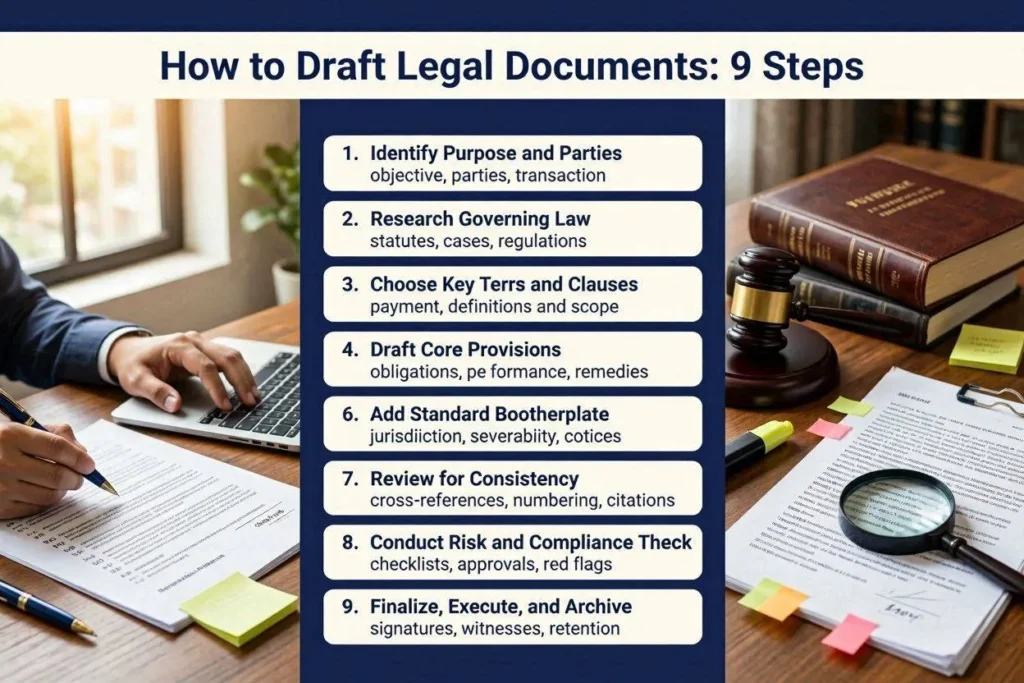
Step 1: Define the Document’s Purpose and Scope
To define the purpose, write one sentence that states what the document must achieve and what it must not cover. A business partnership agreement establishes the rights of each partner. A lease agreement sets out rent, duration, and maintenance responsibilities. Defining the scope prevents clause creep — the addition of unrelated terms that create conflicts.
Answer 4 questions before writing: What legal relationship does this document create? Which parties are bound by it? What jurisdiction’s law governs the document? What happens when one party fails to perform?
Step 2: Identify All Parties and Their Roles
To identify parties, list the full legal name, address, and role of each person or entity involved. Use exact registered names for companies — “ABC Corp.” and “ABC Corporation” are legally different entities in some jurisdictions.
A contract for a sole proprietorship names the owner individually. An LLC (Limited Liability Company) contract names the LLC, not the members. Misidentifying a party renders the document unenforceable against the correct legal entity.
Define a short-form name for each party immediately after the full legal name — for example, “JusticeInTown LLC (the ‘Company’)”. Use that short form consistently throughout the document.
Step 3: Research the Governing Law
To research the governing law, identify the state or country whose statutes and case precedents control the document. Every contract must comply with the laws of the jurisdiction where it is executed or where performance occurs.
Research 3 sources for every document: the relevant state statutes (via the state legislature’s website or Westlaw), applicable federal regulations, and recent case law that interprets the key terms in your document. Bryan A. Garner’s “Legal Writing in Plain English” provides a reliable framework for applying that research.
Employment contracts in California must comply with California Labor Code provisions that differ significantly from Texas or New York law. A governing law clause selects the jurisdiction — but the selected law must have a reasonable connection to the transaction.
Step 4: Choose a Structure and Build an Outline
To choose a structure, select the standard format for the document type, then adapt it to the transaction’s specific needs. Every well-drafted legal document contains 6 core sections: title and preamble, recitals (background), definitions, operative clauses, boilerplate clauses, and signature block.
The definitions section carries significant weight. Every technical term, dollar amount threshold, or date reference appearing later in the document must be defined here. Defined terms appear in Title Case throughout the document — “Confidential Information,” “Effective Date,” “Service Fee.”
Organize operative clauses from most important to least important. Courts give more weight to early clauses when ambiguity arises in contracts governed by the plain meaning rule.
Step 5: Draft Each Clause in Plain Language
To draft clauses, write each obligation as a direct active-voice sentence. “The Tenant shall pay rent” is stronger than “Rent is to be paid.” Active voice identifies the actor clearly and reduces the chance of a court finding the obligation ambiguous.
Avoid archaic legal terms — “whereas,” “heretofore,” and “witnesseth” — unless the jurisdiction’s courts have given those terms settled meaning through case law. Plain-language drafting produces documents all parties understand and that courts enforce without reinterpretation.
4 types of operative clauses appear in most transactional documents: obligations (Party A shall do X), conditions (payment is due only if Y occurs), representations (Party A states that the information is accurate), and warranties (Party A guarantees the product is free of defects for 12 months).
Step 6: Add Protective Clauses to Reduce Legal Risk
To add protective clauses, select the provisions that match the document’s risk profile. A standard commercial contract includes 5 protective clauses: confidentiality, indemnification, limitation of liability, dispute resolution, and termination provisions.
- Confidentiality clause — restricts the use and disclosure of private information shared during the relationship.
- Indemnification clause — specifies which party bears the cost of third-party claims arising from the agreement.
- Limitation of liability clause — caps the total financial exposure of each party, typically at the contract value.
- Dispute resolution clause — specifies arbitration, mediation, or litigation and selects the venue. The American Arbitration Association (AAA) and JAMS are the 2 major private arbitration providers in the U.S.
- Termination clause — defines the conditions and notice period required to end the contract without breach.
You can access professionally prepared clause templates through legal document preparation services that tailor standard language to your specific transaction type.
Step 7: Review the Draft for Consistency and Completeness
To review the draft, read the entire document aloud once. Sentences that do not read clearly when spoken will not be interpreted clearly by a court. A 45-minute read-aloud of a 10-page contract identifies 90% of ambiguities before they reach an attorney’s desk.
Run a 5-point consistency check: defined terms match their definitions; party names are identical throughout; all cross-references point to the correct section numbers; dates and amounts are consistent across all clauses; the governing law clause aligns with jurisdiction-specific requirements in the document body.
Software tools — including Kira Systems, Ironclad, and ContractPodAi — automate consistency checks for clause-level errors. These AI drafting tools reduce review time by 60% in high-volume document environments.
Step 8: Obtain a Professional Legal Review
To obtain a legal review, find a qualified lawyer who specializes in the document type. A real estate attorney reviews lease agreements; a corporate attorney reviews shareholder agreements; an employment attorney reviews non-compete clauses.
Attorney review costs $150 to $500 per hour (£120 to £400) for a specialist. A flat-fee document review for standard contracts runs $300 to $800 (£240 to £640). The cost of review is always lower than the cost of litigation over a disputed clause.
Provide the attorney with 3 things: the signed copy of any template used as a starting point, a written summary of the deal’s key commercial terms, and any correspondence between the parties that clarifies intent.
Step 9: Execute the Document Correctly
To execute the document, confirm the required formalities for the document type and jurisdiction. A contract between 2 businesses requires dated signatures from authorized representatives. A real estate deed requires notarization. A will requires 2 witnesses present at the same time in most U.S. states.
E-signatures are legally valid for most commercial contracts under the E-Sign Act and UETA (Uniform Electronic Transactions Act). DocuSign, Adobe Sign, and PandaDoc are 3 platforms that produce legally compliant electronic signatures. Notarization and wet signatures remain required for wills, real estate deeds, and court filings in most jurisdictions.
File or register the document according to applicable requirements. A real estate deed must be recorded with the county recorder’s office — typically within 30 to 90 days from execution, depending on state law. Employment agreements take effect on the date stated in the document.
How to Draft Legal Documents for 4 Common Document Types
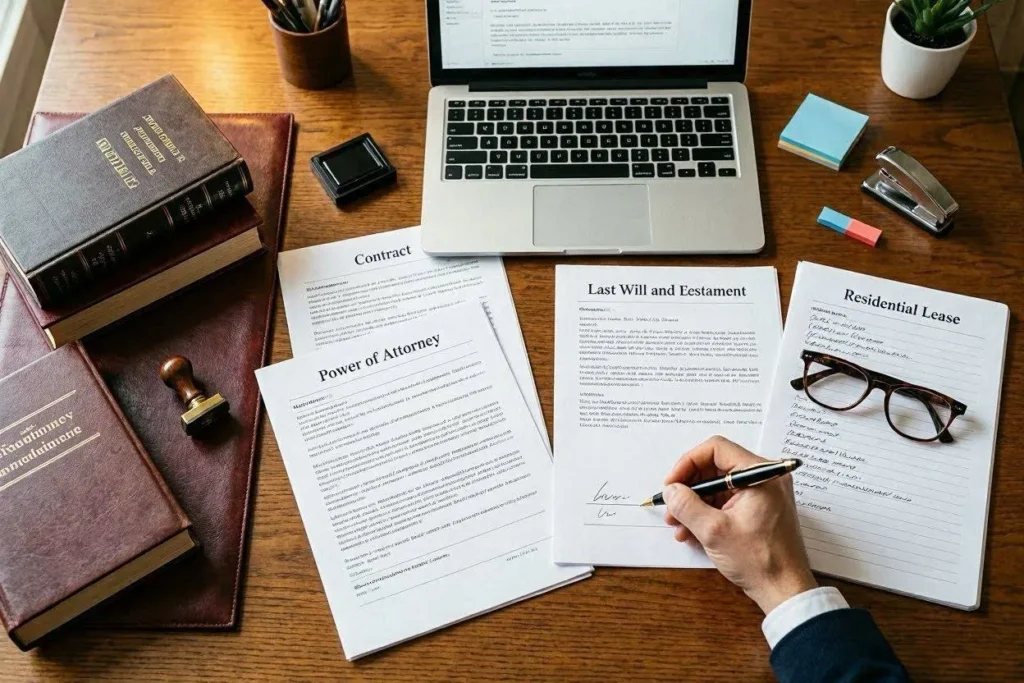
How to Draft a Contract Agreement
To draft a contract agreement, include 6 essential elements: offer, acceptance, consideration, mutual assent, capacity, and legality. A contract missing any element is unenforceable. Consideration — the thing of value each party exchanges — must be stated explicitly. “$5,000 in exchange for 20 hours of consulting services” satisfies the consideration requirement.
Every contract needs a payment clause, a performance standard clause, and a dispute resolution clause. Add a force majeure clause to address events outside both parties’ control — natural disasters, government orders, or pandemics. Specify that force majeure does not excuse payment obligations that accrued before the triggering event.
How to Draft an NDA
To draft an NDA, define 3 elements precisely: what constitutes Confidential Information, what the receiving party may do with that information, and how long the obligation lasts. Overly broad definitions of confidential information create enforcement problems — courts will not uphold NDAs that attempt to cover all information shared between parties.
A mutual NDA binds both parties equally. A unilateral NDA protects only one party’s information. Standard NDA duration is 2 to 5 years. Trade secret protection under the DTSA (Defend Trade Secrets Act) provides indefinite protection separate from the NDA — specify that the NDA obligations survive expiration for trade secret information.
How to Draft Legal Documents: 6 Common Errors That Invalidate Documents
Avoiding drafting errors protects the document’s enforceability. These 6 errors account for the majority of document disputes:
- Using inconsistent party names — switching between “ABC Corp.” and “the Company” without a definition creates ambiguity about which entity is bound.
- Leaving blanks unfilled — incomplete form documents with “[INSERT DATE]” or “[TBD]” create ambiguity about what the parties agreed.
- Using the wrong jurisdiction’s law — a California-based contract governed by New York law may lack certain mandatory California protections, creating enforceability gaps.
- Including unenforceable clauses — non-compete clauses that exceed 12 months are void in California; non-compete clauses without geographic limits are void in many states.
- Failing to define technical terms — a software contract that uses “delivery” without defining it invites a dispute over whether delivery means transfer of files, installation, or acceptance testing.
- Improper execution — a contract signed by an employee without authority to bind the company is not enforceable against the company.
How to Draft Legal Documents: When to Do It Yourself vs. Hire an Attorney
You can draft the document yourself when the transaction is straightforward, both parties agree on all terms before drafting begins, the dollar value is under $5,000, and no specialized regulatory compliance is required. Bill of sale documents, simple service agreements under $2,500, and basic promissory notes fall into the self-draft category.
Hire an attorney when the document involves real estate, employment with non-compete provisions, intellectual property rights, multi-party transactions over $10,000, or regulatory compliance requirements. The cost of an attorney drafting a complex agreement — $500 to $2,000 (£400 to £1,600) — is negligible compared to a breach of contract lawsuit, which averages $91,000 in legal fees per case in U.S. District Courts.
Regardless of which path you choose, reviewing the hire the right attorney guide helps you identify when specialist input is worth the cost and how to find a qualified professional for your document type.
How AI Tools Change Legal Document Drafting in 2026

AI tools now produce the first draft of most standard legal documents in under 5 minutes. Tools including Harvey AI, Clio Draft, and ContractPodAi generate clause-level drafts from a user’s description of the deal terms. These tools reduce initial drafting time by 70% for standard contracts.
AI-generated drafts require attorney review before execution. AI tools do not know the specific facts of your transaction, the recent case law in your jurisdiction, or the negotiating history between the parties. Treat the AI output as a structured starting point — not a finished document.
AI tools produce first drafts that frequently omit jurisdiction-specific mandatory disclosures. A residential lease in California requires 9 mandatory disclosure statements that a general AI tool does not automatically include. Identify the mandatory requirements for your document type before accepting an AI-generated draft as complete.
Start Drafting with Confidence
Drafting legal documents becomes manageable when you break the process into 9 defined steps: defining purpose, identifying parties, researching governing law, structuring the document, writing clauses in plain language, adding protective provisions, reviewing for consistency, obtaining legal review, and executing correctly.
The most common drafting errors — inconsistent party names, unfilled blanks, unenforceable clauses, and improper execution — are all preventable with a disciplined review process before signing.
JusticeInTown provides legal document preparation by licensed U.S. attorneys across all 50 states. Whether you need a contract reviewed, an NDA drafted, or a will prepared, the team delivers precise, enforceable documents. Request a free consultation today and protect your rights from the first word.
Frequently Asked Questions About How to Draft Legal Documents

Amanda Brooks
Amanda Brooks leads JusticeInTown’s legal, justice, and community advocacy content division. She holds a background in legal research and public policy and specializes in topics related to civil rights, access to justice, legal awareness, and community issues. With years of experience researching legal and social justice topics, Amanda brings a careful, research-driven approach to complex legal information and public-interest issues. She is the primary author of JusticeInTown’s legal guides, justice-related resources, and community-focused content, helping readers better understand their rights, legal options, and the issues affecting their communities.
Related Posts