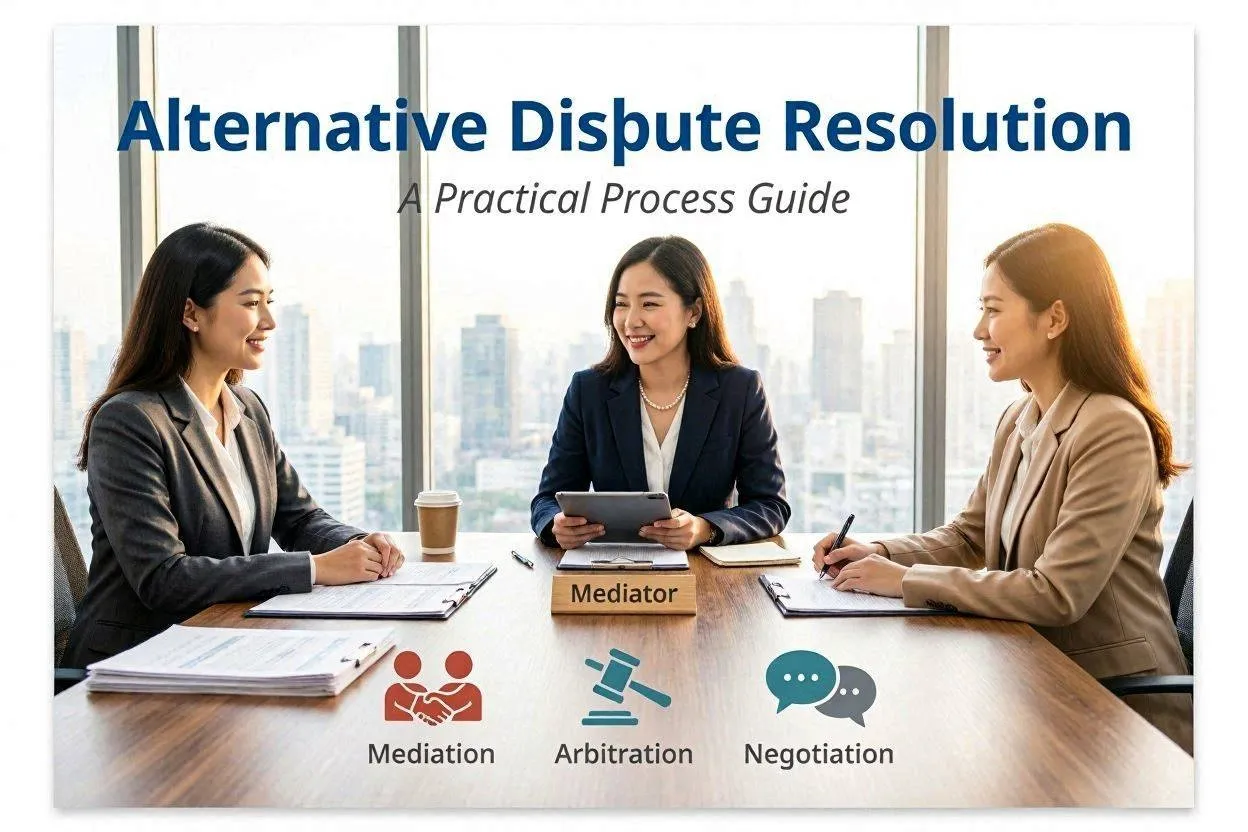
Alternative Dispute Resolution Process Guide 2026
The alternative dispute resolution process resolves legal disputes outside court through methods such as mediation, arbitration, negotiation, conciliation, and neutral evaluation. Parties choose ADR [Alternative Dispute Resolution] to avoid the expense, delay, and uncertainty of litigation.
ADR costs 60–90% less than traditional court proceedings on average. A typical civil lawsuit in the United States costs $15,000–$100,000 (£12,000–£80,000) and takes 2–5 years. Mediation resolves most disputes in 1–8 weeks for $1,500–$10,000 (£1,200–£8,000).
What the Alternative Dispute Resolution Process Covers
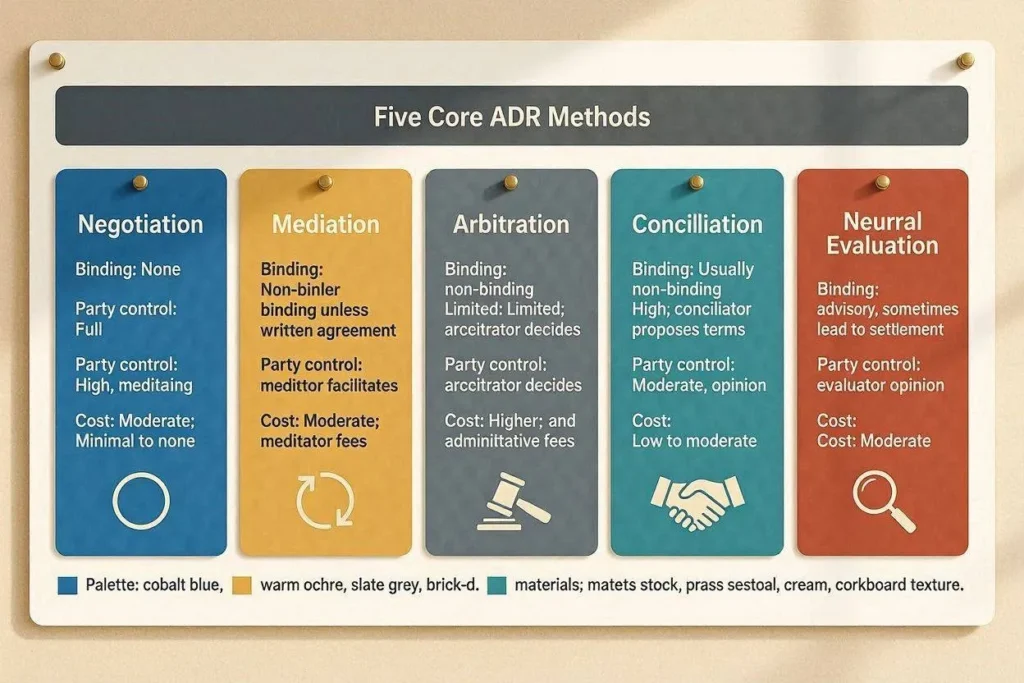
The alternative dispute resolution process covers 5 main method categories: negotiation, mediation, arbitration, med-arb, and neutral evaluation. Each method differs in formality, cost, and whether the outcome is binding.
ADR applies to disputes in 8 areas: employment, business contracts, family law, personal injury, consumer protection, real estate, landlord-tenant conflicts, and environmental disagreements. Courts across all 50 U.S. states now encourage or mandate ADR before trial.
How the 5 Core ADR Methods Differ
To understand the differences, compare each method on binding authority, party control, and cost:
- Negotiation — parties resolve the dispute directly, with no third party. No cost, no formality, fully voluntary.
- Mediation — a neutral mediator facilitates communication. The mediator does not decide the outcome. The result is non-binding unless parties sign a written agreement.
- Arbitration — a neutral arbitrator hears each side and renders a binding decision called an arbitration award. Providers such as the American Arbitration Association (AAA) and JAMS administer most U.S. arbitrations.
- Med-Arb — a hybrid process that starts as mediation. If mediation fails, the same or a different neutral moves into arbitration and issues a binding decision.
- Neutral Evaluation — a qualified expert, usually an attorney, reviews each side’s case and gives a non-binding opinion on likely trial outcomes. This opinion motivates settlement.
ADR Method Quick Reference
| ADR Method | Typical Timeline | Binding? | Cost Range (USD) | Difficulty |
|---|---|---|---|---|
| Negotiation | 1–7 days | No (unless written) | $0–$500 | Low |
| Mediation | 1–8 weeks | No (voluntary) | $1,500–$10,000 | Low–Medium |
| Arbitration | 3–12 months | Yes (binding) | $5,000–$50,000+ | Medium–High |
| Med-Arb | 2–6 months | Yes (if mediation fails) | $3,000–$30,000 | Medium |
| Neutral Evaluation | 2–4 weeks | No (advisory) | $500–$5,000 | Low–Medium |
How the Alternative Dispute Resolution Process Works Step by Step
The alternative dispute resolution process follows 6 standard steps regardless of which method parties choose.
Step 1: Identify the Dispute Type and Choose the Right ADR Method
To identify the right ADR method, match the dispute’s characteristics to the method’s strengths. Use negotiation for low-stakes or early-stage disputes between parties who communicate. Use mediation for disputes requiring ongoing relationships, such as business partnerships or family matters. Use arbitration for contract disputes where a binding, final decision is required quickly.
Contracts often include an ADR clause that specifies the required method. Review the contract before selecting a method. The Administrative Dispute Resolution Act [ADRA] of 1996 requires U.S. federal agencies to consider ADR for all qualifying disputes.
Step 2: Select and Appoint a Neutral Third Party
To select a neutral third party, request a list of certified neutrals from providers such as AAA, JAMS, or your state bar association. Parties must agree on the neutral. A mediator must hold no financial interest in the outcome. An arbitrator must disclose any past relationship with either party.
Arbitrators do not need to be attorneys. Parties select arbitrators based on subject-matter expertise — engineers for construction disputes, accountants for financial disputes, doctors for medical malpractice cases. Tripartite arbitration panels use 3 arbitrators: 1 chosen by each party and 1 chosen jointly.
Step 3: Prepare and Exchange Pre-Session Statements
To prepare a pre-session statement, each party writes a summary of the dispute, the relief requested, and supporting documents. Statements go to the neutral and, in mediation, to the opposing party. ADR rules from providers like AAA and JAMS specify statement lengths — typically 5–20 pages (single-sided, 8.5 × 11 in / 21.6 × 27.9 cm).
Step 4: Attend the ADR Session
The ADR session structure depends on the method. A mediation session lasts 4–8 hours on average and includes opening statements, joint discussion, and private caucuses where the mediator meets each side separately. An arbitration hearing resembles a trial: opening statements, witness testimony, cross-examination, and closing arguments.
All ADR proceedings are confidential under state and federal rules. Mediation communications are protected under the Uniform Mediation Act in 13 states. Federal Rule of Evidence 408 prohibits using settlement discussions as evidence at trial.
Alternative Dispute Resolution Process in Business Contracts
The alternative dispute resolution process in business contracts begins with the ADR clause. Most commercial contracts include a mandatory arbitration clause or a tiered ADR clause requiring negotiation, then mediation, then arbitration — in that sequence.
To draft an effective ADR clause, specify 4 elements: the required ADR method, the administering body (AAA, JAMS, or another provider), the seat of arbitration (city and state), and the governing law. A missing seat or governing law provision causes procedural delays before resolution even begins.
Companies that use structured ADR programs resolve contract disputes in 3–6 months on average, compared to 24–48 months for litigation. The AAA reports that arbitration fees for disputes under $75,000 (£60,000) range from $925 to $3,000 (£740 to £2,400).
Your business disputes involve specific ADR procedures. Review mediation and arbitration services to understand which method fits your contract type.
Advantages and Disadvantages of the Alternative Dispute Resolution Process
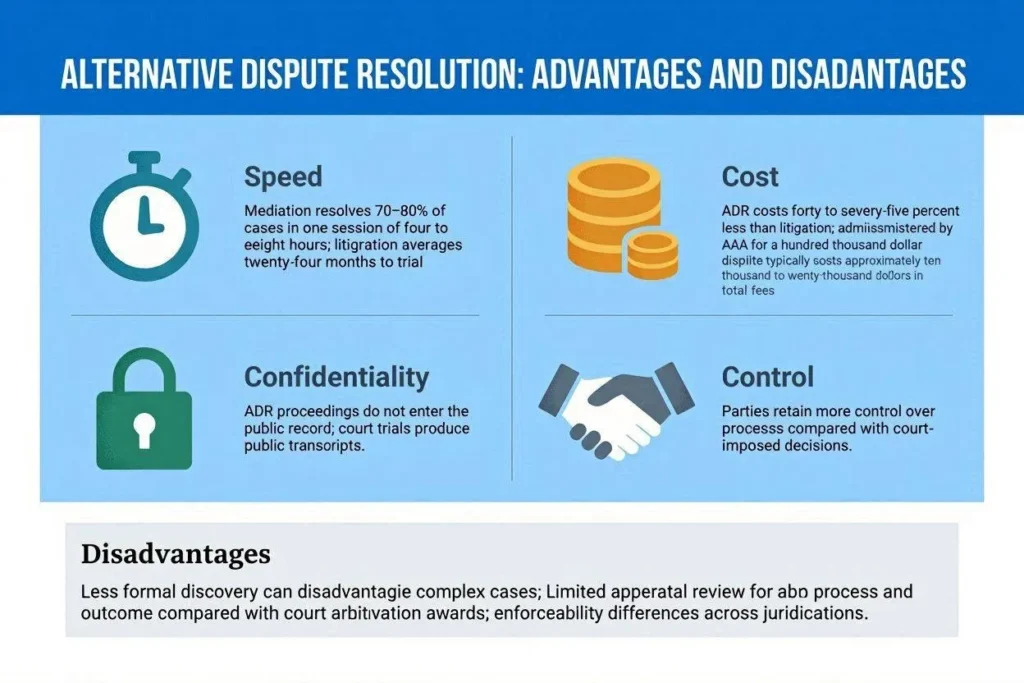
4 Key Advantages of ADR
- Speed: Mediation resolves 70–80% of cases in 1 session of 4–8 hours. Litigation averages 24 months to trial.
- Cost: ADR costs 40–75% less than litigation. Arbitration through AAA for a $100,000 (£80,000) dispute costs approximately $10,000–$20,000 (£8,000–£16,000) in total fees.
- Confidentiality: ADR proceedings do not enter the public record. Court trials produce public transcripts, judgments, and exhibits.
- Party control: Parties choose their neutral, set the schedule, and control the process. Court dockets set timelines without party input.
3 Disadvantages of ADR You Must Know
- No guaranteed resolution in mediation: Parties can walk away from mediation with no agreement. The case returns to court.
- Limited discovery: Arbitration restricts the scope of document requests and depositions. Parties with strong document evidence benefit more from litigation.
- Arbitration awards are final: Courts overturn arbitration awards in fewer than 5% of appeals. Errors of fact or law by the arbitrator almost always stand.
When the Alternative Dispute Resolution Process Does Not Apply
ADR does not apply in 4 types of situations. First, criminal cases cannot use ADR to substitute for prosecution. A district attorney brings criminal charges; the victim cannot agree to mediate instead of prosecute. Second, cases requiring a court injunction — such as restraining orders in domestic violence situations — need judicial authority that ADR neutrals do not hold.
Third, disputes involving one party without bargaining capacity — due to coercion, mental incapacity, or extreme power imbalance — produce agreements a court can void. Fourth, class action lawsuits involve too many parties for mediation. Courts must certify class actions. Arbitration clauses in consumer contracts prohibiting class actions face ongoing legal scrutiny under consumer protection law.
If ADR does not fit your situation, a qualified attorney from find dispute help can review your options and guide the right next step.
How to Choose Between Mediation and Arbitration in the ADR Process
To choose between mediation and arbitration, answer 3 questions: Do you need a binding decision? Do you want to preserve the relationship with the other party? Does your dispute involve complex technical facts?
Choose Mediation When Relationship Preservation Matters
Mediation produces non-binding outcomes negotiated by the parties themselves. Mediation suits disputes where parties must continue interacting — business partners, co-parents, neighbors, employers and employees. The Harvard Law School Program on Negotiation documents that mediated agreements show higher long-term compliance rates than court judgments because both parties shaped the terms.
Mediation also suits cases with emotional or communication barriers. A trained mediator breaks impasses by running separate caucuses, reframing positions as interests, and generating options neither party considered.
Choose Arbitration When You Need a Final Decision
Arbitration suits disputes requiring a final, enforceable ruling — breach of contract, securities claims, and labor grievances. Hi-lo arbitration limits monetary risk: parties agree in advance that the award will not fall below a floor or exceed a ceiling. Final-offer arbitration, used in Major League Baseball salary disputes and police officer wage negotiations, forces each side to submit a single reasonable number.
Arbitration awards are enforceable in 168 countries under the New York Convention on the Recognition and Enforcement of Foreign Arbitral Awards. This makes international arbitration the preferred mechanism for cross-border commercial disputes.
How to Start the Alternative Dispute Resolution Process in 4 Steps

To start the alternative dispute resolution process, follow these 4 steps:
Step 1: Review the existing contract or agreement for any ADR clause specifying the required method and provider. If no clause exists, both parties must agree on the method.
Step 2: Select a provider — AAA, JAMS, or your state’s court-annexed ADR program. Each provider publishes filing fees online. AAA charges a filing fee of $925 (£740) for claims under $75,000 (£60,000).
Step 3: File the demand — submit a written demand for mediation or arbitration to the provider. The demand describes the dispute, names the parties, and states the relief requested. The provider then notifies the opposing party.
Step 4: Appoint a neutral and schedule the session — the provider sends a list of certified neutrals. Each party strikes names and ranks remaining candidates. The provider appoints the highest-ranked mutual choice.
Starting the ADR process requires precise documentation. Book a legal consultation today to get attorney support at every step.
Conclusion
The alternative dispute resolution process offers 5 proven methods to resolve disputes faster, at lower cost, and with greater confidentiality than litigation. Negotiation starts in days. Mediation settles most cases in 1 session. Arbitration delivers a binding ruling in 3–12 months. Choosing the right method depends on your dispute type, whether you need a binding result, and the strength of your documentation.
Qualified legal guidance makes ADR more effective. An attorney reviews your contract clauses, selects the right provider, prepares your pre-session statement, and advocates during arbitration hearings. Start the process with a free case review from the attorneys at legal consultation today. Resolve your dispute without the courtroom.
Frequently Asked Questions About the Alternative Dispute Resolution Process

Amanda Brooks
Amanda Brooks leads JusticeInTown’s legal, justice, and community advocacy content division. She holds a background in legal research and public policy and specializes in topics related to civil rights, access to justice, legal awareness, and community issues. With years of experience researching legal and social justice topics, Amanda brings a careful, research-driven approach to complex legal information and public-interest issues. She is the primary author of JusticeInTown’s legal guides, justice-related resources, and community-focused content, helping readers better understand their rights, legal options, and the issues affecting their communities.
Related Posts