How to File for Divorce in USA 2026: Step-by-Step Guide
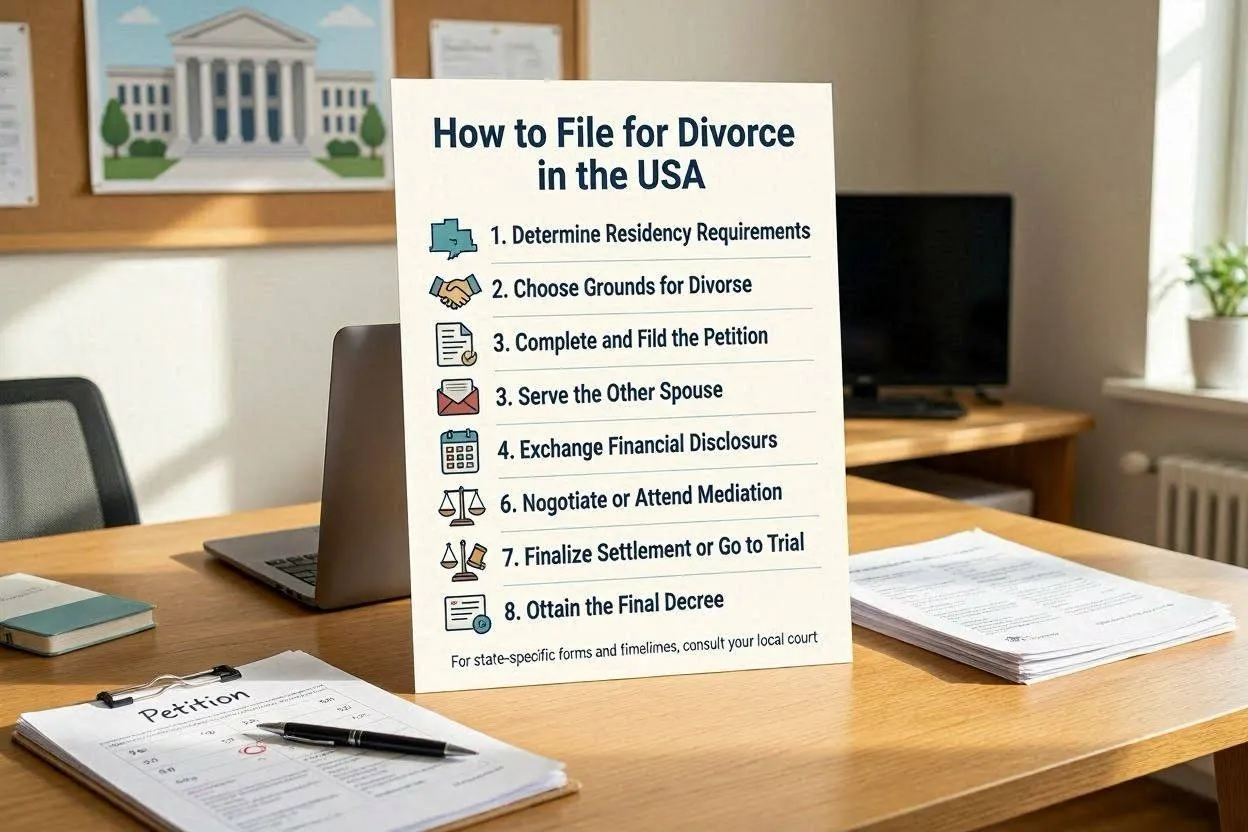
To file for divorce in the USA, you submit a divorce petition to your county family court, serve the document on your spouse, and follow your state’s mandatory waiting period before a judge issues a final decree. The full divorce process in the USA follows 7 steps: confirm residency, choose divorce grounds, draft the petition, file with the court, serve your spouse, negotiate or litigate terms, and obtain the final order.
This guide covers every step of the divorce process step by step, explains what happens to assets in a divorce, and identifies the exact costs, timelines, and deadlines you need to know in 2026.
What Are the Residency Requirements to File for Divorce in the USA?
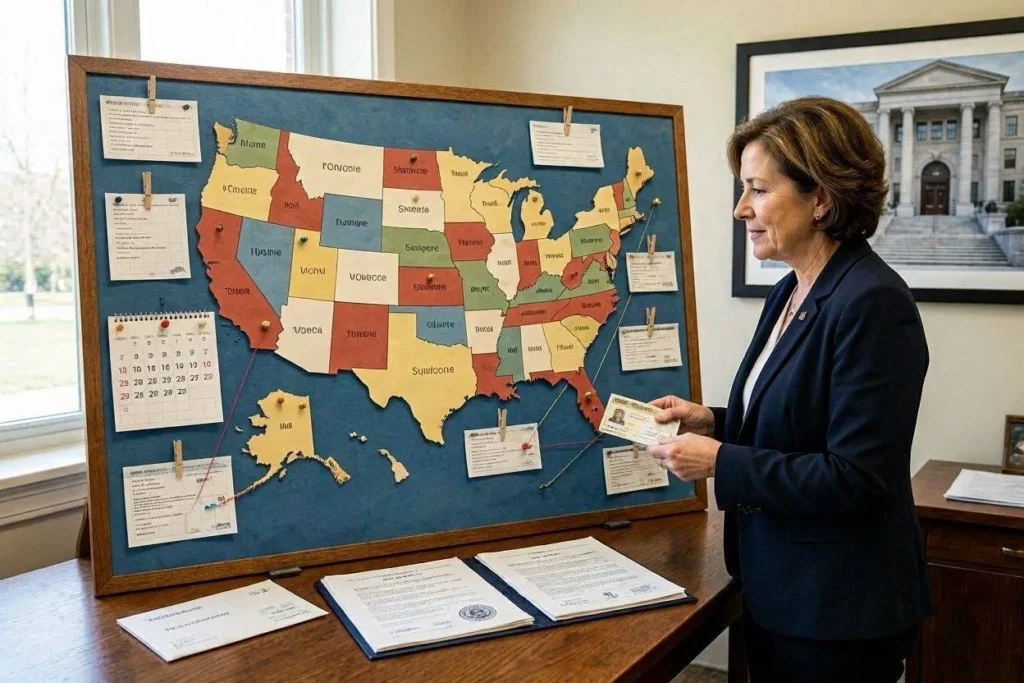
Every U.S. state requires at least one spouse to meet a residency requirement before a court accepts a divorce petition. Most states set this minimum at 6 months to 1 year. Nevada allows filing after only 6 weeks (42 days). New York requires 1 full year of residency in most situations.
You file in the county where you or your spouse currently lives. To confirm your county’s family court address, visit that court’s official website or call the county clerk’s office directly.
3 states with notable residency rules: Nevada (6 weeks), Texas (6 months statewide + 90 days in the county), and New York (1 year in most cases)
Some states add a mandatory separation period on top of the residency requirement. Delaware requires 6 months of separation before filing. Maryland accepts a 6-month separation as a ground for divorce. Louisiana requires couples to live separately for a period before a no-fault filing is recognized.
Confirm your state’s exact rules with a licensed family law attorney before you begin paperwork.
How to File for Divorce: The 7-Step Process
To file for divorce in the USA, follow these 7 steps in order. Each step has a specific legal requirement attached.
Step 1: Choose Your Divorce Grounds — No-Fault vs. Fault-Based
To choose your divorce grounds, decide whether you file on no-fault or fault-based grounds.
No-fault divorce is available in all 50 states. The petitioner cites ‘irreconcilable differences’ or an ‘irretrievable breakdown’ of the marriage. No proof of wrongdoing is required.
Fault-based divorce requires proof of specific conduct: adultery, abandonment, cruelty, or imprisonment. Proving fault is expensive and time-consuming. A fault finding can increase alimony, reduce the opposing spouse’s share of assets, or waive a mandatory waiting period in some states.
Covenant marriages — recognized in Louisiana, Arkansas, and Arizona — impose stricter grounds. Premarital counseling is required, and only documented grounds such as adultery or abuse justify divorce under covenant marriage law.
Step 2: Draft the Divorce Petition
To draft the divorce petition, download your state’s official petition form from the county court website or obtain it from the clerk’s office. Fees for blank forms range from $0 to $25.
Your petition must state: full legal names of both spouses, date and place of marriage, date of separation, names and ages of all minor children, grounds for divorce, and the relief you request — property division, child custody, child support, and alimony.
Online services such as 3StepDivorce and CompleteCase.com offer guided petition packages for $150–$299. These services work for uncontested divorces only. A family law attorney drafts the petition for $500–$2,500 depending on case complexity.
Step 3: File the Petition with the County Court
To file the petition, take the original plus 2 signed copies to the county clerk’s office or upload to your state’s e-filing portal where available.
Filing fees range from $150 to $435 across U.S. states. California charges $435 (for petitions without children). Texas charges $300–$350. New York charges $210. If you cannot afford the fee, submit a fee waiver application (called a ‘Petition to Proceed In Forma Pauperis’).
The clerk stamps your copies with the case number and filing date. This date starts your state’s mandatory waiting period. Washington state’s waiting period is 90 days. California’s is 6 months from service. Texas’s is 60 days from filing.
For help preparing your petition, connect with a licensed attorney through find a family lawyer at JusticeInTown before you file.
Step 4: Serve Divorce Papers on Your Spouse
To serve the divorce papers, a neutral adult — not you — must deliver copies to your spouse. This legal process is called ‘service of process.’
3 accepted methods of service: personal delivery by a process server or county sheriff, certified mail with return receipt in states that permit it, and service by publication in a newspaper if your spouse cannot be located.
New York requires the process server to be a state resident. Hawaii allows certified mail service. Some states permit your spouse to sign an ‘Acknowledgment of Service’ form, which eliminates the need for a third-party server.
After service, you file the ‘Proof of Service’ or ‘Affidavit of Service’ with the court. This document starts your spouse’s response clock.
Step 5: Wait for Your Spouse’s Response
Your spouse has 20 to 30 days to respond in most states. The response period is 20 days in Washington and New York. California allows 30 days.
If your spouse agrees with all petition terms, the divorce proceeds as an uncontested divorce. If your spouse contests any term, the divorce becomes contested, and the court schedules hearings.
If your spouse does not respond within the deadline, you file a ‘Request for Default.’ The judge then grants the divorce on your stated terms without the other spouse’s input.
Step 6: Negotiate or Litigate the Divorce Terms
To resolve contested issues, you and your spouse negotiate a marital settlement agreement [MSA] covering 4 categories: property division, debt allocation, child custody and support, and spousal support.
Mediation resolves most contested divorces without a trial. A divorce mediation option costs $1,500–$10,000 and takes 1–8 weeks — far less than the $15,000–$50,000 a contested trial costs.
Discovery runs during contested divorces. Each spouse submits a financial disclosure form listing all income, assets, and debts. Subpoenas, depositions, and interrogatories can add 3–12 months to the process.
Step 7: Obtain the Final Divorce Decree
To obtain the final decree, a judge reviews your signed MSA or the trial record and issues the Final Divorce Order. Both spouses receive a certified copy of the decree.
The divorce becomes legally final the day the judge signs the order and the clerk files it. The divorce decree ends the marriage, divides property, and sets custody and support terms.
Update your legal documents — Social Security records, bank accounts, vehicle titles, insurance policies, and beneficiary designations — within 30 days of the decree.
Divorce Process Quick-Reference Table
| Task | Timing | Method | Who Performs It | Difficulty |
| Meet residency requirement | 6 weeks–1 year before filing | Live in state/county | One or both spouses | Low |
| Draft divorce petition | 1–3 days | Court form or attorney | Petitioner (filing spouse) | Low–Medium |
| File petition with court | 1 day | In-person or e-filing | Petitioner | Low |
| Serve papers on spouse | 1–14 days after filing | Process server / sheriff | Neutral third party | Low |
| Spouse’s response period | 20–30 days | Court filing | Respondent (other spouse) | Low–Medium |
| Discovery / negotiation | 30 days–12 months | Mediation / depositions | Both spouses + attorneys | High |
| Final decree issued | After waiting period ends | Judge signs order | Judge / court clerk | Low |
What Happens to Assets in a Divorce in the USA?
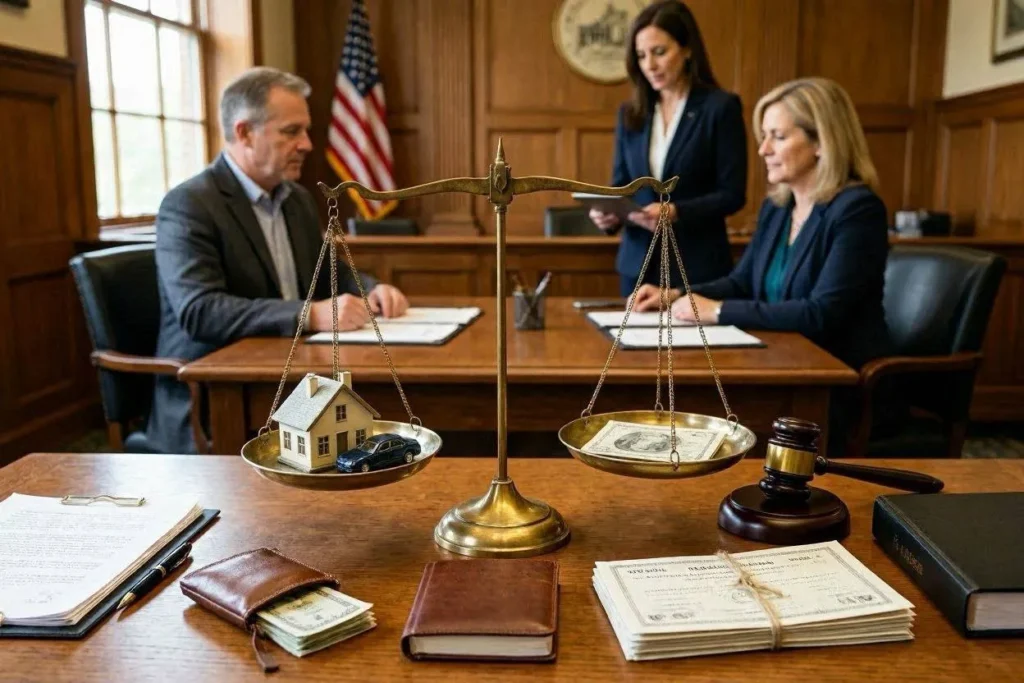
Assets in a divorce are divided based on whether each asset is ‘marital’ or ‘separate’ property. Marital property includes everything both spouses earned or acquired during the marriage. Separate property includes assets owned before the marriage, gifts, and inheritances received during the marriage.
Equitable Distribution vs. Community Property States
41 states use equitable distribution, which divides marital assets fairly but not necessarily equally. A judge considers 6 factors: length of marriage, each spouse’s income, each spouse’s earning potential, each spouse’s contributions (including homemaking), the needs of each spouse, and whether either spouse wasted marital assets.
9 community property states — Arizona, California, Idaho, Louisiana, Nevada, New Mexico, Texas, Washington, and Wisconsin — divide marital assets 50/50 by default. Some of these states allow a judge to deviate from equal division when fairness requires it. Texas requires a ‘just and right’ division rather than a strict 50/50 split.
How Retirement Accounts Are Divided in Divorce
Retirement accounts such as 401(k) plans and pensions require a Qualified Domestic Relations Order [QDRO] to divide without triggering tax penalties. The QDRO directs the plan administrator to create a separate account for the non-employee spouse.
Individual Retirement Accounts [IRAs] are divided differently. A tax-free ‘transfer incident to divorce’ moves the IRA funds without taxes or penalties. Dividing a business interest requires a forensic accountant or business appraiser to determine fair market value before a judge allocates shares.
How Commingling Affects Separate Property
Separate property loses its protected status when it is ‘commingled’ with marital property. Depositing an inheritance into a joint checking account converts those funds into marital property. Using premarital savings to pay down a jointly held mortgage can transmute those funds into shared equity.
Both spouses must submit a full financial disclosure sworn before a notary. Hiding assets is illegal. A judge can impose sanctions, order the hiding spouse to pay the other spouse’s attorney fees, or award the non-hiding spouse a larger share of the hidden asset as punishment.
How to File for Divorce Without a Lawyer in the USA
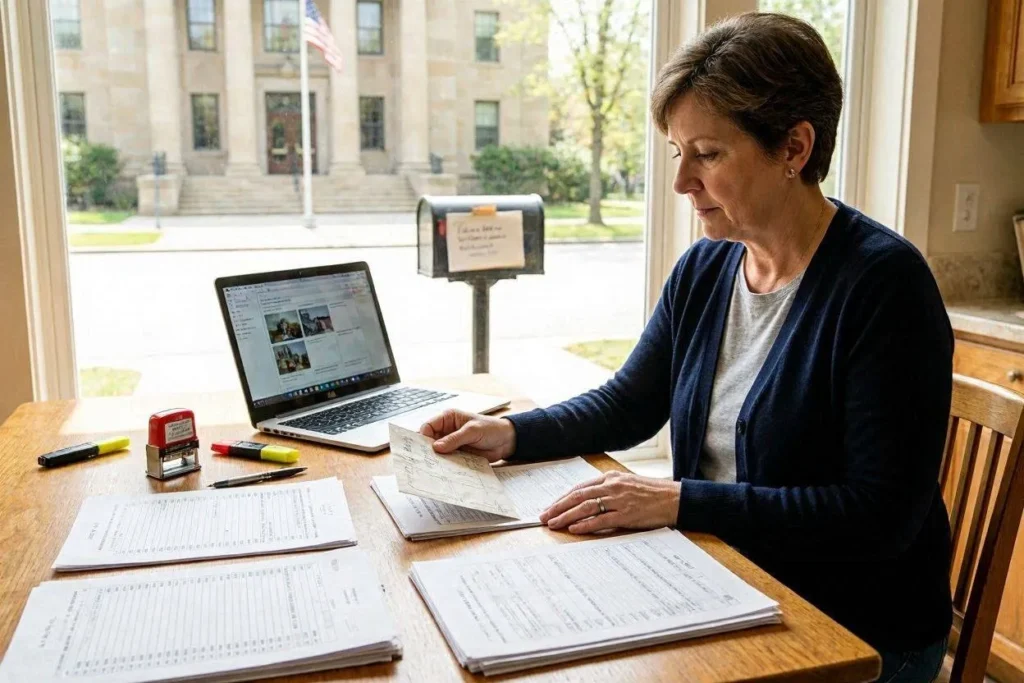
You can file for divorce without a lawyer only in an uncontested divorce where both spouses agree on every issue: property division, debt allocation, child custody, child support, and alimony.
To file without a lawyer: download your state’s self-help divorce forms from the court website, complete the petition and MSA, file at the county clerk’s office, arrange service of process, and submit the final order forms after the waiting period.
Most state courthouses have self-help centers staffed by paralegals. These centers explain forms and procedures. They cannot give legal advice. A self-represented uncontested divorce costs $150–$500 in filing fees plus $50–$150 for service of process.
A contested divorce without a lawyer is high-risk. Missing a response deadline, filing the wrong forms, or failing to disclose assets can result in an unfair decree that courts rarely modify after it is signed.
How to File for Divorce Online in the USA
Online divorce filing is available for uncontested divorces in select states, including California (San Diego Superior Court), Texas (via 1eFile), Illinois (via 1eFile), and New York (via NYSCEF in certain counties).
To file for divorce online: visit your state’s official court e-filing portal, create an account, upload completed petition forms, pay the filing fee by credit card, and the court clerk processes the submission within 1–3 business days.
Online divorce services such as 3StepDivorce and DivorceWriter prepare your forms for $150–$299 and submit them to the correct court on your behalf. These services do not provide legal advice and are not suitable for divorces involving disputes over significant assets, business interests, or child custody.
How Long Does a Divorce Take in the USA?
An uncontested divorce takes 2–6 months from filing to final decree. A contested divorce takes 12–36 months depending on the number of issues in dispute and court backlog.
3 factors that extend the timeline: mandatory waiting periods (60–180 days in most states), discovery in contested cases (3–12 months), and court scheduling delays in high-volume counties.
The 3 fastest divorce states by waiting period: Alaska (no mandatory waiting period), South Dakota (no mandatory waiting period), and Nevada (60-day waiting period with established residency).
How Much Does It Cost to File for Divorce in the USA?
Divorce costs vary by case type: uncontested divorces cost $500–$1,500 total (filing fees plus optional document service). Contested divorces cost $15,000–$50,000+ when both spouses hire attorneys and the case goes to trial.
4 main cost categories: filing fees ($150–$435), service of process ($50–$150), attorney fees ($3,500–$30,000+ per spouse in contested cases), and mediation costs ($1,500–$10,000 for full session).
Fee waivers are available in all states. To request a fee waiver, submit Form IFP (In Forma Pauperis) or the state-equivalent form at the clerk’s office before paying the filing fee. Courts grant waivers based on income below 125–200% of the federal poverty level.
For a cost estimate tailored to your state and situation, book a free legal consultation with a JusticeInTown attorney who handles family law cases.
Conclusion
Filing for divorce in the USA follows 7 clear steps: confirm residency, select grounds, draft the petition, file with the county court, serve your spouse, resolve terms, and obtain the final decree. An uncontested divorce costs $500–$1,500 and takes 2–6 months. A contested divorce costs $15,000–$50,000+ and takes 12–36 months. Every state has different residency rules, waiting periods, and property division systems — so your state’s specific rules determine your timeline and costs.
Work with a licensed family law attorney from day one. A JusticeInTown attorney reviews your petition, confirms your state’s residency and service requirements, drafts your marital settlement agreement, and represents you in court if needed. Start with a free legal consultation and get your case assessed at no cost.
Frequently Asked Questions About How to File for Divorce in the USA

Amanda Brooks
Amanda Brooks leads JusticeInTown’s legal, justice, and community advocacy content division. She holds a background in legal research and public policy and specializes in topics related to civil rights, access to justice, legal awareness, and community issues. With years of experience researching legal and social justice topics, Amanda brings a careful, research-driven approach to complex legal information and public-interest issues. She is the primary author of JusticeInTown’s legal guides, justice-related resources, and community-focused content, helping readers better understand their rights, legal options, and the issues affecting their communities.
Related Posts