

Can I Sue for Emotional Distress? A 2026 Legal Guide
Yes, you can sue for emotional distress after a car accident, slip and fall, or other personal injury, and courts award compensation for this harm alongside medical bills and lost wages in most cases. An accident victim who suffers anxiety, PTSD, or ongoing psychological harm after a collision has a recognized legal claim in every U.S. state. This guide covers when an emotional distress claim applies to a personal injury case, what evidence a personal injury attorney needs to prove it, typical settlement amounts, and the filing deadline that applies to your state.
What Emotional Distress Means in a Personal Injury Claim

Emotional distress, called mental anguish in many state statutes, describes psychological suffering that follows a car accident, workplace injury, or other personal injury. Personal injury attorneys treat this harm as a component of the overall damages claim, alongside medical expenses, lost wages, and property damage from the same incident.
Accident victims commonly report these symptoms after a car accident or other personal injury:
- Diagnosed anxiety, depression, or Post-Traumatic Stress Disorder (PTSD)
- Sleep disturbances lasting several weeks after the accident
- Panic attacks triggered by driving or by the location of the crash
- Loss of enjoyment of activities the accident victim previously valued
- Withdrawal from work or family life following the injury
How Insurance Adjusters Evaluate Emotional Distress After an Accident
An insurance adjuster reviewing a car accident claim looks for medical documentation connecting the psychological symptoms to the collision itself, not just to general life stress. Adjusters commonly request therapy records, psychiatric evaluations, and a written statement from the treating physician linking the diagnosis to the accident date.
NIED vs. IIED in Personal Injury Cases
Two legal theories support an emotional distress claim tied to a personal injury, and the applicable theory changes the proof required.
Negligent Infliction of Emotional Distress (NIED)
Negligent Infliction of Emotional Distress (NIED) applies when a careless driver, property owner, or other party causes an accident that produces psychological harm alongside physical injury. A distracted driver who rear-ends another vehicle has not intended to traumatize the other driver, yet the resulting anguish supports an NIED claim within the same personal injury lawsuit. Proving NIED requires four elements: the at-fault party owed a duty of care, the at-fault party breached that duty, the breach caused the accident, and the accident caused foreseeable emotional harm.
Intentional Infliction of Emotional Distress (IIED)
Intentional Infliction of Emotional Distress (IIED) applies when a defendant’s conduct was deliberate or reckless, such as a hit-and-run driver who flees the scene of a collision, or a driver who deliberately threatens another motorist. Courts require proof that the conduct was extreme and outrageous, that the defendant intended the harm or acted with reckless disregard, and that the resulting distress was severe.
When Can You Sue for Emotional Distress After an Accident?
You can sue for emotional distress when a car accident, slip and fall, or other personal injury causes documented psychological harm, when you witness a serious accident involving a close family member, or when a driver’s conduct was extreme and outrageous.
The most common scenario is a car accident or truck accident that produces both a physical injury and psychological symptoms. A personal injury attorney typically includes emotional distress as part of the same demand letter and lawsuit that seeks compensation for medical bills, lost wages, and property damage from the collision.
The second scenario is a bystander claim, tracing to the 1968 California Supreme Court decision in Dillon v. Legg. A parent who witnesses a reckless driver strike their child in a crosswalk may recover for the resulting psychological harm even without suffering a physical injury.
The third scenario involves extreme and outrageous conduct connected to an accident, such as a driver under the influence who deliberately runs a red light at high speed, producing severe psychological harm in survivors even absent the most serious physical injuries.
A personal injury attorney can review your accident report and medical records in a single free consultation and confirm whether your emotional distress claim meets the threshold your state requires.
Do You Need a Physical Injury to Sue for Emotional Distress?
No, a physical injury is not always required in a personal injury case, though the rule varies by state.
States following the impact rule require a physical impact or physical symptom connected to the accident before a court hears the emotional distress portion of the claim. States following the zone-of-danger rule allow recovery when the accident victim stood in the immediate area of danger, even without direct physical contact. States following the foreseeability rule, the majority approach, allow an emotional distress claim without physical injury when the psychological harm was a reasonably foreseeable result of the accident.
Evidence a Personal Injury Attorney Needs to Prove Emotional Distress
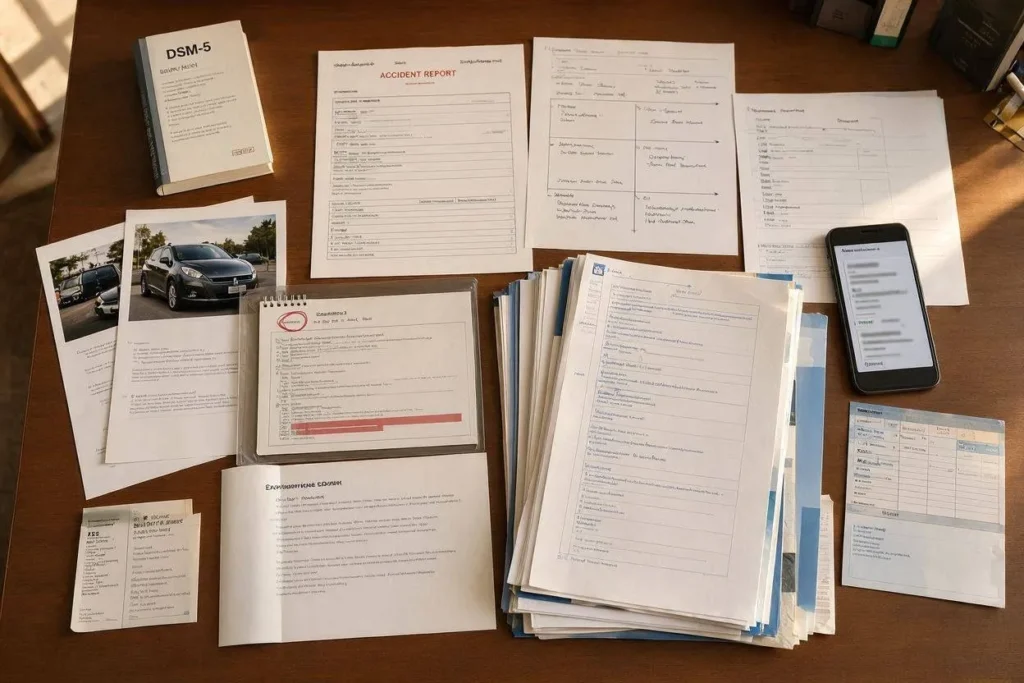
Winning an emotional distress claim after an accident depends on medical documentation connecting the psychological harm to the collision date.
- Medical and mental health records from a psychologist or psychiatrist, ideally referencing DSM-5 (Diagnostic and Statistical Manual of Mental Disorders, 5th Edition) criteria for PTSD or a related diagnosis.
- Treatment and prescription records showing therapy sessions and medications tied to the accident.
- Employment records documenting missed workdays following the collision.
- A personal journal tracking nightmares, panic episodes, and mood changes since the accident.
- Witness statements from family members or coworkers describing behavioral changes after the crash.
How Much Can You Sue for Emotional Distress in a Personal Injury Case?
Emotional distress settlements in personal injury cases range from roughly $5,000 for mild, short-term symptoms to $500,000 or more for a documented PTSD diagnosis following a serious accident, and jury verdicts in the most severe cases have reached into the millions.
Personal injury attorneys commonly apply the multiplier method: total economic damages from the accident, meaning medical bills and lost wages, multiplied by a factor between 1.5 and 5 based on severity. An accident victim with $20,000 in documented medical and wage losses and moderate psychological symptoms might see a multiplier of 2 applied, producing a suggested value of $40,000 before negotiation with the insurance company.
Statute of Limitations for Emotional Distress Claims After an Accident
Filing deadlines for an emotional distress claim tied to a personal injury typically run between 1 and 3 years from the accident date.
| State (example) | Typical Deadline | Notes |
| Texas | 2 years | Runs from the date of the accident |
| Illinois | 2 years | Applies to personal injury and emotional distress claims together |
| California | 2 years | Same deadline applies to the physical injury and emotional distress portions |
| New York | 3 years for NIED tied to an accident | IIED claims run on a separate, shorter deadline |
| Nevada | 2 years | Tolled until age 18 when the accident victim was a minor |
Common Accidents That Lead to Emotional Distress Lawsuits
- Car and truck accidents, producing anxiety about driving and PTSD alongside physical injuries from the collision.
- Slip and fall accidents, producing lasting fear of falling again and reduced mobility confidence.
- Workplace accidents, producing psychological harm alongside a workers’ compensation or third-party injury claim.
- Wrongful death from an accident, producing grief and mental anguish for surviving family members.
Steps to Take After an Accident If You Want to Sue for Emotional Distress
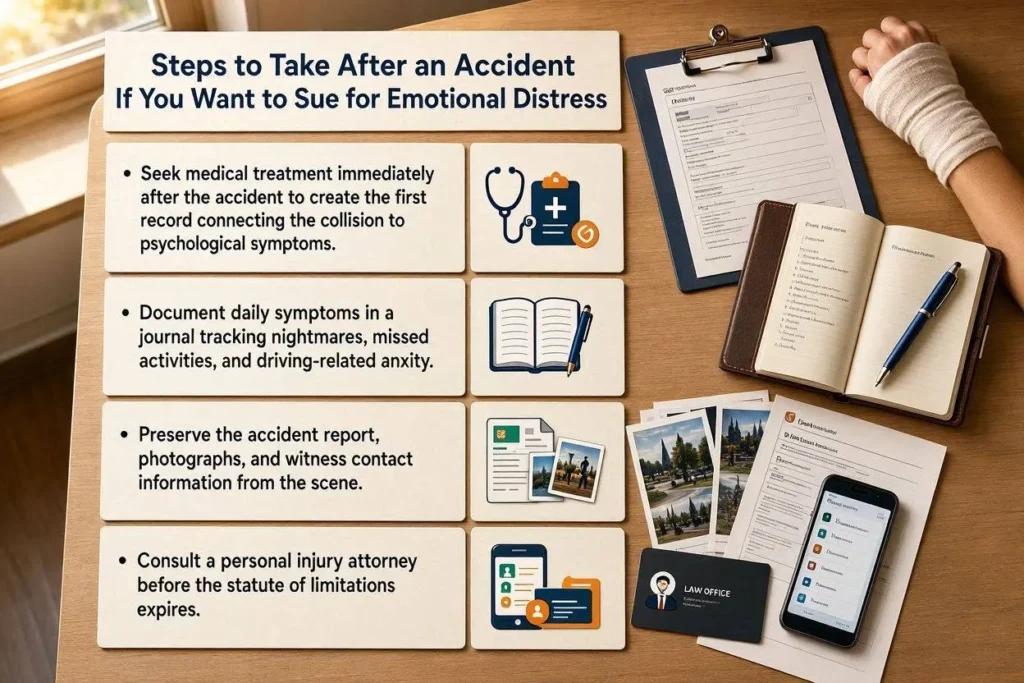
- Seek medical treatment immediately after the accident to create the first record connecting the collision to psychological symptoms.
- Document daily symptoms in a journal tracking nightmares, missed activities, and driving-related anxiety.
- Preserve the accident report, photographs, and witness contact information from the scene.
- Consult a personal injury attorney before the statute of limitations expires to confirm the applicable deadline and estimate a realistic settlement value.
If a car accident, workplace injury, or other personal injury has caused documented psychological harm, a personal injury attorney can review your accident report and medical records and outline the evidence needed to pursue fair compensation. Schedule a free case evaluation today.
Conclusion
An emotional distress claim tied to a personal injury succeeds on documentation, not on how badly the accident victim was hurt. Match the accident to the right legal theory, keep medical records from day one, and file before the statute of limitations closes — usually one to three years from the accident date.
FAQs

Amanda Brooks
Amanda Brooks leads JusticeInTown’s legal, justice, and community advocacy content division. She holds a background in legal research and public policy and specializes in topics related to civil rights, access to justice, legal awareness, and community issues. With years of experience researching legal and social justice topics, Amanda brings a careful, research-driven approach to complex legal information and public-interest issues. She is the primary author of JusticeInTown’s legal guides, justice-related resources, and community-focused content, helping readers better understand their rights, legal options, and the issues affecting their communities.
Related Posts