

How Is Child Custody Determined? Factors, Standards & Legal Process (2026)
Courts determine child custody by applying the best interest of the child standard, weighing factors such as the child’s emotional and physical needs, each parent’s fitness, home stability, and any history of family violence. A judge — or, in Texas, sometimes a jury — reviews evidence about both parents and the child’s circumstances before issuing a custody order, also called a conservatorship order. No single factor controls the outcome; courts combine evidence from multiple categories to reach a decision built around the child’s welfare rather than either parent’s preference.
Custody determinations happen most often during divorce proceedings, but they also arise in paternity cases, cases involving unmarried parents, and cases where a non-parent relative seeks custody. The legal process, called a Suit Affecting the Parent-Child Relationship (SAPCR) in Texas and similar proceedings elsewhere, produces a binding court order covering where the child lives, who makes major decisions, and how time is divided between parents.
The Best Interest of the Child Standard
The best interest of the child standard is the legal test every family court uses to decide custody, visitation, and support matters. Texas Family Code Section 153.002 states that the child’s best interest is the primary consideration in any suit affecting the parent-child relationship. Judges apply this same standard in divorce cases, modification cases, paternity cases, and cases initiated by Child Protective Services.
The standard gives judges flexibility rather than a fixed checklist. A court can weigh any evidence relevant to the child’s welfare, including facts that fall outside a state’s formal factor list. This flexibility explains why two custody cases with similar facts can produce different outcomes — the weight given to each factor depends on the specific child and family involved.
The Nine Holley Factors Courts Weigh
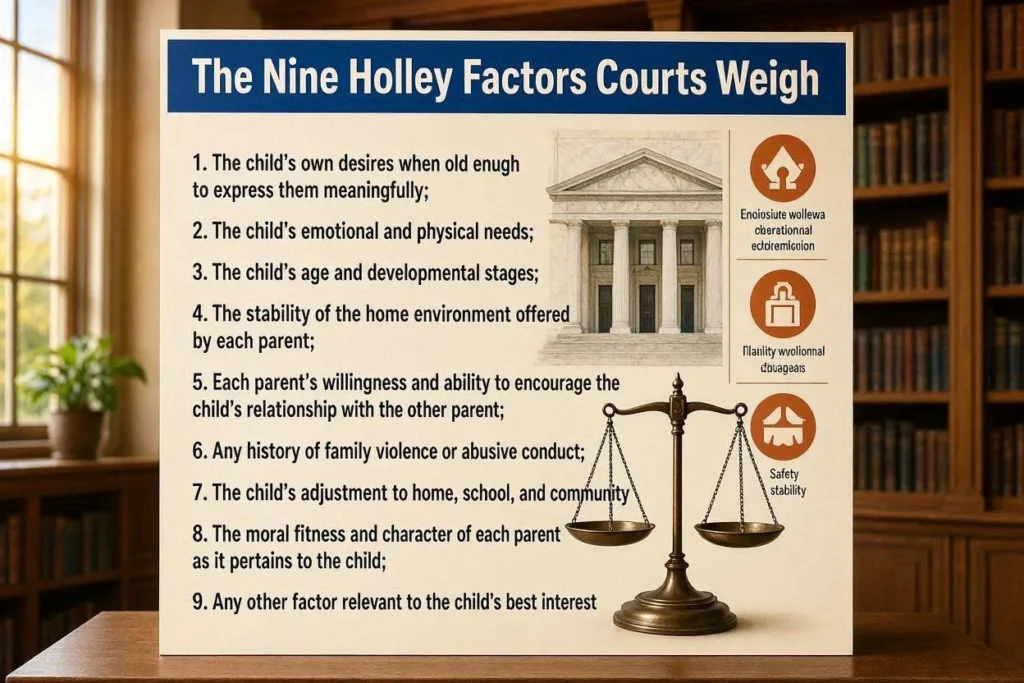
Texas courts apply nine factors from the 1976 Texas Supreme Court case Holley v. Adams to determine what serves a child’s best interest. These factors originated in a parental-rights termination case, but Texas courts now apply them broadly across custody, conservatorship, and visitation disputes. The nine factors are:
- The child’s own desires, when the child is old enough to express them meaningfully.
- The child’s emotional and physical needs, both now and in the future.
- Any emotional or physical danger to the child, both now and in the future.
- The parenting abilities of each individual seeking custody.
- Programs available to assist each parent in promoting the child’s best interest.
- Each parent’s plans for the child, including the agency’s plans if a state agency seeks custody.
- The stability of the current home or the home being proposed.
- Any acts or omissions by a parent suggesting the existing parent-child relationship is not appropriate.
- Any excuse offered for those acts or omissions.
Courts outside Texas use comparable factor lists under different names, but the substance overlaps heavily: emotional bonds, stability, parental capability, and safety consistently rank as the highest-weighted categories nationwide. A judge is not required to address every factor equally in a written ruling, and the presence of one negative factor does not automatically outweigh several positive ones.
Legal Custody vs. Physical Custody
Legal custody covers decision-making authority, while physical custody covers where the child lives day to day. Courts can — and often do — award these two types of custody differently. A parent might share legal custody equally with the other parent, deciding jointly on schooling, medical care, and religious upbringing, while one parent holds primary physical custody and the other receives a possession or visitation schedule.
Texas law uses different terminology than most states. Instead of “custody,” Texas Family Code Chapter 153 refers to “conservatorship” (decision-making rights), “possession” (physical time with the child), and “access” (contact short of overnight possession). A parent can be named a joint managing conservator without receiving equal physical time, since conservatorship status and possession schedule are determined separately.
Joint vs. Sole Conservatorship
Joint managing conservatorship means both parents share decision-making rights, while sole managing conservatorship gives one parent exclusive authority over major decisions. Texas Family Code Section 153.131 creates a rebuttable presumption favoring joint managing conservatorship, meaning courts start from the assumption that shared decision-making serves the child’s best interest unless evidence proves otherwise.
A parent can overcome this presumption, if that parent presents evidence showing joint conservatorship would significantly impair the child’s physical health or emotional development. Common grounds for awarding sole conservatorship include a documented history of family violence, untreated substance abuse, or a demonstrated pattern of one parent obstructing the other’s relationship with the child. Courts distinguish joint conservatorship from a 50/50 time split — parents can share legal decision-making while one parent still holds the larger share of overnight possession.
Domestic Violence, Abuse, and Safety Findings
Yes, a documented history of family violence changes how courts apply standard custody presumptions. Texas Family Code Section 153.004 removes the usual joint-conservatorship and standard-possession presumptions in cases involving family violence, child abuse, or neglect. Courts treat these cases as a distinct category rather than folding safety concerns into the general best-interest analysis.
Judges respond to documented abuse with several tools: supervised visitation, protective orders restricting contact, geographic restrictions on where a parent can relocate the child, and, in the most severe cases, termination of parental rights. Evidence considered includes police reports, protective order filings, medical records, and testimony from the child, other family members, or mental health professionals. Marital infidelity, by contrast, rarely affects custody decisions on its own — courts distinguish between conduct that harms a spouse and conduct that harms a child, and only the latter typically influences custody outcomes.
Parental Fitness: Mental and Physical Health
Courts evaluate parental fitness by examining each parent’s mental health, physical health, and demonstrated capacity to meet a child’s daily needs. A parent with a documented mental health condition or substance abuse history does not automatically lose custody. Judges instead look at whether the condition is being managed through treatment and whether it currently interferes with parenting capacity.
Courts frequently order formal psychological evaluations in contested cases, appointing a licensed mental health professional to assess each parent and report findings back to the court. A parent working toward recovery from a substance abuse issue can strengthen their case by presenting evidence of consistent treatment, clean drug screens over a defined period (commonly 90 to 180 days), and a stable living environment. Courts weigh current fitness and demonstrated trajectory more heavily than past mistakes alone.
The Child’s Preference and Age Thresholds
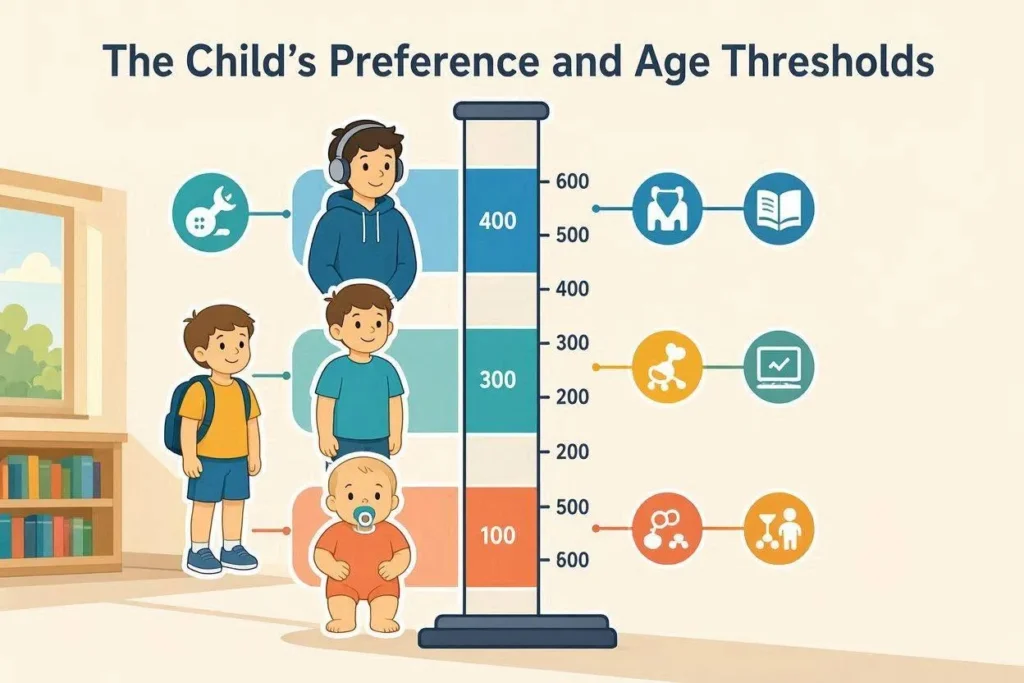
A child’s preference carries legal weight starting at age 12 in Texas, though a judge retains final authority regardless of the child’s stated wish. Texas Family Code Section 153.009 allows either parent to request that the court interview a child aged 12 or older about custody preferences. Courts in other states set the threshold differently — some consider a child’s wishes informally starting around age 10, while formal weight typically increases through the early teenage years.
Younger children’s preferences can still factor into a ruling, if the child demonstrates sufficient maturity to explain the reasoning behind a preference. Judges discount preferences that appear coached, vague, or based on which household offers fewer rules rather than better care. The interview typically happens in the judge’s chambers rather than open court, and some jurisdictions allow attorneys from both sides to be present.
Stability, Work Schedules, and Co-Parenting Ability
Home stability, work schedule compatibility, and each parent’s willingness to support the other parent’s relationship with the child all factor into custody rulings. Courts favor arrangements that minimize disruption to a child’s school, friendships, and daily routine. A parent who has served as the primary caregiver before separation often has an advantage in retaining that role, provided the parent can continue meeting the child’s needs.
Work schedules matter because a parent working significant overnight or travel-heavy hours may need a schedule that accounts for childcare during those periods, rather than losing custody outright. Courts also scrutinize co-parenting behavior directly: a parent who actively supports the child’s relationship with the other parent is viewed favorably, while a parent who attempts to alienate the child from the other parent risks losing custodial time as a result. Judges view this factor as a forward-looking predictor of how well an arrangement will function after the order is signed.
Jurisdiction: Which Court Has Authority
A custody case must be filed in the state and county where the child has lived for the six months immediately preceding the filing. This rule comes from the Uniform Child Custody Jurisdiction and Enforcement Act (UCCJEA), adopted in all 50 states and the District of Columbia. Jurisdiction determines which court has legal power to issue and enforce a binding custody order — a court lacking proper jurisdiction cannot rule on the case, even if both parents want that court to hear it.
Interstate disputes arise, if one parent relocates with the child before a custody order exists, or if a parent tries to file in a new state after an order is already in place elsewhere. The UCCJEA generally requires the state that issued the original order to retain authority over modifications, preventing parents from forum-shopping for a more favorable court. Parents relocating from another country face an added step: registering the foreign custody order with a US court, sometimes called domesticating the order, before it can be enforced domestically.
Legal Presumptions and How Parents Rebut Them
Courts start certain custody decisions from a legal presumption, then allow either parent to present evidence disproving that presumption. Three presumptions appear most often in Texas custody cases: joint managing conservatorship, adherence to the standard possession order for visitation scheduling, and application of the statutory child support guidelines under Family Code Section 154.125.
A parent seeking to rebut the joint-conservatorship presumption must prove that shared conservatorship would significantly impair the child’s physical health or emotional development, a higher evidentiary bar than simply showing the arrangement would be inconvenient. Parents can also agree to deviate from these presumptions by mutual consent, if both parties show the court that a different arrangement — such as a below-guideline support amount — still serves the child’s best interest.
Custody Evaluations and Guardians Ad Litem
Courts appoint neutral third parties, including custody evaluators and guardians ad litem, to represent the child’s interests separately from either parent’s position. A guardian ad litem is a court-appointed advocate, often an attorney or trained volunteer, tasked with investigating the family situation and recommending an arrangement that serves the child directly, independent of either parent’s legal strategy. An attorney ad litem serves a similar function but specifically represents the child’s stated legal position in court.
A custody evaluation typically involves home visits, interviews with each parent and the child, and sometimes psychological testing, culminating in a written report submitted to the judge. Courts weigh these reports heavily because evaluators observe family dynamics directly rather than relying solely on parent testimony, which each side has an incentive to shape favorably.
Mediation vs. Litigation
Mediation resolves most custody disputes without a trial, since parents who reach a written agreement avoid a judge imposing a decision neither party fully controls. A mediator — a neutral third party, often a retired judge or family law attorney — helps both parents negotiate terms covering conservatorship, possession schedules, and decision-making authority. Many jurisdictions require mediation before scheduling a contested custody hearing.
Litigation becomes necessary, if parents cannot reach agreement through mediation or if one parent raises safety concerns that require judicial fact-finding, such as documented abuse allegations. A collaborative divorce process offers a middle path: both parents retain attorneys trained in collaborative law and commit to resolving disputes outside court, with the understanding that both attorneys withdraw if the case proceeds to litigation. Parents who reach agreement through mediation or collaborative law retain far more control over the final custody terms than parents who leave the decision entirely to a judge.
Special Circumstances: Military Service, Incarceration, and Relocation
Military deployment does not disqualify a parent from custody, but it does require a plan addressing the child’s care during deployment periods. Courts evaluate whether a deploying parent’s service branch, duty station, and family support plan can accommodate custodial responsibilities, and many states offer temporary custody modifications that automatically revert once deployment ends. Benefits associated with military life — base schools, on-base childcare, and healthcare access — can weigh in a service member’s favor rather than against it.
Incarceration affects custody differently depending on the offense and sentence length, with courts distinguishing between parents who maintain contact and financial support from prison and parents who become entirely absent from a child’s life. Relocation cases arise, if a parent with primary custody wants to move the child a significant distance, often triggering a geographic restriction already written into the custody order. Courts evaluate proposed relocations by weighing the reason for the move, the impact on the other parent’s access, and whether the move genuinely improves the child’s circumstances rather than simply serving the relocating parent’s convenience.
Modifying an Existing Custody Order

A parent can request a custody modification, if that parent shows a material and substantial change in circumstances since the original order and proves the requested change serves the child’s best interest. Courts do not revisit custody arrangements simply because a parent is dissatisfied with the current terms — the legal standard for modification is deliberately higher than the standard for an initial determination, since children benefit from stability once an order is in place.
Common grounds for modification include a parent’s relocation, a documented change in a child’s needs, evidence of family violence arising after the original order, or a parent’s voluntary relinquishment of primary care to someone else for at least six months. Texas law adds a further restriction: modifications filed within one year of the current order face a stricter evidentiary standard, requiring proof that the current arrangement endangers the child’s physical health or emotional development, or that the parent seeking primary custody has voluntarily given up primary care.
Conclusion
No court hands out custody based on a formula — a judge looks at the whole family and asks one question: what actually serves this child? That question pulls in stability, safety, each parent’s daily involvement, and sometimes the child’s own voice, weighted differently depending on what’s really at stake in a given case.
Parents heading into this process gain the most ground by staying consistent and documented long before a hearing date, rather than scrambling to build a case once a filing is already underway. A family law attorney who knows the specific state’s statutes still matters more than any general guide, since the factors above explain the reasoning courts use, not the outcome any one family should expect.
FAQs

Amanda Brooks
Amanda Brooks leads JusticeInTown’s legal, justice, and community advocacy content division. She holds a background in legal research and public policy and specializes in topics related to civil rights, access to justice, legal awareness, and community issues. With years of experience researching legal and social justice topics, Amanda brings a careful, research-driven approach to complex legal information and public-interest issues. She is the primary author of JusticeInTown’s legal guides, justice-related resources, and community-focused content, helping readers better understand their rights, legal options, and the issues affecting their communities.
Related Posts