

What Is Uncontested Divorce? Cost, Timeline & How to File (2026)
An uncontested divorce is a divorce in which both spouses agree on every major issue — property division, debt, child custody, child support, and spousal support — so no judge has to decide those questions for them. Because nothing is left for a court to fight over, the case skips the slow, adversarial parts of litigation and moves through the system on paperwork and a short review instead of a trial.
That single trait — full agreement — separates an uncontested divorce from every other kind. Reach agreement on all of it, and you file jointly and finish fast. Disagree on even one issue, such as who keeps the house or how holidays get split, and the case becomes contested until that issue gets resolved.
This guide walks through how an uncontested divorce works, what it costs in dollars and months, the exact steps to file, and where state rules change the math. Treat the specifics as a starting map, not legal advice: divorce law is set state by state, so confirm the details with a licensed attorney or your local court before you file.
Uncontested Divorce vs. Contested Divorce
A contested divorce puts a judge in charge of the outcome; an uncontested divorce keeps both spouses in charge. When spouses cannot agree on custody, money, or property, a court steps in, weighs evidence, and rules — a process that pulls in hearings, discovery, and sometimes a trial.
Contested cases run longer and cost more for one reason: conflict has a price. Discovery alone (the formal exchange of financial records, bank statements, and testimony) can add months and thousands of dollars in attorney time. A contested divorce commonly stretches past a year and runs $5,000 to $15,000 or higher once experts, depositions, and court appearances stack up.
An uncontested divorce strips those layers away. No discovery fights, no dueling expert witnesses, no judge deciding your parenting schedule. Spouses who cooperate keep control of the result and hand the court a finished agreement to approve rather than a dispute to referee.
One point worth holding onto: the two are not permanent labels. A contested case can convert to uncontested the moment both sides sign a settlement, and an uncontested case can turn contested if one spouse withdraws consent before the decree is signed.
Two Paths to an Uncontested Divorce: Agreed and Default
Uncontested divorce reaches the finish line through two different doors, and knowing which one applies to your situation shapes the paperwork ahead.
An agreed divorce happens when both spouses participate, negotiate the terms, and sign the documents together. Both people read the settlement, understand what they are agreeing to, and put their names on the final decree. Most couples pursuing an uncontested divorce take this route, because a signed agreement gives each spouse certainty about property, parenting, and support.
A default divorce happens when one spouse files and the other never responds within the deadline set by the summons. Silence from the other side lets the filing spouse proceed alone, and the court can grant the divorce without the missing spouse’s input. Georgia illustrates the timing precisely: under Georgia Superior Court Rule 24.6, a judge may grant a default divorce 46 days after service, versus 31 days when both spouses give written consent.
A default is technically uncontested, but the word “agree” does not apply — a non-response is not the same as a signature. Confirm which path you are on before assuming the terms are settled, because a spouse who resurfaces mid-case can flip a default into a contested fight.
Who Qualifies: The Five Issues Both Spouses Must Settle
Qualifying for an uncontested divorce is not about income or assets. It comes down to a single test: can you and your spouse agree, in writing, on all five of the issues below? Leave any one of them open, and the case cannot proceed as uncontested.
Property and Debt Division
Both spouses must agree on how to split everything acquired during the marriage — homes, vehicles, bank accounts, retirement funds, and debts. How a court would otherwise divide those assets depends on which system your state uses.
Nine community property states (Arizona, California, Idaho, Louisiana, Nevada, New Mexico, Texas, Washington, and Wisconsin) treat most assets and debts acquired during the marriage as jointly owned, regardless of whose name sits on the title. The remaining states follow equitable distribution, dividing marital property by what a judge considers fair rather than a strict split. Texas layers on its own “just and right division” standard, which does not guarantee a 50/50 result even in a community property state.
Retirement accounts add a wrinkle most people miss. Splitting a 401(k) or pension without triggering taxes or penalties requires a Qualified Domestic Relations Order (QDRO) — a separate court order that instructs the plan administrator how to divide the funds. Skip the QDRO, and a well-meaning agreement can cost one spouse thousands in avoidable tax.
Child Custody and Child Support

Parents must agree on legal custody, physical custody, a visitation schedule, and a child support amount before a court will treat the divorce as uncontested. Every state ties these decisions to one standard — the best interest of the child — and a judge will reject an agreement that shortchanges a kid even when both parents signed it.
Child support is rarely a free negotiation. Most states calculate a guideline figure from each parent’s income and the parenting-time split, and you generally submit a Child Support Worksheet showing the math. Parents can agree to more than the guideline amount, and sometimes less, if the court approves the reasoning.
Couples with minor children face two extra requirements in many states: a written Parenting Plan detailing the schedule and decision-making authority, and a parenting-education class that both parents complete before the divorce is finalized. Check your county’s rules early, because an unfinished class can stall an otherwise ready case.
Spousal Support
Spouses must agree on whether alimony will be paid, how much, and for how long — or agree that neither will pay any. Spousal support (also called alimony or, in states like Texas, spousal maintenance) does not apply to every divorce, but leaving the question unanswered keeps the case from being uncontested.
Where support does apply, the agreement should spell out the amount, the duration, and the conditions that would modify or end payments, such as remarriage or a major income change. Vague language here is a frequent source of post-divorce disputes.
How to File an Uncontested Divorce, Step by Step
Filing follows a predictable arc in most states, though the form names and the presence of a hearing shift from one jurisdiction to the next. Here is the sequence you can expect.
- Confirm residency and settle every issue. Meet your state’s residency requirement first, then reach written agreement on property, debt, custody, support, and alimony. Texas, for example, requires 6 months of residence in the state and 90 days in the filing county.
- File the petition. Submit a Petition for Divorce (sometimes titled a Complaint or Petition for Dissolution) to the appropriate court and pay the filing fee. Some states ask for a supplemental information sheet at this stage.
- Notify your spouse. Serve your spouse with the filing. A cooperating spouse can sign a Waiver of Service instead, which skips formal service and speeds the case along.
- Submit the signed settlement agreement. File the Marital Settlement Agreement laying out all agreed terms. Cases with children include the Parenting Plan and Child Support Worksheet here.
- Observe the waiting period. Most states impose a mandatory waiting period between filing and finalization, and no agreement can shorten it.
- Finalize the decree. Prepare and sign the Final Decree of Divorce. Some states require a brief hearing — Texas calls it a “prove-up hearing,” a review that often lasts under 15 minutes — while others let a judge approve the paperwork without anyone appearing in person.
- Handle post-divorce housekeeping. Obtain certified copies of the decree, then update beneficiaries, titles, and records. File any QDRO needed to divide retirement accounts.
How Long an Uncontested Divorce Takes
Most uncontested divorces finalize in 1 to 6 months, and the biggest variable is your state’s mandatory waiting period, not how fast you and your spouse agree. You can settle everything in a weekend and still wait weeks for the clock to run out.
The waiting period exists to give spouses a window to reconsider, and its length swings widely by state:
| State | Mandatory waiting period |
| Georgia | 31 days (with written consent) |
| Texas | 60 days from filing |
| Rhode Island | ~3 months (nominal/uncontested track) |
| Typical range across states | 0 to 6 months |
Limited exceptions exist. Texas, for instance, can waive its 60-day wait in cases involving family violence or a military deployment. Outside those exceptions, plan around the full period.
How Much an Uncontested Divorce Costs
An uncontested divorce typically runs $300 to $3,000 all-in, versus $5,000 to $15,000 or more for a contested one. Three cost buckets make up the total, and you control how much of each you spend.
Court filing fees are fixed by the state and county, and they vary more than most people expect:
| State | Approximate filing fee |
| South Dakota | $95 |
| Rhode Island | $160 |
| New Jersey | $300 |
| Texas | $200–$400 (by county) |
| Florida | ~$400 |
Attorney fees are the swing factor. Hire a lawyer for full representation and the rate matters: family attorneys average about $344 per hour in California and roughly $199 per hour in South Dakota, so geography alone can double the bill. Many couples spend far less by using an attorney only to review the settlement rather than run the whole case.
Online divorce services and document-preparation platforms occupy the middle ground, generally charging $150 to $1,500 to prepare and file the paperwork for a straightforward, no-children case. The right choice among the three depends on complexity, which the next section unpacks.
How Rules Change by State
No single set of uncontested divorce rules applies nationwide — residency requirements, waiting periods, filing fees, and even the names of the forms differ in every state. A guide can teach the pattern, but your state fills in the numbers.
Three variables shift the most:
- Residency. States require you to live there for a set period before filing, from a few weeks to a full year. Texas requires 6 months in-state plus 90 days in the county; Rhode Island requires one year.
- Property system. Community property states and equitable distribution states divide assets on different principles, which changes what a “fair” agreement looks like.
- Hearing requirement. Some states finalize on paperwork alone. Others, including Texas, require a short court appearance before a judge signs the decree.
Louisiana shows how far the variation can run: uncontested cases there proceed under either Article 102 or Article 103 of the Louisiana Civil Code depending on how long the spouses have lived apart, and covenant marriages cannot use the uncontested route at all. Verify your state’s specifics with a court self-help center or a local attorney before filing.
Do It Yourself, Use an Online Service, or Hire an Attorney
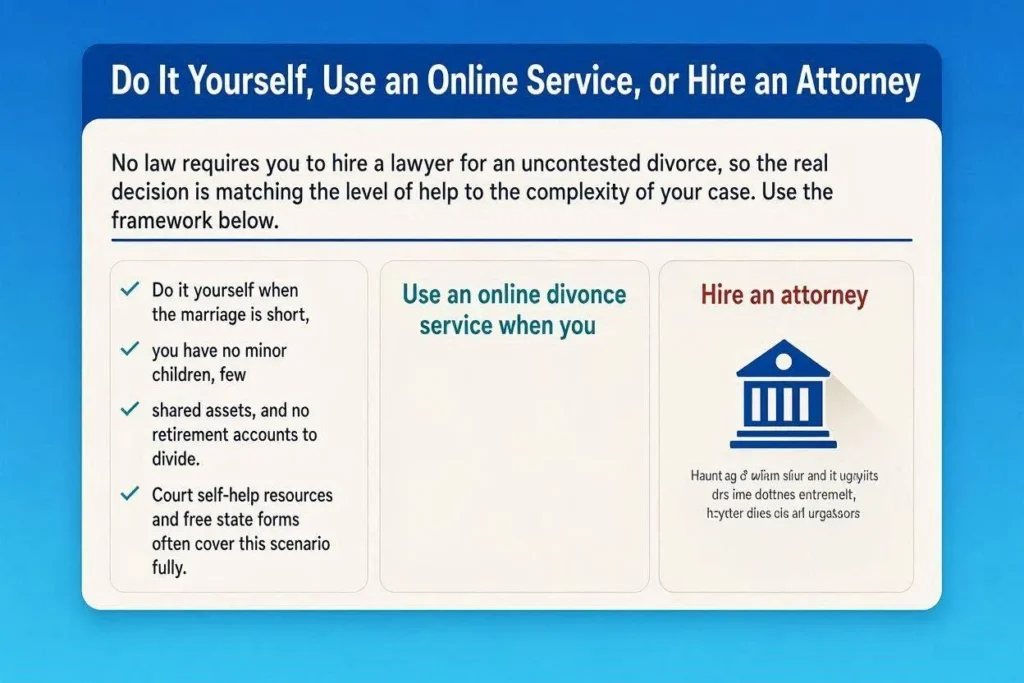
No law requires you to hire a lawyer for an uncontested divorce, so the real decision is matching the level of help to the complexity of your case. Use the framework below.
- Do it yourself when the marriage is short, you have no minor children, few shared assets, and no retirement accounts to divide. Court self-help resources and free state forms often cover this scenario fully.
- Use an online divorce service when your case is straightforward but you want the paperwork prepared and filed correctly without hourly legal fees. These platforms suit amicable splits with simple finances.
- Hire an attorney when the case involves a business, real property, retirement accounts, a large income gap between spouses, or any hint of pressure or unfairness. Even then, a single settlement-review consultation can protect your interests without full representation.
One honest caution: an agreement that looks balanced can hide a lopsided outcome, especially around retirement, tax, and support. Spend a few hundred dollars on a review before signing away tens of thousands in assets.
Documents You Will Prepare
Paperwork drives an uncontested divorce, and knowing the core documents in advance keeps the case from stalling. Expect to handle most of the following:
- Petition for Divorce — the opening document that starts the case.
- Waiver of Service — the responding spouse’s option to accept the filing without formal service.
- Marital Settlement Agreement — the signed contract covering property, debt, custody, and support.
- Financial affidavit — a sworn disclosure of income, assets, and debts that many states require even when both spouses agree.
- Parenting Plan and Child Support Worksheet — required when minor children are involved.
- Qualified Domestic Relations Order (QDRO) — needed to divide a 401(k) or pension without tax penalties.
- Final Decree of Divorce — the document a judge signs to end the marriage.
Benefits of an Uncontested Divorce
An uncontested divorce saves money, saves time, protects privacy, and keeps decisions in the hands of the people the decisions affect. Each benefit traces back to the absence of a courtroom fight.
Cost drops because there is no discovery, no expert testimony, and little to no trial time — the exact line items that inflate contested cases. Timelines shrink for the same reason, with many couples finishing in a few months instead of a year or more. Privacy improves because no public trial airs the details of your finances or your marriage.
The subtlest benefit is control. Parents who write their own parenting schedule tend to follow it, which cuts down on the return trips to court that plague high-conflict divorces. A judge who has never met your children will not weigh their routines the way you can.
Drawbacks, and When an Uncontested Divorce Is the Wrong Choice
An uncontested divorce is the wrong choice whenever the two spouses do not stand on equal footing. Cooperation only produces a fair result when both people negotiate freely and know what they are giving up.
Walk away from the uncontested route when any of these apply:
- One spouse controlled the finances and the other cannot verify the full picture of assets or debts.
- Assets are complex or disputed — a business, multiple properties, or hidden accounts.
- A large income gap leaves one spouse unable to support themselves after the split.
- Any history of abuse, coercion, or intimidation makes free negotiation impossible.
A power imbalance turns a “simple” agreement into a quiet loss for the weaker party. In those situations, the cost of a contested divorce buys something valuable: a process built to surface hidden facts and protect the person with less leverage.
Legal Separation vs. Uncontested Divorce
A legal separation lets a couple live apart with court-ordered terms while staying legally married, whereas an uncontested divorce ends the marriage entirely. People confuse the two because both involve dividing responsibilities without a courtroom battle.
The practical differences matter. A legally separated spouse cannot remarry, often keeps access to a partner’s health insurance, and may preserve certain tax or religious considerations. An uncontested divorce cuts every legal tie, frees both people to remarry, and severs the benefit and insurance links a separation can keep intact.
Some couples use a legal separation as a trial run and convert it to a divorce later. If remarriage or a clean financial break is the goal, an uncontested divorce reaches it directly.
Mistakes That Turn an Uncontested Divorce Contested
Small oversights sink cases that should have been easy. Avoid the errors that most often flip an agreement into a dispute or leave a spouse exposed after the decree.
- Relying on verbal promises. Put every term in the written agreement — unwritten deals invite disputes the moment memories differ.
- Overlooking an asset or debt. A forgotten account, pension, or credit-card balance can reopen negotiations or surface as a fight years later.
- Ignoring taxes. Support payments, asset transfers, and retirement withdrawals carry tax consequences that a rushed agreement misses.
- Skipping the QDRO. Dividing retirement funds without the proper order triggers penalties that erase the savings the split was meant to preserve.
- Rushing the signature. Signing before a legal review can lock in terms a spouse later regrets and cannot easily undo.
When to Hire an Attorney
Hire an attorney the moment your case involves real financial or parental complexity, even if you and your spouse agree on everything. Agreement makes a case uncontested; it does not make the terms fair or the paperwork correct.
Bring in a lawyer for a business, real estate, retirement accounts, a significant income disparity, or contested custody concerns. Board-certified family law specialists — a credential fewer than 1% of Texas lawyers hold, for example — carry the depth to catch problems a form cannot flag. Consult one when you feel pressured or unsure, since a single review often costs less than one overlooked asset.
This article explains general legal concepts and does not constitute legal advice. Divorce law varies by state. Consult a licensed attorney in your jurisdiction before making decisions about your case.
FAQs

Amanda Brooks
Amanda Brooks leads JusticeInTown’s legal, justice, and community advocacy content division. She holds a background in legal research and public policy and specializes in topics related to civil rights, access to justice, legal awareness, and community issues. With years of experience researching legal and social justice topics, Amanda brings a careful, research-driven approach to complex legal information and public-interest issues. She is the primary author of JusticeInTown’s legal guides, justice-related resources, and community-focused content, helping readers better understand their rights, legal options, and the issues affecting their communities.
Related Posts