
How Long Does a Contested Texas Divorce Take? 2026 Timeline Guide
A Texas divorce takes a minimum of 61 days from the date of filing — but that number rarely tells the real story. Most divorces that end up taking real time aren’t waiting on paperwork; they’re waiting on two people who can’t agree. Contested divorces involving custody disputes, property fights, or trial often stretch to 6 months to 2 years, and high-conflict cases involving abuse allegations, hidden assets, or a parent trying to limit the other’s access to the kids can run even longer. The Texas Family Code sets a mandatory 60-day floor after the petition is filed, but that floor is almost never where a disputed case actually lands.
The exact length depends on three factors: whether the divorce is contested or uncontested, how busy the county court’s docket is, and whether either spouse requests a jury trial. This guide breaks down what actually drives a long, difficult divorce timeline, using the current Texas Family Code, so you know what to expect before you file — especially if you suspect your spouse isn’t going to make this easy.
When a Divorce Turns Contested: The Real Timeline Driver
A divorce becomes contested the moment either spouse disagrees on one or more issues — custody, property division, spousal support, or even the grounds for divorce itself. A respondent who files an answer instead of a waiver of service signals a contested case, even if the disagreement involves only one term. Texas courts require at least 45 days’ notice before a contested final hearing, which adds time on top of the 60-day statutory minimum — and that’s before accounting for how long it actually takes two people in conflict to reach agreement, or a judge, on anything.
Contested Texas divorces typically take 6 months to 2 years to reach a final decree, and complex cases involving business valuations, hidden income, or extensive litigation can extend well beyond 2 years. The added time comes from discovery fights, temporary order hearings, mediation sessions that stall, and — in cases that never settle — a trial date on the court’s docket. Couples who thought they’d agree on everything sometimes discover mid-process that they don’t, and the case shifts from uncontested to contested overnight.
What Pushes a Case From Disagreement Into Full Conflict

Several patterns show up again and again in cases that drag on:
- Custody and conservatorship disputes. When parents disagree on who the child lives with, how decisions get made, or how much time each parent gets, courts prioritize the child’s best interest under Texas Family Code Section 153.002 and may order custody evaluations that take 60 to 90 days to complete on their own. One parent alleging the other is unfit, unsafe, or manipulative adds evaluators, guardians ad litem, and hearings — each one a new delay.
- A spouse hiding or undervaluing assets. Complex property division slows cases involving business ownership, multiple real estate holdings, or retirement accounts, especially when one spouse suspects the other is concealing income or moving money. Courts often need forensic accountants or business valuation experts before dividing community property under Section 7.001, and a suspicious spouse’s attorney will fight to get full financial transparency before agreeing to anything.
- Domestic violence allegations. These add hearings for protective orders and require additional safety planning during mediation, which extends the overall timeline even as it removes the mandatory 60-day waiting period for the person seeking protection. Courts take these allegations seriously, and the process of establishing what happened — and structuring safe custody exchanges — takes real time.
- A spouse who won’t respond or cooperate. Some contested cases aren’t fought over specific terms so much as one spouse simply refusing to engage — missing deadlines, ignoring discovery requests, or not showing up. This can eventually lead to a default judgment, but getting there still takes months of documented attempts and court patience wearing thin.
- Fault-based filings. Fault-based grounds — cruelty, adultery, felony conviction, abandonment for at least one year, or living apart for at least three years — require the accusing spouse to present evidence, and the accused spouse frequently contests the allegation. That turns a filing decision into a fight over facts, which extends the timeline through additional hearings and, in many cases, trial. Fault findings can also influence how a judge divides community property, so a longer, harder-fought timeline sometimes comes with a different financial outcome.
The 61-Day Minimum: How the Waiting Period Works (Even in Conflict Cases)
Texas Family Code Section 6.702 prohibits a judge from granting a divorce until 60 days have passed since the petition was filed. Add one day for the actual court date, and the fastest possible Texas divorce takes 61 days. This rule applies whether both spouses agree on every term or are fighting over each one — the waiting period doesn’t pause or restart because a case turns contentious.
The clock starts the day after filing, not the filing day itself. A spouse who files a petition on March 1 begins counting on March 2, reaching day 60 on April 30. Courts calculate this period using calendar days, including weekends, not business days only.
The Two Exceptions — Both Tied to Safety, Not Convenience
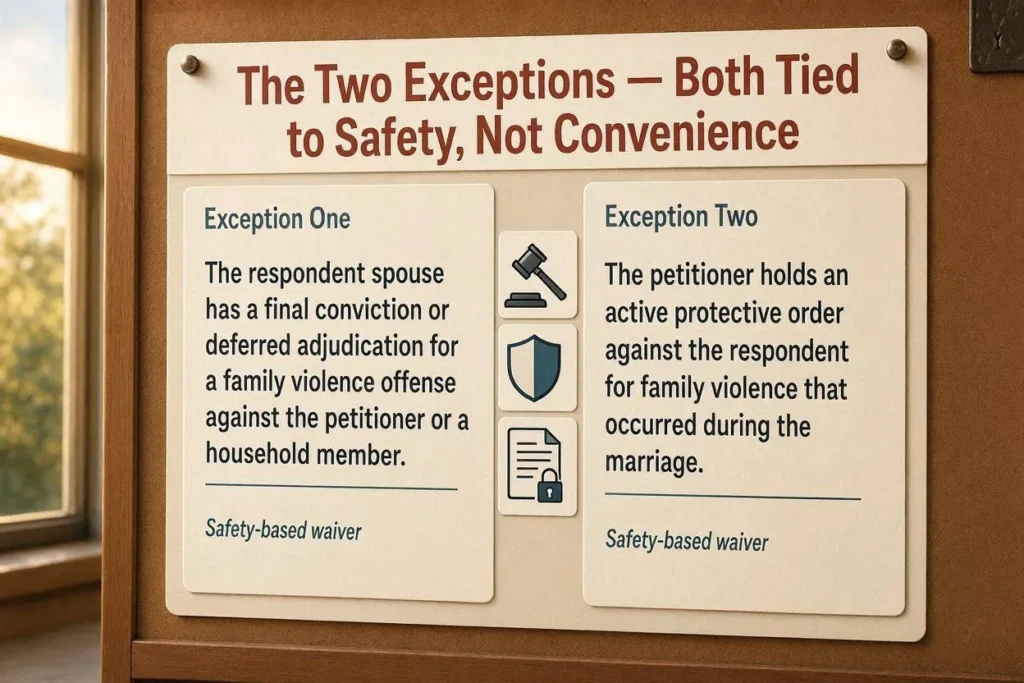
A judge can waive the 60-day requirement in exactly two situations, and both exist because of danger, not disagreement:
- The respondent spouse has a final conviction or deferred adjudication for a family violence offense against the petitioner or a household member.
- The petitioner holds an active protective order against the respondent for family violence that occurred during the marriage.
Outside these two circumstances, no judge in Texas can shorten the waiting period, even when both spouses request it and even when the conflict feels urgent for other reasons.
Residency Requirements Before You Can File
At least one spouse must have lived in Texas for the six months immediately before filing, and in the specific county of filing for the 90 days before that. Texas Family Code Section 6.301 sets this rule, and courts dismiss petitions filed before these thresholds are met. Military spouses stationed outside Texas can still meet the residency requirement if Texas remains their home state of record, and time spent accompanying a military spouse abroad counts toward the six-month total.
A spouse can file for divorce in Texas even when the other spouse lives in a different state, as long as the filing spouse meets the residency requirements above. Courts need personal jurisdiction over an out-of-state spouse to issue orders that create financial obligations, such as child support or debt division, so the petition should include jurisdictional grounds that apply to the case — something worth confirming with an attorney if you expect the other side to contest jurisdiction itself.
Uncontested Divorce Timeline: 61 Days to 4 Months
Not every divorce turns into a fight. Most uncontested Texas divorces finalize between 61 days and 4 months after filing. The exact date within that range depends on how quickly both spouses complete paperwork and how soon the county court schedules a final hearing. Counties with lighter dockets, such as many rural counties, often schedule uncontested prove-up hearings within days of the 60-day mark. Larger metro counties, including Harris, Bexar, Tarrant, Travis, and Dallas, sometimes add 2 to 6 weeks of additional wait time due to court caseloads.
A divorce qualifies as uncontested when both spouses agree on every major issue before filing or shortly after — grounds for divorce, division of community property and debt, child custody and visitation terms, and child support amounts. Neither spouse can be actively going through bankruptcy without complications, and neither can dispute the amount of spousal maintenance if maintenance applies. When every condition is met, the case can finish through a brief “prove-up” hearing rather than a contested trial. But agreement can be fragile — a case that starts uncontested can turn contested the moment one spouse’s attorney reviews the numbers, or one parent has second thoughts about a custody schedule.
Step-by-Step Process, With an Eye on Where Conflict Enters
Step 1 — Filing the Original Petition. The petitioner files with the district clerk in the correct county, pays a filing fee that typically ranges from $250 to $350 depending on the county, or submits a Statement of Inability to Afford Payment of Court Costs to waive the fee. Filing starts the 60-day clock immediately — and often the first moment the other spouse learns how serious this is.
Step 2 — Service and Response. The respondent must receive formal notice through personal service by a constable, sheriff, or private process server, or through a signed waiver of service if both spouses cooperate. A respondent who is served has 20 days plus the following Monday at 10 a.m. to file an answer. A contested answer here — rather than a waiver — is usually the first formal signal that the case will not be quick.
Step 3 — Temporary Orders. Either spouse can request temporary orders covering child custody, child support, spousal support, and use of the marital home while the case is pending. This step often becomes the first real battleground in a contested case, since it sets the working arrangement — sometimes for months — while everything else gets sorted out. Courts typically schedule these hearings within 2 to 4 weeks of the request.
Step 4 — Discovery. Discovery is where spouses exchange financial records, property documents, and other evidence through interrogatories, requests for production, and depositions. Simple uncontested cases often skip formal discovery altogether. Contested cases with business interests, retirement accounts, or a spouse suspected of hiding assets can spend 2 to 6 months in discovery, depending on how cooperative each side is with document production — and uncooperative discovery is one of the single biggest drivers of a long, expensive divorce.
Step 5 — Mediation. Many Texas counties require mediation before setting a contested case for trial, and Travis County specifically mandates mediation when a hearing is expected to run longer than 4 hours. Mediation sessions typically last a half day to a full day. A successful mediation produces a binding settlement agreement that shortens the remaining timeline substantially; a failed one means the case is headed toward trial.
Step 6 — Prove-Up Hearing or Trial. Uncontested cases finish through a short prove-up hearing where the petitioner testifies that the terms in the Final Decree are true and complete, and the judge signs the decree the same day. Contested cases that do not settle proceed to trial, where a judge decides the remaining issues; trial dates depend entirely on the county’s court calendar and can add several months beyond the 60-day minimum.
Divorce With Children: Where Conflict Runs Deepest
A divorce involving minor children takes longer than a divorce without children in nearly every contested scenario, since custody and support terms require additional documentation and, frequently, additional court review. Parents who disagree on conservatorship, possession schedules, or child support amounts move into contested territory, where courts may order custody evaluations or appoint an amicus attorney to represent the child’s interests — both of which add months to the case and reflect how seriously the court treats a genuine dispute over a child’s wellbeing.
Parents who agree on custody and support can still finish in the standard 61-day to 4-month uncontested range. It’s the parents who don’t agree — over where a child lives, how holidays split, or whether one parent poses a risk — whose cases stretch out the longest.
How to Protect Your Timeline (and Yourself) in a Conflict Case

If you’re heading into a divorce you expect will be contested, a few steps matter more than paperwork speed:
- Document everything early. Financial records, communication patterns, and anything relevant to custody concerns are far easier to gather before things escalate.
- Use mediation early, before positions harden — resolving even one or two disputed terms without a trial date narrows what’s left to fight over.
- Request temporary orders promptly if there are immediate safety, custody, or financial issues that can’t wait for the rest of the case to resolve.
- Respond to discovery on time. Delay from either side slows the entire case, and a pattern of stalling can affect how a judge views a spouse’s credibility later.
- If safety is a concern, say so immediately. A protective order isn’t just a legal tool — it changes the waiting-period rules and puts the court on notice from day one.
The Bottom Line
Sixty days on paper, months or years in practice — that gap is really just the distance between two people agreeing and two people fighting it out. If your spouse is cooperative, the process moves close to that statutory floor. If not, every unresolved issue becomes another hearing, another delay, another few weeks added to the clock. The timeline isn’t really set by the court; it’s set by how much you and your spouse can settle on your own before a judge has to settle it for you.
FREQUENTLY ASKED QUESTIONS

Amanda Brooks
Amanda Brooks leads JusticeInTown’s legal, justice, and community advocacy content division. She holds a background in legal research and public policy and specializes in topics related to civil rights, access to justice, legal awareness, and community issues. With years of experience researching legal and social justice topics, Amanda brings a careful, research-driven approach to complex legal information and public-interest issues. She is the primary author of JusticeInTown’s legal guides, justice-related resources, and community-focused content, helping readers better understand their rights, legal options, and the issues affecting their communities.
Related Posts