
Can My Employer Fire Me Without Warning? US Laws Explained (2026)
Yes, employers in 49 of the 50 US states can legally fire you without any warning. No write-up, no performance improvement plan (PIP), no meeting where somebody hints that things aren’t working out. Montana stands alone as the exception, and even Montana only protects workers who have finished their probationary period. Everywhere else in 2026, the default rule is at-will employment, and most people learn what at-will employment means the hard way — on the day HR asks for their badge.
Here’s the distinction that actually decides your case, though: the warning is optional, but the reason is not. Employers can skip the warning and stay perfectly legal. Employers cannot fire you for an illegal reason, and no amount of “at-will” language protects them when they do. Whether you walked out of that building with a bad memory or a wrongful termination claim depends entirely on why the firing happened — not on how much notice you got.
I’ve spent years reading termination stories, and the pattern rarely changes. Someone gets fired cold, Googles “can my employer fire me without warning,” finds a wall of legal jargon, and gives up. So let’s do this properly, in plain English, with the numbers and deadlines the law firm blogs tend to skip.
What At-Will Employment Means (and What It Doesn’t)
At-will employment means either side can end the working relationship at any time, for a good reason, a bad reason, or no reason at all. You can quit without notice. Your employer can fire you without notice. That symmetry sounds fair on paper, and it’s been the American default for over a century.
The doctrine covers nearly every private-sector worker in the country. A manager who decides your working style “isn’t a culture fit” after four solid years? Legal. A company that cuts your entire department the same week it posts record profits? Legal. A friend of mine in Dallas got walked out the same morning her team celebrated hitting quarterly targets — the company was quietly trimming a layer of managers, and Texas required exactly zero notice or explanation. Brutal, yes. Unlawful, no.
One misconception trips people up constantly. Progressive discipline — the familiar ladder of verbal warning, written warning, final warning — is a company habit, not a legal requirement. Plenty of employers skip warnings deliberately, because every written warning creates a paper trail that a lawyer can pick apart later for inconsistencies. A clean, sudden termination feels safer to their legal department. Hold that thought, because the instinct to avoid paperwork can boomerang on the employer, and I’ll show you exactly how a few sections down.
Fairness and legality live in different buildings. Courts don’t ask whether your firing was kind, sensible, or deserved. Courts ask one question: did the termination violate a statute, a contract, or public policy? Everything below maps out when the answer becomes yes.
Montana: The One State Where “Good Cause” Is the Law
Montana passed the Wrongful Discharge from Employment Act back in 1987, and no other state has followed since. Under that law, once you complete your employer’s probationary period (or 12 months of employment if no probationary period exists), your employer needs good cause to fire you — a legitimate, job-related reason such as poor performance, misconduct, or a genuine business restructuring.
Fired in Billings without cause after your probation ended? You can sue for up to 4 years of lost wages and benefits under the statute. Fired in any of the other 49 states under identical circumstances? The at-will doctrine applies, and you’ll need one of the exceptions below to have a case. Geography matters more in employment law than almost anyone realizes.
7 Situations Where a No-Warning Firing Breaks the Law
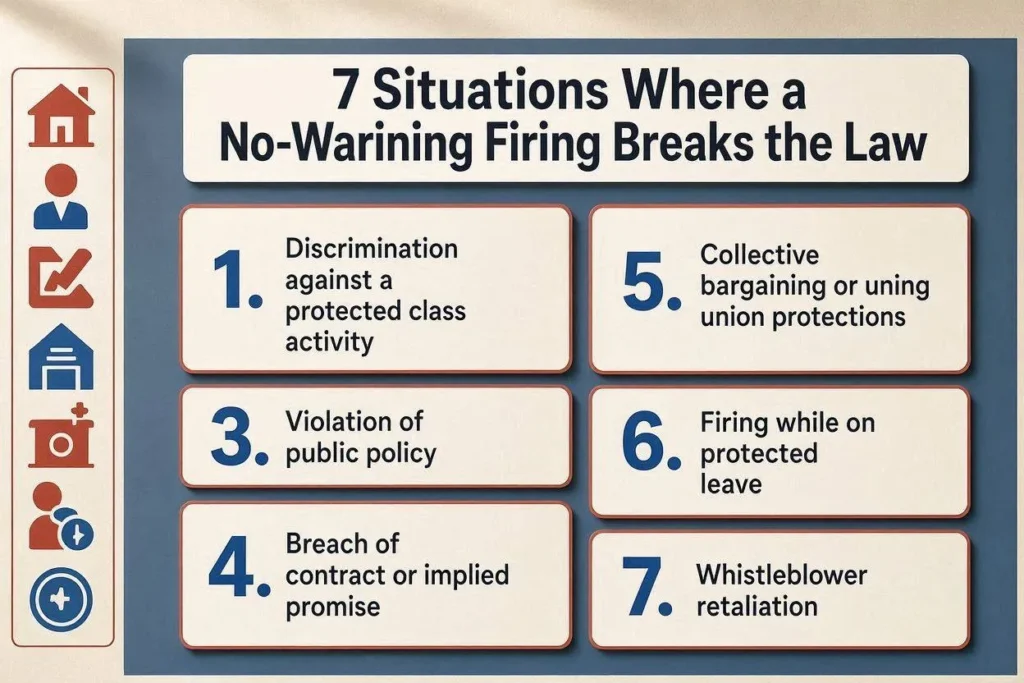
At-will employment is a default setting, not an absolute rule. Federal law, state law, and contract law all carve out exceptions, and your no-warning firing crosses into wrongful termination territory when the true motive lands in any of the following seven categories.
1. Discrimination Against a Protected Class
Federal law prohibits firing anyone because of race, color, religion, sex, national origin, pregnancy, disability, age over 40, or genetic information. Title VII of the Civil Rights Act of 1964 covers most of those categories, while the Americans with Disabilities Act (ADA) handles disability and the Age Discrimination in Employment Act (ADEA) protects workers 40 and older.
Company size matters here. Federal anti-discrimination laws generally apply to employers with 15 or more employees — 20 or more for age claims. State laws frequently reach smaller businesses: California’s Fair Employment and Housing Act (FEHA) covers employers with as few as 5 workers, and New York’s Human Rights Law covers employers of any size for harassment claims. Small-company workers who assume they have no protection are often wrong.
2. Retaliation for a Protected Activity
Retaliation has ranked as the number one charge category at the Equal Employment Opportunity Commission (EEOC) for more than a decade, appearing in over half of all charges filed. The law bars employers from firing you for protected activities, such as reporting harassment to HR, filing a workers’ compensation claim after an injury, taking leave under the Family and Medical Leave Act (FMLA), reporting safety hazards to the Occupational Safety and Health Administration (OSHA), or blowing the whistle on illegal company conduct.
Timing carries enormous weight in retaliation cases. You complained about your manager on March 3 and got fired on March 14 with no warning and no explanation? That 11-day gap becomes the centerpiece of your claim. Judges and juries understand suspicious timing without needing a law degree.
3. Public Policy Violations
Every state except a handful recognizes a public policy exception to at-will employment. Your employer cannot fire you for serving on a jury, taking time off to vote, filing a legitimate legal claim, or refusing to commit an illegal act on the company’s behalf. A trucking company that fires a driver for refusing to exceed federal hours-of-service limits has violated public policy, warning or no warning.
4. Talking About Pay With Coworkers
Almost nobody knows this one. Section 7 of the National Labor Relations Act (NLRA) protects “concerted activity” — two or more employees discussing wages, hours, or working conditions — and the protection applies even when no union exists anywhere in the company. An employer who fires you for comparing salaries with a coworker, or for a group text complaining about mandatory overtime, has violated federal law enforced by the National Labor Relations Board (NLRB). Those “don’t discuss your pay” policies you’ve seen in handbooks? Generally unenforceable, and firing someone over them invites an NLRB charge.
5. A Written Employment Contract
A signed contract overrides the at-will default completely. Contracts that require “cause” for termination, guarantee a fixed term of employment, or spell out a mandatory disciplinary procedure bind the employer to those terms. Firing a contracted executive without following the contract’s termination clause is a straightforward breach of contract claim, and the missing warning becomes the breach itself rather than a side detail.
6. An Employee Handbook That Acts Like a Contract
Handbooks occupy a genuine gray zone. Courts in some states — Michigan, New Jersey, and Wyoming among them — have held that a handbook promising progressive discipline can create an implied contract, meaning the employer must follow its own stated steps before firing anyone. Other states reject the implied contract theory outright, especially when the handbook carries a clear at-will disclaimer on page one. Whether your handbook helps you is a state-specific question, which makes it one of the best reasons to spend 30 minutes with a local employment attorney rather than a national blog post.
7. A Union Collective Bargaining Agreement
Union members essentially opt out of at-will employment. Collective bargaining agreements (CBAs) almost universally require just cause for termination plus a documented disciplinary process, and violations run through the union’s grievance procedure rather than a personal lawsuit. Fired union workers should call their steward before calling a lawyer — the CBA usually offers a faster path to reinstatement than any court.
Government Employees Play by Different Rules
Public-sector workers get protections their private-sector neighbors can only envy. Federal employees who complete their probationary year become permanent, and permanent federal workers can generally only be removed for documented performance problems, misconduct, or medical inability to do the job — with advance written notice, a chance to respond, and appeal rights through the Merit Systems Protection Board. State and municipal employees frequently enjoy similar civil-service protections, and many hold constitutional due-process rights in their jobs that require notice and a hearing before termination. A no-warning firing that would be routine at a private company can be flatly illegal at a government agency.
Mass Layoffs: When the Law Requires 60 Days’ Notice
Individual firings need no notice, but large-scale layoffs are a different animal. The Worker Adjustment and Retraining Notification (WARN) Act requires employers with 100 or more full-time employees to provide 60 calendar days (roughly 2 months) of written notice before a plant closing or a mass layoff affecting 50 or more workers at a single site. Employers who skip the notice owe affected workers back pay and benefits for every day of the shortfall, up to the full 60 days.
Several states stack stricter “mini-WARN” laws on top of the federal floor. New York requires 90 days of notice and applies to employers with just 50 employees. New Jersey demands 90 days plus mandatory severance of one week per year of service — the only state to require severance by statute. California’s version covers layoffs of 50 or more workers regardless of what percentage of the workforce they represent. Workers caught in sudden large layoffs frequently leave real money on the table because nobody told them two layers of notice law existed.
Why a Missing Warning Can Strengthen Your Case
Now for the twist I promised, and honestly, my favorite part of this entire topic.
An employer who fires you without warning has committed to nothing on paper. Reality then forces a commitment. When you file for unemployment benefits, the employer bears the burden of proving misconduct if they want to block your claim — and “we never documented any problems” is a losing hand at that hearing. When you file a discrimination charge, the EEOC requires the employer to state a legitimate, non-discriminatory reason for the firing. A reason that surfaces for the first time months after the termination, or that shifts between the unemployment hearing and the EEOC response, reads to courts as pretext — a manufactured excuse covering an unlawful motive.
Employment lawyers frame this through the McDonnell Douglas test, a burden-shifting framework from a 1973 Supreme Court case that still governs most discrimination claims. You establish the basic facts suggesting discrimination (protected class, qualified for the job, fired, suspicious circumstances). The employer then offers its legitimate reason. The burden swings back to you to prove that reason false. Sudden terminations with zero warnings, aimed at employees carrying years of strong reviews, hand you the pretext argument almost gift-wrapped.
The sharpest version of this argument involves differential treatment. Suppose your employer routinely gave struggling employees written warnings and improvement plans, then fired you cold two weeks after you reported harassment. The absence of a warning — measured against the warnings your coworkers received — becomes direct evidence you were singled out. Employers skip the paper trail thinking silence protects them. Sometimes the silence testifies louder than any document could.
Money and Benefits After a Sudden Firing
Four financial questions hit within days of a no-warning termination, and competitor articles almost never answer them with real numbers.
Your final paycheck deadline depends on state law, not payroll convenience. California and Colorado require payment of all earned wages, including accrued vacation, on the day of an involuntary termination. Texas allows 6 calendar days. New York permits payment by the next regular payday. Late payment triggers penalties in many states — California charges the employer one full day of your wages for each day the check runs late, capped at 30 days, which can add thousands of dollars to what you’re owed.
Health insurance survives the firing if you act within 60 days. The Consolidated Omnibus Budget Reconciliation Act (COBRA) lets workers at companies with 20 or more employees continue their group health plan for up to 18 months. You pay the full premium plus a 2% administrative fee, which hurts, but the 60-day election window works retroactively — coverage backdates to your termination date even if you sign up on day 59.
Severance follows different rules for workers 40 and older. No federal law requires severance pay, but any severance agreement asking a worker 40+ to waive age discrimination claims must comply with the Older Workers Benefit Protection Act (OWBPA): 21 days to consider the agreement (45 days in a group layoff), plus 7 days to revoke after signing. Agreements skipping those windows are legally defective, and the waiver inside them may be worthless to the employer. Whatever your age, never sign a severance agreement in the termination meeting. I watched a colleague turn a 4-week severance offer into 12 weeks after a $300 attorney review found the company had botched its own release language.
Unemployment eligibility turns on “misconduct,” not on being fired. Getting fired does not disqualify you from unemployment benefits — only misconduct does, and states define misconduct narrowly as deliberate rule violations or willful disregard of the employer’s interests. Ordinary poor performance, personality conflicts, and “not a good fit” firings qualify you for benefits in every state. File immediately, because the claim costs nothing and the employer’s stated reason on that filing gets locked into the record.
What to Do in Your First 7 Days
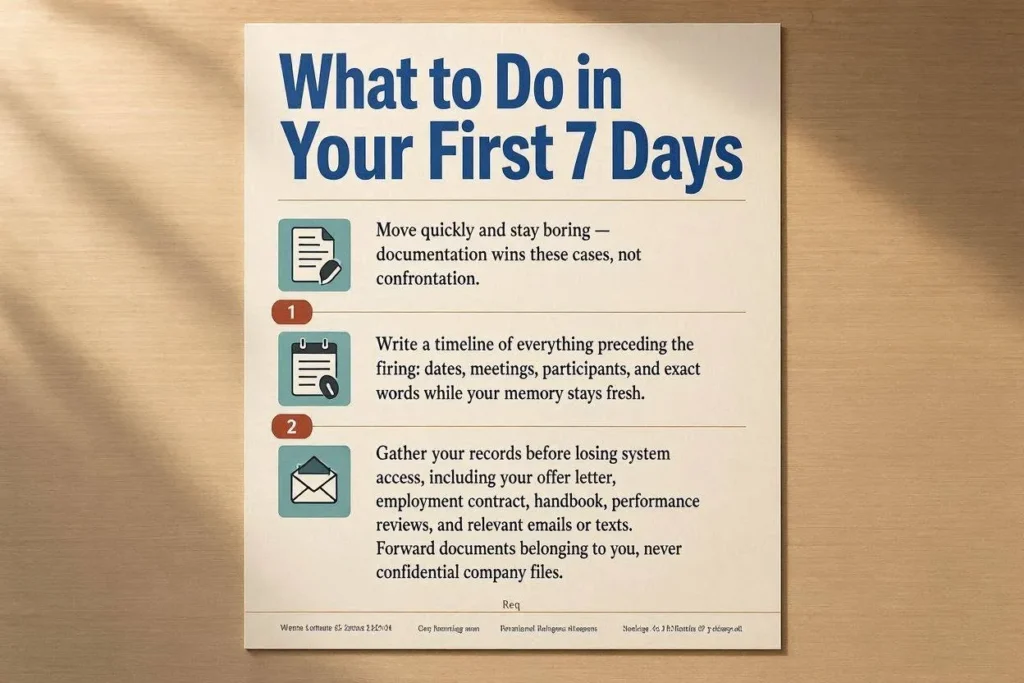
Move quickly and stay boring — documentation wins these cases, not confrontation.
- Write a timeline of everything preceding the firing: dates, meetings, participants, and exact words while your memory stays fresh.
- Gather your records before losing system access, including your offer letter, employment contract, handbook, performance reviews, and relevant emails or texts. Forward documents belonging to you, never confidential company files.
- Request your personnel file in writing. States such as California, Illinois, and Massachusetts grant employees a legal right to a copy within set deadlines.
- File for unemployment benefits the same week, both for income and to force the employer’s reason onto the record.
- Ask HR in writing why you were fired, and preserve the answer — or the refusal to answer, which speaks for itself.
- Decline to sign anything presented in the termination meeting, especially a release of claims attached to severance money.
- Book a consultation with an employment lawyer if any red flag below matches your situation. Most offer free case evaluations and work on contingency.
Deadlines here are unforgiving. Discrimination and retaliation charges must reach the EEOC within 180 days of the firing, extended to 300 days in states operating their own fair employment agency. Strong cases die on missed deadlines every single week.
Red Flags That Point to an Illegal Firing
Certain patterns show up in wrongful termination cases so reliably that lawyers screen for them in the first phone call. Watch for suspicious timing, such as a firing within weeks of a harassment complaint, an injury report, an FMLA request, or a pregnancy announcement. Watch for shifting explanations, where the reason changes between your termination meeting, the unemployment filing, and the EEOC response. Watch for uneven treatment, where coworkers who committed identical infractions kept their jobs and their warning letters. Watch for a sudden “performance problem” appearing after years of positive reviews. One red flag suggests bad luck. Two or more suggest pretext, and pretext is where cases get won.
The Bottom Line
Most no-warning firings in America are legal, because at-will employment is a genuinely employer-friendly doctrine and 49 states enforce it. Legal and untouchable aren’t the same thing, though. Discrimination, retaliation, contract breaches, public policy violations, protected pay discussions, and mass layoff notice laws all cut through the at-will shield — and a missing warning, far from dooming your case, often becomes the evidence that exposes what the employer was really doing. Spend your first week documenting instead of despairing, file for unemployment without delay, and let a lawyer spend 30 free minutes telling you whether you’re holding a bad memory or a claim. Employers count on fired workers assuming nothing can be done. Prove that assumption wrong when the facts are on your side.
This article covers US employment law as of 2026 for general information and isn’t legal advice. State laws vary, and your specific facts control the outcome. Consult a licensed employment attorney in your state about your situation.
FAQs

Amanda Brooks
Amanda Brooks leads JusticeInTown’s legal, justice, and community advocacy content division. She holds a background in legal research and public policy and specializes in topics related to civil rights, access to justice, legal awareness, and community issues. With years of experience researching legal and social justice topics, Amanda brings a careful, research-driven approach to complex legal information and public-interest issues. She is the primary author of JusticeInTown’s legal guides, justice-related resources, and community-focused content, helping readers better understand their rights, legal options, and the issues affecting their communities.
Related Posts