
What Is Wrongful Termination? Definition, Examples & Deadlines (2026)
Wrongful termination is a firing that violates federal law, state law, an employment contract, or public policy. That single word — illegal — is what separates a wrongful termination from a firing that’s merely unfair, and honestly, the difference trips up almost everyone who searches for this topic after losing a job.
Here’s the uncomfortable truth up front. Your boss can fire you for a bad reason, a petty reason, or no reason at all, and in 49 states that firing is perfectly legal. What your boss can’t do is fire you for an illegal reason. The entire question of wrongful termination comes down to which side of that line your situation falls on.
This guide walks through where that line sits, the deadlines that can kill a valid claim (some are as short as 180 days), and what to do in the first few days after a firing — because the choices you make that week matter more than most people realize.
At-Will Employment: Why Most Firings Are Legal
At-will employment means either the employer or the employee can end the working relationship at any time, for almost any reason, without notice. Every US state follows the at-will rule by default except one. Montana requires employers to show “good cause” for firing most employees who’ve completed their probationary period, under the Montana Wrongful Discharge from Employment Act — a fact that surprises people, and one that almost no article on this topic bothers to mention.
The at-will rule cuts both ways. You can quit tomorrow without giving two weeks’ notice, and your employer can let you go tomorrow without giving you a warning first. No federal law requires a warning, a performance improvement plan, or even an explanation. Getting fired by email feels cold, but the delivery method is legal too.
So where does wrongful termination fit? Think of at-will employment as the default setting, and the illegal reasons as carve-outs. The carve-outs are narrower than most fired employees hope, but they’re real, they’re enforceable, and they cover more situations than the average HR department would like you to know.
The Reasons That Make a Firing Illegal
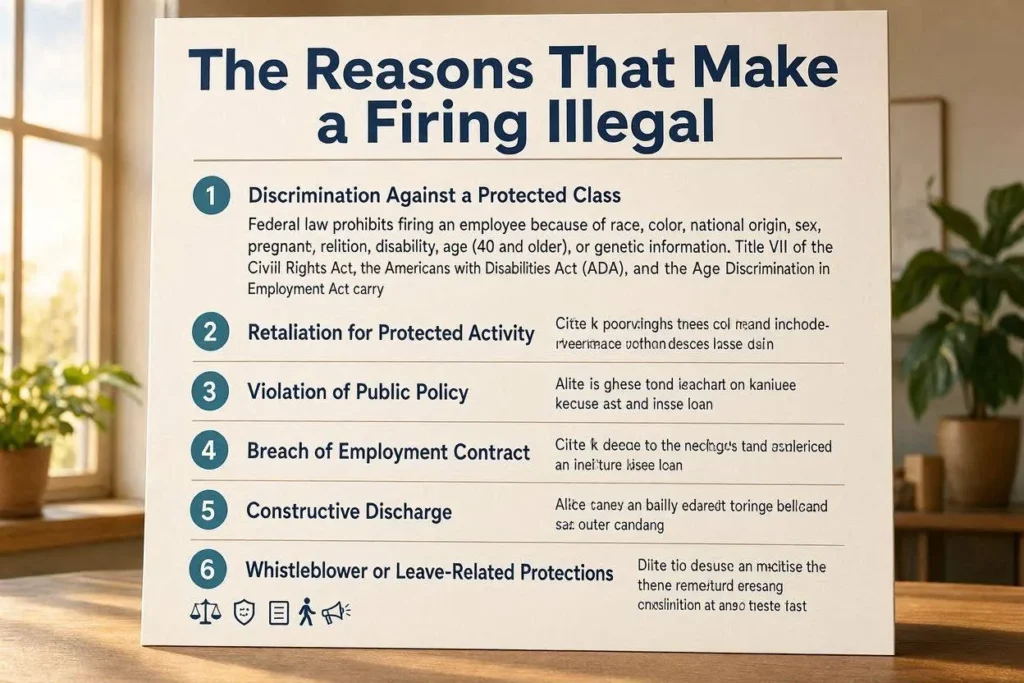
Six categories of firings cross the legal line. Most wrongful termination cases fall into the first two.
Discrimination Against a Protected Class
Federal law prohibits firing an employee because of race, color, national origin, sex, pregnancy, religion, disability, age (40 and older), or genetic information. Title VII of the Civil Rights Act, the Americans with Disabilities Act (ADA), and the Age Discrimination in Employment Act carry most of the weight here. The Pregnant Workers Fairness Act (PWFA), which took effect in 2023, added a requirement that employers provide reasonable accommodations for pregnancy — so firing someone instead of accommodating a pregnancy-related limitation now violates federal law directly.
State laws often go further. California’s Fair Employment and Housing Act and New Jersey’s Law Against Discrimination (NJLAD) protect marital status, and both states apply their rules to smaller employers than federal law reaches. Federal discrimination statutes generally kick in at 15 employees (20 for age claims); some state laws apply from the very first hire.
Retaliation for Protected Activity
Retaliation means firing an employee for exercising a legal right or reporting misconduct, and the Equal Employment Opportunity Commission (EEOC) reports retaliation in roughly half of all charges filed — making retaliation the single most common basis for a claim, more common than discrimination itself.
Protected activities include reporting harassment or discrimination, filing a workers’ compensation claim after an injury, complaining about unpaid overtime under the Fair Labor Standards Act (FLSA), reporting safety violations to the Occupational Safety and Health Administration (OSHA), taking leave under the Family and Medical Leave Act (FMLA), and discussing pay with coworkers. That last one catches people off guard. The National Labor Relations Act (NLRA) protects wage conversations between employees, so a company policy banning salary discussions doesn’t just fail — firing someone for breaking that policy is itself illegal.
A realistic example of how these cases look: an employee reports her manager for sexual harassment in March, receives her first negative performance review in April after six years of positive ones, and gets terminated in May for “performance issues.” Nothing in that sequence proves retaliation on its own. The timing, the sudden reversal in reviews, and the thin paper trail together form exactly the pattern that employment lawyers build cases around.
Breach of Contract
Employees with a written contract can sue for wrongful termination if the employer fires them in violation of the contract’s terms. A contract that permits termination only “for cause” — meaning a legitimate business justification, such as documented poor performance or economic layoffs — removes the at-will default entirely.
Implied contracts count too, and courts have enforced them for decades. An employee handbook that lays out a progressive discipline system (verbal warning, written warning, suspension, then termination) can create an implied promise that the employer will follow those steps. In Nicosia v. Wakefern, the New Jersey Supreme Court held that handbook language promising for-cause termination created an enforceable implied contract. Years of strong reviews, promotions, and verbal assurances of job security strengthen an implied contract argument; a signed at-will acknowledgment in the handbook weakens one considerably.
Union members get contract protection through their collective bargaining agreement. A union employee who believes the firing lacked just cause files a grievance through the union rather than heading straight to court — the union then decides whether to arbitrate, and it owes the member a duty of fair representation in making that call.
Violations of Public Policy
Courts in most states recognize wrongful discharge claims when the firing punishes an employee for doing something the law protects or encourages. Four situations dominate this category: refusing to commit an illegal act (an accountant fired for refusing to falsify tax filings), performing a civic duty (serving on a jury), exercising a statutory right (filing for workers’ comp), and whistleblowing to a government agency.
Whistleblowers get an extra layer of protection through agency-specific programs. Reports of workplace safety hazards go to OSHA, securities fraud tips go to the Securities and Exchange Commission (SEC), tax fraud reports go to the Internal Revenue Service (IRS), and mine safety complaints go to the Mine Safety and Health Administration (MSHA). Each program prohibits firing the person who filed the report.
Constructive Discharge
Constructive discharge happens when working conditions become so intolerable that a reasonable person would feel forced to quit. The law treats that resignation as a firing. Employers sometimes engineer these situations deliberately — slashing hours, reassigning someone to a windowless basement office, or tolerating open harassment — precisely because a resignation looks cleaner on paper than a termination. Courts see through the tactic, though the employee carries a heavier burden of proof than in a straightforward firing.
Mass Layoffs Without Notice
The federal Worker Adjustment and Retraining Notification (WARN) Act requires employers with 100 or more full-time employees to give 60 days’ written notice (about two months) before a plant closing or mass layoff. Several states expanded the rule — New Jersey’s version requires 90 days and mandates severance pay. A layoff itself is legal; skipping the notice window is what triggers liability, and affected workers can recover back pay for each day of missing notice.
What Wrongful Termination Is NOT
This section exists because the gap between “unfair” and “illegal” generates most of the confusion around this topic, and frankly, most of the disappointing conversations in employment lawyers’ offices.
Getting fired without warning isn’t wrongful termination. Getting fired for a mistake someone else made isn’t either, as long as the real motive wasn’t discriminatory or retaliatory. A firing based on personality conflict, favoritism, office politics, an unproven accusation, or a manager who simply doesn’t like you — all legal under at-will employment. Termination over a political post on your personal social media is generally legal too when the employer is a private company, since the First Amendment restricts government action, not private employers (a handful of states, including California, protect off-duty political activity by statute).
The test is never whether the reason was good. The test is whether the reason was prohibited. An employer can fire you for wearing a green shirt on a Tuesday. An employer cannot fire you for being pregnant and claim the green shirt was the reason — and proving which reason actually drove the decision is where these cases are won or lost.
How to Prove Wrongful Termination

Winning a wrongful termination claim requires evidence connecting a protected characteristic or protected activity to the firing decision. Employers rarely announce illegal motives, so lawyers build the connection from three elements.
Timing comes first. A termination that lands two weeks after a harassment complaint tells a story; a termination two years later usually doesn’t. Documentation comes second — performance reviews, commendation emails, and raise histories that contradict the employer’s stated reason for the firing carry enormous weight. Motive evidence comes third: biased comments from decision-makers, coworkers outside your protected class who kept their jobs after identical conduct, or a “restructured” position that got refilled a month later.
Start collecting before you lose access. Forward performance reviews, complaint emails, and relevant messages to a personal account while you still can (without taking confidential company data — that distinction matters legally). Write a dated timeline of events while your memory is fresh. Get contact information for coworkers who witnessed the discrimination or the complaint you made. Cases settle or collapse on documentation, and the employee who saved everything negotiates from a completely different position than the one who saved nothing.
Deadlines: How Long You Have to File
Wrongful termination deadlines are short, and missing one permanently bars the claim regardless of how strong the evidence is.
| Claim Type | Deadline | Where to File |
| Federal discrimination/retaliation | 180 days (roughly 6 months); extended to 300 days (about 10 months) in states with their own fair-employment agency | EEOC |
| Post right-to-sue letter lawsuit | 90 days (about 3 months) from receiving the letter | Federal or state court |
| California wrongful termination (public policy) | 2 years from termination date | State court |
| California discrimination (Civil Rights Department) | 3 years to file the administrative complaint | CRD |
| OSHA safety retaliation | 30 days (about 1 month) | OSHA |
| FLSA wage retaliation | 2 years (3 years for willful violations) | Court or DOL |
The 30-day OSHA window deserves emphasis. Someone fired for reporting a safety hazard has one month — not one year — to act, which is why “I’ll deal with the legal stuff after I find a new job” turns out to be such an expensive plan.
What to Do in the First 72 Hours
Three moves protect a potential claim in the days right after a firing, and one mistake undermines it.
Don’t sign the severance agreement at the meeting. Severance agreements almost always include a release of claims — signing one typically waives the right to sue, and employers know a stunned, scared employee signs faster than a rested one who’s talked to a lawyer. You’re allowed to take the document home. Workers 40 and older get a legal minimum of 21 days to consider any agreement waiving age discrimination claims, plus 7 days to revoke after signing, under the Older Workers Benefit Protection Act. A lawyer can often negotiate the severance number upward, which regularly pays for the consultation many times over.
Request your personnel file in writing. Around 20 states, including California, give employees a legal right to a copy, and the file locks in the employer’s version of events before anyone can improve it.
File for unemployment benefits immediately — more on that below. Then write everything down: who said what at the termination meeting, the stated reason, who was in the room, and the sequence of events over the prior six months.
The EEOC Process and the Right-to-Sue Letter
You can’t just sue for federal discrimination — the law requires filing a charge with the EEOC first, a step called exhausting administrative remedies. Skipping it gets a lawsuit dismissed no matter how strong the underlying facts are.
The process runs in a fixed sequence. You file the charge (online through the EEOC public portal, by phone, or at a field office), the EEOC notifies the employer within 10 days, and an investigation follows that commonly takes 6 to 12 months. The agency then either pursues the case itself (rare — the EEOC litigates fewer than 1% of charges), facilitates a settlement through mediation, or issues a Notice of Right to Sue. That letter is the key that unlocks the courthouse door, and it starts the 90-day clock for filing a lawsuit. You can request the letter after 180 days if the investigation is still dragging and you’d rather move straight to court.
State agencies run parallel tracks. California’s Civil Rights Department and New Jersey’s Division on Civil Rights handle state-law claims, and filing with one agency usually cross-files with the other automatically.
What You Can Recover
Damages in a wrongful termination case aim to put the employee in the financial position the illegal firing took away. Back pay covers lost wages and benefits from the termination date forward, including the value of health insurance and retirement contributions. Front pay covers projected future losses when getting the job back isn’t realistic. Emotional distress damages compensate for the anxiety, humiliation, and reputational harm — and yes, courts recognize damage to professional reputation as a real, compensable loss.
Punitive damages punish employers who acted with malice or reckless indifference. Federal law caps combined emotional distress and punitive damages under Title VII on a sliding scale by company size: $50,000 for employers with 15 to 100 employees, rising to $300,000 for employers with more than 500. State-law claims in places like California carry no such caps, which is one reason plaintiffs’ lawyers file under state statutes whenever the facts allow.
Most cases never see a courtroom. Settlements resolve the large majority, typically landing somewhere between a few months’ and a couple of years’ salary depending on evidence strength, the employer’s exposure, and how badly each side wants to avoid discovery.
Can You Get Unemployment After Wrongful Termination?

Yes — and this question matters because so many people wrongly assume a firing disqualifies them. Unemployment insurance covers employees who lost work through no fault of their own, and every state’s definition of disqualifying “misconduct” requires something worse than poor performance or a personality clash. A wrongfully terminated employee almost always qualifies.
File the claim in week one. Benefits typically replace 40 to 50% of prior wages up to a state cap, they don’t reduce a future settlement, and collecting them doesn’t weaken a legal claim in any way. If the employer contests the claim and loses at the unemployment hearing, the hearing record sometimes even produces useful sworn testimony for the wrongful termination case later. Small silver lining.
What a Lawyer Actually Costs
Most employment lawyers take wrongful termination cases on contingency — the lawyer collects a percentage of the recovery, usually 33 to 40%, and collects nothing without a win or settlement. Initial consultations run free at many firms. That fee structure means the realistic barrier isn’t cost; the barrier is case strength, because contingency lawyers only accept claims they believe will pay. A lawyer declining your case is genuinely useful information, and getting a second opinion before giving up costs nothing.
Several federal and state statutes shift attorney’s fees to the losing employer on top of damages, which gives lawyers extra incentive to take strong statutory claims even when the wage losses are modest.
Final Thoughts
Wrongful termination law rewards people who move fast and document everything, and it punishes hesitation without mercy. A strong claim with a missed 180-day deadline is worth exactly nothing, while a moderate claim backed by saved emails, a dated timeline, and a timely EEOC charge settles for real money every single day. The law can’t make a firing fair. What the law can do — when the reason crossed from unfair into illegal — is make the employer pay for it, but only for the employees who protect their rights while the window is still open.
FAQs

Amanda Brooks
Amanda Brooks leads JusticeInTown’s legal, justice, and community advocacy content division. She holds a background in legal research and public policy and specializes in topics related to civil rights, access to justice, legal awareness, and community issues. With years of experience researching legal and social justice topics, Amanda brings a careful, research-driven approach to complex legal information and public-interest issues. She is the primary author of JusticeInTown’s legal guides, justice-related resources, and community-focused content, helping readers better understand their rights, legal options, and the issues affecting their communities.
Related Posts