
Employee Rights After Workplace Injury: What Your Employer Won’t Tell You
Getting hurt on the job comes with an immediate legal safety net, even if nobody at your company walks you through it. You’re entitled to medical treatment, wage replacement, and protection from retaliation the moment an injury happens, whether or not your employer admits fault. The catch is that workers’ compensation is state-regulated, so the rules in Ohio aren’t the rules in New York, and the pamphlet your HR department hands you tends to leave out the parts that actually matter. Honestly, most of what gets left out isn’t an accident. Insurance carriers make more money when workers don’t know what they’re owed. Here’s what you’re actually entitled to, and where most people get tripped up.
You Have More Rights Than Your Employer Wants You to Use

The moment you get hurt on the job, you’re entitled to medical treatment, wage replacement, and protection from retaliation, whether or not your employer admits fault. That’s the short version. The long version is messier, because workers’ compensation is state-regulated, which means the rules in Ohio aren’t the rules in New York, and the pamphlet your HR department hands you leaves out the parts that actually matter. Insurance carriers make more money when workers don’t know what they’re owed.
Let’s get into it properly.
The First 72 Hours Matter More Than People Think
Nobody tells you this part, but the first three days after a workplace injury shape everything that comes after. Skip a step here and you can hand the insurance company an excuse to deny your claim later.
First, report the injury. Most states give you a narrow window, sometimes as short as 30 days, though some states allow up to a year. Don’t wait to see how you feel tomorrow. Tell your supervisor in writing, even if you already told them out loud, and keep a copy for yourself. A text message with a timestamp counts. An email counts. A verbal “hey, I hurt my back” that nobody wrote down does not hold up nearly as well.
Second, get medical treatment, and get it from a source that’s actually documented. Some states require you to see a doctor from an employer-approved list for your first visit. If your employer sends you to their clinic, go, but say exactly what happened and how it happened, in plain terms, because that first medical record becomes the anchor document for your entire claim. Adjusters read it line by line looking for anything that contradicts what you say later.
Third, do not give a recorded statement to the insurance adjuster without thinking it through first. This is where a lot of people trip themselves up. The adjuster isn’t hostile on the phone, they’re actually pretty friendly, which is exactly the point. A casual comment like “it’s not that bad” or “I’ve had back issues before” can get used against you weeks later, out of context, to argue your injury isn’t work-related or isn’t as serious as your doctor says.
Fourth, write down what happened while it’s fresh. Names of coworkers who saw it, the exact location, what equipment was involved, the time. Memory fades fast, and insurance investigations sometimes don’t start for weeks.
Fifth, avoid posting about it on social media. I know that sounds paranoid, but claims adjusters do look, and a photo of you at your nephew’s birthday party smiling can get twisted into “not that injured” even if you were in pain the whole time and left early.
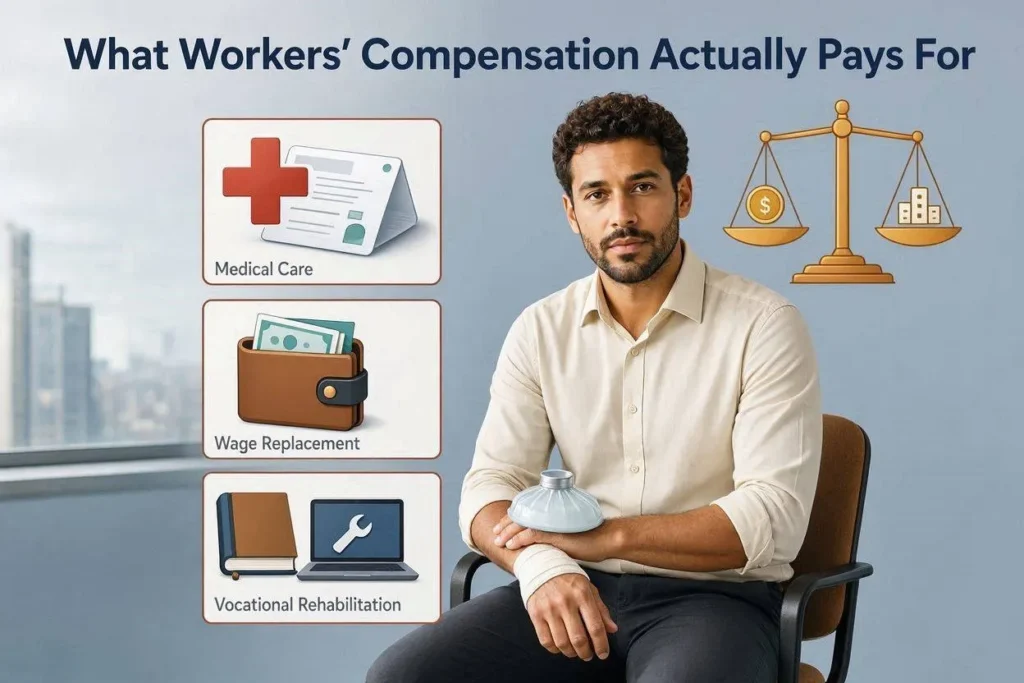
What Workers’ Compensation Actually Pays For
Workers’ compensation is a no-fault system. That’s the whole design of it. You don’t need to prove your employer did anything wrong, and in exchange, you generally give up the right to sue your employer directly for the injury. It’s a trade-off, and it’s called the exclusive remedy doctrine, though almost nobody uses that phrase out loud. Your employer’s injury lawyer knows the term. You probably don’t, and that gap in vocabulary is part of why so many workers don’t realize there’s a separate path available in certain cases (more on that below).
Coverage generally falls into a few buckets:
- Medical treatment — doctor visits, surgery, physical therapy, prescriptions, and in most states, this is a lifetime benefit for the injury in question unless you sign it away through a settlement.
- Lost wages — typically about two-thirds of your average weekly wage while you’re out, though the exact fraction and the cap vary by state.
- Permanent disability benefits — paid differently depending on whether the impairment is partial or total, and whether it’s scheduled (a specific body part) or unscheduled (a broader loss of earning capacity).
- Vocational rehabilitation — job retraining or placement help if you can’t return to your old role.
Here’s a fact that surprises a lot of people: medical care under workers’ comp often doesn’t have a hard end date. As long as the treatment relates to the original injury, the carrier keeps paying, sometimes for decades, unless you agree to a lump-sum settlement (often called a Section 32 waiver in New York, with equivalent names elsewhere) that closes out future medical rights in exchange for a payout now. Read that kind of agreement slowly. Once you sign it, the lifetime benefit is gone.
The Exclusive Remedy Doctrine, and the Loophole Almost Nobody Explains Clearly
Because workers’ comp is no-fault, you generally can’t sue your employer for a workplace injury even if they were careless. That’s the trade. But the doctrine only protects your employer, not everyone else on the job site.
Say you’re a subcontractor’s employee and you get hurt because a general contractor left a scaffold unsecured. You can still collect workers’ comp from your own employer, and separately, you may be able to sue the general contractor for negligence, because they’re a third party, not your employer. Construction sites are full of this exact scenario. So are delivery jobs where a faulty piece of equipment owned by another company causes the injury.
One thing that rarely gets mentioned: if you win a third-party lawsuit, the workers’ comp carrier that paid your medical bills and wage benefits usually has a right to be reimbursed out of that settlement. It’s called subrogation, and it can eat a meaningful chunk of what you’d otherwise keep. A lawyer who handles both claims together can often negotiate that lien down. A lawyer who only knows one side of it might not even flag it.
Retaliation and Discrimination: What Your Employer Legally Cannot Do
Filing a workers’ comp claim is a protected activity in every state. Your employer cannot fire you, demote you, cut your hours, or otherwise punish you specifically because you filed. If that happens, it’s retaliation, and it’s illegal, full stop.
Proving it is a different matter, and timing helps a lot. If you’re written up for the first time ever two weeks after you report an injury, that timeline alone is worth documenting. Keep performance reviews, emails, anything that shows your standing before the injury versus after. Discrimination claims tied to a disability arising from the injury typically have to be filed within a set window, often around 180 days to two years depending on the state and which agency you’re filing with, so don’t sit on it.
The Independent Medical Examination: The Part That Quietly Kills the Most Claims
If there’s one gap that almost every article on this topic skips, it’s the independent medical examination, usually shortened to IME. Once you’re on workers’ comp, the insurance carrier has the right to send you to a doctor of their choosing, not yours, to evaluate your injury. Despite the name, “independent” is doing a lot of work in that phrase, because the carrier is paying that doctor’s bill.
It’s common, not rare, for an IME doctor to conclude you’ve reached maximum medical improvement earlier than your own doctor thinks, or that your restrictions are lighter than what you’re actually feeling. When that happens, your benefits can get reduced or cut off entirely based on that one report. You’re allowed to have your treating physician respond in writing, and you’re allowed, in most states, to request a second opinion or a hearing where a judge weighs both medical opinions. Don’t skip the appointment. Missing an IME without a good reason can get your benefits suspended on the spot, regardless of how legitimate your injury is.
What Happens If Your Employer Doesn’t Have Workers’ Comp Insurance
This one gets almost no coverage anywhere, and it should get more. Every state requires most employers to carry workers’ comp insurance, but plenty of small and mid-size employers skip it illegally, betting that nobody gets hurt. If you’re injured and find out your employer has no coverage, you are not simply out of luck, even though it might feel that way at first.
Most states run an uninsured employers’ fund, sometimes called a special disability fund or similar, that steps in to pay benefits when the employer failed to carry insurance. You still have to file a claim, often through the same state workers’ comp board, and the process usually takes a bit longer because the fund investigates the employer’s status first. Separately, an uninsured employer can often be sued directly and doesn’t get the exclusive remedy protection that insured employers have, because they broke the law by not carrying coverage in the first place. That’s a real advantage if you end up going that route with a lawyer.
“You’re a 1099 Contractor” — and Why That’s Not Always True
This is probably the single most common denial tactic, and it works because most workers don’t know how to push back. Your employer tells you that you’re an independent contractor, not an employee, which means (in their telling) you’re not covered by workers’ comp at all.
Job titles and 1099 tax forms don’t decide this. States use tests, most commonly some version of the “ABC test” or an “economic realities” test, that look at how much control the employer actually has over your schedule, your tools, your methods, and whether the work you do is central to the business itself. A delivery driver who’s told exactly which route to take, wears a company uniform, and drives a company-branded van is functioning like an employee no matter what the paperwork says. If you were misclassified, you can often challenge that status directly with the state labor department or the workers’ comp board, and if the challenge succeeds, coverage applies retroactively to your injury.
How ADA, FMLA, and Return-to-Work Rights Fit Together
Once you’re cleared to go back to work, or partially cleared, three separate systems can apply at once, and people mix them up constantly.
Workers’ comp handles the injury and the benefits tied to it. The Americans with Disabilities Act (ADA), which applies to employers with 15 or more employees, requires reasonable accommodations if your injury counts as a disability under the law, things like a modified schedule, different equipment, or a temporary change in duties. The Family and Medical Leave Act (FMLA), which applies to employers with 50 or more employees within a certain radius, guarantees up to 12 weeks of unpaid, job-protected leave, separate from whatever workers’ comp is paying you.
These three don’t always agree with each other. You might be medically cleared for light duty under workers’ comp while your FMLA leave is still running, and your employer has to figure out how those interact rather than picking whichever one is cheapest for them. If your employer offers you a “light duty” role that’s clearly designed to make you quit, or that ignores your actual medical restrictions, that’s worth flagging to your state’s labor board.
If Your Claim Gets Denied, Here’s What the Appeal Actually Looks Like
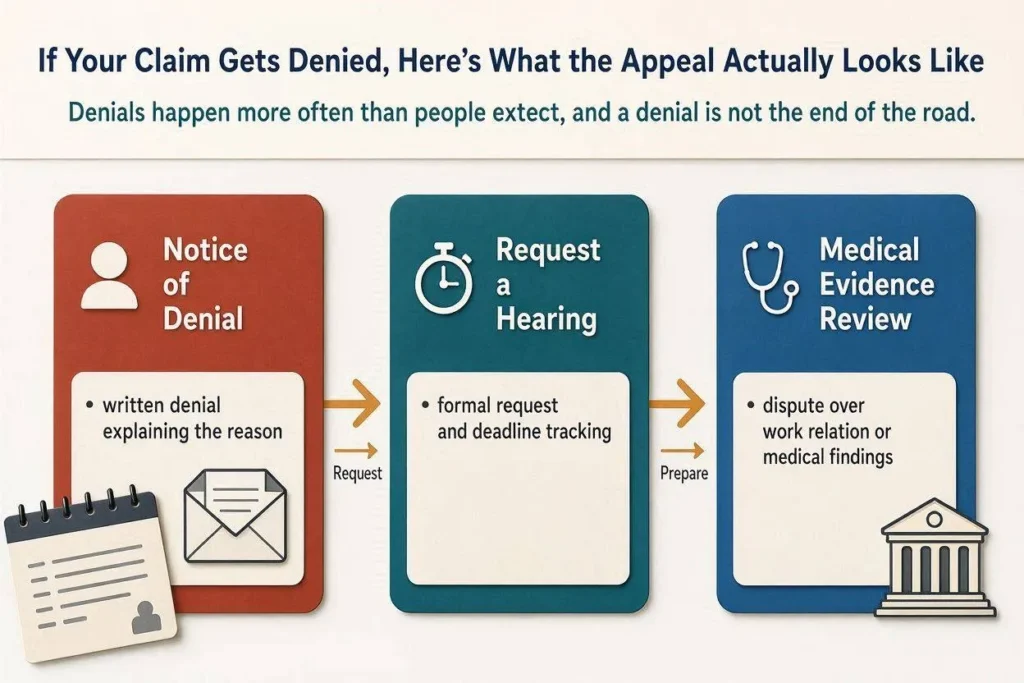
Denials happen more often than people expect, and a denial is not the end of the road. It’s usually the start of a formal process with real steps and real deadlines.
You’ll typically get a written denial notice explaining the reason, whether it’s a dispute over whether the injury is work-related, a missed deadline, or a disagreement about the medical evidence. From there, most states let you request a hearing in front of a workers’ comp judge or administrative law judge, sometimes within 30 to 60 days of the denial, so don’t let that window close while you’re deciding what to do. You can bring your own medical records, your own doctor’s testimony, and in a lot of cases, an attorney at this stage changes outcomes significantly, since insurance carriers show up with their own lawyers as a matter of routine. If the hearing doesn’t go your way, most states have a further appeal level, sometimes an appellate board and then the state court system after that.
The one thing that trips people up the most: missing that first appeal deadline because they assumed a phone call to the adjuster asking “can you reconsider” counted as an appeal. It usually doesn’t. Get the formal request filed in writing, on time, through the actual state process.
Why “It Depends on Your State” Is the Honest Answer, Not a Cop-Out
Workers’ compensation isn’t federal, aside from a few carve-outs like federal employees under the Federal Employees’ Compensation Act (FECA) and maritime workers under the Longshore and Harbor Workers’ Compensation Act. Everyone else falls under state law, and the differences aren’t small. Reporting deadlines range from a matter of days to a full year. Wage replacement percentages vary. Whether medical care is truly lifetime, or capped, depends entirely on where you live and work.
That’s frustrating if you’re hurt and just want a straight answer, and I get it. But the honest move here is telling you to check your specific state workers’ comp board’s website, or call them directly, because a generic national article (this one included) can only get you so far on the exact numbers.
Conclusion
Getting hurt at work throws enough at you already without having to untangle a system built on deadlines, forms, and fine print designed by people who don’t have your recovery as their top priority. The rights are real, and they’re yours whether or not anyone at your job spells them out. Report the injury in writing, get treatment on record, be careful what you say to an adjuster, and don’t sign anything closing out your future medical care until you understand exactly what you’re giving up. If a claim gets denied or an employer starts acting differently after you file, that’s usually the moment to call a workers’ comp attorney in your state rather than trying to sort it out solo. Most offer a free consultation, and at that point, you’re not paying for peace of mind, you’re paying for someone who already knows where the traps are.
FAQs

Amanda Brooks
Amanda Brooks leads JusticeInTown’s legal, justice, and community advocacy content division. She holds a background in legal research and public policy and specializes in topics related to civil rights, access to justice, legal awareness, and community issues. With years of experience researching legal and social justice topics, Amanda brings a careful, research-driven approach to complex legal information and public-interest issues. She is the primary author of JusticeInTown’s legal guides, justice-related resources, and community-focused content, helping readers better understand their rights, legal options, and the issues affecting their communities.
Related Posts