Can I Record My Boss at Work? What’s Legal in Every State (2026)
Yes, you can legally record a conversation with your boss in 39 states plus Washington, D.C., without telling anyone — as long as you’re part of the conversation. In the other 11 states, secret recording is a crime — a felony in Florida and Pennsylvania. And here’s the part most articles bury: your company can fire you for recording even where the recording itself is legal.
The honest answer has three layers. State wiretapping statutes decide whether the recording is legal, employment policy and at-will doctrine decide whether the recording is fireable, and the National Labor Relations Act occasionally overrides both. Getting this wrong doesn’t just risk a lawsuit — it can cost you the job you were trying to protect.
Quick note: this is general legal information, not legal advice. Talk to an employment attorney in your state before you do anything you can’t undo.
Workplace Recording Laws at a Glance
US workplace recording is governed by four authorities: the federal Electronic Communications Privacy Act (18 U.S.C. § 2511), state wiretapping and eavesdropping statutes, the National Labor Relations Act (29 U.S.C. §§ 157–158), and employer policy enforced through at-will employment. Federal law and 39 states permit one-party consent recording, while 11 states impose all-party consent under criminal penalties. National Labor Relations Board precedent, including Starbucks Corp., 372 NLRB No. 50 (2023), can preempt state consent law when a recording qualifies as protected concerted activity.
Consent Laws Decide Everything: One-Party vs. All-Party States
Every recording law in America comes down to one question: who has to agree to the recording before it happens?
Federal law sets the floor. The federal wiretap statute (18 U.S.C. § 2511, part of the Electronic Communications Privacy Act, or ECPA) allows you to record any conversation as long as one participant consents. You count as a participant. Press record on your own conversation with your manager and you’ve satisfied federal law, because you consented the moment you hit the button. Nobody else needs to know.
Most states copied that approach. These are called one-party consent states, and the list includes Texas, New York, Ohio, Georgia, Colorado, Virginia, New Jersey, North Carolina, Tennessee, Arizona, and about 28 others, plus Washington, D.C. Live in one of these states, and recording your own meeting with your boss — a performance review, a disciplinary write-up, a hallway conversation — breaks no recording law.
A minority of states went the other direction. All-party consent states (sometimes called two-party consent states) require every person in the conversation to agree before anyone records. Hit record in a private meeting in Los Angeles without your boss’s permission and you’ve committed a misdemeanor under California Penal Code § 632, punishable by a fine of up to $2,500 and up to 1 year in jail.
The gap between those two outcomes — totally fine in Houston, criminal in Sacramento — is why employment lawyers make “check your state’s recording statute first” the opening line of every consultation on this topic.
The 11 States Where Secret Recording Is Illegal
Memorize this list if you live in one of these states, because a recording that would be routine in Dallas becomes a criminal act here:
| All-Party Consent State | Key Statute | Penalty Class |
| California | Penal Code § 632 | Misdemeanor — up to $2,500 fine, 1 year jail |
| Delaware | 11 Del. Code § 1335 | Felony |
| Florida | Fla. Stat. § 934.03 | Third-degree felony — up to 5 years |
| Illinois | 720 ILCS 5/14-2 | Felony (when privacy expected) |
| Maryland | Cts. & Jud. Proc. § 10-402 | Felony — up to 5 years |
| Massachusetts | Ch. 272 § 99 | Felony — up to 5 years |
| Michigan | MCL § 750.539c | Felony (see participant exception below) |
| Montana | § 45-8-213 | Misdemeanor (“knowledge” required, not consent) |
| New Hampshire | § 570-A:2 | Felony / misdemeanor tiers |
| Pennsylvania | 18 Pa. C.S. § 5703 | Third-degree felony |
| Washington | RCW 9.73.030 | Gross misdemeanor |
Verify your state’s current statute before relying on this table — legislatures amend these laws, and the citations above reflect the law as competitor sources and public statute databases reported it heading into 2026.
Hybrid consent states: Nevada, Oregon, Connecticut, Michigan, Vermont
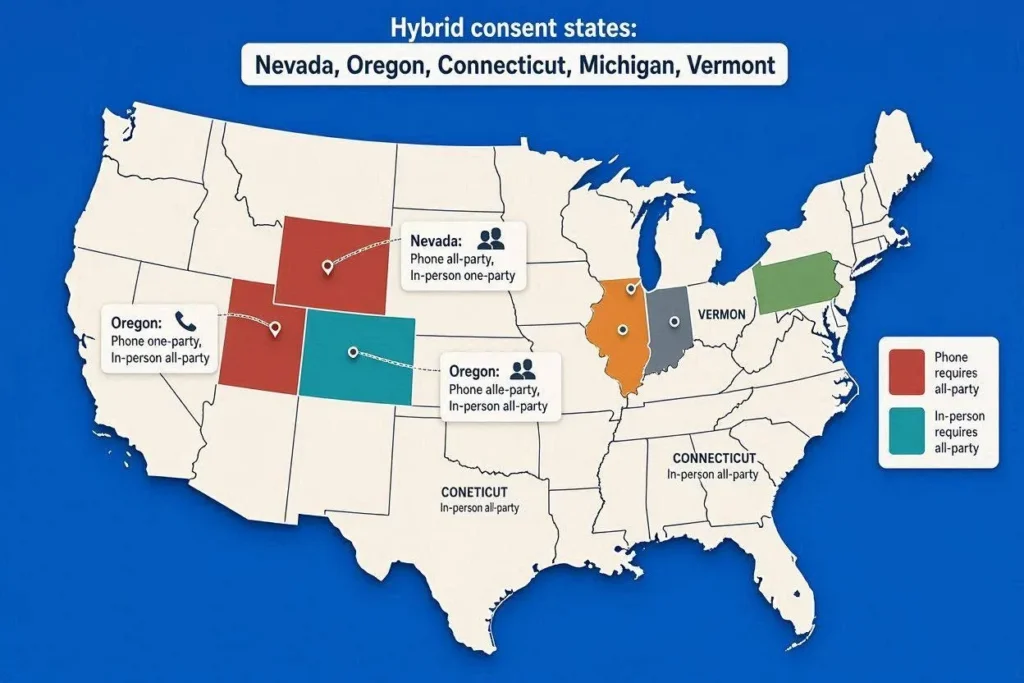
A few state wiretapping statutes refuse to fit the two boxes, and honestly this is where most internet legal advice falls apart:
- Nevada requires all-party consent for phone calls but only one-party consent for in-person conversations. Record your boss face-to-face in Las Vegas: legal. Record the same boss on a phone call: illegal.
- Oregon flips Nevada’s rule. Phone calls need one party’s consent; in-person conversations need everyone’s.
- Connecticut uses one-party consent for criminal purposes but creates civil liability for recording phone calls without all-party consent — so your boss could sue you even if prosecutors won’t touch you.
- Michigan courts read the state’s eavesdropping law to include a “participant exception.” You can record conversations you’re personally part of; you can’t plant a recorder to capture conversations between other people.
- Vermont has no recording statute at all, which means federal one-party consent fills the gap.
The pattern in all these quirks: being a participant in the conversation almost always puts you in a stronger legal position than eavesdropping on other people ever does. Recording your own meeting is one legal question. Bugging the manager’s office is a different and much worse one — that’s illegal everywhere, no exceptions.
Criminal and Civil Penalties for Illegal Workplace Recording
Three separate things can go wrong, and they stack.
First, criminal charges. Florida and Pennsylvania both classify illegal recording as a third-degree felony, which carries up to 5 years in prison. California treats a first offense as a misdemeanor. Prosecutors rarely chase workplace recording cases on their own, but the person you recorded — your boss — can file a complaint and push the issue.
Second, civil lawsuits. Most all-party consent states let the recorded person sue you for damages. California allows $5,000 per violation or three times actual damages, whichever is greater. Imagine losing a harassment case and then owing your former manager money on top of it. It happens.
Third, and this one stings the most: an illegal recording is usually inadmissible in court. Judges toss recordings made in violation of state consent law, even when the recording captures your boss admitting to discrimination outright. You’d have committed a crime to obtain evidence you can’t use. The Orange County criminal defense bar sees exactly this fact pattern — an employee records a smoking-gun confession in California, and the recording dies at the evidentiary hearing while the employee faces a Penal Code § 632 charge.
“Reasonable Expectation of Privacy” — Why the Break Room Is Different From the Office
Consent laws in most all-party states only protect confidential communications — conversations where participants reasonably expect privacy. The California Supreme Court defined that standard in Flanagan v. Flanagan (2002): a conversation is confidential when the people talking reasonably believe nobody outside the conversation is listening.
Location does a lot of work here. A one-on-one meeting behind a closed office door carries a strong expectation of privacy. A conversation in a crowded break room, an open-plan bullpen, or a shop floor where 6 coworkers stand within earshot carries a weak one, and courts have allowed recordings made in those settings even in all-party consent states.
Don’t treat that as a loophole to bet your career on, though. “Reasonable expectation” gets decided by a judge after the fact, case by case, and you won’t know which side of the line you were on until it’s too late to matter. The doctrine explains why some recordings survive challenges. It’s a terrible planning tool.
Legal Doesn’t Mean Safe: No-Recording Policies and At-Will Employment
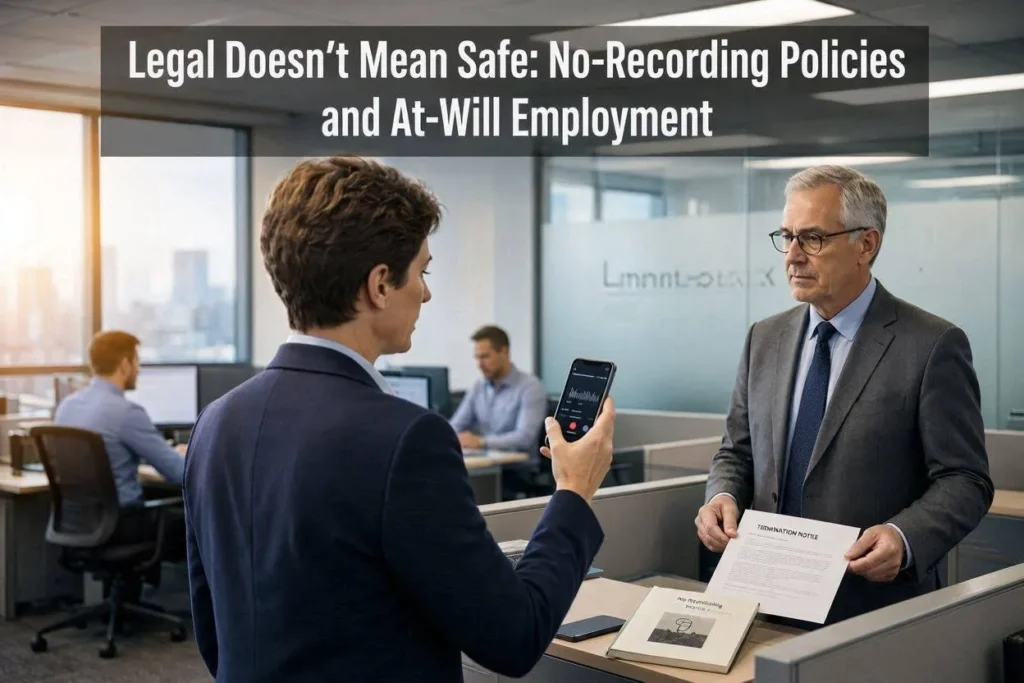
Here’s the trap that catches people in one-party consent states. They confirm recording is legal in Texas or Ohio, hit record, and get fired two weeks later — legally.
Most US employment is at-will, which means your employer can terminate you for any reason that isn’t specifically illegal. Violating a written company policy is a legal reason. And no-recording policies are everywhere now; employee handbooks at large companies routinely ban audio and video recording on company property, usually citing customer privacy, trade secrets, and open communication.
So the three-layer framework looks like this in practice:
- State law answers: is the recording a crime?
- Company policy answers: is the recording a fireable offense?
- Federal labor law answers: does anything override the first two?
An employee in Atlanta recording a hostile performance review breaks no Georgia law and no federal law. That same employee still gets a clean, lawful termination letter if the handbook bans recordings and HR finds out. Legal and safe are different questions. Answer both before you press record.
When the National Labor Relations Act Protects You Anyway
Layer three is where things get genuinely interesting, and it’s the part almost every competitor article aimed at employees skips entirely. Section 7 of the National Labor Relations Act (NLRA) protects “concerted activity” — employees acting together for mutual aid and protection regarding working conditions — and you don’t need a union for Section 7 to apply.
The National Labor Relations Board (NLRB) has ruled that secret workplace recording qualifies as protected concerted activity when the recording serves one of three purposes:
- Documenting unsafe or unlawful conditions — harassment, discrimination, or safety violations
- Preserving evidence of inconsistent discipline — proving a rule gets enforced against some employees and not others
- Capturing management conduct during organizing efforts — what supervisors say in anti-union meetings
Case study: the Starbucks firings
In Starbucks Corp., 372 NLRB No. 50 (2023), two Philadelphia baristas secretly recorded meetings with management while organizing coworkers. Starbucks fired them, arguing the recordings broke company policy and Pennsylvania’s all-party consent law — a felony statute.
The NLRB rejected both defenses. The recordings were protected Section 7 activity because the baristas made them to preserve a neutral account of what management said, fearing retaliation. Then the Board went further: under Garmon preemption, federal labor law overrides state consent law when the two collide. Pennsylvania’s felony statute had to yield. Result: both employees reinstated with back pay.
Federal appeals courts had already signaled the same direction on policy language — the Second Circuit in Whole Foods Market Group v. NLRB (2017) and the Fifth Circuit in T-Mobile USA v. NLRB (2017) both struck down blanket no-recording policies, because total bans chill protected activity.
Two honest caveats before you get excited:
- The protection is politically fragile. The NLRB’s composition changed after the 2025 administration transition, and enforcement shifts with membership — a June 2025 General Counsel memo (GC 25-07) already declared secret recording of collective bargaining sessions an automatic NLRA violation, which cuts the other way.
- The protection is narrow. Section 7 covers recordings made for collective, work-conditions purposes. Recording your boss over a personal grudge gets no federal cover.
Real, narrow, and currently in flux. Don’t build a plan on Section 7 alone.
Recording to Prove Harassment or Discrimination: The Gray Zone
Most people searching “can I record my boss at work” aren’t running an experiment. Something happened. A manager said something in a closed-door meeting that they’d deny in front of HR — a slur, a threat, a “we don’t promote people like you.” The recording feels like the only way to be believed.
The law is split on this, and pretending otherwise would be doing you a disservice. The Equal Employment Opportunity Commission (EEOC) takes the position that employees documenting discrimination or harassment engage in protected activity, and that firing someone for such a recording can itself be retaliation. Federal appeals courts disagree with each other. The Seventh Circuit held in Argyropoulos v. City of Alton (2008) that an employer could lawfully discipline an employee for secret recording even when the employee claimed the recording documented discriminatory treatment.
What that means practically:
- In a one-party consent state: the recording is legal, likely admissible, and genuinely useful evidence in an EEOC charge or lawsuit. You still risk termination under company policy, and depending on your circuit, that termination might stick. Weigh whether the evidence is worth the job.
- In an all-party consent state: don’t secretly record, full stop. The recording is a crime, courts will likely exclude the recording anyway, and you hand your employer a legitimate, non-retaliatory reason to fire you. There are better tools — the last section covers them.
One move worth knowing in all-party states: ask for consent on the record. Open the meeting with “I’d like to record this conversation so we both have an accurate record — is that okay?” A yes makes the recording legal everywhere in the country. A no is itself informative, and you can follow up in writing: “Per our meeting today, you declined to have the conversation recorded. To confirm what was discussed…” That email is now evidence, and creating that email is legal in all 50 states.
Zoom Calls, Remote Work, and AI Notetakers
Nobody was writing about this in 2019, and most competing guides still ignore the fact that half of workplace conversations now happen through a screen with a transcription bot sitting in the corner.
Workplace privacy law applies to virtual meetings exactly as it applies to conference rooms: consent requirements follow the conversation, not the room. Hitting “record” on a Zoom call, running Otter.ai in the background, or letting Microsoft Teams Copilot transcribe a one-on-one all count as recording. Zoom’s built-in recording banner and consent prompts exist specifically because of all-party consent states — when every participant sees “This meeting is being recorded” and stays on the call, courts generally treat continued participation as consent.
The riskier scenario is the silent AI notetaker. Tools that join calls as invisible participants, or run locally on your machine without any on-screen notice, generate recordings without the banner that creates implied consent. Run one of those during a call with a boss in California and you’ve got the same Penal Code § 632 problem as a hidden voice recorder, wrapped in friendlier software. Employers have started adding AI-transcription clauses to handbook recording policies for exactly this reason. Check yours before you let a bot into a sensitive meeting.
Calls Across State Lines
Remote work created a question the classic guides never answer: you’re in Austin (one-party consent), your manager is in San Francisco (all-party consent), and the call happens on Slack. Whose law applies?
Courts have gone different directions — some apply the law where the recording happens, others apply the law of the state with the strongest privacy interest. The California Supreme Court took the second approach in Kearney v. Salomon Smith Barney (2006), applying California’s all-party rule to calls recorded in Georgia because the recorded parties were in California.
The practical rule employment lawyers give clients: follow the stricter state’s law whenever any participant sits in an all-party consent state. Treat a Texas-to-California call as a California call. You lose nothing by over-complying, and you avoid becoming the test case.
How to Use a Workplace Recording as Legal Evidence
Say you did everything right — one-party consent state, no policy violation or a Section 7 justification, clean recording. The recording is a tool, and tools get misused. Here’s the sequence that protects its value:
Preserve the original. Keep the file unedited, back it up in two places (personal cloud plus a personal device — never company systems, which your employer controls and can access), and note the date, time, location, and participants while your memory is fresh.
Don’t publish it. Posting the recording to social media or sending clips to coworkers can create defamation exposure, destroy its evidentiary weight, and convert a protected documentation effort into a fireable conduct problem. A recording that goes to your lawyer helps you. A recording that goes viral helps nobody, least of all you.
Get it to an employment attorney early. Most offer free consultations, and many work on contingency for discrimination and retaliation cases. A lawyer can tell you within 20 minutes whether the recording is admissible, whether the recording strengthens an EEOC charge, and whether disclosing the recording to HR now or holding it for litigation serves you better. That timing decision is strategic, and people get it wrong constantly by showing their whole hand to HR in week one.
Know your filing deadlines. An EEOC discrimination charge generally must be filed within 180 days of the discriminatory act, extended to 300 days in states with their own fair-employment agencies. Wage claims run through the Department of Labor or state equivalents on their own clocks. A great recording attached to a late claim is worth nothing.
Legal Documentation Alternatives in All-Party Consent States
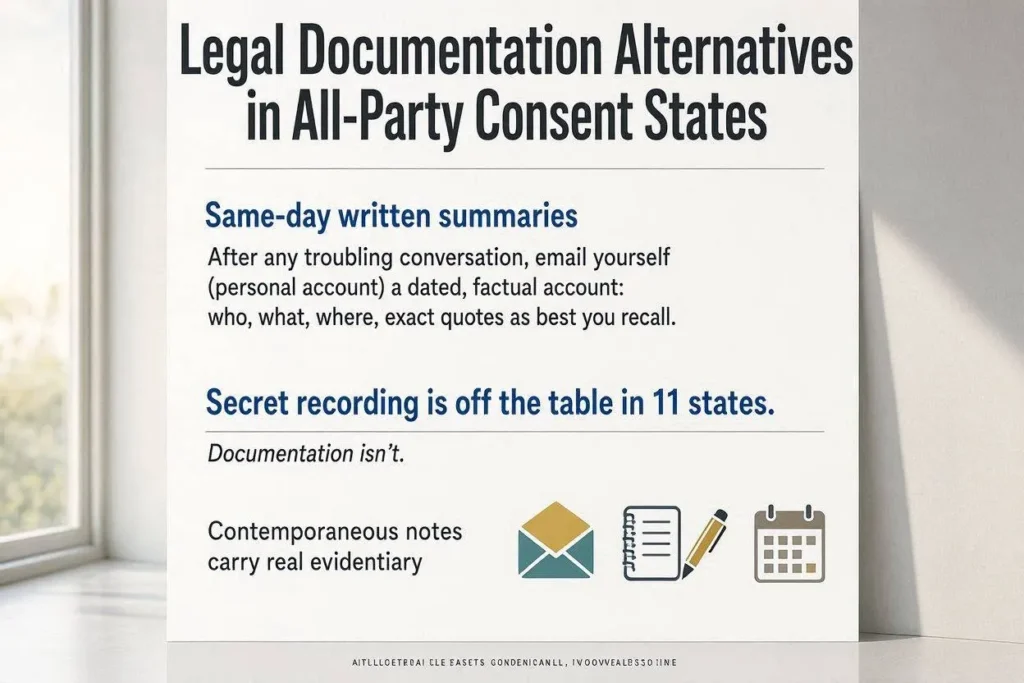
Secret recording is off the table in 11 states. Documentation isn’t. These alternatives are legal in every state and, honestly, often more persuasive to investigators than a scratchy phone recording:
- Same-day written summaries. After any troubling conversation, email yourself (personal account) a dated, factual account: who, what, where, exact quotes as best you recall. Contemporaneous notes carry real evidentiary weight.
- Confirmation emails to the other person. “Following up on our conversation this morning — you stated my schedule change was because I filed the safety complaint. Please correct me if I’ve misstated anything.” Silence in response to a confirmation email speaks loudly later.
- Witnesses. Bring a coworker to meetings when you can. In union shops, Weingarten rights guarantee a representative in investigatory interviews.
- Requests in writing. Push conversations to email. A boss who insists on verbal-only communication after you’ve started documenting is generating evidence too.
- Formal complaints. A written complaint to HR, the EEOC, or your state’s fair employment agency creates an official record and triggers anti-retaliation protections that a secret recording never does.
The Bottom Line
Workplace recording law sits at the intersection of three rulebooks — state wiretapping statutes, employment policy, and federal labor law — and you need all three green lights, not one. State consent law comes first: 39 states plus D.C. let you record your own conversations freely, while 11 states — California, Florida, Pennsylvania, Illinois, Washington, Massachusetts, Maryland, Michigan, Montana, New Hampshire, and Delaware — make secret recording a crime that can reach felony level. Company policy comes second, because a legal recording can still be a lawful firing in an at-will job. Federal labor law comes third, and the NLRA sometimes overrides the other two — the Starbucks reinstatements proved that — but Section 7 protection is narrow and politically weather-dependent.
If you’re in a one-party consent state with real misconduct to document, recording can be a legitimate, powerful move; just read your handbook first and get the file to a lawyer instead of HR’s inbox or Instagram. If you’re in an all-party consent state, put the phone away and build a paper trail instead — it’s legal everywhere, it holds up, and it doesn’t hand your employer the one clean reason they were looking for. The goal was never the recording. The goal is being believed, and there’s more than one way to get there.
FAQs

Amanda Brooks
Amanda Brooks leads JusticeInTown’s legal, justice, and community advocacy content division. She holds a background in legal research and public policy and specializes in topics related to civil rights, access to justice, legal awareness, and community issues. With years of experience researching legal and social justice topics, Amanda brings a careful, research-driven approach to complex legal information and public-interest issues. She is the primary author of JusticeInTown’s legal guides, justice-related resources, and community-focused content, helping readers better understand their rights, legal options, and the issues affecting their communities.
Related Posts