Exempt vs. Non-Exempt Employees: The Complete 2026 Guide
The difference between exempt and non-exempt employees comes down to overtime pay: exempt employees receive a fixed salary and no overtime pay, while non-exempt employees earn at least minimum wage and receive time-and-a-half pay for every hour worked beyond 40 in a workweek. The Fair Labor Standards Act (FLSA) sets this rule. Classification depends on three tests: salary basis, salary level, and job duties. Get either category wrong, and an employer is looking at wage-and-hour liability, IRS exposure, and — in states like California — class-action risk under the Private Attorneys General Act (PAGA).
This guide walks through the classification tests, the 2026 state salary thresholds, tax and payroll differences, worked overtime-pay calculations, misclassification penalties, and the remote-work classification questions most competing guides skip entirely.
What Is the Difference Between Exempt and Non-Exempt Employees?
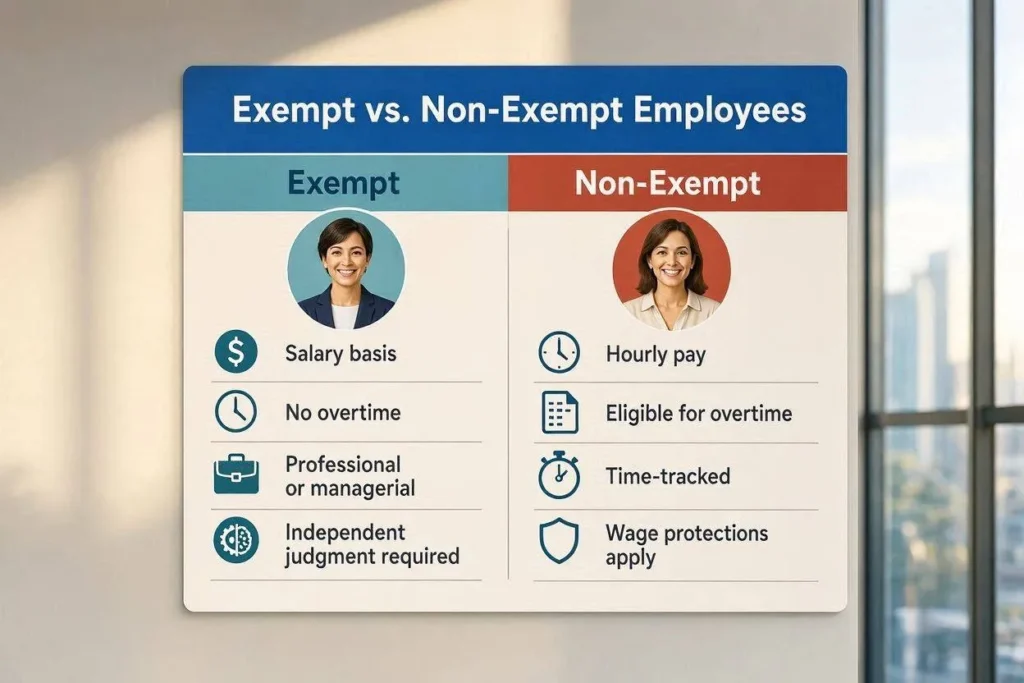
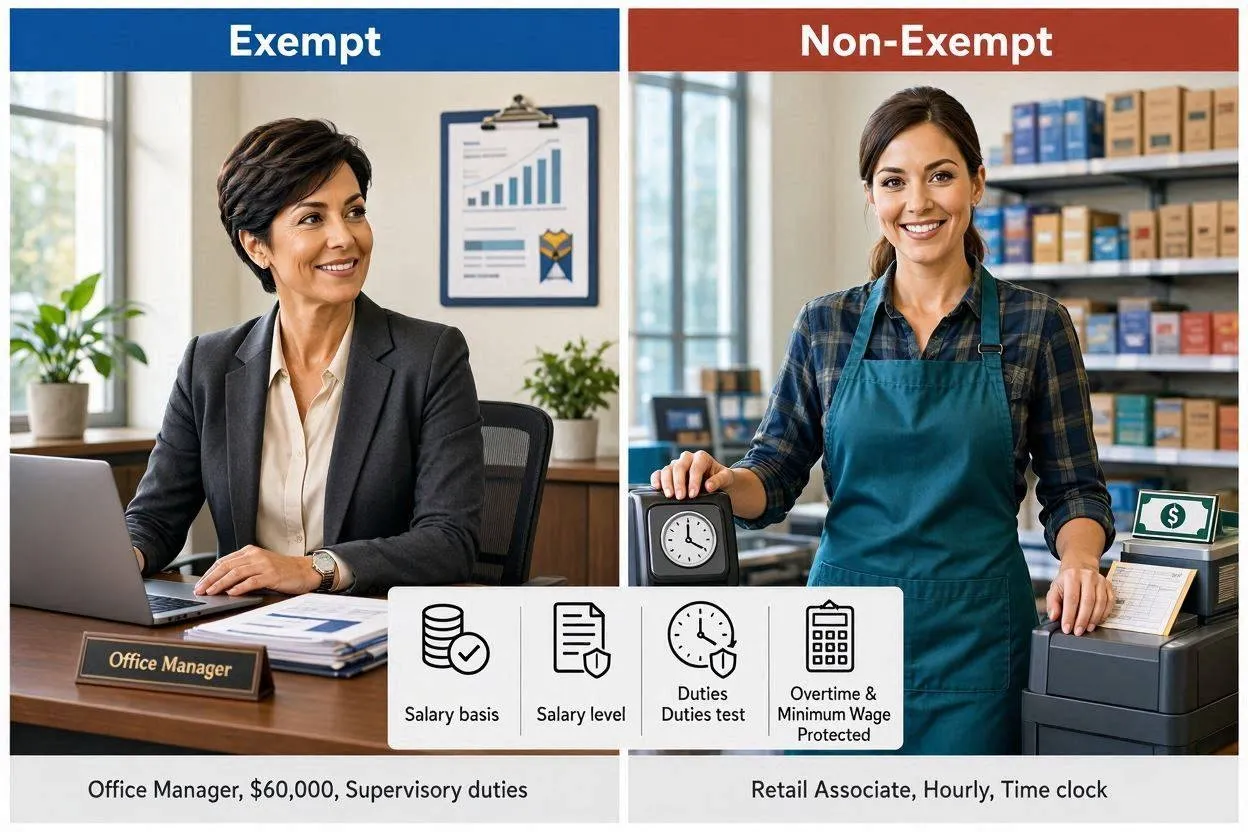
Exempt employees are excluded from the FLSA’s overtime and minimum-wage protections because their role meets the salary basis test, salary level test, and duties test. Non-exempt employees don’t get that exclusion. They’re covered by those protections regardless of whether they’re paid hourly or on salary. An office manager earning $60,000 a year with real supervisory authority is exempt. A retail associate earning the same salary but stocking shelves under a manager’s direction is not, because the duties test fails even though the salary would clear the threshold.
| Factor | Exempt | Non-Exempt |
| Overtime pay | Not required | Required after 40 hours/week |
| Minimum wage guarantee | Not required | Required |
| Pay structure | Salary only | Hourly or salary |
| Time tracking | Not required | Required |
| Typical roles | Executive, administrative, professional, computer, outside sales | Retail, food service, clerical, skilled trades, most hourly roles |
| Federal minimum salary (2026) | $844/week ($43,888/year) | Not applicable — pay tied to hours worked |
Exempt Employees Explained
An exempt employee is paid a predetermined salary that doesn’t change based on hours worked or quality of output. Their primary duties have to fall under one of the FLSA’s white-collar exemptions: executive, administrative, professional, computer, or outside sales. Each exemption category has its own duties requirement, and none of them are optional add-ons — an employer has to prove the employee’s actual day-to-day work matches the category, not just the job title on paper.
Common exempt roles: office managers, marketing associates, software engineers, teachers, and licensed attorneys.
Executive exemption: The employee manages a department or subdivision as their primary duty, regularly directs the work of at least two full-time employees (or the equivalent), and has real input into hiring, firing, or promotion decisions. A shift supervisor who occasionally schedules coworkers but has no hiring authority typically fails this test.
Administrative exemption: The employee’s primary duty involves office or non-manual work directly related to business operations, and the role requires exercising independent judgment on matters of significance. A benefits coordinator who evaluates plan options and makes recommendations qualifies; a data-entry clerk who follows a fixed script does not.
Professional exemption: This covers two sub-types. The learned professional exemption applies to work requiring advanced knowledge in a field of science or learning, usually gained through prolonged specialized instruction — think registered nurses, accountants, and engineers. The creative professional exemption applies to work requiring invention, imagination, originality, or talent in a recognized artistic or creative field.
Computer exemption: This applies to systems analysts, programmers, software engineers, and similarly skilled workers in computer systems design. The role must involve applying systems analysis techniques, designing or testing computer systems or programs, or a combination of these duties. Help-desk technicians who mainly troubleshoot hardware usually don’t qualify.
Outside sales exemption: Unlike every other category, this one carries no salary minimum. The employee’s primary duty must be making sales or obtaining orders away from the employer’s place of business. A field sales rep who visits client sites daily qualifies regardless of how their compensation is structured.
The Highly Compensated Employee (HCE) Exemption
There’s a sub-category worth knowing: the highly compensated employee (HCE) exemption. An HCE earning above the federal HCE threshold qualifies for exempt status under a relaxed duties test, as long as the employee performs at least one exempt duty regularly. In Helix Energy Solutions Group v. Hewitt, the Supreme Court ruled that a daily-rate pay structure fails the salary basis test — even at a high dollar amount — unless it guarantees a minimum weekly amount regardless of hours worked. Any employer still paying exempt staff by the day instead of a fixed weekly salary needs to pay attention to that ruling, since it applies to HCEs and standard exempt employees alike.
Pros and Cons of Exempt Status
Exempt status offers employees predictable pay regardless of a slow week, and it typically comes with more schedule flexibility since hours aren’t tracked. The downside shows up during high-demand periods: an exempt employee working 55 hours in a crunch week earns the same salary as a 40-hour week, with no overtime compensation for the extra time.
Non-Exempt Employees Explained
A non-exempt employee is covered by FLSA overtime rules no matter how they’re paid. Most hourly workers are non-exempt by default. Salaried employees can be non-exempt too, though, if their salary falls below the threshold or their duties don’t meet an exemption test.
Common non-exempt roles: retail associates, food servers, mechanics, construction workers, and administrative assistants whose duties don’t meet the administrative exemption’s independent-judgment requirement.
Hourly-Exempt Industry Exceptions
Three industries carry hourly-exempt exceptions: agriculture, movie theaters, and railroads. Agricultural workers, movie theater employees, and railroad employees can be exempt from overtime rules even when paid hourly, under specific FLSA carve-outs. These exceptions exist because Congress wrote industry-specific provisions into the FLSA decades ago, and they remain in effect regardless of how the general white-collar exemptions evolve.
Pros and Cons of Non-Exempt Status
Non-exempt employees get paid for every hour worked, including overtime at 1.5 times their regular rate. That guarantee comes with less flexibility: hours have to be tracked, and unauthorized overtime can trigger disciplinary action even though the employer still has to pay for it under FLSA rules.
How to Classify Employees: The Three-Part FLSA Test
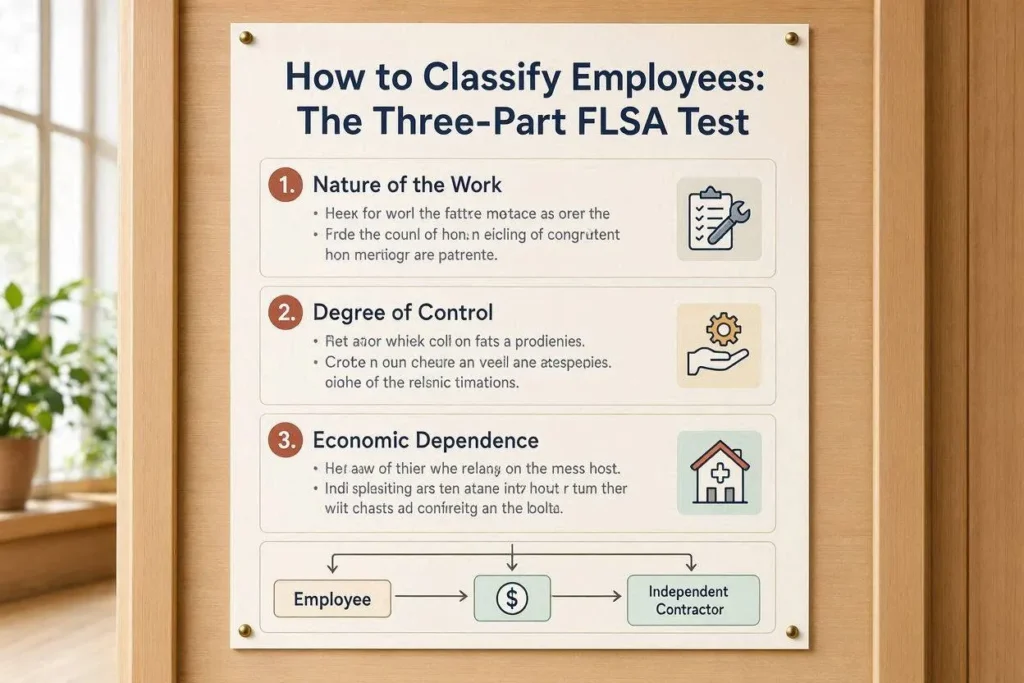
An employee has to pass all three tests to qualify as exempt. Fail one, and the employee is non-exempt — no exceptions.
- Salary basis test: The employee receives a fixed salary that doesn’t fluctuate with hours worked or work quality. Docking pay for a partial-day absence, except in specific permitted circumstances, can jeopardize exempt status for the entire pay period.
- Salary level test: The salary meets or exceeds the federal minimum ($844/week as of 2026) or the applicable state minimum, whichever is higher.
- Duties test: The employee’s primary duties fall under an exempt category — executive (managing a department, directing at least two full-time employees), administrative (exercising independent judgment on significant matters), professional (work requiring advanced knowledge or creative talent), computer (systems analysis, programming, or software engineering), or outside sales (no salary minimum applies to this category).
The employer must apply the higher state number if a state salary threshold exceeds the federal minimum. A common employer mistake is checking only the salary level test and skipping the duties test, since a high salary alone never satisfies FLSA exemption requirements.
2026 State Salary Thresholds
Six states set exempt salary minimums above the federal floor. Employers with staff in these states must meet the state threshold, not the federal one.
| State | 2026 Minimum Weekly Salary | Annual Equivalent | Notes |
| Alaska | $952 | $49,504 | Applies statewide |
| California | $1,320 | $68,640 | Computer professionals: $58.85/hour |
| Colorado | $1,086.25 | $56,485 | Adjusted annually for inflation |
| Maine | $978.75 | $50,895 | Adjusted annually |
| New York (NYC, Long Island, Westchester) | $1,237.50 | $64,350 | Lower thresholds apply outside these regions |
| Washington | $1,499.40–$1,724.30 | $77,968.80–$89,663.60 | Threshold scales with employer size |
Employers operating across multiple states can’t apply one blanket number. Each state’s threshold has to be tracked separately, and the employer applies whichever figure is higher for each employee’s actual work location. California’s computer-professional carve-out is a particularly common trap: an hourly computer professional in California can be exempt from overtime at $58.85 an hour, a structure that doesn’t exist under federal law or most other states’ rules.
Tax and Payroll Implications: Exempt vs. Non-Exempt
Classification affects more than overtime eligibility — it shapes how paychecks get calculated. Exempt employees typically receive the same gross pay every pay period, which makes tax withholding and W-4 (Employee’s Withholding Certificate) calculations straightforward. Non-exempt employees, especially those working variable hours, see their net pay fluctuate week to week even when their hourly rate stays constant, because total hours worked directly change gross pay and, by extension, FICA (Federal Insurance Contributions Act) withholding for Social Security and Medicare.
Payroll teams handling a mixed workforce need separate processes for each group: exempt payroll runs on a fixed schedule with minimal variation, while non-exempt payroll requires accurate time capture every pay period to calculate regular and overtime rates correctly. A single missed punch or unrecorded overtime hour on the non-exempt side creates a wage claim risk that doesn’t exist for exempt staff.
How to Calculate Overtime Pay
Non-exempt employees earn 1.5 times their regular rate of pay for every hour beyond 40 in a workweek. The regular rate includes hourly wages plus most bonuses and commissions, divided by total hours worked.
Example 1 — Hourly employee: An employee earning $22/hour works 46 hours in one week. Regular pay: 40 × $22 = $880. Overtime pay: 6 × ($22 × 1.5) = $198. Total pay: $1,078.
Example 2 — Salaried non-exempt employee: An employee earns a fixed $1,000 weekly salary and works 46 hours. Regular rate: $1,000 ÷ 46 = $21.74/hour. The salary already covers straight-time pay for all 46 hours, so only the 0.5 overtime premium applies to the 6 overtime hours: 6 × ($21.74 × 0.5) = $65.22. Total pay: $1,065.22.
Example 3 — Blended rate with bonus: An employee earns $20/hour plus a $50 weekly production bonus and works 44 hours. Total straight-time earnings: (44 × $20) + $50 = $930. Regular rate: $930 ÷ 44 = $21.14. Overtime premium: 4 × ($21.14 × 0.5) = $42.28. Total pay: $972.28.
Salaried Non-Exempt Employees: The Hybrid Status
A salaried non-exempt employee receives a fixed weekly salary but still qualifies for overtime pay, because their duties or salary level don’t meet an exemption test. Employers like this structure because it makes payroll predictable while staying FLSA-compliant. It comes with a catch, though: the structure requires tracking actual hours worked every week, unlike true exempt roles, which need no time tracking at all.
The fixed salary is treated as pay for all hours worked in a normal week. That’s why the overtime calculation uses the 0.5 premium method shown in Example 2, not the full 1.5 rate used for hourly employees. Employers who misapply the full 1.5 rate to a salaried non-exempt employee end up overpaying, while those who skip the 0.5 premium entirely end up underpaying and exposed to a wage claim.
Consequences of Misclassifying Employees
Misclassification exposes employers to liability on three fronts: federal wage law, state law, and tax law.
Federal exposure: The Department of Labor (DOL) can order back pay for up to two years of unpaid overtime, or three years for willful violations, plus liquidated damages equal to the back-pay amount. That effectively doubles the penalty. Employees can file private lawsuits directly, too, and often do so as part of a collective action covering an entire job classification.
State exposure: California allows misclassified employees to pursue claims under PAGA, which permits penalties per pay period, per employee, and lets employees sue on behalf of the state. Across a full workforce, that risk scales fast — a single misclassified job title affecting fifty employees over two years can generate thousands of separate pay-period violations.
IRS exposure: Misclassifying an employee as an independent contractor is a related but distinct error, and it triggers IRS penalties for unpaid FICA, Social Security, and Medicare taxes, plus interest. This is separate from exempt/non-exempt misclassification but often gets confused with it, since both involve paying someone incorrectly under federal rules.
Employers can voluntarily pay overtime to an exempt-eligible employee without violating FLSA rules. Going the other direction isn’t legal: an employer can’t classify a truly non-exempt employee as exempt just to avoid overtime obligations, regardless of what the employee agrees to in writing.
Remote and Multi-State Employee Classification

A remote employee’s classification follows the wage-and-hour law of the state where the work is physically performed, not the state where the employer is headquartered. The employer must meet the higher threshold to maintain exempt status if an employee lives in a state with a higher salary threshold than the employer’s home state. That requirement kicks in even when the employer has no other physical presence in that state — a company based in Texas with one remote employee in Washington still has to meet Washington’s threshold for that employee.
Multi-state employers should audit remote staff locations at least annually, since state thresholds — particularly in Colorado, Maine, and Washington — adjust yearly. An employee who relocates mid-year can flip from correctly classified to misclassified without any change in job duties, simply because the applicable threshold changed underneath them.
Benefits Eligibility: Exempt vs. Non-Exempt
Classification status doesn’t dictate benefits eligibility under federal law. Plenty of employers structure benefits differently between the two groups anyway. Exempt employees more commonly get unlimited or accrual-based PTO tied to salaried status, while non-exempt employees typically accrue PTO based on hours worked. For Affordable Care Act (ACA) purposes, eligibility depends on average hours worked per week — 30 or more triggers eligibility — not exempt or non-exempt status. Employers get this one wrong often, assuming exempt automatically means benefits-eligible and non-exempt automatically means it doesn’t, when the ACA calculation runs entirely on hours.
Can You Reclassify an Employee?
Yes. Employers can reclassify an employee from exempt to non-exempt, or the reverse, whenever the role’s duties, salary, or a threshold change makes the current classification inaccurate. Going from exempt to non-exempt means setting up time tracking and calculating a regular rate of pay. Going from non-exempt to exempt means confirming the role passes all three FLSA tests before the change takes effect. Reclassifying based on salary alone, without a duties-test review, is a common and costly mistake — and one that regularly shows up in DOL audits.
What’s Next: Threshold Indexing Beyond 2026
Federal salary threshold rulemaking has shifted between fixed dollar amounts and automatic indexing over the past several years, and employers should expect that pattern to continue. A rule that ties the threshold to a percentage of full-time salaries nationwide, rather than a flat dollar figure, would trigger automatic increases every few years without new legislation. Employers that build compliance processes assuming a static number are the ones most likely to get caught off guard when the next adjustment lands.
Conclusion
Exempt and non-exempt classification isn’t a formality — it determines who gets overtime, how payroll gets calculated, and how much legal exposure an employer carries. The three-part FLSA test, current state thresholds, and accurate duties documentation are the foundation for getting it right. Review job descriptions against actual duties at least once a year, track state threshold changes for every remote employee’s location, and treat a borderline classification as a reason to dig deeper, not a reason to guess.
FAQ

Amanda Brooks
Amanda Brooks leads JusticeInTown’s legal, justice, and community advocacy content division. She holds a background in legal research and public policy and specializes in topics related to civil rights, access to justice, legal awareness, and community issues. With years of experience researching legal and social justice topics, Amanda brings a careful, research-driven approach to complex legal information and public-interest issues. She is the primary author of JusticeInTown’s legal guides, justice-related resources, and community-focused content, helping readers better understand their rights, legal options, and the issues affecting their communities.
Related Posts