
Employment Contract Review: What to Check Before You Sign in 2026
An employment contract review is a legal examination of a job offer or employment agreement, performed before signing, to identify unfavorable terms, missing protections, and wage-and-hour compliance risks. A lawyer reads the document clause by clause, compares each provision against market standards and the applicable state labor code, then flags language that could limit pay, restrict future employment, or waive statutory employee rights. A marketing manager offered a role with a 12-month non-compete clause covering the entire United States, for example, would learn during a review whether that geographic scope holds up under her state’s non-compete statute before she signs anything.
Reviews cover offer letters, full employment agreements, executive contracts, and modifications to existing agreements. The process typically happens before the first day of work, though employees renegotiating an existing contract or weighing a promotion offer request reviews at that stage too.
Legal Framework Governing Employment Contracts
Federal employment contracts operate within a framework of five core statutes: the Fair Labor Standards Act, Title VII of the Civil Rights Act of 1964, the Americans with Disabilities Act, the Age Discrimination in Employment Act, and the National Labor Relations Act. The Fair Labor Standards Act (FLSA) sets minimum wage, overtime pay, and exempt-versus-non-exempt classification rules that any compensation clause has to satisfy, no matter what the contract states. A contract labeling a worker “exempt” from overtime doesn’t override the FLSA’s duties test — misclassification stays an FLSA violation even with a signed agreement in place.
Title VII, the Americans with Disabilities Act (ADA), and the Age Discrimination in Employment Act (ADEA) bar contract terms that discriminate based on a protected class, and no severance or arbitration clause can waive a discrimination claim that arises after signing. The National Labor Relations Act (NLRA) protects an employee’s right to discuss wages and working conditions with coworkers. That protection makes broad confidentiality clauses barring salary discussion unenforceable, regardless of how the contract phrases it.
State labor codes add another layer on top of federal law. Wage-payment timing statutes, non-compete statutes, and paid-leave mandates vary by jurisdiction, and several states set protections well above the federal minimum. An employee working in Illinois under a contract that references only federal law still falls under Illinois’s own wage-payment statute, which sets stricter deadlines than the FLSA requires. Checking which department of labor has jurisdiction — federal, state, or both — determines which rules actually govern a dispute if one comes up later.
When You Need an Employment Contract Review
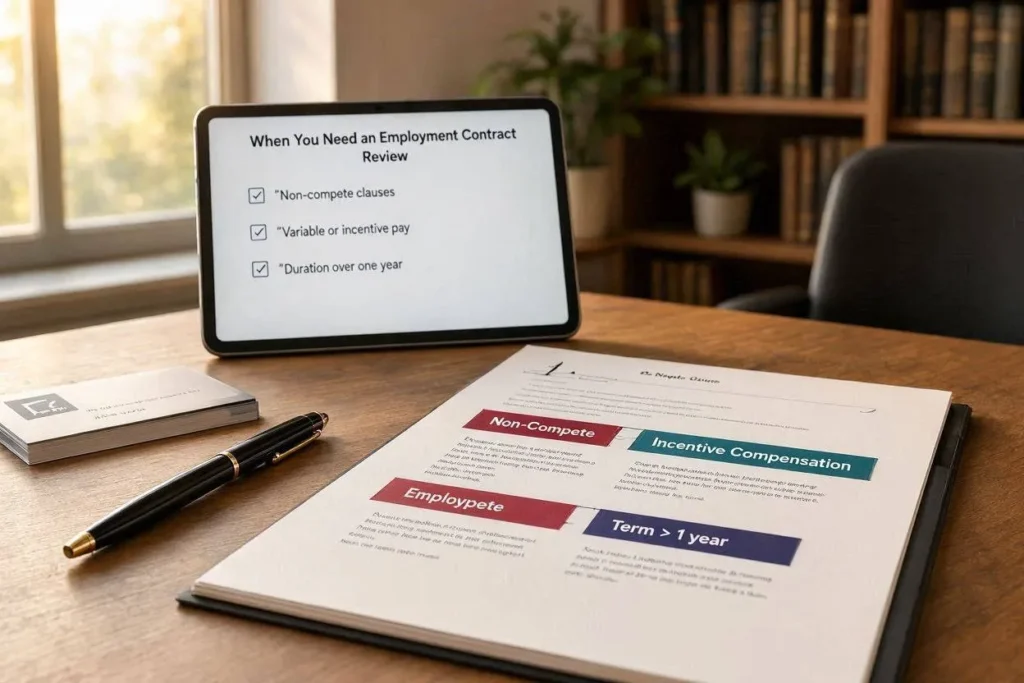
You need an employment contract review if the agreement includes a non-compete clause, incentive compensation, or a term longer than one year — situations where mistakes carry real financial cost. Not every offer letter requires legal scrutiny. A standard at-will position with no restrictive covenants and a fixed salary rarely justifies attorney fees. The calculation changes once complexity enters the picture.
Specific triggers include:
- Non-compete or non-solicitation clauses that could block a future job change
- Commission or bonus structures with vesting schedules, clawback provisions, or performance thresholds
- Equity compensation, including stock options or restricted stock units with vesting cliffs
- Severance or change-in-control payments tied to termination circumstances
- Arbitration clauses that waive the right to bring a wage claim or discrimination claim in court
- Relocation or visa sponsorship terms with repayment obligations if you leave early
A software engineer offered restricted stock units on a four-year vesting schedule, for instance, benefits from a review explaining what happens to unvested shares if the company terminates her without cause in year two.
Key Clauses an Employment Contract Review Should Cover
An employment contract review needs to examine six categories of clauses at minimum: compensation, restrictive covenants, termination, confidentiality, dispute resolution, and work-arrangement terms. Each category carries different risks under both contract law and labor law, so each calls for different questions.
Compensation and Bonus Structure
A compensation clause review confirms base salary, bonus eligibility, commission formulas, and payment timing match what the employer promised verbally, while also satisfying FLSA wage-and-hour requirements. Oral promises rarely hold up in a dispute unless the written contract reflects them. A sales director told during interviews that her commission rate would be 8% needs that figure written into the agreement, along with the calculation method and payment schedule, because a verbal number carries no legal weight once she starts the job.
Watch for vague language around “discretionary bonuses,” unclear proration for partial years worked, and clawback clauses allowing the employer to reclaim already-paid commissions.
Non-Compete and Non-Solicitation Clauses
Non-compete and non-solicitation clauses restrict where you can work after leaving the company, and both require scrutiny of duration, geographic scope, and enforceability under the governing state’s non-compete statute. A twelve-month non-compete covering three states reads very differently in California, where non-competes are void by statute, than in Florida, where courts enforce them if reasonable in scope. Duration beyond twelve months and geography broader than the employer’s actual market footprint count as common warning signs.
Non-solicitation clauses, which restrict contact with former clients or coworkers rather than employment itself, tend to survive legal challenges more often than broad non-competes.
Termination and Severance Terms
Termination clauses define how the employment relationship can end and what happens financially when it does — the section most likely to trigger a wrongful termination claim if things go wrong. Look for the distinction between termination “for cause” and “without cause,” since the definition of cause determines whether severance pay applies. A contract stating termination for cause includes “failure to meet performance expectations” gives the employer broad discretion to avoid paying severance, compared with a contract requiring documented misconduct or repeated written warnings.
Severance terms should specify payment amount, continuation of health benefits, and any conditions attached, such as signing a release of claims.
Confidentiality and Invention Assignment
Confidentiality and invention-assignment clauses determine what information you must protect and who owns work you create, both during employment and sometimes after. Standard confidentiality provisions cover trade secrets and proprietary business information, though the NLRA limits how far an employer can extend confidentiality into wage discussions among coworkers. Invention-assignment clauses go further, often granting the employer ownership of anything created using company resources or during company time, even outside normal work hours.
A software developer working on a personal app during weekends, using her own laptop, could still lose ownership rights if her contract’s invention-assignment language is broad enough to cover any work “related to the employer’s business.”
Arbitration and Class Action Waivers
Arbitration clauses require disputes to go through private arbitration instead of court, and most also include a waiver of the right to join a class action. These clauses limit your options if a wage claim or discrimination claim arises later — arbitration proceedings stay private, decisions are difficult to appeal, and individual arbitration often costs more per person than a shared class action would. Federal law carves out one exception: employees can opt out of mandatory arbitration for sexual harassment or sexual assault claims, regardless of what the contract states.
Remote Work and Monitoring Clauses
Remote and hybrid work clauses, now standard in most 2026 contracts, define required office days, equipment stipends, and any employee-monitoring software the employer uses. Contracts silent on monitoring don’t mean monitoring won’t happen — many employers reserve that right under general “company property” language covering laptops and email. A remote employee working from a different state than the employer’s headquarters should confirm which state’s labor code governs the relationship, since tax and wage-and-hour obligations shift based on where the work actually happens.
How to Choose an Attorney for Contract Review
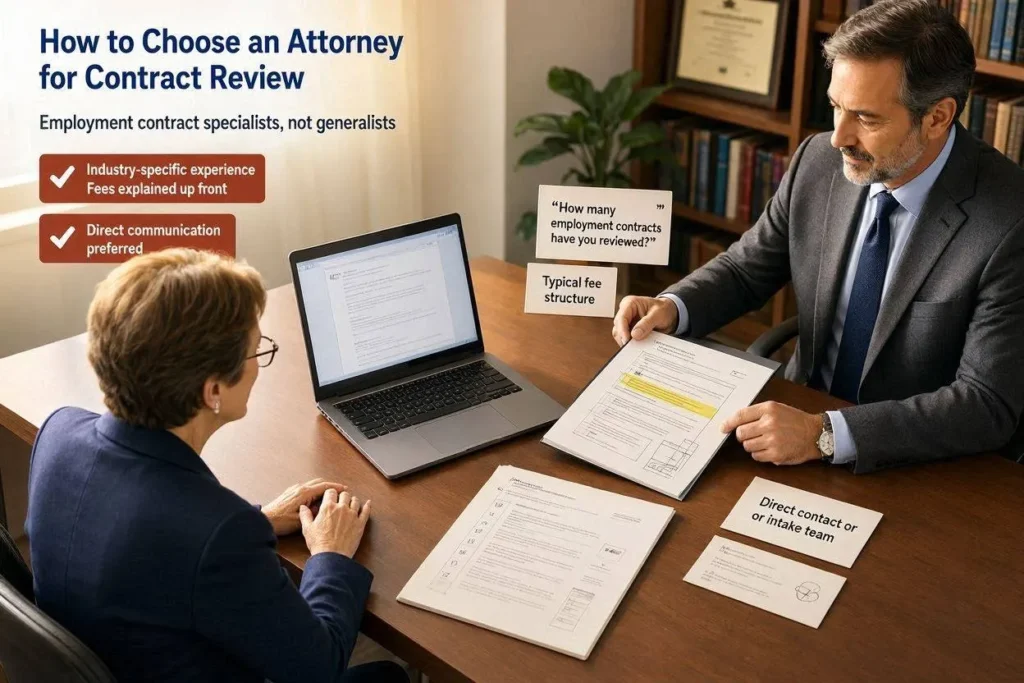
Choose an employment attorney who reviews contracts regularly in your industry, explains fees clearly upfront, and communicates directly rather than through a generic intake process. Not every business lawyer handles labor and employment law well, and general practice attorneys sometimes miss industry-specific red flags that a specialist catches immediately.
Ask candidates these questions before hiring:
- How many employment contracts do you review each month?
- What is your fee structure — flat rate, hourly, or capped?
- How long will the review take, and what’s included?
- Have you worked with contracts in my industry before?
- Will you contact my employer directly, or prepare talking points for me?
Green flags include specific numbers when describing experience, a written fee estimate before work begins, and a clear explanation of which clauses matter most for your situation. Red flags include vague answers about timelines, reluctance to quote a fee range, and pressure to sign a large retainer before any conversation about your contract.
Employment Contract Review Cost and Timeline
A standard employment contract review costs between $300 and $900 for a flat-fee arrangement, or $250 to $650 per hour if billed hourly, with most straightforward reviews completed in three to five business days. Executive contracts with complex compensation structures or multiple incentive plans run higher, often $1,500 to $5,000, and can take one to two weeks given the additional negotiation involved.
Flat fees typically cover one full read-through, a written summary of concerns, and one round of redlines sent to the employer. Additional negotiation calls or a second round of edits often trigger extra charges unless the engagement letter specifies otherwise. Ask for that scope in writing before the review begins, so a $400 quote doesn’t turn into $1,200 after two follow-up calls.
Non-Compete Enforceability by State
Non-compete enforceability varies significantly by state, ranging from a complete statutory ban in California to case-by-case reasonableness review in most other states. California, North Dakota, and Oklahoma prohibit non-compete agreements for employees under their respective labor codes, with narrow exceptions tied to business sales. Minnesota banned most employee non-competes by statute in 2023. Several states, including Illinois, Colorado, Washington, and Massachusetts, allow non-competes only above a minimum salary threshold, adjusted periodically for inflation under state wage-and-hour rules.
Most remaining states apply a reasonableness test, weighing duration, geographic scope, and legitimate business interest against the burden placed on the employee. A one-year non-compete limited to a 25-mile radius stands a better chance of surviving that test than a three-year nationwide restriction for the same role. Confirm which state’s labor code governs before assuming a non-compete clause applies, or doesn’t, based on where the company is headquartered rather than where you actually work.
Red Flags to Watch For in an Employment Contract
The biggest red flags in an employment contract are vague termination language, one-sided non-competes, unlimited liability clauses, and any provision that contradicts verbal promises made during hiring. These issues surface most often in contracts drafted quickly or copied from generic templates without adjustment for the specific role or applicable labor code.
Common warning signs include:
- Termination “for cause” defined broadly enough to cover almost any performance issue
- Non-compete clauses with no geographic or time limit specified
- Confidentiality language extending indefinitely with no end date
- Mandatory arbitration bundled with a class-action waiver and no opt-out
- Bonus or commission terms marked “subject to change at company discretion”
- Indemnification clauses requiring the employee to cover the employer’s legal costs
A contract requiring an employee to indemnify the company for “any claims arising from employee’s actions” places financial risk on someone who has no control over the company’s broader legal exposure — language worth negotiating out before signing.
Employment Contract Review Checklist
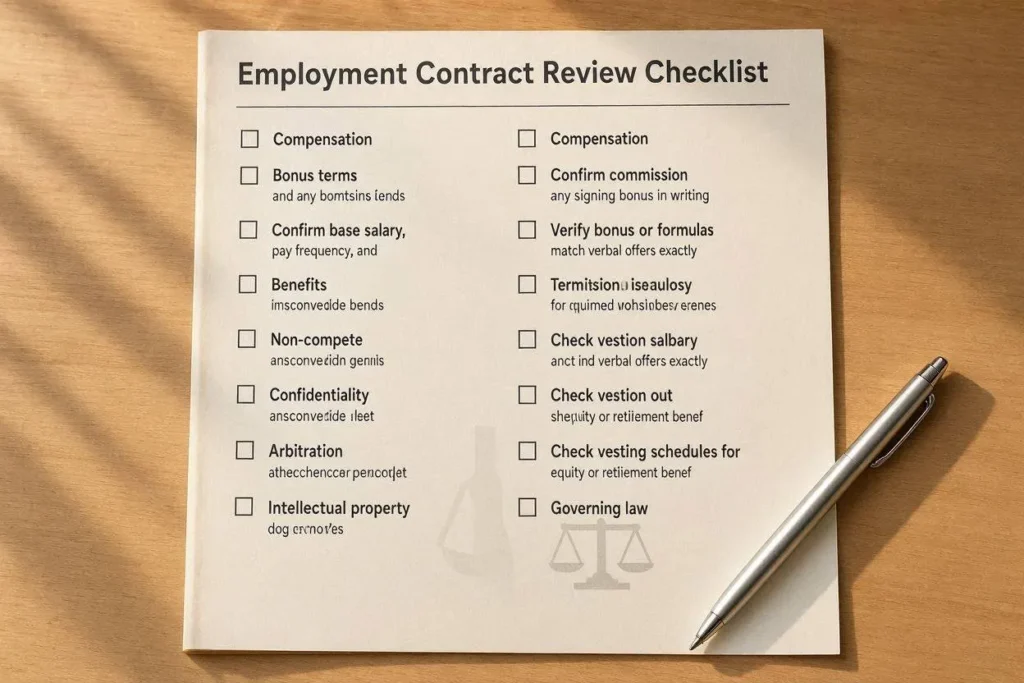
A complete employment contract review checklist covers nine areas: compensation, bonus terms, benefits, termination, non-compete, confidentiality, arbitration, intellectual property, and governing law. Work through each category before signing anything.
- Confirm base salary, pay frequency, and any signing bonus in writing
- Verify bonus or commission formulas match verbal offers exactly
- Check vesting schedules for equity or retirement benefits
- Read the termination section for “cause” definitions and notice periods
- Measure non-compete duration and geographic scope against your industry
- Note confidentiality obligations and how long they last after employment ends
- Identify whether arbitration is mandatory and whether a class-action waiver applies
- Review invention-assignment language for scope creep into personal projects
- Confirm which state’s labor code governs the agreement
Keep a copy of the offer letter, any email promises from the hiring manager, and the final signed contract in one folder. Disputes months or years later often hinge on matching the signed document against what was actually promised.
Conclusion
An employment contract review costs a few hundred dollars and takes less than a week — a small trade-off against a non-compete clause that blocks a career move or a severance term that pays nothing after termination. Read every clause against what was promised verbally, confirm which state’s labor code governs the agreement, and get a second opinion from an employment attorney before signing anything with a non-compete, incentive pay, or arbitration clause attached. The signature takes seconds. The terms last for years.
FAQs

Amanda Brooks
Amanda Brooks leads JusticeInTown’s legal, justice, and community advocacy content division. She holds a background in legal research and public policy and specializes in topics related to civil rights, access to justice, legal awareness, and community issues. With years of experience researching legal and social justice topics, Amanda brings a careful, research-driven approach to complex legal information and public-interest issues. She is the primary author of JusticeInTown’s legal guides, justice-related resources, and community-focused content, helping readers better understand their rights, legal options, and the issues affecting their communities.
Related Posts