
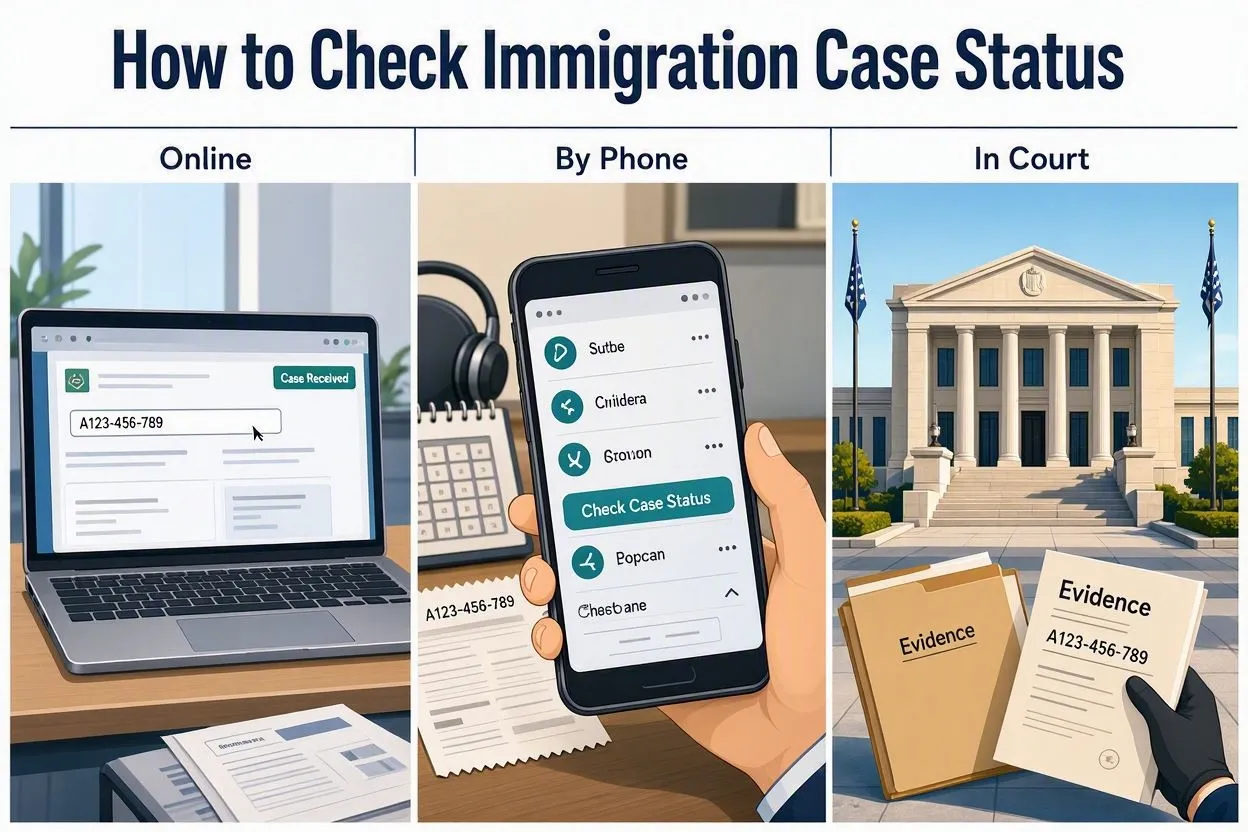
How to Check Immigration Case Status Online, by Phone, or in Court (2026 Guide)
Checking your immigration case status comes down to one of four systems, and which one you need depends entirely on who’s handling your filing. U.S. Citizenship and Immigration Services (USCIS) handles applications and petitions. The Executive Office for Immigration Review (EOIR) handles court proceedings. The Department of State handles visa processing. And the SAVE program handles public benefits verification. Each one wants a different identifier and hands back different information, so knowing which tool to use matters just as much as knowing how to use it.
This guide covers every official method for checking your status, explains what the status messages actually mean, and points out the scam patterns that target people while they wait on a decision.
What Does Immigration Case Status Mean?
It’s the current processing stage of your application, petition, or court proceeding, tracked through whatever identifier the government assigned to that specific filing. A receipt number, an Alien Registration Number, a visa case number: they all do the same job. They let an agency pull up exactly where your file sits in the queue.
USCIS gives every application or petition it accepts a 13-character receipt number: three letters followed by 10 digits, something like IOE0912345678. Those letters tell you which service center picked it up. EAC is Vermont. WAC is California. LIN is Nebraska. SRC is Texas. NBC is the National Benefits Center. MSC is the National Records Center. IOE means you filed electronically through USCIS’s online system.
Court cases work differently. EOIR tracks proceedings with a nine-digit A-Number instead of a receipt number, and you’ll find that number on the Notice to Appear or other paperwork DHS issued at intake. If yours only has eight digits, add a leading zero: 12345678 becomes 012345678 in the system.
How to Check Immigration Case Status Online
Your fastest option is the USCIS Case Status Online tool at egov.uscis.gov/casestatus, using your 13-character receipt number. No login, no account, no fee.
Using the USCIS Case Status Online Tool
Type in the receipt number exactly as it appears on your Notice of Action (Form I-797). Skip the dashes, but keep any asterisks. Hit submit and you’ll get your case’s most recent status along with a short note on what usually happens next. Someone checking an I-485 might see “Case Was Received, and A Receipt Notice Was Sent,” and later, once USCIS moves the file forward, “Biometrics Appointment Was Scheduled.”
There’s also a field labeled “Enter Another Receipt Number” that lets you check a second or third case without starting over. Families filing jointly, a spouse’s I-485 alongside a child’s, for instance, use this a lot to track everything in one sitting.
Using a MyUSCIS Online Account
A myUSCIS account at my.uscis.gov gets you more: case history covering your last five actions, email or text alerts, and one dashboard for every pending case you have. Setting one up takes an email address, a password, and identity verification based on questions tied to your credit history. If you filed electronically through USCIS’s online system, you probably already have an account linked to your receipt number.
How to Check Immigration Case Status by Phone
Call the USCIS Contact Center at 1-800-375-5283 (TTY 1-800-767-1833) if you’re in the U.S. and would rather not deal with the website. Outside the country, dial 212-620-3418 or visit your nearest USCIS international field office.
The automated system handles most routine questions on its own, which is by design: USCIS built it that way to cut down on hold times for people who could’ve just used the online tool. If you do need a live agent, plan on waiting 30 to 45 minutes during normal business hours, based on what immigration law firms have been tracking through 2026. Live help is limited to the applicant or petitioner, an attorney or accredited representative of record, a parent or legal guardian handling a case for their child, or someone the applicant has formally authorized.
Have your receipt number, full legal name, and date of birth ready before you call. Lost your receipt number? A representative can look it up using your name, date of birth, and A-Number, though it takes longer than checking a number you already have.
How to Check Immigration Court Case Status Through EOIR
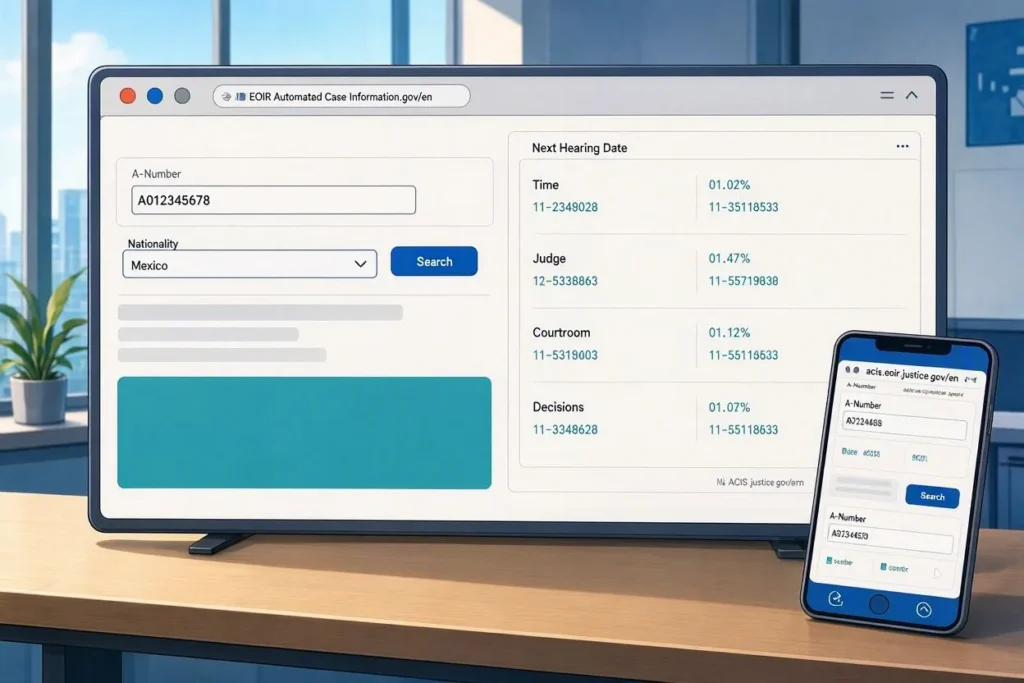
For court cases, use the EOIR Automated Case Information system (ACIS) at acis.eoir.justice.gov/en with your nine-digit A-Number. This covers anything pending before an immigration judge or the Board of Immigration Appeals, a completely separate track from USCIS processing.
Enter your A-Number, pick your nationality from the dropdown, and ACIS returns your next hearing date, time, judge, courtroom, and any decisions already made. If you see “no case found for this A-Number,” your case isn’t currently pending in immigration court. That could mean it was closed administratively, transferred, or never scheduled in the first place.
There’s also a phone option that works around the clock: the Automated Voice Case Information System (VCIS) at 1-866-222-8029. It’s toll-free, works on any touch-tone phone, and needs no internet. Attorneys and accredited representatives usually skip both of these in favor of the EOIR Courts & Appeals System (ECAS), which lets them file electronically and pull case documents beyond just status.
How to Check Visa Case Status Through CEAC
Visa applicants, both immigrant and nonimmigrant, check status through the Consular Electronic Application Center (CEAC) at ceac.state.gov. This one’s run by the Department of State, not USCIS or EOIR, and that distinction trips a lot of people up. A visa petition can start at USCIS and then move entirely into State Department territory once it reaches a consulate abroad.
CEAC asks for your visa case number, passport number, and the first five letters of your surname. If you filed before January 1, 2022, and those fields weren’t part of your process, enter “NA” for passport and surname. A typical immigrant visa case number looks something like MTL1999626025, where the first three letters mark the processing post.
What Do USCIS Case Status Messages Actually Mean?
Each message maps to a specific milestone, not a vague progress bar. Here’s what the common ones mean:
- Case Was Received: USCIS logged your filing and gave it a receipt number. Nothing for you to do yet.
- Case Was Transferred to Another Office: Your file went to a different service center, usually just for workload balancing, not because something’s wrong.
- Fingerprint Fee Was Received: Your biometrics fee cleared, and a biometrics appointment notice should follow within a few weeks.
- Request for Additional Evidence Was Sent (RFE): USCIS wants more documentation than you originally sent. Check the notice for your deadline, usually somewhere between 30 and 87 days depending on the form.
- Case Was Approved: A final favorable decision. A physical notice or card typically arrives by mail within 7 to 30 days.
- New Card Is Being Produced: For green cards and work permits specifically. Approval already happened; your card is now in the production queue.
Denials work a bit differently. USCIS mails the actual denial notice with the legal grounds spelled out, and the online tool rarely just says “denied” outright. More often you’ll see a generic “Case Was Denied” line telling you to check the mail.
How to Check SAVE Case Status for Public Benefits
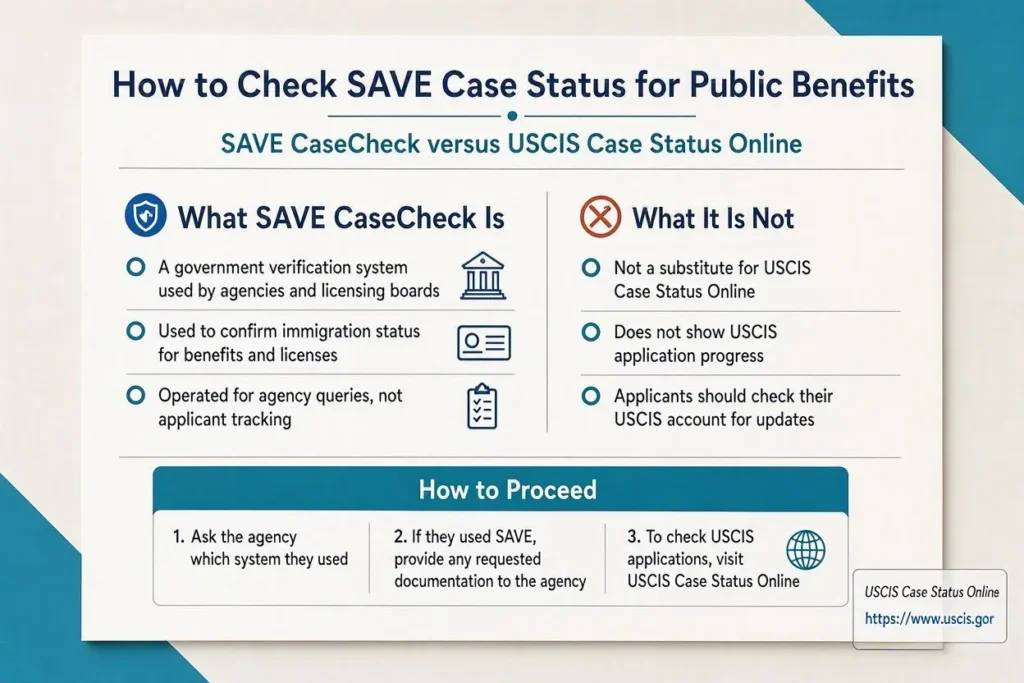
SAVE CaseCheck is its own thing entirely, a verification system that government agencies and licensing boards use to confirm someone’s immigration status before granting a benefit. It’s not built for tracking a USCIS application. People applying for a driver’s license, professional license, or public assistance sometimes get sent here without realizing it has nothing to do with Case Status Online.
Enter your document number and date of birth through the SAVE CaseCheck portal, and you’ll see whether a verification request is still pending or already answered. If the agency has a response on file but hasn’t acted on it yet, that’s a question for the agency, not for SAVE.
How Long Does It Take for Immigration Case Status to Change?
Depends entirely on the form and the service center. Some filings take a few weeks. Family-based green card categories can drag on for more than two years. USCIS posts current processing time estimates at uscis.gov/processingtimes, and you can search by form number and office.
An I-765 work permit, for example, often runs two to five months depending on eligibility category. An I-485 adjustment of status can range from eight months to several years, largely driven by visa category backlogs and country of birth. These numbers move month to month, so it’s worth checking the processing time tool alongside your status message rather than relying on either one alone.
What to Do If Your Immigration Case Status Hasn’t Changed
If your case has sat past the posted processing time with no movement, file an e-Request at uscis.gov/e-request. This kicks off a formal inquiry, not just another status check. It’s the right move when a notice never showed up, a document has a USCIS error on it, or you need an appointment accommodation, all things the basic status tool can’t touch.
Submit your receipt number, form type, and a short description of the delay. USCIS says it typically responds within 30 days. Still no movement after that? Reaching out to a congressional representative’s casework office is a common next step. Several senators keep dedicated immigration casework staff who take on constituent requests to help push stalled USCIS or State Department cases along.
How to Avoid Immigration Case Status Scams
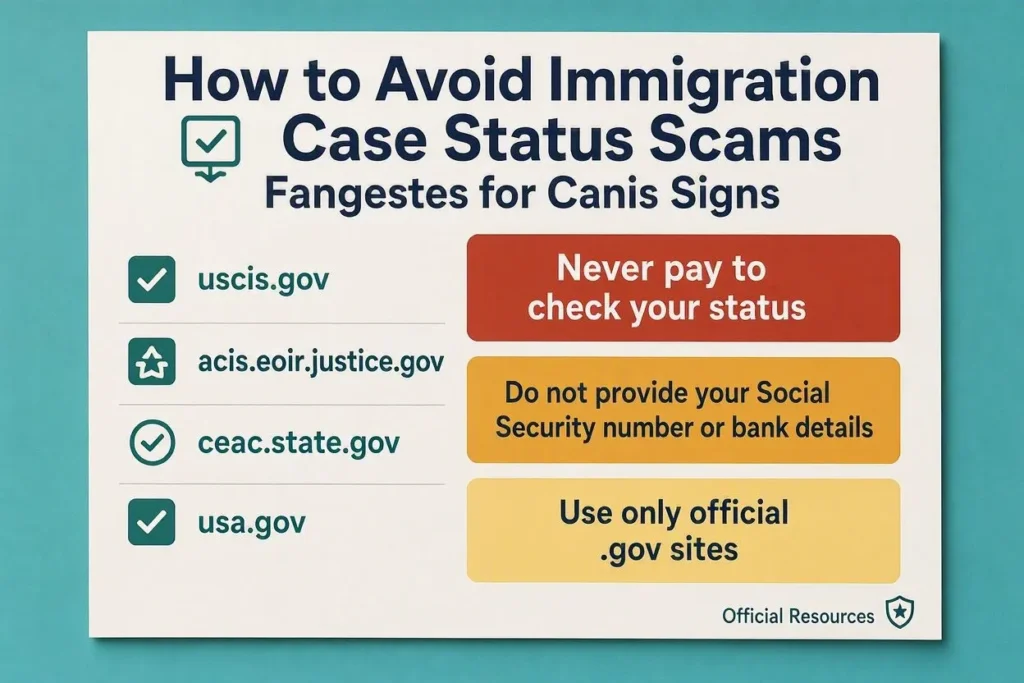
Stick to official .gov sites: uscis.gov, acis.eoir.justice.gov, ceac.state.gov, and usa.gov. Third-party sites charging a fee for status information have nothing to do with any federal agency, and checking your status through the real government tools costs nothing, ever.
Watch for a few red flags: a site asking for payment before showing results, a site wanting your Social Security number or bank details for what should be a routine lookup, and search ads dressed up like USCIS that lead to lookalike domains. One example making the rounds in 2026, a site called CaseStatusAPI.com, bills itself as an “AI-powered” layer on top of USCIS’s internal data. It’s not affiliated with USCIS at all, and it asks you to paste in raw account data, which is a real privacy risk. If you run into something like this, report it through USCIS’s fraud reporting page instead of engaging further.
Conclusion
Start by figuring out which system your case actually lives in: USCIS for applications and petitions, EOIR for court proceedings, CEAC for consular visa processing, SAVE for public benefits verification. A 13-character receipt number gets you into the USCIS tool, a nine-digit A-Number gets you into EOIR’s ACIS system, and a visa case number paired with a passport number gets you into CEAC. Every one of these is free and government-run: uscis.gov, acis.eoir.justice.gov, ceac.state.gov, or by phone at 1-800-375-5283 for USCIS cases and 1-866-222-8029 for EOIR court cases.
FAQs

Amanda Brooks
Amanda Brooks leads legal, justice, and community advocacy content at JusticeInTown, drawing on a background in legal research and public policy. She specializes in civil rights, access to justice, and legal awareness, bringing a careful, research-driven approach to complex legal and public-interest topics. Her guides help readers better understand their rights, legal options, and the issues affecting their communities.
Related Posts