

What Is Personal Injury Law? Complete 2026 Guide
Personal injury law is the branch of civil law that lets an injured person recover money from whoever caused their harm through negligence, recklessness, or an intentional act. Attorneys call this area of practice tort law. The injured party who files suit is the plaintiff; the party being sued is the defendant. A warehouse worker struck by a forklift, a cyclist hit by a driver running a red light, a nursing home resident injured through neglect: all three share the same legal thread. Another party owed them a duty of care and broke it.
Money doesn’t undo an injury, but it’s the remedy civil courts are built to provide. Personal injury law shifts the financial burden, medical bills, lost income, long-term harm, from the victim onto the at-fault party, usually through an insurance settlement or a civil lawsuit. Most cases never reach a jury. Roughly 95% resolve before trial, according to data cited by the American Association for Justice (AAJ), and it’s easy to see why: both sides typically come out ahead by avoiding the cost and uncertainty of litigation. A trial can run a defendant’s legal costs into six figures before a verdict even comes back, so insurers have every incentive to settle a claim they know they’re likely to lose anyway.
What Are the Four Elements of a Personal Injury Claim?
Duty, breach, causation, damages. A plaintiff has to prove all four, and losing any one of them sinks the case. Duty just means the defendant owed the plaintiff some standard of care. Every driver, for example, owes every other driver on the road a duty to obey traffic laws; a store owner owes customers a duty to keep aisles reasonably free of hazards; a doctor owes patients a duty to treat them at the level of skill a competent physician would use in the same situation. Breach is where that standard gets broken, whether that’s running a stop sign or leaving a wet floor unmarked in a grocery store.
Causation is usually where cases actually get won or lost. It’s not enough to show the defendant did something careless; the plaintiff has to draw a straight line from that carelessness to the specific injury. Say a driver runs a red light and clips a cyclist, but the cyclist was already recovering from a shoulder injury from a fall the week before. The defense will argue that some of the harm predates the crash, and the plaintiff’s attorney has to separate what the collision caused from what was already there, usually with help from a treating physician.
Damages close the loop. Courts want documentation, not estimates: itemized medical bills, pay stubs showing missed income, a mechanic’s repair quote, sometimes a vocational expert’s opinion on reduced future earning capacity. A plaintiff who shows up with nothing but a story, however credible, is going to struggle. Insurance adjusters are trained to discount anything that isn’t backed by paper.
What Types of Cases Fall Under Personal Injury Law?
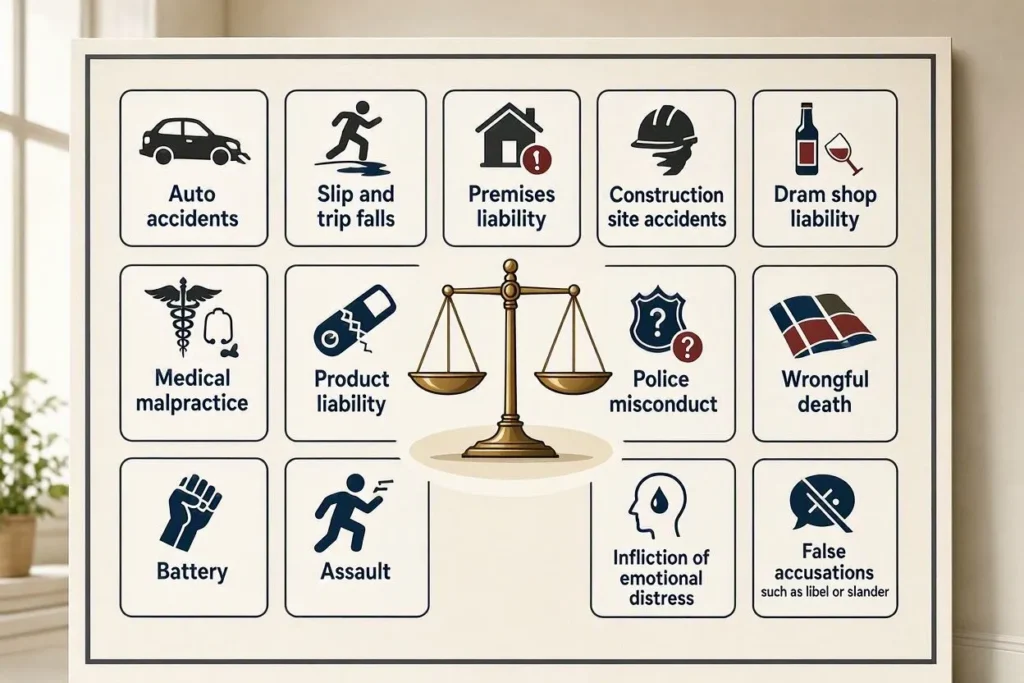
Auto accidents, slip and trip falls, premises liability, construction site accidents, dram shop (alcohol) liability, medical malpractice, product liability, police misconduct, wrongful death, battery, assault, infliction of emotional distress, and false accusations such as libel or slander. That’s 13 recognized categories, and they range from a fender bender to a defamation suit.
Auto accidents generate the largest share of filed personal injury claims in the United States each year; slip-and-fall cases rank second. Two claims from these categories show how differently a case can unfold depending on which one applies. A rear-end collision on a state highway typically resolves through the at-fault driver’s liability insurance within three to six months. A birth injury claim against a hospital can take two to four years, since it requires expert medical testimony to establish that the standard of care was breached during delivery, and that kind of testimony takes time to line up.
Premises liability and construction site accidents deserve separate mention because they involve overlapping legal systems. A retail customer injured by a collapsing shelf files a straightforward premises liability claim against the store. A construction worker injured by that same kind of falling equipment often can’t sue their own employer directly. Workers’ compensation is usually the exclusive remedy against an employer. That worker can still bring a third-party personal injury claim against a subcontractor, equipment manufacturer, or property owner whose negligence contributed to the accident, and that’s why construction injury cases so often name three or four defendants instead of one.
What Legal Standards Determine Liability in a Personal Injury Case?
Negligence, recklessness, intentional conduct, strict liability. Courts sort every personal injury case into one of these four buckets, and which bucket applies changes what the plaintiff actually has to prove. Negligence is the default: a person failed to exercise the ordinary care a reasonable person would use in the same situation. A driver checking a phone while approaching a stop sign meets that standard the moment the vehicle enters the intersection, whether or not a collision actually happens.
Recklessness sits a step above negligence and shows up less often. It’s usually reserved for cases involving a police officer or firefighter who acts with utter disregard for public safety while responding to an emergency call, say, running a red light at high speed with no siren on. Intentional torts are different again: deliberate harm rather than carelessness, like a bar patron who punches another guest without provocation. Strict liability breaks the pattern entirely. It doesn’t require proof of wrongful intent or carelessness at all. If a defective product injures a consumer, a car with faulty brakes, a power tool with a missing safety guard, the manufacturer can be held liable purely because the product was defective, regardless of how much care went into designing it.
What Compensation Can You Recover in a Personal Injury Case?
Three types: economic damages, non-economic damages, punitive damages. Economic damages cover measurable financial losses: medical bills, lost wages, property damage, diminished future earning capacity. These are the numbers with paper trails behind them, so they’re usually the easiest part of a claim to defend. Non-economic damages are murkier. They compensate losses that don’t come with a receipt, pain and suffering, emotional distress, loss of enjoyment of life, and juries often lean on comparable verdicts or a multiplier of the medical bills to put a dollar figure on something inherently hard to price.
Punitive damages work differently from both. Courts award them only when a defendant’s conduct was especially reckless or malicious, and the goal isn’t to make the victim whole, it’s to punish the defendant and deter others from the same behavior. Take a slip-and-fall case where a jury awards $50,000 for medical expenses and $75,000 for pain and suffering. If it comes out that the property owner knew about the hazard for six months and ignored repeated complaints from customers and staff alike, the same jury might tack on $200,000 in punitive damages just to punish that pattern of disregard.
Most states cap non-economic and punitive damages by statute, and the caps vary enormously from one state to the next. Texas limits non-economic damages in medical malpractice cases to $250,000 per provider (so a claim against a hospital and a surgeon separately could theoretically hit $500,000 in non-economic damages alone), while states like New York impose no cap at all.
How Does the Personal Injury Claims Process Work?
Five stages, roughly in order: medical treatment, investigation, demand letter, negotiation, resolution. Medical treatment comes first after any accident, and not just because health matters more than money. Medical records establish injury severity and directly affect how much a case is worth later, so gaps in treatment, or worse, big gaps in time before someone first sees a doctor, can hand the insurer an easy argument that the injury wasn’t serious or wasn’t caused by the accident at all. An attorney then investigates liability by gathering police reports, witness statements, surveillance footage, and photographs of the scene, often racing the clock before that footage gets overwritten or a witness’s memory fades.
Once the investigation wraps up, the attorney sends a demand letter to the at-fault party’s insurance company, laying out the facts of the accident and requesting a specific settlement figure, usually well above what the attorney actually expects to accept. Negotiation follows, and most claims resolve at this stage without a lawsuit ever being filed. If negotiation stalls, the claim proceeds to a formal civil lawsuit, though even filed lawsuits frequently settle before trial, sometimes within days of jury selection, once both sides have a clearer read on how a jury might actually respond.
What Role Does Insurance Play in a Personal Injury Claim?
Liability insurance funds the vast majority of personal injury settlements. Most defendants pay through a policy rather than out of pocket, which is a big part of why these cases get negotiated with an insurance adjuster rather than the person who caused the harm. Auto insurance, homeowners insurance, and commercial general liability policies each cover different categories of claims, and the policy limits often set a practical ceiling on what a victim can recover no matter how severe the injury is.
Subrogation complicates the picture further. If a health insurer pays $40,000 in medical bills for an accident victim, that insurer typically has the right to reclaim a portion of any personal injury settlement to recover its own costs, a process called subrogation. An accident victim who settles a claim for $100,000 without accounting for a subrogation lien might discover afterward that $30,000 or more is owed back to the health insurer before any money actually reaches their pocket. It’s the kind of detail that catches unrepresented claimants off guard more than almost anything else in the process.
Policy limits create a separate, often bigger problem in catastrophic injury cases. Standard auto liability policies often max out at $25,000 to $100,000 per person, and a single hospital stay for a traumatic brain injury can blow past that within days, sometimes hours. That’s why injury attorneys routinely check whether a defendant carries an umbrella policy: supplemental coverage that sits on top of a standard policy and can add $1 million or more in available compensation. Without it, a severely injured victim can end up with a valid, well-documented claim worth far more than the money actually available to pay it.
What Is the Difference Between a Personal Injury Claim and a Lawsuit?

A personal injury claim is a request for compensation sent directly to an insurance company. A lawsuit is a formal court proceeding filed after that claim fails to produce a fair settlement. Every lawsuit starts as a claim, but not every claim becomes a lawsuit; most get resolved through negotiation long before a complaint is ever filed with the court. Once filed, a lawsuit moves through discovery, depositions, and pretrial motions before either settling or reaching trial, a process that can stretch on for a year or more even in a fairly straightforward case.
Filing a lawsuit changes the leverage even when both sides still expect to settle eventually. Insurance companies often revise their offers upward once a complaint lands, since litigation exposes the insurer to added costs, including the plaintiff’s attorney fees if the case goes to trial and a jury returns a verdict higher than the insurer’s last offer. A car accident claim that stalled at a $40,000 offer during negotiation might jump to $95,000 within weeks of a lawsuit being filed, simply because the insurer now faces real litigation risk instead of a negotiation it can stall indefinitely.
What Is the Statute of Limitations for Personal Injury Claims?
The statute of limitations for personal injury claims ranges from one year to six years, depending on the state where the injury occurred. California and Louisiana set the shortest deadline at one year, while Maine and North Dakota allow six. Most states, including Texas, Florida, and New York, fall somewhere in between at two to three years from the date of injury.
Courts apply an exception called the discovery rule in cases where the injury isn’t immediately obvious. A patient who develops complications from a surgical error, say, a piece of surgical material left behind, might not discover the harm for months, sometimes not until a completely unrelated scan turns it up. In states that recognize the discovery rule, the clock starts running from the date of discovery rather than the date of the surgery itself. Missing the applicable deadline bars the claim permanently, and courts rarely grant extensions, only in narrow, statutorily defined circumstances, like the plaintiff being a minor at the time of injury.
Is Comparative Negligence Different From Contributory Negligence?
Yes. Comparative negligence reduces a victim’s compensation by their percentage of fault, while contributory negligence bars recovery entirely if the victim holds any fault at all. Forty-six states use some form of comparative negligence, and most of those apply a modified version built around a 51% bar rule: a plaintiff found more than half at fault recovers nothing.
Four states, Alabama, Maryland, North Carolina, and Virginia, still use pure contributory negligence, along with Washington, D.C. Under that rule, a pedestrian found just 1% at fault for jaywalking during a collision could lose the entire claim, even if the driver was 99% responsible for the crash. The gap between these two systems can be worth hundreds of thousands of dollars in a single case, which is exactly why an injury attorney checks the applicable state rule before advising a client on anything else.
Do You Need a Personal Injury Lawyer?
Hiring a personal injury lawyer isn’t legally required, but claims with lawyer representation settle for significantly more than claims without one. Insurance Research Council data shows represented claimants recover roughly three-and-a-half times more, on average, than unrepresented claimants, even after subtracting attorney fees from the total. Minor claims, like a low-speed fender bender with no injury and an undisputed at-fault party, can sometimes be resolved without legal help.
Complex cases change that math quickly. A commercial truck accident involving multiple insurance policies, a trucking company, and a cargo owner requires legal expertise most accident victims can’t navigate alone. Insurers routinely offer settlements far below actual case value to claimants without representation in these situations, and there’s little incentive for them to volunteer a better number.
How Much Does a Personal Injury Lawyer Cost?

Personal injury attorneys typically work on contingency, charging 33% to 40% of the final settlement or verdict instead of billing by the hour. Clients pay nothing upfront under this arrangement and owe nothing if the case doesn’t result in a recovery. That’s why firms commonly advertise it as a “no win, no fee” service. The contingency percentage usually increases if a case proceeds to trial rather than settling early, since trial preparation demands far more attorney time than a routine settlement negotiation.
Court costs and expert witness fees sit outside the contingency percentage in most fee agreements. A case requiring an accident reconstruction expert and a medical expert might rack up $10,000 to $25,000 in costs. Attorneys typically front these expenses before deducting them from the final settlement alongside their fee.
Conclusion
Personal injury law gives accident victims a legal path to recover medical costs, lost income, and pain-and-suffering damages from whoever caused their harm. The legal standard that applies, whether negligence, recklessness, strict liability, or intentional conduct, determines both how a case gets proven and how much it’s ultimately worth. Deadlines matter as much as the facts of the accident itself: a valid claim filed one day after the statute of limitations expires gets dismissed, no matter how strong the evidence behind it is.
FAQs

Amanda Brooks
Amanda Brooks leads legal, justice, and community advocacy content at JusticeInTown, drawing on a background in legal research and public policy. She specializes in civil rights, access to justice, and legal awareness, bringing a careful, research-driven approach to complex legal and public-interest topics. Her guides help readers better understand their rights, legal options, and the issues affecting their communities.
Related Posts