
Can Grandparents Get Visitation Rights? A 2026 Legal Guide
Yes. Grandparents can petition for court-ordered visitation in all 50 states and the District of Columbia. Every state legislature has passed a grandparent visitation statute, so the courthouse door is open everywhere.
Grandparent visitation is a question of state family law, decided in family court under each state’s child custody and visitation statutes. No federal statute grants grandparents visitation, and no two state family codes treat a grandparent petition the same way.
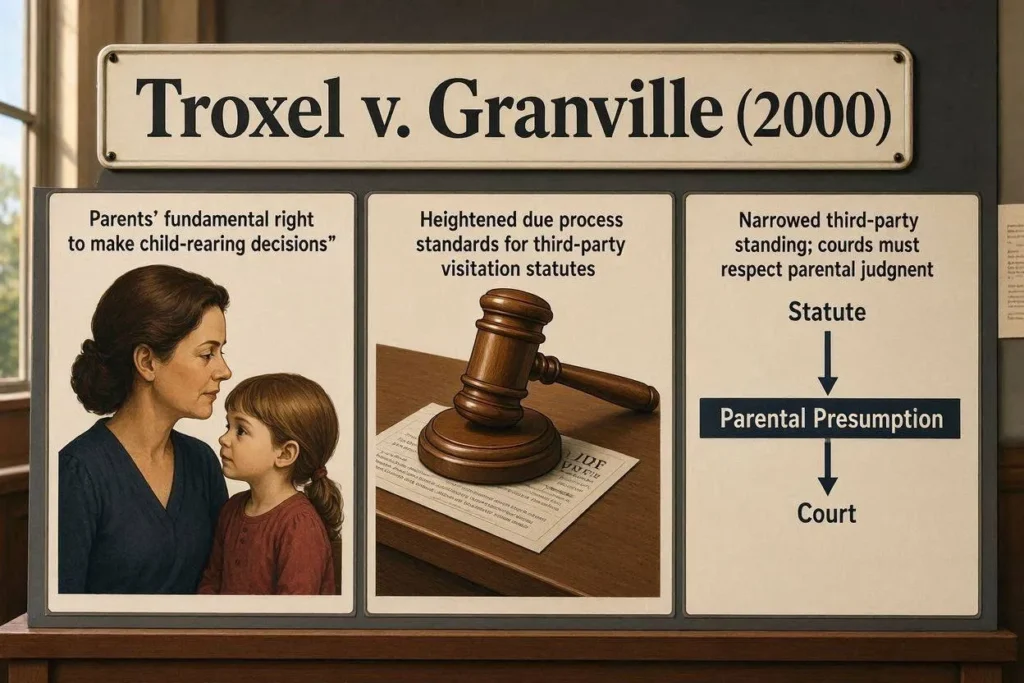
Winning behind that door is a separate question with a harder answer. A grandparent begins every case at a constitutional disadvantage, because Troxel v. Granville, 530 U.S. 57 (2000), requires judges to presume that a fit parent’s decision about visitation is correct. The presumption, not the strength of the grandparent-grandchild bond, decides most petitions.
Can grandparents get visitation rights in every state?
Yes, though the conditions differ sharply by jurisdiction. Roughly half the states require a disruption in the family — a divorce, a separation, or the death of a parent — before a grandparent may file at all. The remaining states permit a petition without any disruption, then apply a demanding standard on the merits.
Two variables control the outcome in every state:
- Standing, meaning the legal right to file
- Burden of proof, meaning what a grandparent must prove once inside
A grandparent who clears standing in Georgia faces a different burden than a grandparent who clears standing in Massachusetts. Reading a national summary and assuming the summary describes your county courtroom is the single most common mistake in this area of law.
What Troxel v. Granville changed for every grandparent petition
What the Supreme Court decided in 2000
Jenifer and Gary Troxel petitioned a Washington court for visitation with their granddaughters, Isabelle and Natalie, after their son Brad died by suicide in 1993. Tommie Granville, the girls’ mother, did not oppose visitation outright — she offered one day per month without an overnight stay. The Troxels asked for two weekends a month plus two weeks each summer. A trial court ordered more visitation than Granville wanted.
Washington’s statute, Wash. Rev. Code § 26.10.160(3), let any person petition for visitation at any time whenever a judge found visitation served the child’s best interest. On June 5, 2000, the Supreme Court struck that application down 6–3. Justice Sandra Day O’Connor announced the judgment, joined by Chief Justice William Rehnquist, Justice Ruth Bader Ginsburg, and Justice Stephen Breyer. Justices Souter and Thomas concurred in the judgment. Justices Stevens, Scalia, and Kennedy dissented.
O’Connor described a parent’s interest in the care, custody, and control of a child as perhaps the oldest fundamental liberty interest the Court recognizes. The Washington trial court had given Granville’s own judgment no special weight. Giving a fit parent’s decision no weight violated the Due Process Clause of the Fourteenth Amendment.
What the fit-parent presumption means inside a hearing
Three practical rules came out of Troxel, and family courts across the country apply all three:
- A judge must presume a fit parent acts in a child’s best interest.
- A judge must give special weight to a fit parent’s decision to deny visitation.
- A judge may not override that decision based only on a personal view that more visitation would be better.
A grandparent therefore does not walk into a neutral courtroom. The grandparent walks in behind, carrying the burden of rebutting a presumption that the parent starts with for free.
One point Troxel deliberately left open still drives litigation in 2026: the Court declined to decide whether the Constitution requires a showing of harm to the child. State supreme courts filled that silence differently, which produced the split described below.
The harm standard and the best-interests standard decide most cases
Your state’s answer to one question predicts your outcome better than any other factor: must you prove the child will be harmed without visitation, or only that visitation serves the child’s best interest?
Harm states require a threshold showing that denying contact damages the child. Best-interests states apply the parental presumption but let a grandparent rebut it with a showing about the child’s welfare, usually by clear and convincing evidence.
The difference is not academic. Proving that a child suffers measurable harm demands documentation, and often expert testimony. Proving that visitation benefits a child is a lower bar that many sympathetic grandparents can clear.
Examples of harm-standard jurisdictions:
- Texas — Tex. Fam. Code § 153.433 requires proof that denial would significantly impair the child’s physical health or emotional well-being.
- Massachusetts — Blixt v. Blixt requires a verified affidavit alleging specific facts showing significant harm; conclusory affidavits draw dismissal before discovery.
- Alabama — E.H.G. v. E.R.G. (Ala. Civ. App. 2010) imposed a threshold harm requirement.
- Washington — In re Custody of Smith held that protecting children from harm is the only state interest compelling enough to override a fit parent.
Examples of best-interests jurisdictions with a rebuttable presumption:
- Arkansas — Ark. Code § 9-13-103 lets a judge find compelling circumstances by clear and convincing evidence.
- California — Cal. Fam. Code § 3104 requires a preexisting relationship plus a best-interests finding.
- Virginia — Va. Code § 20-124.1 et seq. requires clear and convincing evidence on best interests.
No competitor page in the top results explains the split. Check your state’s standard before you spend a dollar on filing fees.
Standing determines whether a family court reaches the merits
Standing is the legal right to bring a case. A grandparent without standing loses on a motion to dismiss, and the judge never hears a word about the relationship with the grandchild.
Texas illustrates the sequence cleanly. A nonparent must first satisfy Tex. Fam. Code § 102.003 to file a Suit Affecting the Parent-Child Relationship (SAPCR). Only after clearing § 102.003 does a court reach §§ 153.432 and 153.433, which govern grandparent possession and access.
Restrictive states gate standing on a family disruption. Massachusetts, under M.G.L. c. 119 § 39D, permits a petition in five defined situations: parents divorced, parents married but living apart, parents under a temporary order of separate support, one or both parents deceased, or a child born out of wedlock whose parents live apart. Married parents living together as an intact household are unreachable.
Permissive states set a wider gate. Georgia amended its statute in 2020 to let any grandparent file a petition where visitation serves the child’s best interest.
What evidence rebuts the fit-parent presumption
Courts respond to documentation, not to sentiment. Grandparents who win produce records; grandparents who lose produce feelings.
Evidence that carries weight:
- Proof of a substantial preexisting relationship — photographs with dates, school pickup logs, birthday cards, text threads, travel records
- Proof of prior caregiving — daycare payments, medical appointments attended, months the child lived in your home
- Proof of harm or benefit — testimony from a therapist, a teacher, a pediatrician, or a school counselor who observed the child before and after contact ended
- Proof of the parent’s reasoning — messages showing that denial followed a dispute between adults rather than any concern about the child
- Third-party affidavits — statements from neighbors, clergy, coaches, or family friends with direct knowledge
Arkansas codifies the analysis, and its factor list under Ark. Code § 9-13-103(b) reads like a checklist for any state. Judges weigh the emotional ties between grandparent and child, the length and quality of the relationship, the mental and physical health of everyone involved, the child’s wishes, the reason the parent denied visitation, the reason the grandparent seeks it, and any history of abuse, neglect, or domestic violence.
Note the sixth factor. A parent who denies contact after an argument about money stands on weaker ground than a parent who denies contact over a safety concern.
Adoption and termination of parental rights end grandparent visitation
Adoption terminates grandparent visitation rights in most states, and terminates them permanently. Grandparent standing flows through the parent’s legal relationship to the child. Sever the parent’s rights and the grandparent’s derivative claim disappears with them.
Massachusetts states the rule without softening it: under M.G.L. c. 119 § 39D, adoption by anyone other than a stepparent automatically ends grandparent visitation — including visitation a court already ordered — with no further hearing. Once a non-stepparent adoption is final, no statutory remedy remains.
The stepparent and relative adoption exceptions
Several states preserve grandparent standing when the adopting party is a stepparent, another grandparent, or a relative:
- California — Cal. Fam. Code § 3103 survives stepparent and grandparent adoption; adoption by anyone else terminates any existing order automatically.
- Vermont — adoption terminates a visitation order unless a stepparent, grandparent, or other relative adopts.
- North Carolina — visitation remains available after stepparent or relative adoption where a substantial relationship exists, and is unavailable once unrelated parties adopt and both biological parents’ rights end.
- Minnesota — visitation may be terminated when someone other than a stepparent or grandparent adopts.
- Texas — adoption severs grandparent access, with a stepparent-adoption exception that still requires proof on best interests.
Timing controls everything here. A grandparent who learns of a pending adoption has options. A grandparent who learns of a finalized adoption usually has none. Act before the decree, not after.
Which state do you file in?
File in the child’s home state. The Uniform Child Custody Jurisdiction and Enforcement Act (UCCJEA), adopted by 49 states, the District of Columbia, Guam, and the U.S. Virgin Islands, defines the home state as where the child has lived with a parent for at least six consecutive months immediately before the case starts. Massachusetts applies its own similar law. A child under six months old has a home state where the child has lived since birth.
The rule matters because grandparents frequently live several states away from a grandchild. Filing in your own state when the grandchild lives elsewhere produces a dismissal for lack of jurisdiction and a wasted filing fee. The home state court that issues the first order generally keeps exclusive continuing jurisdiction to modify it, which prevents forum shopping.
Federal law reinforces the framework. The Parental Kidnapping Prevention Act of 1980 requires each state to give full faith and credit to custody decrees from other states, and 1998 federal legislation requires state courts to recognize and enforce grandparent visitation orders issued elsewhere.
What a grandparent visitation case costs and how long it takes
Published national figures for grandparent visitation costs and success rates do not exist. Any site quoting a precise national average invented it. What follows is the cost structure — verify each figure against your own county’s schedule.
Cost components:
- Filing fee — set by county, commonly $90 to $400 (roughly £70–£315). Massachusetts petitions on form CJD-105 start near $90.
- Service of process — sheriff or private process server, commonly $30 to $150 per party served
- Attorney fees — hourly in most markets, retainers frequently $2,500 to $7,500
- Guardian ad litem or attorney ad litem — appointed at the judge’s discretion, often split between parties, frequently $1,500 to $5,000
- Expert testimony — a child psychologist’s evaluation and testimony, commonly $2,000 to $6,000 in harm-standard states
- Mediation — $100 to $400 per hour, sometimes court-subsidized
Timeline components:
- Filing to service: 1 to 4 weeks
- Service to first hearing: 4 to 12 weeks in most counties
- Contested case to final order: 6 to 18 months
- Appeal, where taken: an additional 12 to 24 months
Fee waivers exist in every state for petitioners below an income threshold. Ask the clerk for an affidavit of indigency on the day you file.
How to file a grandparent visitation petition in six steps

- Confirm standing under your state’s statute before drafting anything.
- Identify your standard — harm or best interests — and gather evidence matching that standard.
- Assemble documentation covering the relationship, the caregiving history, and the effect of the denial on the child.
- File the petition in the child’s home state, in the county where the child resides.
- Serve every required party — both parents, any stepparent, and any person with physical custody.
- Attend the hearing prepared to rebut the presumption with records and witnesses rather than with narrative.
A verified affidavit reciting the legal standard without specific facts draws dismissal in Massachusetts before discovery begins. Specificity at step three prevents dismissal at step six.
Mediation resolves cases that litigation would not
Filing a petition against your own child, or against the surviving parent of your deceased child, converts a family conflict into an adversarial record that outlives the case. Consider the sequence before you consider the courthouse.
Direct conversation costs nothing and resolves a meaningful share of disputes. Mediation brings a neutral third party who facilitates an agreement without a judge, typically over one to three sessions. A written agreement reached in mediation can be submitted for entry as a consent order, which gives it the same enforceability as an order won at trial — without the testimony, the cost, or the permanent damage.
Litigation belongs last.
Grandparent visitation and grandparent custody carry different burdens
Visitation asks a court for scheduled contact. Custody asks a court to move a child into your home and give you decision-making authority. Courts grant the second far less often than the first.
Grandparent custody generally requires proof that both parents are unfit, demonstrated through substance abuse, severe mental illness, abandonment, or documented abuse or neglect. Death of both parents also opens the door.
Adjacent routes exist for grandparents already raising a grandchild. De facto custodian statutes and in loco parentis standing — meaning the grandparent has functioned as the child’s parent — grant standing in several states after a defined caregiving period. Arizona requires a grandparent to show in loco parentis status, significant detriment to the child in the legal parent’s care, and clear and convincing evidence that awarding decision-making to the parent would not serve the child’s best interests. Arkansas grants custody standing where a child lived with the grandparent at least one year (six months for a child under one), the grandparent was primary caregiver and financial supporter, and the grandparent petitioned within one year of that custody.
Three state examples: Texas, Arkansas, California
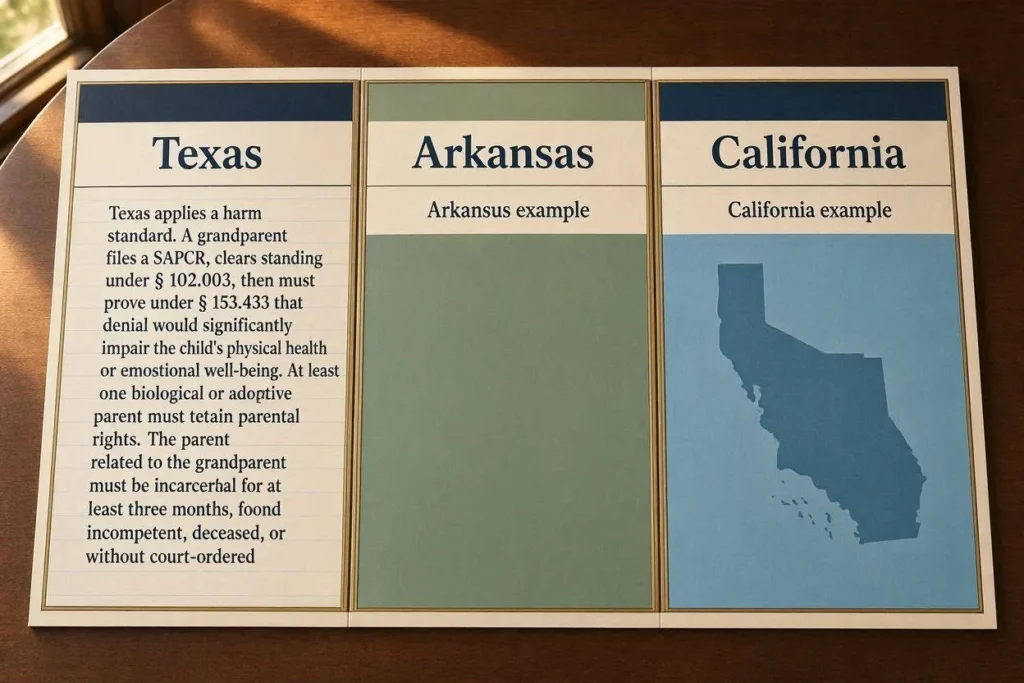
Texas applies a harm standard. A grandparent files a SAPCR, clears standing under § 102.003, then must prove under § 153.433 that denial would significantly impair the child’s physical health or emotional well-being. At least one biological or adoptive parent must retain parental rights. The parent related to the grandparent must be incarcerated for at least three months, found incompetent, deceased, or without court-ordered access.
Arkansas applies a best-interests standard with four standing gates: parents divorced or separated, a parent deceased, a child born to an unmarried mother (maternal grandparents only, absent established paternity), or a judicial finding by clear and convincing evidence that the custodian is unfit or that compelling circumstances favor visitation. Ten enumerated factors then govern the merits under § 9-13-103(b).
California bars a petition while the natural or adoptive parents are married, with exceptions: parents living separately on a permanent or indefinite basis, one parent absent more than a month with unknown whereabouts, one parent joining the petition, or the child residing with neither parent. Section 3104 requires a preexisting relationship plus a best-interests finding. Section 3103 survives stepparent and grandparent adoption.
Conclusion
Yes — grandparents can ask a court for visitation in every state, and most who ask are turned down. One Supreme Court rule explains the gap. A judge must begin by assuming a fit parent already made the right call about who sees the child, so changing a judge’s mind takes evidence rather than feeling.
Four questions are worth answering before you file. Does your state let you file at all? Must you prove harm to the child, or only benefit? Can you prove the bond with dates, photos, messages, and records? And is an adoption in progress? The last question outranks the rest, because most states end grandparent standing for good once an adoption by an unrelated person becomes final. Act before the decree, not after.
FAQs

Amanda Brooks
Amanda Brooks leads JusticeInTown’s legal, justice, and community advocacy content division. She holds a background in legal research and public policy and specializes in topics related to civil rights, access to justice, legal awareness, and community issues. With years of experience researching legal and social justice topics, Amanda brings a careful, research-driven approach to complex legal information and public-interest issues. She is the primary author of JusticeInTown’s legal guides, justice-related resources, and community-focused content, helping readers better understand their rights, legal options, and the issues affecting their communities.
Related Posts