
Car Accident Claims: How to File, Prove Fault & Get Paid
A car accident claim is a formal request to an insurance company for payment after a collision, covering vehicle repairs, medical costs, and lost income. You file it with your own insurer, the at-fault driver’s insurer, or both, depending on where you live and who caused the crash. Most insurers want the claim reported within days of the accident. The legal deadline to actually sue, though, can run anywhere from one to six years depending on the state, province, or country. (This guide covers the US, UK, Australia, and Canada, since the rules shift so much by country, and by province or state within them, that jurisdiction is worth confirming before anything else.)
What Is a Car Accident Claim?
A car accident claim is the paperwork trail that turns a crash into a payout. It starts the moment you report the collision to an insurer and ends when a settlement check clears or a court issues a verdict. In between sits an adjuster, a pile of evidence, and usually some back-and-forth negotiation.
There are three types. A first-party claim goes to your own insurer under your own policy. A third-party claim goes to the other driver’s insurer, based on their liability. Then there’s the UM/UIM claim (uninsured/underinsured motorist), which sits in an odd middle ground: you’re claiming against your own policy for someone else’s negligence.
Every jurisdiction handles this differently, too. California runs on pure comparative negligence. Texas caps recovery at 51% fault. The UK uses a fault-based tort system regulated by the Financial Conduct Authority (FCA). Australia layers a no-fault Compulsory Third-Party (CTP) scheme on top of at-fault property claims. The underlying idea of a “claim” doesn’t change across any of this, but almost everything about how you actually win one does.
How to File a Car Accident Claim in 6 Steps
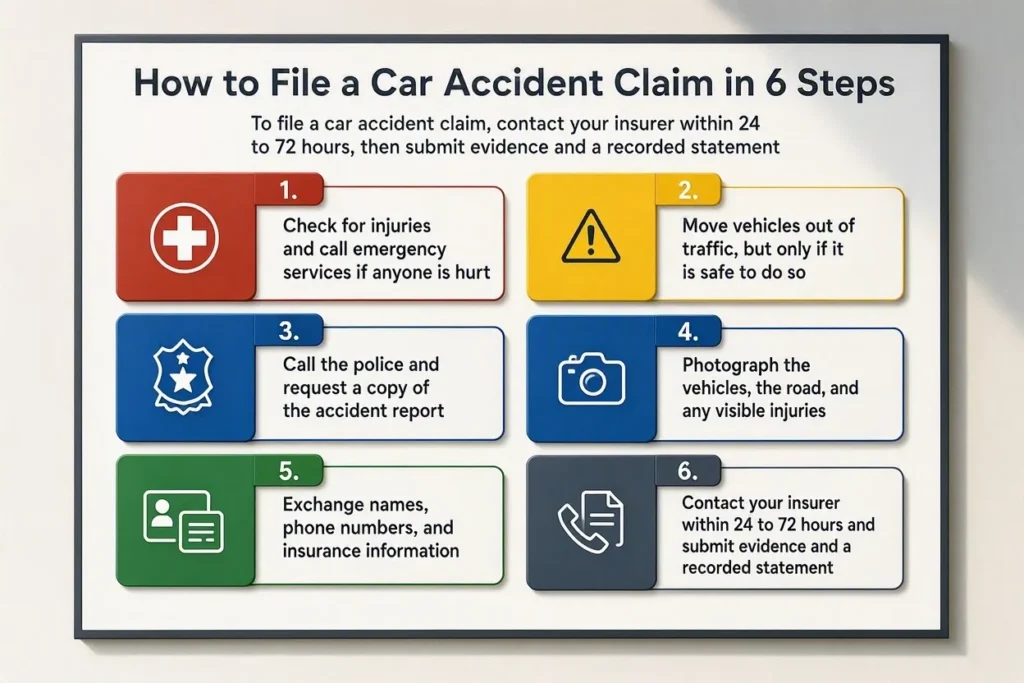
To file a car accident claim, contact your insurer within 24 to 72 hours, then submit evidence and a recorded statement. The full sequence looks like this:
- Check for injuries and call emergency services if anyone is hurt.
- Move vehicles out of traffic, but only if it’s safe to do so.
- Call the police and request a copy of the accident report.
- Photograph the vehicles, the road, and any visible injuries.
- Exchange names, phone numbers, license numbers, and insurance details with the other driver.
- Report the crash to your insurer and open the claim, usually by phone, app, or online portal.
Skipping step three trips up more people than you’d think. Adjusters lean on the police report to establish fault quickly. Without it, they’re stuck piecing the story together from statements alone, and that almost always slows things down.
Liberty Mutual’s own consumer guidance makes a point worth repeating: don’t apologize at the scene. Even a simple “I’m sorry” can, in some states and situations, be read as an admission of legal liability. Stick to facts. Save the story for the report.
What Information Do You Need Before You File?
You need six categories of information before you call your insurer: identity details, vehicle data, the police report number, photos, witness contacts, and medical records if anyone was hurt. Missing even one slows everything down.
- Driver details — full name, phone number, license number, and address for every driver involved.
- Vehicle details — license plate, make, model, and vehicle identification number (VIN).
- Insurance details — policy number and the name of each driver’s insurer.
- Scene evidence — timestamped photos of damage, road conditions, and traffic signals.
- Witness information — names and numbers of anyone who saw the crash happen.
- Medical documentation — hospital records, treatment notes, and receipts if you sought care.
Gather this at the scene whenever you can. Memory fades fast, and insurers move faster than most people expect.
Once your claim is open, the next question is who pays for it, and that depends entirely on where the accident happened.
How Fault Affects Your Claim (US, UK, Australia, and Canada)
Fault determines who pays, and the rules differ sharply by country. Four systems dominate the English-speaking world, and knowing which one applies to you changes your entire strategy.
United States. Most states run on a tort, or at-fault, system, where the at-fault driver’s liability insurer pays your damages. Within that system, states split further:
- Pure comparative negligence (California, New York) — you recover damages minus your percentage of fault, even if you’re 90% responsible.
- Modified comparative fault with a 50% or 51% bar (Texas, most states) — you recover nothing if you’re found more at fault than the other party.
- Contributory negligence (a handful of states, including Virginia) — any fault on your part, even 1%, can bar recovery entirely.
- No-fault states (Florida, Michigan, New York for injury claims) — your own Personal Injury Protection (PIP) pays your medical bills regardless of fault, up to a policy limit, and you only sue the other driver if injuries cross a state-defined severity threshold.
United Kingdom. The system is fault-based tort law. The at-fault driver’s insurer pays under the Road Traffic Act 1988, and claims management companies (CMCs) regulated by the FCA often handle the process for injured claimants. The UK also runs the Motor Insurers’ Bureau (MIB) scheme, which steps in when the at-fault driver has no valid insurance.
Australia. Injury and property claims split apart entirely. Compulsory Third-Party (CTP) insurance, sometimes called “green slip” cover in New South Wales, pays for personal injury regardless of fault in most states, while a separate at-fault claim through comprehensive or third-party property insurance covers vehicle damage. Rules vary by state. Victoria’s Transport Accident Commission (TAC), for instance, runs its own no-fault injury scheme.
Canada. There’s no single national system here either, and several provinces are mid-overhaul. Quebec runs a pure no-fault model through the public insurer SAAQ, which covers bodily injury regardless of fault while private insurers handle only vehicle damage. British Columbia, Saskatchewan, and Manitoba also run public no-fault schemes through provincial insurers (ICBC, SGI, and MPI), with BC having shifted to its “Enhanced Care” no-fault model in 2021. Ontario blends the two approaches: no-fault accident benefits kick in automatically, but you can still sue an at-fault driver for damages above a legislated threshold, and several of Ontario’s benefit rules changed again in mid-2026. Alberta remains a tort, at-fault system for now, but it’s scheduled to move to a no-fault “care-first” model in 2027.
These systems aren’t interchangeable, and the gap matters. A driver who’s 20% at fault in California still recovers 80% of damages. The same driver in Virginia recovers nothing at all.
What You Can Actually Claim For
Car accident claims typically cover four broad categories: property damage, medical costs, lost income, and non-economic losses.
- Property damage — vehicle repair costs, or the Actual Cash Value (ACV) if the car is a total loss, plus diminished value if the vehicle’s resale price dropped even after a good repair.
- Medical expenses — emergency care, surgery, physical therapy, prescriptions, and, in disputed injury cases, an Independent Medical Examination (IME) requested by the insurer.
- Lost income — wages missed during recovery, and future earning capacity if the injury affects long-term work ability.
- Non-economic damages — pain and suffering, emotional distress, and loss of enjoyment of life, calculated differently depending on jurisdiction.
Diminished value claims get overlooked constantly, and that’s a real gap worth closing. If your car’s book value drops from $22,000 to $18,000 after an accident, even with a flawless repair, that $4,000 difference is recoverable in many states. Insurers rarely bring it up on their own, for obvious reasons.
How Long Do Car Accident Claims Take to Settle?

Most car accident claims settle within 30 to 90 days for property damage, and six months to two years for injury claims involving ongoing treatment. Complexity drives the timeline, not paperwork speed.
Simple fender-benders with clear fault and no injuries often close in two to three weeks. Add a contested liability dispute, a serious injury, or an insurer that’s slow to respond, and the case can stretch past a year. California’s Fair Claims Settlement Practices Regulations, for reference, require insurers to acknowledge a claim within 15 days and accept or deny it within 40 days of receiving proof of loss (10 CCR §§ 2695.5, 2695.7). The actual payment still only follows once both sides agree on a number.
Injury claims move slower on purpose. Settling too early, before you’ve reached “maximum medical improvement,” locks in a number before anyone knows the full cost of recovery. A six-figure injury claim closing in three weeks isn’t a good sign. It’s usually a red flag.
Time Limits: How Long Do You Have to File?
Every jurisdiction sets a hard deadline, called the statute of limitations, and missing it usually ends your right to sue. The clock starts on the date of the accident in most places.
| Jurisdiction | Typical Deadline |
| California | 2 years (personal injury) |
| Texas | 2 years |
| New York | 3 years |
| England & Wales | 3 years |
| Australia (varies by state) | 3 years (NSW), 3 years (Victoria via TAC, with exceptions) |
These figures shift with the specifics of a case, and legislatures amend them more often than people expect, so treat the table as a starting point, not a final answer. Claims against a government entity, for example, often carry a much shorter notice window, sometimes 90 days or less. Check the exact, current rule for your state, province, or country before assuming you have years to decide.
Do You Need a Lawyer, or Can You Handle It Yourself?
Not always. Injury claims above minor scrapes usually benefit from a lawyer, but a clean fender-bender with no injuries and a cooperative insurer is often manageable on your own.
Hire an attorney when any of these apply: the insurer disputes fault, your injuries required hospitalization, a settlement offer arrives suspiciously fast, or the other driver was uninsured. The insurance industry’s own research backs this up: an Insurance Research Council study on attorney involvement in auto injury claims found that represented claimants settled for roughly 3.5 times more, on average, than claimants who negotiated alone, even after legal fees came out. The initial number an adjuster offers is rarely their best one.
Most personal injury attorneys work on contingency, taking 25% to 40% of the final settlement, with nothing owed if the case doesn’t win. That structure removes the upfront cost barrier, which is exactly why a free consultation is worth an hour of your time before deciding to go it alone.
What Happens If the Other Driver Has No Insurance?
If the at-fault driver is uninsured, your Uninsured Motorist (UM) coverage pays for your damages instead, up to your policy limit. Without that coverage, your options narrow fast.
More than 1 in 7 US drivers, about 15.4%, were uninsured as of the Insurance Research Council’s most recent (2023) nationwide data, and the rate climbs well past 1 in 4 in states like Mississippi. In the UK, the Motor Insurers’ Bureau steps in for uninsured or untraced drivers. In Australia, CTP covers injury regardless of fault, but property damage from an uninsured driver often falls back on your own comprehensive policy, assuming you have one.
Underinsured Motorist (UIM) coverage matters just as much. If the at-fault driver carries only the state minimum, say $30,000 in bodily injury liability, and your medical bills reach $80,000, UIM coverage fills that $50,000 gap, but only if you purchased it beforehand.
Five Mistakes That Shrink or Kill a Claim
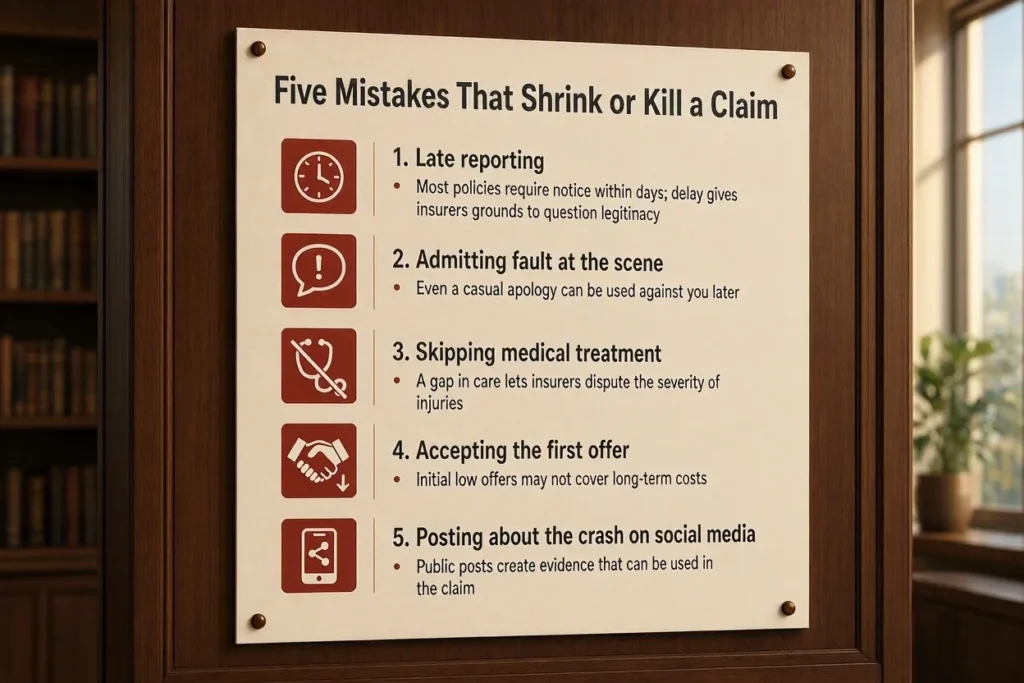
The five most common mistakes are late reporting, admitting fault, skipping medical care, accepting the first offer, and posting about the crash on social media.
- Reporting late — most policies require notice within days, and delay gives insurers grounds to question the claim’s legitimacy.
- Admitting fault at the scene — even a casual apology can be used against you later.
- Skipping medical treatment — a gap in care lets insurers argue the injury wasn’t serious, or wasn’t caused by the crash at all.
- Accepting the first settlement offer — initial offers typically undervalue long-term costs, especially with injuries that worsen over weeks.
- Posting on social media — a vacation photo taken during a “debilitating injury” claim is exactly the kind of thing adjusters go looking for.
None of these require legal training to sidestep. Just a bit of restraint at the exact moment restraint feels hardest.
Conclusion
A car accident claim rewards preparation more than luck. Gather evidence at the scene, report the crash quickly, and confirm which fault system governs your jurisdiction before a single dollar changes hands, since that one fact changes almost everything downstream of it. Most claims resolve without ever seeing a courtroom. The ones that settle fairly are the ones built on documentation, patience, and a clear read of the deadline sitting on the calendar.
FAQs

Amanda Brooks
Amanda Brooks leads JusticeInTown’s legal, justice, and community advocacy content division. She holds a background in legal research and public policy and specializes in topics related to civil rights, access to justice, legal awareness, and community issues. With years of experience researching legal and social justice topics, Amanda brings a careful, research-driven approach to complex legal information and public-interest issues. She is the primary author of JusticeInTown’s legal guides, justice-related resources, and community-focused content, helping readers better understand their rights, legal options, and the issues affecting their communities.
Related Posts