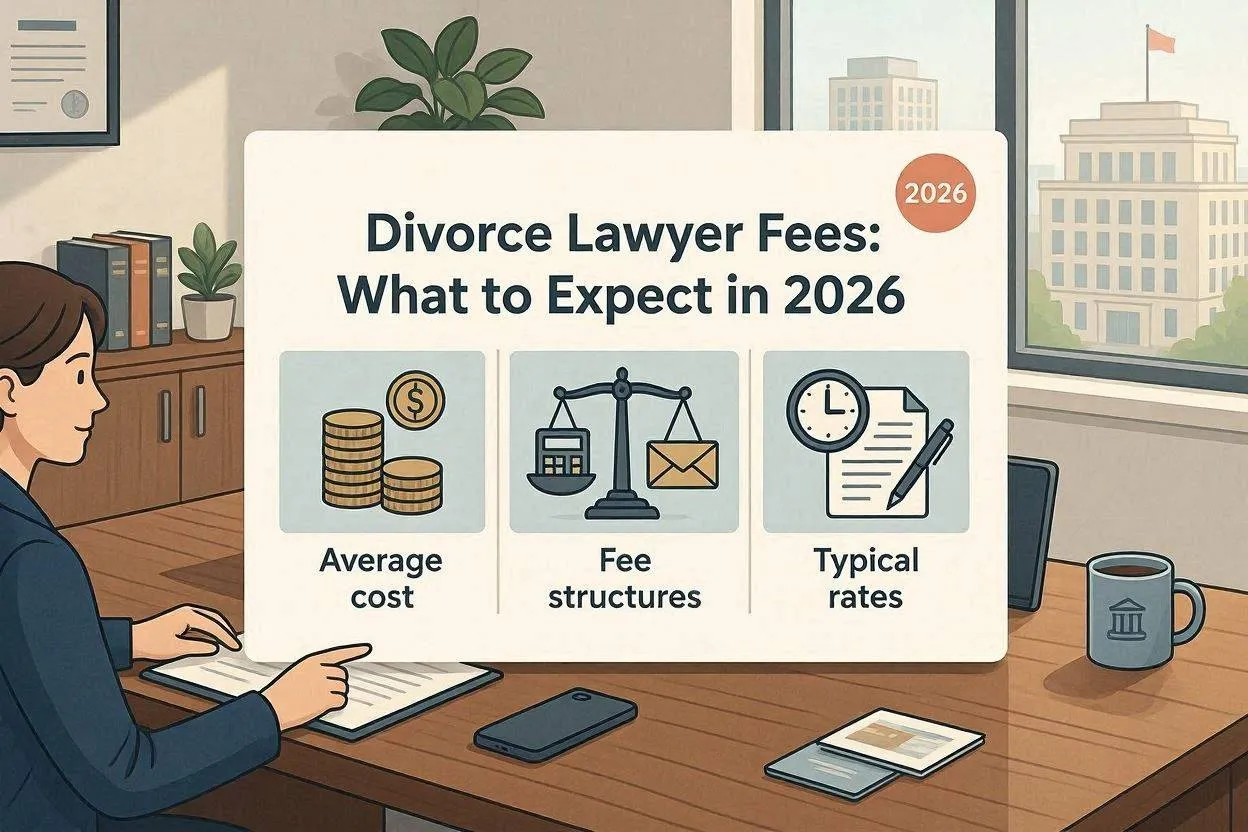
Divorce Lawyer Fees Explained: What to Expect in 2026
Divorce lawyer fees in 2026 range from $150 to $500 per hour, with a national average of $313 per hour. Most clients who hire a full-scope attorney pay between $7,000 and $11,300 total — but your final bill depends on 6 key factors you control.
This guide breaks down every fee type, explains what drives costs up or down, and shows you 5 proven strategies to cut your total bill without sacrificing legal protection.
How Divorce Lawyer Fees Are Structured in 2026
Divorce attorneys use 3 main billing models: hourly, flat fee, and alternative fee arrangements (AFAs). Hourly billing covers the vast majority of cases.
Hourly Billing: The Standard Rate Model
Hourly billing means you pay for every unit of attorney time spent on your case. Most firms bill in 6-minute increments — called 0.1-hour units. A 4-minute phone call still appears on your invoice as 0.1 hours.
The 2026 national average hourly rate is $313, based on data from the Clio Legal Trends Report. Rates range from $150/hour for newer attorneys in rural areas to $500+/hour for senior partners at major metropolitan firms.
Attorneys bill hourly time for these 6 activities: drafting motions and legal documents, attending court hearings, participating in mediation sessions, reviewing financial disclosures, responding to client emails and calls, and conducting discovery.
Flat Fee Billing: Fixed Cost for Simple Cases
Flat fee billing sets one total price for the entire case scope. Attorneys offer flat fees exclusively for uncontested divorces — cases where both spouses already agree on all major issues.
A flat fee for an uncontested divorce typically runs $1,500 to $5,000, covering document preparation, court filing, and one or two review sessions. If complications arise mid-case, the attorney charges hourly for work beyond the flat fee scope.
Alternative Fee Arrangements for Complex Cases
Alternative Fee Arrangements (AFAs) include installment plans, hybrid hourly-with-cap models, and monthly fixed-fee retainers. Large law firms increasingly offer AFAs to clients with long, multi-issue divorces.
Contingency fees — where the attorney earns a percentage of the outcome — are prohibited in divorce cases in most states and classified as unethical by the American Bar Association (ABA) for family law matters.
Average Divorce Lawyer Fees by Case Type in 2026
The average total attorney fees for a divorce are $11,300, with a median of $7,000. Case type is the single biggest driver of total cost.
Here is the breakdown by case type:
- Uncontested divorce (full agreement): $1,500–$5,000 total
- Contested divorce (disputes resolved before trial): $15,000–$30,000 per spouse
- Contested divorce that goes to trial: $30,000–$75,000+ per spouse
- Consulting attorney only (review and advice): $1,000–$4,600 total
- DIY divorce with document service: $500 or less
Clients who hired a consulting attorney — instead of full representation — paid a median of $3,000 in total fees, compared to $7,000 for full-scope representation. A consulting attorney reviews documents and advises you but does not appear in court.
For guidance on whether your case qualifies for simplified proceedings, review the available family law services at JusticeInTown to match your situation with the right level of representation.
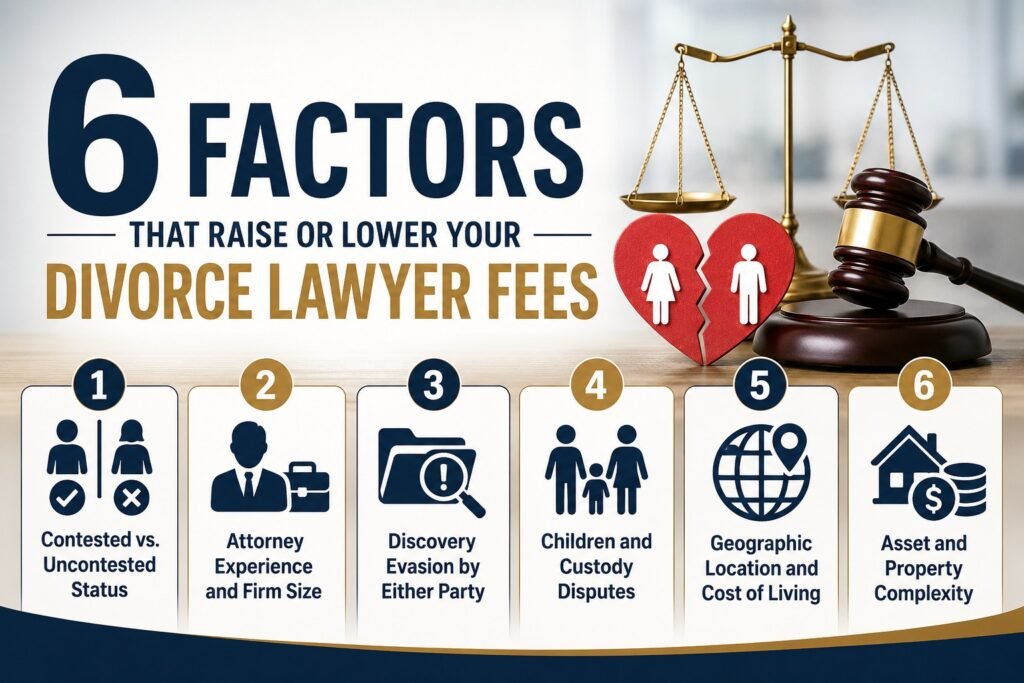
6 Factors That Raise or Lower Your Divorce Lawyer Fees
Your geographic location is the most consistent fee driver. Attorneys in New York City and San Francisco charge $350–$600/hour; attorneys in North Dakota or West Virginia charge $150–$250/hour.
These 6 factors determine where your bill falls on the cost spectrum:
Factor 1: Contested vs. Uncontested Status
An uncontested divorce — where both parties agree on asset division, child custody, and spousal support — costs 70–85% less than a fully contested case. Every disputed issue adds attorney hours for negotiation, discovery, and court hearings.
Attorneys spend the most time on 4 contested issues: property division, child custody arrangements, alimony amounts, and hidden asset investigations involving forensic accountants.
Factor 2: Attorney Experience and Firm Size
First-year associates charge $100–$200/hour. Experienced partners at regional firms charge $300–$500/hour. Senior partners at national firms charge $500–$700/hour.
Law firm partners typically charge 2 to 3 times more per hour than first-year associates at the same firm. Paralegals and legal assistants bill at $75–$150/hour — always ask which team member handles routine tasks.
Factor 3: Discovery Evasion by Either Party
When one spouse hides assets, delays document production, or refuses to cooperate with discovery, attorney hours multiply rapidly. Discovery evasion can add $5,000–$20,000 to the total bill through repeated motions, forensic accounting fees, and court appearances.
Fault grounds — such as adultery or abandonment — require evidence gathering and court proof, which increases both attorney hours and expert witness fees.
Factor 4: Children and Custody Disputes
Divorces with minor children and contested custody arrangements cost significantly more — often exceeding $23,500 in states like Texas.
Child custody cases add costs through parenting evaluations, child psychologist testimony, Guardian Ad Litem fees, and multiple court hearings on parenting time and decision-making authority.
Factor 5: Geographic Location and Cost of Living
Location changes your hourly rate by up to $450. Attorneys in New York City, Los Angeles, and San Francisco charge $350–$600/hour. Attorneys in North Dakota, West Virginia, and rural Texas charge $150–$250/hour. Urban firms carry higher overhead — office space, staff salaries, malpractice insurance — and pass that cost directly into billing rates.
State law also affects total cost. Community property states (California, Texas, Arizona) require formal asset division calculations that add attorney hours. Equitable distribution states use judicial discretion, which shortens the process in low-conflict cases but extends it in disputed ones.
Factor 6: Asset and Property Complexity
Divorces involving business ownership, multiple real estate properties, or investment portfolios cost 2 to 4 times more than divorces with straightforward asset splits. Attorneys need forensic accountants to value private businesses, appraisers to price real estate, and financial experts to trace retirement accounts and stock options.
A single business valuation adds $3,000 to $10,000 in expert fees alone, separate from attorney hours spent reviewing the valuation report. Couples with retirement accounts requiring a Qualified Domestic Relations Order (QDRO) pay an additional $500 to $2,000 for QDRO preparation, billed either by the attorney or a specialized QDRO firm.
Divorce Lawyer Fees: Quick Reference Table
Use this table to estimate your costs based on task type, timeline, method, and difficulty level.
| Task | Typical Timeline | Method / Fee Type | Difficulty Level |
| Uncontested divorce | 1–3 months | Flat fee ($1,500–$5,000) | Low |
| Contested — settlement | 6–18 months | Hourly ($15,000–$30,000) | Medium |
| Contested — full trial | 12–36 months | Hourly ($30,000–$75,000+) | High |
| Consulting attorney only | As needed | Hourly or flat ($1,000–$4,600) | Low–Medium |
| Court filing fees | Day of filing | Direct court fee ($100–$435) | Low |
| Mediation sessions | 1–4 sessions | Hourly split ($100–$300/hr) | Low–Medium |
| Process server fee | 1–3 days | One-time fee ($50–$100) | Low |
Divorce Court Filing Fees and Other Mandatory Costs
Court filing fees run $100 to $435, set by your state or county clerk’s office. California charges $435; North Dakota charges under $100. Most states fall between $150 and $300.
Beyond attorney fees, expect these 4 additional costs in most divorces:
- Court filing fee: $100–$435 depending on state
- Process server or sheriff service: $50–$100 (avoidable if spouse accepts voluntary service)
- Mediation fees: $100–$300/hour split between both parties
- Expert witnesses — forensic accountants, child psychologists, real estate appraisers: $1,500–$10,000+
Clients in contested divorces pay an average of $1,480 in non-attorney costs — including expert witnesses and court fees — with a median of $500 for simpler cases.
You can apply for a court fee waiver if your income falls below your state’s threshold. Contact the court clerk’s office directly to request the indigency application form.
How Divorce Lawyer Fees Work: Retainers Explained
A retainer fee is an upfront deposit — typically $3,000 to $5,000 — that the attorney holds in a trust account and draws from as hours are billed.
A retainer is not a flat fee. Once the retainer runs out, you replenish it or the attorney stops work. Most attorneys require a retainer before starting any work on your case.
Retainer vs. Flat Fee: Key Differences
A retainer applies to hourly billing — you pay a deposit that gets drawn down as work proceeds. A flat fee covers a pre-defined scope for one fixed price, paid upfront.
Choose a flat fee arrangement when: your divorce is uncontested, you have few shared assets, and no minor children are involved. Flat fees give you cost certainty; retainers give you flexibility for cases where the workload is unpredictable.
How to Read Your Attorney Fee Agreement
Every attorney must provide a written fee agreement before starting work. Review the fee agreement for these 5 items: the hourly rate for each team member, the retainer amount and replenishment triggers, the billing increment (confirm it is 6-minute / 0.1-hour, not 15-minute), the scope of flat fee work and what triggers hourly overages, and the dispute resolution process for billing disagreements.
Keep a copy of the signed fee agreement and compare it against each invoice you receive.
5 Proven Ways to Reduce Your Divorce Lawyer Fees
The most effective cost-reduction strategy is reaching agreement with your spouse before engaging attorneys. Every issue you resolve directly removes attorney hours from your total bill.
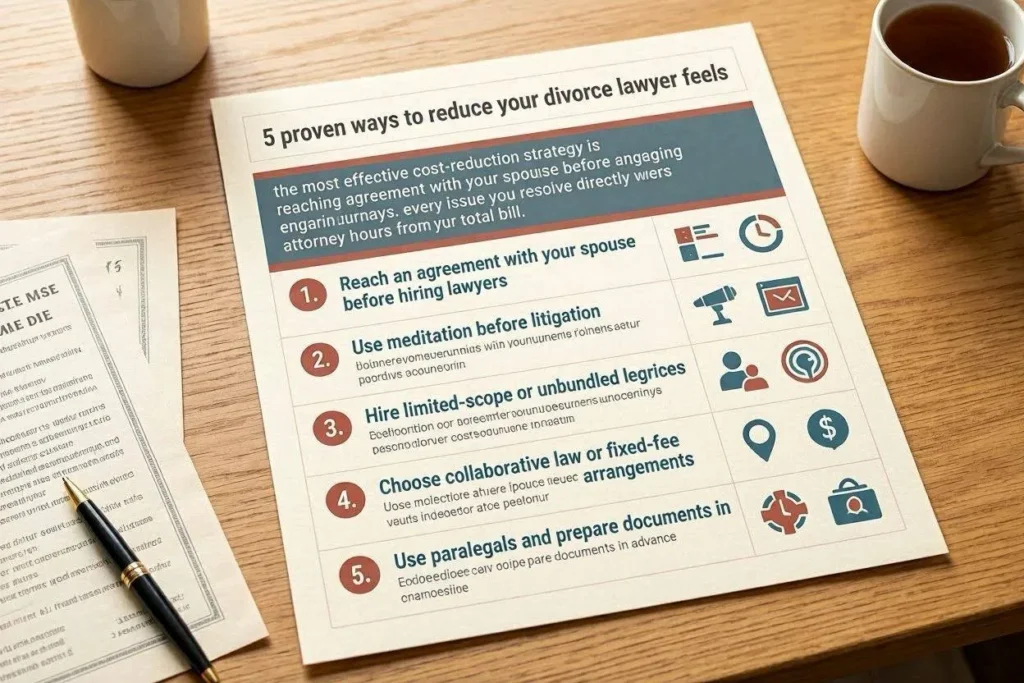
Apply these 5 strategies to reduce your total legal costs:
-
- Use mediation before litigation. Court-connected mediators charge $100–$300/hour split between spouses — far less than attorney billing rates. Many states require mediation for custody disputes; use it voluntarily for property issues too. Review how mediation and arbitration can lower your total divorce cost.
- Organize documents before every meeting. Attorneys bill for time spent sorting through disorganized financial records, tax returns, and property deeds. Arrive with documents sorted and indexed.
- Communicate in batches, not individually. Every email or call triggers a 0.1-hour (6-minute) billing increment. Send 1 detailed weekly update instead of 5 short daily messages.
- Hire a consulting attorney instead of full representation. A consulting attorney reviews your documents and advises you at $200–$300/hour — without appearing in court. Clients using consulting attorneys paid a median of $3,000 total versus $7,000 for full-scope representation.
- Request an itemized invoice monthly. Monthly invoice reviews catch billing errors early. If a charge looks incorrect, dispute it in writing within 30 days.
How to Find and Evaluate a Divorce Lawyer Within Your Budget

To find a qualified divorce attorney within your budget, start with 3 free consultations at different fee levels. Most family law attorneys offer a free or reduced-cost initial meeting.
Use the find a lawyer directory at JusticeInTown to locate licensed family law attorneys in your state — with verified credentials and initial consultation options.
Ask these 4 questions at every consultation:
- What is your hourly rate, and who else will work on my case and at what rate?
- Do you offer flat fee pricing for uncontested divorces?
- What is your retainer amount, and under what conditions must I replenish it?
- Based on my situation, what is your estimated total fee range?
Verify that the attorney holds an active bar license in your state. Check your state bar association’s online directory — a search by name and bar number confirms active status, discipline history, and practice areas.
Poor attorney communication is a leading driver of both cost and client frustration. Choose an attorney who returns calls within 24 hours and explains billing clearly.
Conclusion
Divorce lawyer fees depend on 6 controllable factors: case complexity, attorney experience, your location, asset volume, child custody disputes, and how quickly you and your spouse reach agreement. The average total bill is $7,000–$11,300, but uncontested cases cost as little as $1,500.
You reduce your total fees fastest by agreeing on issues before filing, using mediation, and hiring a consulting attorney instead of full-scope representation.
Ready to understand your specific costs? find a lawyer at JusticeInTown for a free initial consultation with a licensed family law attorney in your state. Get clear answers about your case before committing to any fee agreement.
Divorce Lawyer Fees FAQs

Amanda Brooks
Amanda Brooks leads JusticeInTown’s legal, justice, and community advocacy content division. She holds a background in legal research and public policy and specializes in topics related to civil rights, access to justice, legal awareness, and community issues. With years of experience researching legal and social justice topics, Amanda brings a careful, research-driven approach to complex legal information and public-interest issues. She is the primary author of JusticeInTown’s legal guides, justice-related resources, and community-focused content, helping readers better understand their rights, legal options, and the issues affecting their communities.
Related Posts