
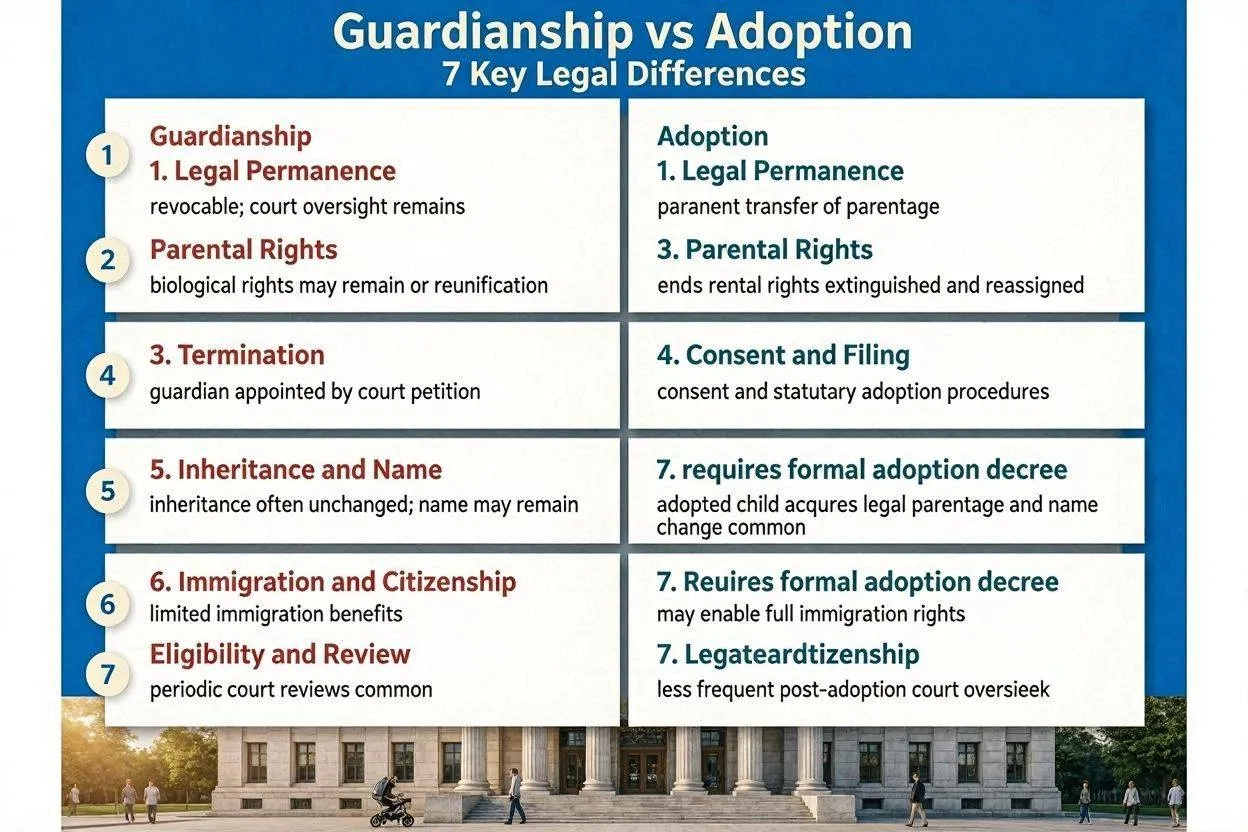
Guardianship vs Adoption 2026: 7 Key Legal Differences
Guardianship gives an adult temporary legal authority over a child while birth parents keep their rights. Adoption permanently transfers parental rights and creates a lifelong legal parent-child bond. This guide compares 7 differences, immigration-specific guardianship options, and exact costs so you can choose the right path for your family.
What Is the Main Difference Between Guardianship and Adoption?
The main difference between guardianship and adoption is permanence. A guardian holds legal authority over a child’s daily care, but a court can end that authority at any time. An adoptive parent holds permanent legal parenthood that no court can reverse except in cases of proven unfitness.
Birth parents keep limited rights under guardianship, including visitation and the right to petition for the child’s return. Birth parents lose all rights under adoption, including visitation, custody, and decision-making authority, the moment a judge signs the final adoption decree.
This distinction shapes 3 practical outcomes: who can request a name change, who appears on the birth certificate, and who controls medical and education decisions. Adoptive parents control all 3. Guardians control only day-to-day decisions unless a court order expands their authority.
Family courts treat both arrangements as serious legal commitments, not informal caregiving agreements. A guardian who fails to meet a child’s needs faces the same court scrutiny as a parent accused of neglect. The legal weight differs, but the duty of care does not.
State law governs both processes, so requirements shift across jurisdictions. Some states require 1 year of continuous guardianship before allowing a conversion to adoption. Others allow the 2 processes to run on separate, unrelated timelines depending on the family’s circumstances.
What Is Legal Guardianship?
Legal guardianship is a court-appointed arrangement that gives a non-parent authority to make daily decisions for a child without ending the birth parents’ legal rights. A judge appoints the guardian after reviewing the child’s best interests and the petitioner’s fitness to provide care.
Guardianship remains active until the child turns 18, unless a court ends it earlier. Either the guardian or a birth parent can petition the court to terminate the arrangement if circumstances change.
Types of Guardianship Arrangements
Guardianship splits into 4 distinct categories based on duration and purpose.
- Temporary guardianship: lasts 10 days to 3 months, used for short-term parental absence
- Permanent guardianship: lasts up to 1 year per renewal, used for long-term care needs
- Standby guardianship: activates automatically when a parent becomes incapacitated or detained
- Kinship guardianship: granted to a relative, most often a grandparent, aunt, or uncle
Who Qualifies to Become a Legal Guardian?
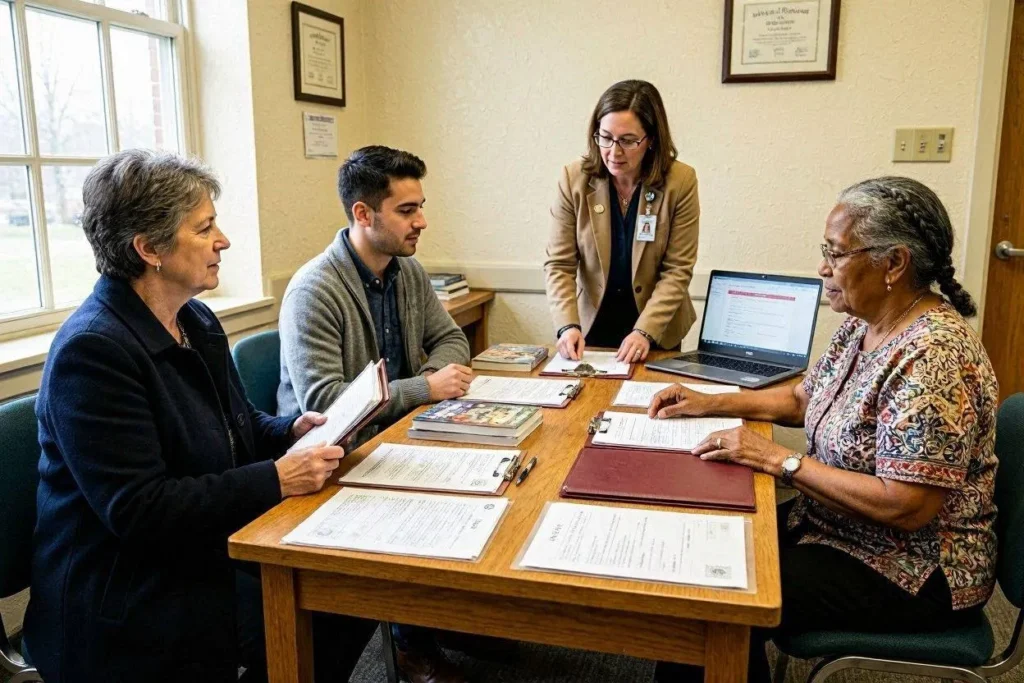
Any adult who passes a court background check and home assessment qualifies to become a legal guardian. Courts favor relatives first, including grandparents, siblings, aunts, and uncles, before considering family friends or “fictive kin” such as neighbors or teachers.
The petitioner must show 3 things to the court: a stable home environment, sufficient income to support the child, and no history of abuse or neglect. A judge reviews these factors before issuing a guardianship order.
A child who is 10 years old or older must usually consent to the guardianship arrangement in most states, though the exact age threshold varies. Courts also require a social worker’s home visit before approving any petition, adding 2–4 weeks to the process.
Guardians take on duties identical to a parent’s daily responsibilities. This includes school enrollment, medical consent, religious upbringing, and ensuring the child receives proper nutrition, housing, and emotional support throughout the arrangement.
What Is Adoption?
Adoption is a legal process that permanently transfers all parental rights and responsibilities from a child’s birth parents to the adoptive parents. The adoptive parents become the child’s legal parents for life, with the same rights as biological parents.
A finalized adoption issues a new birth certificate listing the adoptive parents’ names. The child gains full inheritance rights, Social Security benefits tied to the adoptive family, and a name change if requested during the adoption hearing.
Types of Adoption Processes
Adoption divides into 5 main categories depending on the child’s relationship to the petitioner.
- Domestic infant adoption: places a newborn with adoptive parents shortly after birth
- Foster care adoption: finalizes parental rights for a child already in state custody
- Stepparent adoption: grants a stepparent full legal rights over a spouse’s child
- Kinship adoption: makes a relative’s guardianship arrangement permanent through adoption
- International adoption: brings a foreign-born child to the United States through USCIS Form I-600 or Form I-130
A child who is 12 years old or older must consent to their own adoption in most states, similar to the consent rule for older children in guardianship cases. Courts waive this requirement only when consent clearly works against the child’s best interests.
Open and closed adoption arrangements add another layer of choice. An open adoption allows continued contact between the child and birth parents, agreed upon in advance. A closed adoption ends all contact, with records sealed except in narrow legal circumstances.
Guardianship vs Adoption: 7 Key Differences Compared
The table below compares 7 factors side by side.
| Factor | Guardianship | Adoption |
| Parental rights | Birth parents retain residual rights | Birth parents’ rights terminate permanently |
| Permanence | Temporary or reviewable until age 18 | Permanent for life |
| Court oversight | Ongoing reviews and annual reports | Ends once finalized |
| Inheritance rights | Not automatic, requires a will | Automatic, same as biological children |
| Birth certificate | Stays unchanged | Reissued with adoptive parents’ names |
| Reversibility | Can be terminated by court petition | Cannot be reversed except for unfitness |
| Typical timeline | 2–6 months | 6–18 months |
How Does Guardianship Affect Immigrant Families?

Guardianship gives immigrant parents a legal safeguard for their children if detention or deportation separates the family. Unlike adoption, guardianship does not require birth parents to give up their rights, which makes it the faster option during a sudden immigration emergency.
Immigrant families typically choose between 3 legal tools: a caregiver authorization affidavit, a temporary agent authorization, or full court-ordered guardianship. The caregiver affidavit grants the least authority but requires no court filing, making it the fastest option to put in place.
A renewable temporary agent authorization sits between the affidavit and full guardianship. This document gives a trusted adult power to act as a parent in nearly every respect for 60 days, though it cannot authorize consent to an adoption and does not require the agent to live with the child.
Demand for these protections has grown sharply. Community organizations across the United States report helping families complete dozens of guardianship affidavits in recent months, driven by rising concern over immigration enforcement actions separating parents from children.
Special Immigrant Juvenile Status (SIJS) and Guardianship
To qualify for Special Immigrant Juvenile Status (SIJS), a juvenile court must first place the child under guardianship, custody, or another protective court order. The U.S. Citizenship and Immigration Services (USCIS) requires this state court determination before a child can apply for SIJS-based lawful permanent residence.
A child qualifies for SIJS if a juvenile court finds reunification with 1 or both parents is not viable due to abuse, neglect, or abandonment. The guardianship order becomes the legal foundation for the entire SIJS petition.
SIJS petitioners cannot include family members as derivative beneficiaries, unlike most family-based immigration categories. A child who later adjusts status through SIJS cannot petition for their birth or prior adoptive parents, even after becoming a naturalized citizen.
The juvenile court issuing the guardianship order must have jurisdiction over dependency, custody, or care determinations under state law. Courts that commonly meet this standard include family, probate, dependency, and youthful offender courts, though the exact title varies by state.
Guardianship Planning for Parents Facing Deportation
To plan guardianship before facing deportation, file a standby guardianship petition that activates automatically once a parent is detained. This step lets a trusted relative take over school enrollment, medical consent, and daily care without delay.
A caregiver authorization affidavit offers a faster but more limited option, covering school and medical decisions for up to 2 years without court involvement. Families facing an active deportation timeline often complete both documents for layered protection.
Guardianship records remain public, unlike sealed adoption records, which creates a privacy tradeoff some immigrant families weigh carefully. An attorney can advise on using a PO box-style address for filings to reduce exposure, though this offers only limited protection.
Advocates recommend gathering 4 documents before a guardianship emergency arises: a completed caregiver affidavit, copies of the child’s birth certificate, a list of medical providers and school contacts, and written guardian designation naming a backup if the first choice becomes unavailable. Preparing this packet in advance removes weeks of delay during an actual detention event.
How to Choose Between Guardianship and Adoption

To choose between guardianship and adoption, match the legal arrangement to your family’s long-term goals and the birth parents’ situation. Choose guardianship if reunification remains possible. Choose adoption if you want a permanent, lifelong legal bond.
Apply these 4 criteria before filing a petition.
- Reunification goal: choose guardianship if birth parents may regain custody later
- Permanence goal: choose adoption if you want full legal parenthood for life
- Speed needed: choose guardianship for faster court approval during emergencies
- Inheritance priority: choose adoption if automatic inheritance rights matter most
Courts weigh the child’s best interests above any preference from the petitioner. A judge can deny a guardianship or adoption petition if the arrangement does not serve the child’s safety and stability.
How Much Does Guardianship or Adoption Cost?
Guardianship costs $500–$3,000 in court and attorney fees, while adoption costs $2,000–$50,000 depending on the type. Domestic infant adoption through a private agency runs the highest, often exceeding $40,000. Kinship adoption through foster care frequently costs under $2,500 due to state subsidies.
Both guardianship and adoption qualify for subsidies in many states when the child has special needs or comes from foster care. A subsidy can cover Medicaid, a monthly maintenance payment, and non-recurring legal fees tied to the court process.
International adoption adds USCIS filing fees on top of agency costs. Form I-600 currently costs several hundred dollars, plus travel expenses for the required home country visit, which can add $10,000–$30,000 to the total.
Hague Convention compliance applies when both the adoptive parent and the child come from Hague-participating countries, adding additional accreditation fees and processing steps. Non-Hague countries instead route through the orphan process under USCIS Form I-600, which carries its own investigation and consular interview requirements.
Guardianship offers a lower-cost path when full legal parenthood is not the immediate goal. Families weighing the 2 options should compare not just the upfront filing cost, but ongoing legal fees tied to court-required annual reports under guardianship versus the 1-time finalization cost of adoption.
Final Verdict: Guardianship or Adoption for Your Family
Guardianship wins for families who need a faster, reversible arrangement that preserves birth parents’ rights. Adoption wins for families who want a permanent, lifelong legal bond with full inheritance rights. Match the legal path to your family’s timeline and goals, then consult a family law or immigration attorney before filing.
Immigrant families facing detention or deportation risk should not wait to act. A standby guardianship petition or caregiver affidavit filed today can protect a child’s care and education tomorrow, regardless of what happens to a parent’s immigration case.
Frequently Asked Questions

Amanda Brooks
Amanda Brooks leads JusticeInTown’s legal, justice, and community advocacy content division. She holds a background in legal research and public policy and specializes in topics related to civil rights, access to justice, legal awareness, and community issues. With years of experience researching legal and social justice topics, Amanda brings a careful, research-driven approach to complex legal information and public-interest issues. She is the primary author of JusticeInTown’s legal guides, justice-related resources, and community-focused content, helping readers better understand their rights, legal options, and the issues affecting their communities.
Related Posts