

How Long Does a Personal Injury Claim Take? (2026 Guide)
A personal injury claim typically takes 6 months to 2 years to resolve. Straightforward claims with clear fault and minor injuries can close in as little as 3 months once treatment ends. Claims involving disputed liability, multiple defendants, or catastrophic injuries commonly run 1 to 3 years, and a small share stretch past 3 years when the case goes to trial.
How Long Does a Personal Injury Claim Take on Average?
Most personal injury claims resolve within 6 to 18 months of the accident date. Insurance companies settle roughly 95% to 97% of these claims before any lawsuit reaches a courtroom, according to data from the U.S. Department of Justice. Only 3% to 5% of personal injury cases go to trial, and those that do take an average of 25.6 months from filing to verdict — a figure that does not include appeals.
Faster is not always better. Accepting an offer before medical treatment finishes often means signing away the right to claim future costs, including ongoing physical therapy, a second surgery, or reduced future earning capacity. Insurance adjusters know that claimants under financial pressure are more likely to accept a lower number, so a rushed settlement usually favors the insurer over the claimant.
The Personal Injury Claim Timeline, Step by Step
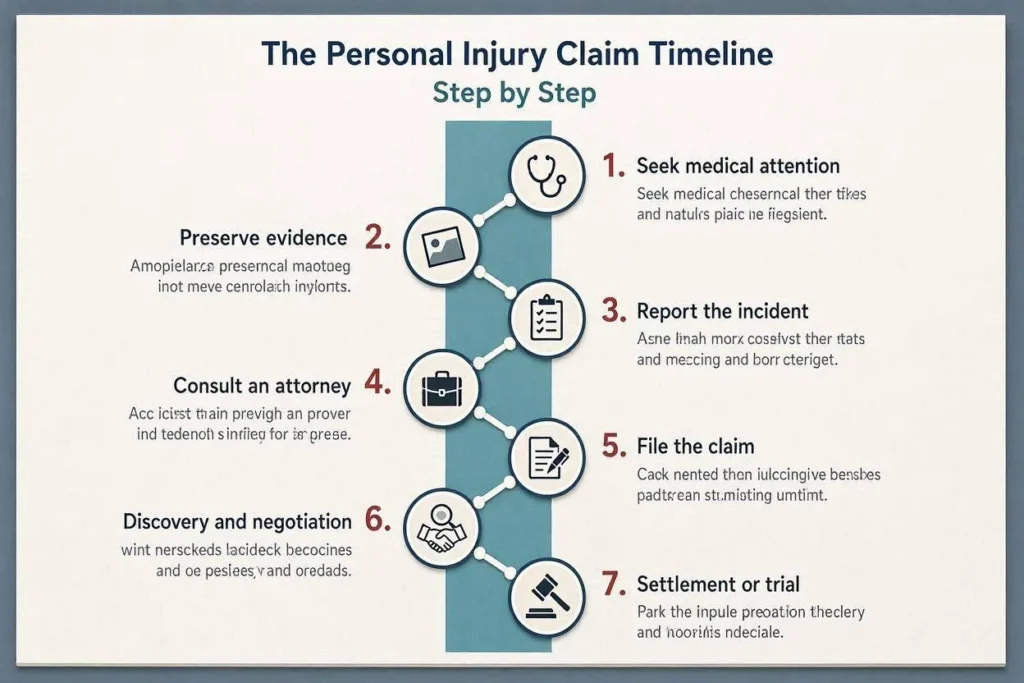
A personal injury claim moves through eight distinct stages: medical treatment, investigation, the demand letter, negotiation, filing a lawsuit, discovery, mediation, and disbursement. Not every claim passes through all eight stages, since most cases settle well before a lawsuit gets filed.
Medical Treatment and Maximum Medical Improvement (MMI)
Medical treatment sets the pace for the rest of the claim, because an attorney cannot calculate full damages until the claimant reaches Maximum Medical Improvement (MMI) — the point at which a physician confirms the injury has stabilized and further treatment will not produce significant improvement. Whiplash and soft-tissue injuries often reach MMI within 6 to 12 weeks. Fractures requiring surgical repair typically take 6 to 12 months to stabilize. Spinal cord injuries, traumatic brain injuries, and cases involving multiple surgeries can take 1 to 2 years, sometimes longer, before a doctor will sign off on MMI.
Signing a release before reaching MMI closes off the ability to reopen the claim if new symptoms appear later, so attorneys generally advise against early settlement in cases with an uncertain medical outcome.
Investigation and Evidence Collection
Investigation runs alongside medical treatment rather than after it. During this phase, the attorney collects the police or incident report, witness contact information, scene photographs, surveillance or dash-cam footage, and early medical records. Cases with contested fault often require an accident reconstruction specialist or a retained expert to establish how the incident occurred. Investigation typically adds 1 to 3 months once medical treatment concludes, though complex cases with multiple witnesses can extend this window further.
The Demand Letter
Once treatment ends and total damages are documented, the attorney sends a demand letter to the at-fault party’s insurance company. The letter lays out the facts of the accident, the extent of the injuries, the medical bills, lost wages, and the dollar amount sought in compensation. Insurance companies generally respond within 30 to 60 days, and that first response is almost always a denial of the full amount or a counteroffer well below the demand.
Settlement Negotiation
Negotiation resolves the majority of personal injury claims. The insurance adjuster reviews every element of the claim looking for reasons to reduce the payout, questioning the necessity of certain treatments or arguing the claimant shares part of the fault. Negotiations on straightforward claims close within 1 to 2 months. Disputed claims, by contrast, can run 3 to 6 months or longer as both sides exchange counteroffers and supporting evidence.
Filing a Lawsuit and Discovery
When negotiation stalls, the claimant’s attorney files a lawsuit before the statute of limitations expires. Filing does not guarantee a trial; it frequently pushes the insurer toward more serious negotiation, since litigation exposes the company to depositions, expert testimony, and mounting legal costs. Discovery begins immediately after filing and is often the longest phase of the entire process, typically lasting 6 to 12 months. During discovery, both sides exchange interrogatories (written questions answered under oath), formal requests for documents, and depositions (sworn testimony taken outside of court).
Mediation
Many courts require mediation before scheduling a trial date. A neutral third party — the mediator — guides both sides toward a compromise across a single session or a short series of sessions, usually completed within 1 day to a few weeks. A large share of cases that reach litigation settle at or shortly after mediation, which explains why so few personal injury cases actually reach a jury.
Trial and Verdict
Cases that fail to settle at mediation proceed to trial. Trial length ranges from a few days for a single-defendant car accident case to several weeks for a case involving multiple parties or extensive medical expert testimony. Counting pre-trial preparation, discovery, and the trial itself, litigated cases average close to 2 years from the initial filing to the final verdict. A verdict can still be appealed by either side, and an appeal typically adds 6 months to 1 year before the case truly closes.
Disbursement of Settlement Funds
Once a settlement is signed or a verdict becomes final, the defense sends payment to the plaintiff’s attorney, who deposits the funds into a trust account. From there, the attorney pays any outstanding medical liens, deducts the contingency fee and case costs, and issues the final net check to the claimant. Disbursement typically takes 2 to 6 weeks once funds arrive, though cases with multiple lienholders or a disputed lien amount can take longer.
How Claim Value Affects the Timeline
Higher-value claims take longer to resolve because insurers scrutinize large payouts more heavily than small ones. A personal injury claim includes two categories of damages: economic damages (medical bills, lost wages, and future earning capacity) and non-economic damages (pain and suffering, emotional distress, and loss of enjoyment of life). Attorneys commonly calculate non-economic damages using a multiplier method, applying a factor of 1.5 to 5 times the economic damages depending on injury severity and permanence.
A claim worth $15,000 in economic damages with a modest multiplier settles faster than a claim worth $150,000, because the insurance company assigns more adjuster time, more medical review, and more internal approval layers to larger payouts. Claimants with permanent impairment ratings or documented future medical needs should expect negotiation to take longer specifically because the dollar figure at stake is larger.
How Case Type Affects Claim Timeline
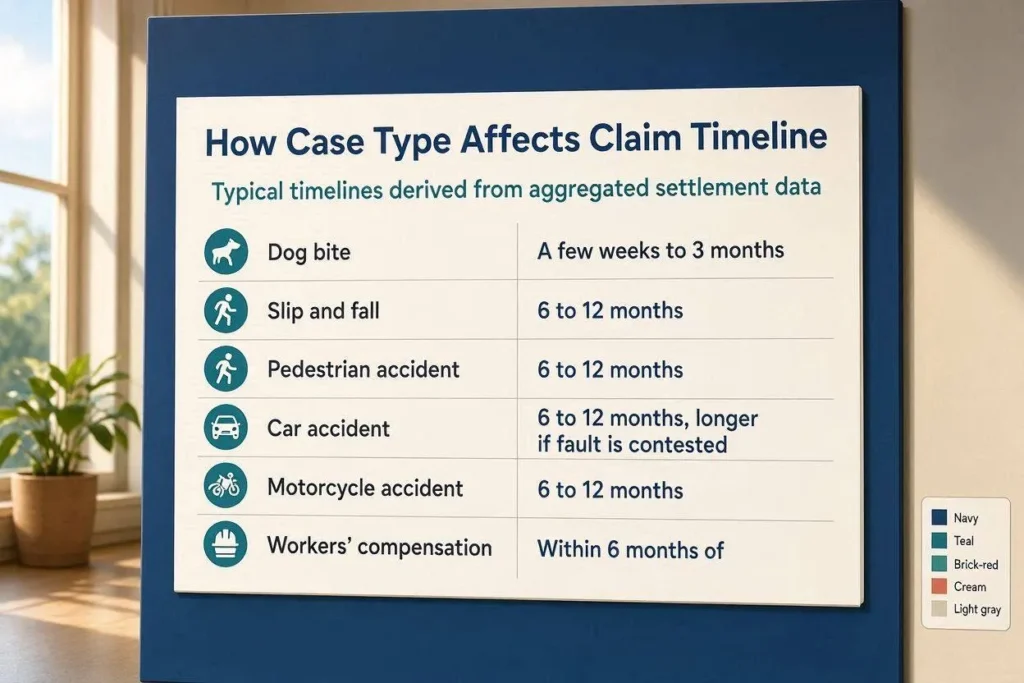
Case type changes the timeline as much as injury severity does. The table below shows typical ranges by case type, based on aggregated settlement data from personal injury law firms.
| Case Type | Typical Timeline |
| Dog bite | A few weeks to 3 months |
| Slip and fall | 6 to 12 months |
| Pedestrian accident | 6 to 12 months |
| Car accident | 6 to 12 months, longer if fault is contested |
| Motorcycle accident | 6 to 12 months |
| Workers’ compensation | Within 6 months of reaching MMI |
| Truck accident | 6 months to several years if litigated |
| Medical malpractice | 1 to 3 years |
| Catastrophic injury or wrongful death | 1 to 3 years, sometimes longer |
Truck accidents and medical malpractice claims sit at the longer end of the range because they involve commercial insurance policies, multiple potential defendants, and expert medical testimony that requires extensive review before either side will discuss numbers.
Factors That Slow Down a Personal Injury Claim
Five factors extend a personal injury claim well beyond the typical range: liability disputes, Independent Medical Examinations (IMEs), Medicare and Medicaid liens, subrogation claims, and court docket backlogs.
Liability Disputes
A liability dispute arises when the at-fault party denies responsibility or argues the claimant shares part of the fault. Resolving a liability dispute requires additional investigation, expert testimony, and a formal comparative negligence analysis before either side will engage in meaningful settlement talks.
Independent Medical Examinations (IMEs)
Insurance companies frequently require an Independent Medical Examination (IME) — an evaluation performed by a physician the insurer selects — before accepting the severity of a claimed injury. Scheduling the exam, waiting for the physician’s report, and responding to its conclusions typically adds 4 to 8 weeks to a claim.
Medicare and Medicaid Liens
Claimants who received treatment through Medicare or Medicaid must resolve a conditional payment lien before the government releases its claim on any settlement proceeds. Requesting a final lien amount from Medicare’s Benefits Coordination & Recovery Center generally takes 6 to 12 weeks, and disputing an inflated lien figure can add several more months to the case.
Subrogation Claims
Private health insurers that paid medical bills related to the injury often hold a subrogation right — a contractual claim to reimbursement out of the eventual settlement. Attorneys routinely negotiate these amounts down, a process that typically adds 2 to 6 weeks near the end of a case.
Court Docket Backlogs
Court availability varies by county and by state. A civil case filed in a congested urban court can wait 6 to 18 months longer for an open trial date than a comparable case filed in a less crowded jurisdiction, regardless of how quickly both sides complete discovery.
Does the Statute of Limitations Affect How Long a Claim Takes?
Yes. The statute of limitations sets the outer filing deadline for a lawsuit and indirectly shapes the claim timeline by forcing legal action before negotiations would otherwise conclude naturally. The deadline varies significantly by state.
| State | Statute of Limitations |
| Texas | 2 years |
| Iowa | 2 years |
| Florida | 2 years for most negligence claims |
| Wisconsin | 3 years |
| Missouri | 5 years |
| Minnesota | 6 years |
| North Dakota | 6 years |
Missing this deadline bars the claimant from pursuing compensation in court, no matter how strong the underlying case is. A shorter statute of limitations, such as the 2-year window in Texas, compresses the negotiation timeline because an attorney must file suit earlier to preserve the claim rather than waiting for an insurer to make a fair offer voluntarily.
How Comparative Negligence Rules Affect Settlement Speed
Comparative negligence — a legal framework that assigns a percentage of fault to each party involved in an accident — directly affects how quickly an insurer makes an offer. States with a 50% or 51% bar, including Wisconsin, Minnesota, and Iowa, allow a claimant to recover damages as long as their share of fault stays under the threshold. North Dakota applies the same 50% bar. When an insurer argues that a claimant bears 40% to 60% of the fault, expect negotiation to take 2 to 3 times longer than an undisputed claim, since the percentage assigned directly reduces the final payout and both sides have strong financial incentive to argue their position.
Structured Settlements vs. Lump-Sum Payments: Which Is Faster?
A lump-sum payment resolves faster than a structured settlement. A lump sum typically disburses within 2 to 6 weeks of the signed release, once outstanding liens are paid. A structured settlement pays compensation through an annuity over months or years rather than in a single check, and setting up that annuity contract adds 2 to 4 weeks to the disbursement phase.
Claimants with permanent injuries, or minors receiving a settlement on their behalf, often choose a structured settlement for long-term financial planning despite the slightly longer setup time, since the annuity provides guaranteed payments over a period that matches ongoing medical or living needs.
Can You Get Money While a Claim Is Pending?

Yes, in some situations. Personal auto insurance policies frequently include MedPay or Personal Injury Protection (PIP) coverage, which pays initial medical bills regardless of fault and does not wait for the underlying claim to resolve. Pre-settlement funding companies also offer cash advances against an anticipated settlement, though this option functions like a high-interest loan and should be approached with caution, since fees can significantly reduce the final payout. Claimants without PIP or MedPay coverage should discuss both options with their attorney before signing any funding agreement.
How to Speed Up a Personal Injury Claim
Five actions shorten a personal injury claim: attending every scheduled medical appointment, following the prescribed treatment plan without gaps, responding to document requests within days rather than weeks, keeping the attorney informed of any change in condition, and declining a recorded statement to the insurance adjuster without legal counsel present. Consistent medical documentation strengthens the causation argument, while prompt communication prevents avoidable delays on both the legal and medical sides of the claim.
Working with an experienced personal injury attorney also affects speed. An attorney familiar with a specific insurance company’s tactics can anticipate delay strategies, calendar every deadline, and move a claim through negotiation without unnecessary back-and-forth.
Conclusion
A personal injury claim rarely follows a fixed schedule. Most claims resolve within 6 to 18 months, but injury severity, liability disputes, lien resolution, and court availability each push the timeline in different directions, which is why two seemingly similar cases can resolve months or years apart. Medical treatment and Maximum Medical Improvement (MMI) set the floor for how quickly a claim can move, while disputes over fault, Medicare or Medicaid liens, subrogation, and court backlogs add time on top of that floor.
Case type also matters: a dog bite claim can close in a few weeks, while a medical malpractice or catastrophic injury claim commonly takes 1 to 3 years. The statute of limitations in the claimant’s state sets the outer deadline for filing suit, and comparative negligence disputes can double or triple negotiation time regardless of case type.
Claimants who prioritize complete medical documentation, respond promptly to document requests, and stay in close communication with their attorney put themselves in the strongest position to reach a fair settlement in the shortest reasonable time — without sacrificing the compensation owed for long-term medical needs or lost income.
This article provides general information only and does not constitute legal advice. Claim timelines vary by jurisdiction and individual circumstances — consult a licensed personal injury attorney in your state for guidance specific to your case.
FAQs

Amanda Brooks
Amanda Brooks leads JusticeInTown’s legal, justice, and community advocacy content division. She holds a background in legal research and public policy and specializes in topics related to civil rights, access to justice, legal awareness, and community issues. With years of experience researching legal and social justice topics, Amanda brings a careful, research-driven approach to complex legal information and public-interest issues. She is the primary author of JusticeInTown’s legal guides, justice-related resources, and community-focused content, helping readers better understand their rights, legal options, and the issues affecting their communities.
Related Posts