

How Personal Injury Settlements Work: Payout, Timeline & Taxes
Most personal injury settlements never see the inside of a courtroom. The insurer or at-fault party pays the injured person a negotiated sum, and in exchange, the injured person gives up the right to sue over that same incident again. That’s the transaction at its simplest. In practice, the money rarely moves straight from insurer to claimant. It passes through attorney’s fees, case costs, and medical liens first, then arrives as either one lump-sum check or a series of scheduled payments. Fewer than 5% of personal injury claims in the U.S. ever reach a jury trial, so understanding how personal injury settlements work matters more than understanding how trials do. Here’s the full process, from what counts as a settlement to what actually lands in your bank account.
What Is a Personal Injury Settlement?
A personal injury settlement is a legal agreement where the at-fault party, or their insurance company, pays you money to resolve a claim without going to court. You sign a release once you accept it, which ends your right to pursue that same defendant over the same incident later. Take a car accident victim with $12,000 in medical bills and $3,000 in lost wages: once pain and suffering gets added in, that claim might settle around $45,000. Nobody pulls that number out of thin air. It comes from negotiation, evidence, and how strong the liability case is.
Timing varies a lot. Some claims resolve within weeks of being filed with the insurer. Others take over a year, particularly once a lawsuit is filed and both sides start exchanging evidence through discovery.
How Personal Injury Settlements Work: The Step-by-Step Process
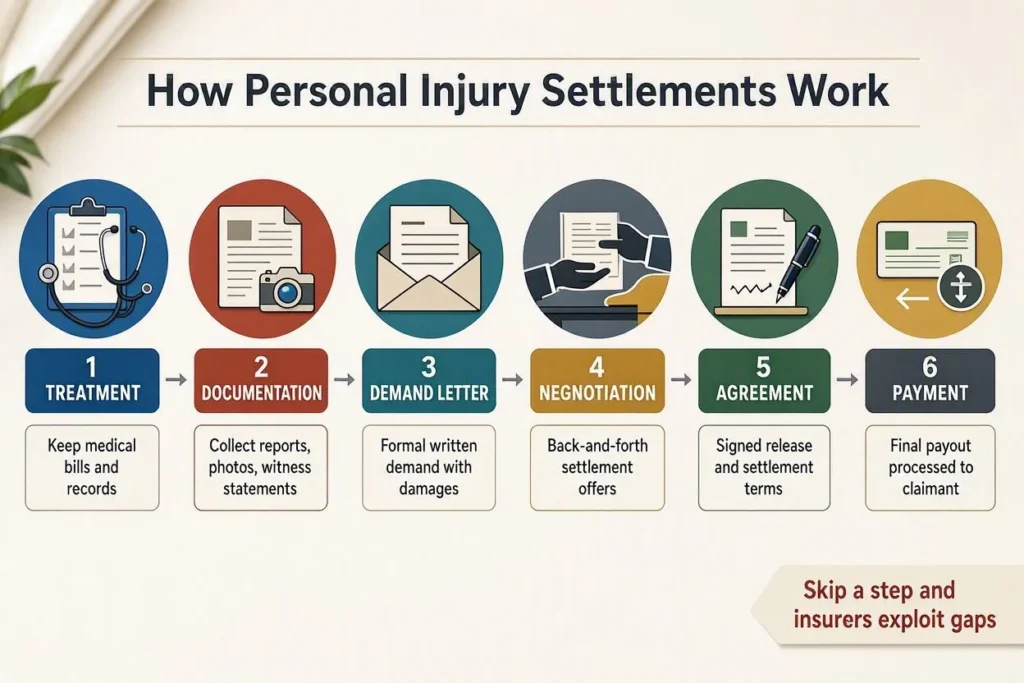
Six stages carry a claim from injury to payout: treatment, documentation, a demand letter, negotiation, agreement, and payment. Skip one of these and it usually costs you money later, since insurers exploit gaps in the record.
- Medical treatment. You seek care and keep every bill, discharge summary, and prescription record.
- Evidence gathering. Police reports, scene photos, and witness statements get collected while memories are still fresh.
- Demand letter. Your attorney sends the insurer a written demand stating the facts, listing damages, and naming a dollar figure.
- Negotiation. The insurance adjuster counters, usually lower, and both sides go back and forth until they land on a number.
- Settlement agreement. You sign a release once both sides agree, which ends your right to sue over that incident.
- Payment. The insurer issues a check to your attorney’s trust account, and the attorney processes it before any money reaches you.
A contested-liability case, or one involving severe injuries, stretches this out considerably, since insurers dig in harder before agreeing to pay anything. A simple rear-end collision with obvious fault, by contrast, can wrap up in weeks.
How Settlement Amounts Get Calculated
Two methods dominate settlement math: the multiplier method and the per diem method. Both start with your economic damages, then apply a formula to estimate what pain and suffering is worth on top of that.
The Multiplier Method
The multiplier method takes your total economic damages, medical bills plus lost wages, and multiplies that number by a factor between 1.5 and 5. Take a broken wrist with $8,000 in medical costs. A multiplier of 2 puts pain and suffering at $16,000, bringing the total demand to roughly $24,000. Severe or permanent injuries push that multiplier toward the higher end.
The Per Diem Method
The per diem method takes a different approach. It assigns a daily dollar value, often tied to your daily wage, then multiplies it by the number of days the injury disrupted your life. Someone earning $200 a day who spends 90 days in pain with limited mobility could see a per diem claim near $18,000 for that stretch alone.
Insurance companies often skip both methods and run proprietary software instead, feeding in injury type, treatment codes, and geographic region to spit out a settlement range. Those formulas tend to lowball claims. That’s exactly why negotiation, not the software’s first number, decides what you actually get offered.
Types of Damages Included in a Personal Injury Settlement

A personal injury settlement usually pulls from three buckets: economic, non-economic, and, occasionally, punitive damages. Each one compensates a different kind of loss.
- Economic damages cover measurable financial losses: medical bills, lost wages, property damage, and future treatment costs.
- Non-economic damages cover intangible harm: pain and suffering, emotional distress, and loss of enjoyment of life.
- Loss of consortium compensates a spouse or family member for how the injury affected companionship or support.
- Punitive damages punish the defendant for especially reckless or intentional conduct rather than compensating you directly.
Punitive damages are the exception, not the rule. Courts reserve them for gross negligence, a drunk driver causing a crash, for example, and most states cap what a jury can award. Nothing close to that level of misconduct means punitive damages simply never come up.
Lump Sum vs. Structured Settlement: Which Pays Out How
You’ll get paid one of two ways once you settle: a single lump-sum payment, or a structured settlement spread over months or years. Both draw from the same negotiated total. What changes is timing, not the underlying value.
Lump Sum Settlements
A lump sum hands you everything at once. Settle for $80,000 and you get that full amount in one check after fees and liens are deducted, which means immediate access to pay off bills or cover costs piling up. The catch: the money has to last, and there’s no second payout waiting if it runs out early.
Structured Settlements
A structured settlement spreads that same $80,000 across scheduled payments, monthly or annually, funded by an annuity the insurer purchases. It fits long-term care situations well, since it guarantees future income instead of handing you a large sum to manage alone. The downside shows up if an unexpected expense hits and the flexibility just isn’t there.
Smaller settlements with short recovery periods usually go the lump-sum route. Catastrophic injuries requiring years of treatment tend toward structured payments instead. Either path gets written into the release agreement before a single dollar moves.
How Personal Injury Settlements Are Paid Out (Disbursement Order)
Money moves in a fixed order once a settlement is finalized: attorney’s fees first, then case costs, then medical liens, and whatever’s left goes to you. The insurer’s check never comes to you directly. It lands in your attorney’s trust account, and every deduction gets handled before a final check is cut.
Run the numbers on a $100,000 settlement with a 33% contingency fee, $2,000 in case costs, and $15,000 in medical liens:
- Attorney’s fees: $33,000
- Case costs: $2,000
- Medical liens: $15,000
- Net to client: $50,000
That $50,000 figure catches a lot of people off guard, mostly because they fixate on the headline settlement number and forget how many deductions come out first. Knowing how personal injury settlements work before you sign anything is the best way to avoid that surprise. Good attorneys push back on lien amounts too, since medical providers and health insurers will frequently accept less than the full bill just to get paid sooner.
Unpaid liens don’t quietly disappear, either. Medicare can pursue double the amount owed if its reimbursement claim goes unresolved, which is why no attorney closes a case without settling every valid lien first.
Are Personal Injury Settlements Taxable?
No. Settlements for physical injuries are generally not taxable under federal law. The Internal Revenue Service (IRS) excludes compensation for physical injury or sickness from gross income under Internal Revenue Code (IRC) Section 61, so medical reimbursement, lost wages, and pain and suffering tied to a physical injury all pass to you tax-free.
A few exceptions exist. Punitive damages get taxed regardless of the underlying injury. So does interest that accrues while a settlement is pending, and so does compensation for emotional distress that isn’t tied to a physical injury.
Some claimants structure part of their settlement into an annuity, or set up a Qualified Settlement Fund (QSF), to defer taxes on certain portions even further. A tax professional can confirm exactly how your specific payout breaks down before you sign. The allocation language written into the release itself decides what counts as taxable, so that wording carries as much weight as the total number.
How Long Personal Injury Settlements Take to Resolve
Expect 3 to 12 months for most cases, though catastrophic injuries can push well past a year. The timeline hinges on two things mostly: how fast your medical treatment stabilizes, and how hard the insurer fights liability.
A four-stage pattern shows up across most claims:
- Initial treatment and documentation: 1 to 2 months
- Demand letter and insurer investigation: 1 to 3 months
- Negotiation phase: 2 to 6 months
- Final agreement and payment processing: 1 to 2 months
Attorneys typically hold off on sending a demand letter until you reach maximum medical improvement, the point where a doctor confirms recovery has plateaued. Settle before that and you risk leaving future treatment costs uncovered entirely. A soft tissue injury that seems minor at first can turn into months of physical therapy, and a settlement signed too early won’t account for any of it.
How Fault and Comparative Negligence Change Your Settlement
Fault chips away at your settlement in direct proportion to how much blame gets assigned to you, under a rule called comparative negligence. Most states run some version of this system, though the exact math shifts state to state.
Pure comparative negligence states simply reduce your award by your fault percentage. A claimant found 30% at fault in a $50,000 case still walks away with $35,000. Modified comparative negligence states cut recovery off completely once a claimant crosses 50% or 51% fault, depending on the state. A few states go further still: North Carolina follows pure contributory negligence, where being just 1% at fault can bar recovery entirely.
Adjusters go looking for anything that shifts fault your way, traffic camera footage, social media posts, whatever’s available. That’s part of why attorneys tell clients to stay quiet about a pending case in public. One photo showing physical activity, stripped of context, becomes ammunition for an adjuster arguing your injury isn’t as severe as claimed.
5 Common Mistakes That Shrink a Settlement
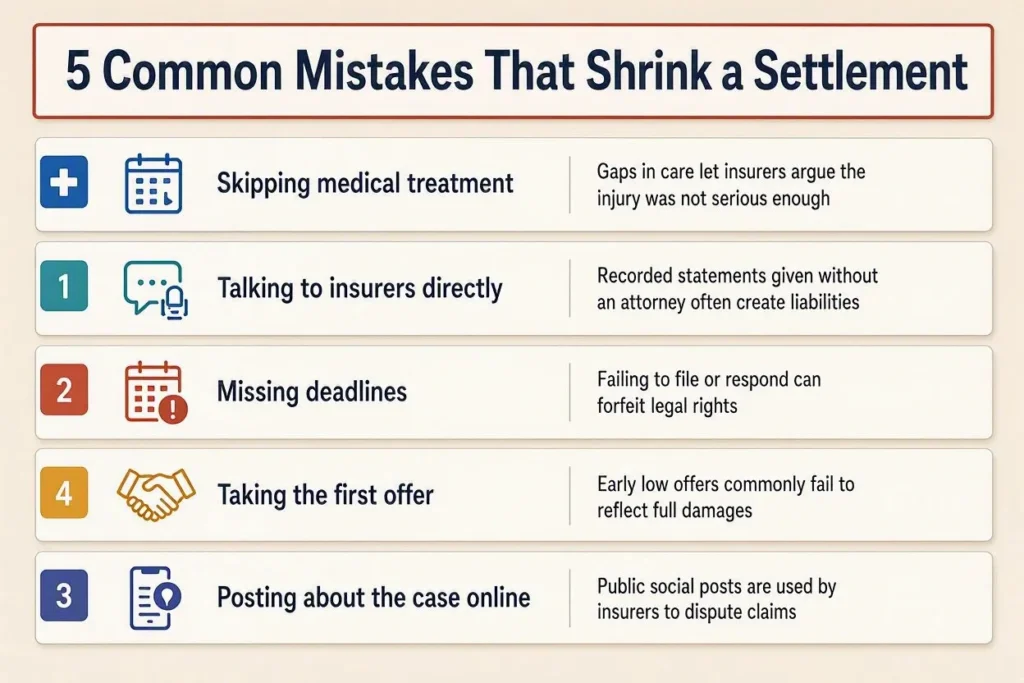
Five habits routinely knock money off a personal injury settlement: skipping treatment, talking to insurers unrepresented, missing deadlines, taking the first offer, and posting about the case online.
- Skipping medical treatment. Gaps in care hand insurers a reason to argue the injury wasn’t serious enough to need ongoing attention.
- Talking to insurers directly. Recorded statements given without an attorney present often contain details used against the claimant later.
- Missing the statute of limitations. Deadlines run between 1 and 6 years depending on the state and case type, and missing one bars the claim outright.
- Accepting the first offer. Initial offers almost always undervalue the claim, banking on claimants not knowing better.
- Posting on social media. Adjusters search public accounts routinely, looking for anything that contradicts the injury claim.
None of these five guarantees a bigger settlement on their own. Ignoring all five, though, comes close to guaranteeing a smaller one.
Conclusion
A predictable pattern runs underneath every personal injury settlement, no matter how the individual numbers shake out. Damages get calculated, fault gets weighed, liens get paid, and only after that does a final figure land in your account. Sign a release without understanding how personal injury settlements work, and there’s a real chance that figure falls short of what the injury actually cost you.
Frequently Asked Questions

Amanda Brooks
Amanda Brooks leads JusticeInTown’s legal, justice, and community advocacy content division. She holds a background in legal research and public policy and specializes in topics related to civil rights, access to justice, legal awareness, and community issues. With years of experience researching legal and social justice topics, Amanda brings a careful, research-driven approach to complex legal information and public-interest issues. She is the primary author of JusticeInTown’s legal guides, justice-related resources, and community-focused content, helping readers better understand their rights, legal options, and the issues affecting their communities.
Related Posts