How to Become Legal Guardian of a Child in 2026
To become legal guardian of a child, you file a guardianship petition in the family or probate court where the child lives. The court reviews your eligibility, orders a background check, and schedules a hearing before a judge grants you legal authority over the child.
This guide walks through every requirement, every form, every cost, and the exact timeline you can expect in 2026. It also covers a situation general guides skip: what happens to guardianship when a parent faces immigration detention or removal proceedings.
What Does It Mean to Become a Legal Guardian?
Legal guardianship gives a court-appointed adult the authority to make decisions for a child whose parents cannot currently provide care. A judge grants this authority through a formal court order, not through a private agreement between adults.
The guardian — called the petitioner before approval — gains rights over 3 main areas: the child’s physical living arrangement, the child’s medical care, and the child’s education. Parental rights are not automatically terminated when a guardian is appointed. Biological parents keep visitation rights and the option to regain full custody once their situation changes.
A court can also appoint 2 separate types of guardians for the same child. A guardian of the person handles daily care decisions. A guardian of the estate manages the child’s money, property, or inheritance, and a court typically appoints this role only when the child holds substantial financial assets.
Guardianship differs from a power of attorney in one critical way. A parent signs a power of attorney voluntarily and can revoke it at any time without court involvement. Guardianship requires a judge’s order both to create and to end, which gives it more legal weight in disputes over a child’s care.
Who Qualifies to Become a Legal Guardian?

Every state sets baseline eligibility rules before a judge considers your petition. These rules fall into 2 categories: who you are, and what your record shows.
Age and Residency Requirements
You must be at least 18 years old and a legal resident of the state where you file your petition. Some states add a minimum residency period — commonly 6 to 12 months — before you qualify to petition in that jurisdiction.
A pre-existing relationship with the child strengthens your petition in most states. Courts give priority consideration to 4 relationship types: grandparents, aunts or uncles, godparents, and close family friends with a documented history of involvement in the child’s life.
Background Check and Criminal History Rules
A felony conviction does not automatically disqualify you, but it triggers stricter court review. States handle this 3 different ways: automatic disqualification for any felony, disqualification only for violent crimes, or case-by-case judicial review.
Courts also run 3 additional checks beyond criminal history: a child abuse registry check, a credit report review for financial stability, and in some states a health assessment confirming you can physically and mentally care for the child.
How to Become Legal Guardian of a Minor Step by Step
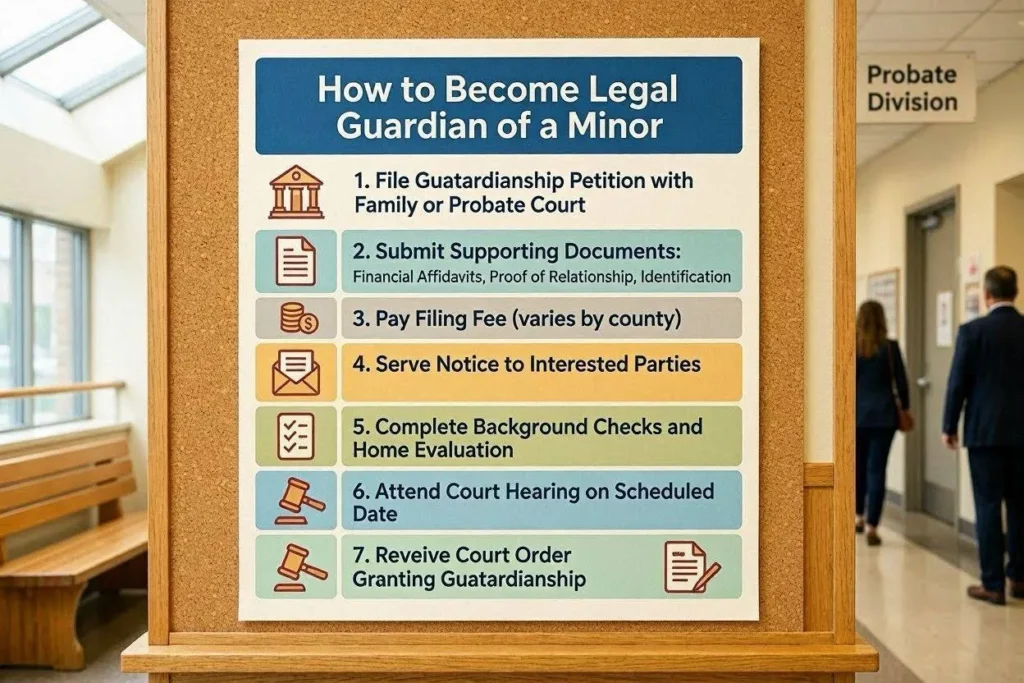
To become legal guardian of a minor, you complete 7 sequential steps from filing through court approval. Skipping any step delays your hearing date.
- File a guardianship petition with the family or probate court in the county where the child currently lives.
- Submit supporting documents — financial affidavits, proof of your relationship to the child, and identification.
- Pay the filing fee, which most counties set between $150 and $435.
- Serve formal notice to the child’s parents and any other interested relatives, giving them the legal right to respond.
- Complete the court-ordered background check, covering criminal history and child abuse registry records.
- Attend the scheduled court hearing, where a judge reviews your petition and hears any objections.
- Receive the signed court order and Letters of Guardianship, the official document proving your legal authority.
A court may also appoint a guardian ad litem (GAL) to represent the child’s interests separately from your petition. A GAL is typically an attorney or social worker who reports directly to the judge, not to you or the child’s parents.
Once approved, you take on 3 ongoing responsibilities beyond the initial court order. You manage the child’s medical records and consent to treatment, you enroll and stay involved in the child’s schooling, and you file a status report with the court — most states require this annually.
How Much Does It Cost to Become a Legal Guardian?
Guardianship filing fees typically run $150 to $435, with total costs reaching $1,000 to $2,500 once attorney fees are included. Los Angeles County, for example, charges $1,495 to file a guardianship petition in probate court unless you qualify for a fee waiver.
3 additional costs can apply depending on your state: a guardianship bond (a form of insurance protecting the child’s assets), background check processing fees, and court-ordered mediation fees if the biological parents contest the petition. Many courts offer a fee waiver for petitioners who demonstrate financial hardship.
How Long Does the Guardianship Process Take?
A standard guardianship case takes 2 to 4 months from filing to final court order. The timeline depends on how quickly relatives respond to notice, how fast the court completes its background investigation, and whether any parent contests the petition.
Temporary guardianship moves faster in most states. Some courts grant temporary authority within 1 to 2 weeks when a parent faces a sudden hospitalization, deployment, or short-term emergency, without requiring the full evidentiary hearing a permanent guardianship needs.
What Happens If a Parent Faces Immigration Detention?
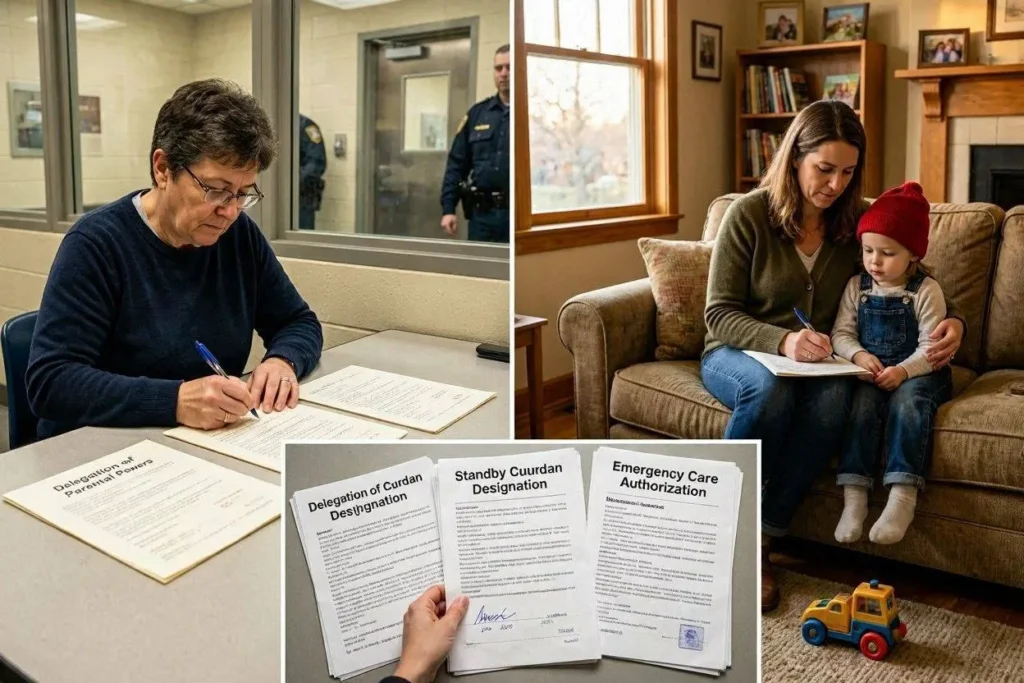
A parent in immigration detention can still designate a standby guardian to care for their child without losing parental rights. Courts treat detention and pending removal proceedings as a qualifying emergency, similar to hospitalization or military deployment.
3 documentation steps matter most in these cases. First, the parent signs a delegation of parental powers or standby guardian designation before or during detention proceedings. Second, the named guardian files a custody or guardianship petition — most states allow 60 days from the triggering event to complete this filing. Third, the family keeps copies of immigration court notices, since judges in family or probate court often request proof of the detention timeline.
A notarized letter from a detained parent does not by itself create legal guardianship. Only a signed court order establishes legal guardianship authority. A notarized letter functions only as a letter of consent, which schools and some medical providers accept temporarily, but it carries no binding legal weight in court.
Guardianship granted under these circumstances does not terminate the detained parent’s rights. The parent keeps the right to petition for reinstated custody once released or once immigration proceedings resolve, unless a separate court order specifically terminates parental rights.
Legal Guardianship vs Custody vs Adoption: Key Differences
Caregivers frequently confuse these 3 legal arrangements. Each carries a different level of permanence and a different effect on the biological parents’ rights.
Guardianship Compared to Legal Custody
Legal custody and guardianship grant similar day-to-day authority, but a stepparent or grandparent typically files for custody within an existing family court case. Guardianship usually starts as a standalone petition rather than an extension of a divorce or custody dispute already on file.
Guardianship Compared to Adoption
Adoption permanently terminates the biological parents’ legal rights; guardianship does not. A guardian does not become the legal parent — parental rights stay suspended, not erased, which means biological parents can petition to reverse the arrangement later.
Adoption requires a more demanding court process, including home studies and a waiting period before finalization. Guardianship moves faster precisely because it remains reversible, while adoption’s permanence justifies the additional court scrutiny.
Guardianship Process Quick-Reference Table
This table summarizes every stage of the guardianship process, including expected timing, the method required, and the relative difficulty of each step.
| Task | Timing | Method | Difficulty |
|---|---|---|---|
| File guardianship petition | Day 1 | Submit forms to family/probate court | Moderate |
| Serve notice to parents | Within 1–2 weeks | Certified mail or process server | Moderate |
| Complete background check | 2–4 weeks | Court-ordered fingerprinting and records review | Low |
| Attend court hearing | 6–12 weeks after filing | In-person or video hearing before a judge | High |
| Receive Letters of Guardianship | Same day as approval | Issued directly by the court clerk | Low |
| File annual report (ongoing) | Every 12 months | Submit status update to the court | Moderate |
Conclusion
Filing a guardianship petition starts a process built around one priority: the court confirming the arrangement serves the child’s best interest. Eligibility, background checks, and a court hearing stand between your petition and a signed order.
Families navigating guardianship alongside an immigration case face extra deadlines and documentation requirements that a standard guardianship guide does not cover. A family immigration attorney can confirm which standby guardian forms apply in your state and help you meet the 60-day filing window tied to a parent’s detention.
Frequently Asked Questions

Amanda Brooks
Amanda Brooks leads JusticeInTown’s legal, justice, and community advocacy content division. She holds a background in legal research and public policy and specializes in topics related to civil rights, access to justice, legal awareness, and community issues. With years of experience researching legal and social justice topics, Amanda brings a careful, research-driven approach to complex legal information and public-interest issues. She is the primary author of JusticeInTown’s legal guides, justice-related resources, and community-focused content, helping readers better understand their rights, legal options, and the issues affecting their communities.
Related Posts