
How to Clear a Criminal Record: Step-by-Step Legal Guide
You clear a criminal record by filing a petition for expungement, sealing, or annulment with the court that handled your case, proving you meet your state’s eligibility rules, and getting a judge to sign an order directing the record’s destruction or restriction. The exact procedure depends on your state’s criminal procedure code and how your case ended. Under Illinois’s Clean Slate law, for instance, a dismissed misdemeanor with no later conviction can be sealed in four to six months, and most petitioners never see the inside of a courtroom for it.
Legal Definition: What Does It Mean to Clear a Criminal Record?
Clearing a criminal record means getting a court-ordered remedy, such as expungement, sealing, annulment, or a pardon, that destroys, restricts, or forgives an entry in your criminal history. Four legal tools do this in the U.S., and each state defines the terminology a little differently. Texas calls it “expunction” under Code of Criminal Procedure Article 55A. Illinois splits the remedy in two: “expungement” and “sealing” are separate statutory options under the Criminal Identification Act. New Hampshire calls it “annulment,” governed by RSA 651:5, and the practical result is the same. California doesn’t use the word expungement at all. Relief under Penal Code section 1203.4 works by letting you withdraw your plea and dismissing the case, which is a different legal mechanism reaching a similar outcome.
Expungement vs. Sealing vs. Annulment vs. Pardon (Legal Distinctions)
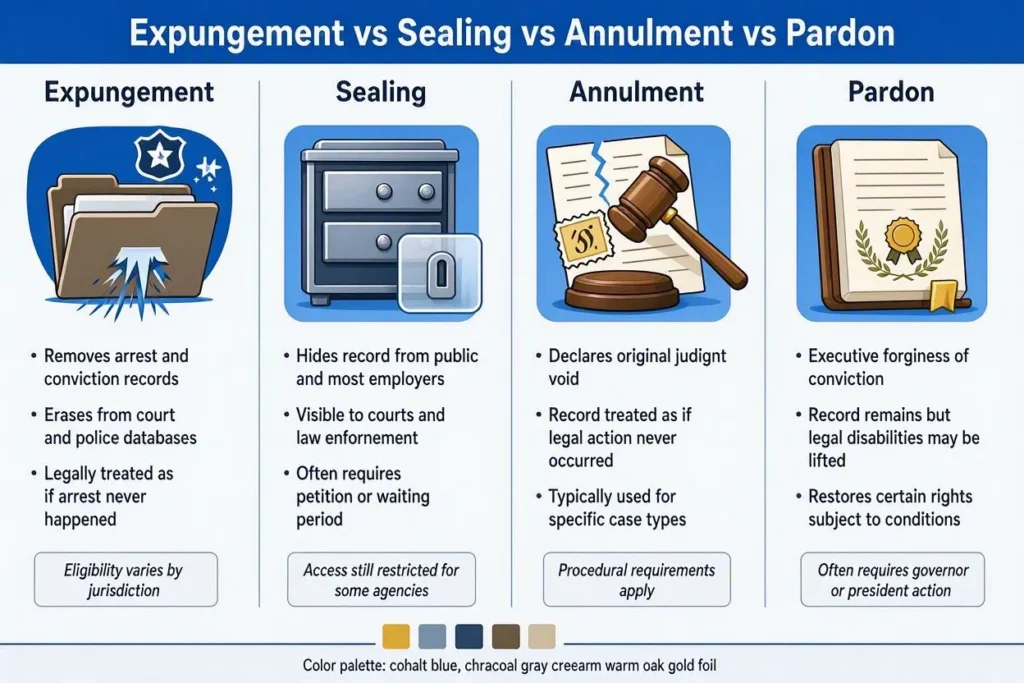
Each remedy does something different to the record, and eligibility rules shift depending on which one you’re pursuing.
- Expungement destroys the arrest or conviction record from court files, police databases, and the state repository. Legally, it’s treated as if the arrest never happened.
- Sealing hides the record from the public and most employers but keeps it visible to courts, law enforcement, and certain licensing boards.
- Annulment is New Hampshire’s word for the same idea, under RSA 651:5, with the same practical effect as expungement.
- Pardon doesn’t erase anything. It forgives the conviction officially, but the record stays, marked “pardoned.”
South Carolina Code Section 17-1-40 limits expungement to a specific list of offenses, so anyone convicted of something outside that list usually ends up applying for a pardon through the Department of Probation, Parole and Pardon Services instead.
Who Qualifies to Clear a Criminal Record?
Yes, most people qualify to clear a criminal record if their case was dismissed, ended in acquittal, or resulted in a single low-level conviction, though violent felonies, sex offenses requiring registration, and most injury-related DUIs are almost always excluded by statute. Whether you qualify comes down to how the case ended, how serious the offense was classified as, and how much time has passed since then.
6 Statutory Eligibility Factors
Courts look at a fairly consistent set of factors when they decide whether a petition moves forward.
- Case disposition. Dismissed charges, not-guilty verdicts, and cases where charges were never filed have the widest eligibility.
- Offense classification. Misdemeanors and lower-level felonies usually qualify. Violent felonies and registrable sex offenses almost never do, in any state.
- Waiting period. States set a fixed clock, running from the arrest, the conviction, or the end of your sentence, and it can run anywhere from one year to more than a decade depending on the offense.
- Subsequent criminal history. You generally need a clean record both before and after the offense. Pick up another conviction in the meantime, and eligibility often disappears.
- Sentence completion. Probation, parole, restitution, and fines all need to be fully paid off and finished first.
- Procedural posture. Finishing a diversion program, like Pre-Trial Intervention (PTI) or deferred adjudication, often unlocks automatic or faster eligibility built into the program itself.
Take South Carolina: a first-offense shoplifting conviction under $500 becomes eligible for expungement three years after probation ends, as long as nothing else shows up on the record in between.
How to Clear a Criminal Record: The 7-Step Legal Process
You clear a criminal record by pulling your certified criminal history, checking eligibility, gathering documents, filing a petition with the right court, paying or waiving the fee, showing up to a hearing if one gets scheduled, and confirming every agency actually complied once the order is signed. The sequence stays fairly similar from state to state, though local court rules change the paperwork details.
- Get your certified criminal history. Order it from the state police records division; expect to pay $15 to $25.
- Check eligibility against the statute. Match your offense, disposition, and waiting period to the controlling law before you file anything.
- Gather your documents. You’ll need the dismissal order, sentencing records, proof of completed probation, and ID.
- File the petition with the right court. File in the county where you were arrested or prosecuted, not necessarily where you live now.
- Pay the filing fee or file a waiver. If you can’t afford it, most courts let you file a statement of inability to pay alongside the petition.
- Go to the hearing, if one gets set. Agencies named in your petition typically get 30 to 60 days to object, depending on the state.
- Confirm compliance after the order is entered. Check that each agency actually purged or restricted the record, and pull an updated criminal history to be sure.
Under the Illinois Criminal Identification Act, the circuit clerk has to notify the state’s attorney, the Illinois State Police, and the arresting agency once you file, and each of them gets 60 days to object before the case heads to a hearing.
Filing Fees and Court Costs to Clear a Criminal Record
Filing costs to clear a criminal record run anywhere from $0 to $600, depending on the base court fee, per-agency notification charges, and whether you hire an attorney. Fee waivers exist in almost every state if you can show you can’t afford it.
South Carolina charges a flat $310 total, split between the solicitor, the clerk of court, and the State Law Enforcement Division (SLED), plus $25 to pull your record beforehand. Texas fees vary county by county, and counties can tack on a $25 mailing surcharge for every agency that doesn’t have an email address on file. Attorneys usually add $500 to $2,000 on top of court costs, though nonprofit groups like Summit Legal Aid in Pennsylvania handle petitions for free if you qualify by income.
Statutory Timelines to Clear a Criminal Record

Clearing a criminal record generally takes three months to a year, with dismissed, uncontested cases moving faster than contested convictions. Court backlogs, the objection window, and how quickly a hearing gets scheduled all factor in.
Texas law sets the hearing at least 30 days after filing, but the full process, especially if you’re waiting on a statute of limitations to run out, can stretch past a year. Once the judge signs off, agencies usually get another 60 days to finish purging their systems. Pulling a fresh background check about six months after the order is signed is the standard way to confirm it actually worked.
State Statutes Governing How to Clear a Criminal Record
State statutes governing how to clear a criminal record vary a lot in terminology, cost, and which offenses qualify, and there’s no federal law that standardizes any of it. Each state legislature writes its own rules.
- California skips expungement entirely. Penal Code section 1203.4 lets you withdraw your plea and dismiss the case instead, through an online screening tool.
- Texas splits the remedy: expunction under Article 55A destroys the record fully but mostly applies to non-convictions, while nondisclosure orders under Government Code Chapter 411 restrict access to certain convictions without erasing them.
- Illinois treats expungement and sealing as two separate remedies, and its Clean Slate law seals some records automatically, no petition needed.
- South Carolina limits expungement under Section 17-1-40 to a defined list, pushing everyone else toward a pardon.
- New Hampshire governs annulment under RSA 651:5, but an annulled conviction can still count toward habitual-offender sentencing if you reoffend later.
If you’re weighing options across state lines, check the current statute yourself. Legislatures tend to amend these laws almost every session.
How to Clear a Criminal Record Under South African Law
In South Africa, you clear a criminal record by applying to the Criminal Record Centre (CRC) of the South African Police Service (SAPS) under the Criminal Procedure Act 51 of 1977, once the waiting period after your sentence ends has passed. The whole process runs through a national police authority instead of a court, which is a real departure from how the U.S. system works.
Waiting periods range from five years, for a caution or a minor offense, up to ten years for anything involving prison time. You’ll need to submit Form 271, a full set of fingerprints, a certified ID copy, and proof that your sentence, fine included, is fully paid off. Offenses that require registration on the National Register for Sex Offenders can’t be expunged under this system, no matter how much time has passed. SAPS processing usually takes six to twelve months, and you get written confirmation from the Department of Justice and Constitutional Development once the expungement goes through and the entry comes off your record.
Legal Representation vs. Pro Se Filing
Hiring an attorney is worth it if your petition involves multiple charges, a contested conviction, or a filed objection from the prosecutor, while an uncontested, dismissed-charge case is often fine to file yourself. Filing without a lawyer saves money, but you’ll need to follow the court’s procedural rules closely.
A single dismissed misdemeanor with no prior record is exactly the kind of case that legal aid groups like TexasLawHelp and Illinois Legal Aid Online build their free self-help kits around. A felony with co-defendants, a prior record, or an active objection from the prosecutor’s office is a different story. That’s where an attorney who can argue eligibility at a contested hearing earns their fee. Limited-scope representation, where a lawyer just reviews your finished forms instead of taking the whole case, splits the difference if money’s tight.
What Happens After You Clear a Criminal Record
Once the order is entered, government agencies have to purge or restrict their records within the deadline set by state law, but private background-check companies often keep old data unless someone corrects it directly. The court order doesn’t automatically reach every private database out there.
Background Check Companies and Data Brokers
Private data brokers buy criminal record data in bulk, and nothing forces them onto a fixed refresh schedule. The Foundation for Continuing Justice, mentioned in official Texas court guidance, forwards expungement orders to major background-check vendors on a petitioner’s behalf, at no cost. If a cleared record turns up on a background check anyway, get a copy of the report and file a dispute directly with the company that issued it.
Clean Slate Statutes and Ban the Box Ordinances
Clean Slate laws seal eligible records automatically once a set waiting period passes, no petition required. Illinois, Pennsylvania, and a handful of other states have versions of this law on the books, though which offenses qualify and how long the wait is changes by state. Ban the Box laws work differently. They don’t clear anything, but they push back the point in hiring where an employer can ask about criminal history, so an applicant’s qualifications get looked at first. Both matter for anyone whose record can’t be fully cleared but who still needs a way back into steady work.
Glossary of Legal Terms
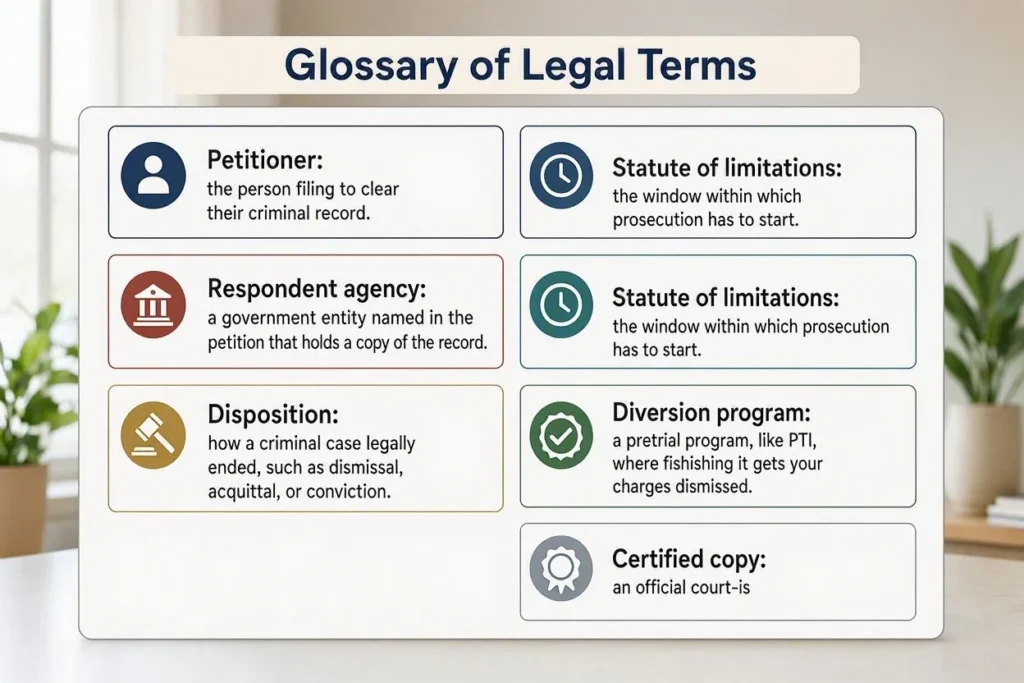
- Petitioner: the person filing to clear their criminal record.
- Respondent agency: a government entity named in the petition that holds a copy of the record.
- Disposition: how a criminal case legally ended, such as dismissal, acquittal, or conviction.
- Statute of limitations: the window within which prosecution has to start.
- Diversion program: a pretrial program, like PTI, where finishing it gets your charges dismissed.
- Certified copy: an official court-issued copy stamped with the clerk’s seal.
- Docket: the court’s official log of everything filed in a case.
- Order of dismissal: a signed judicial order ending a charge without a conviction.
- Fee waiver: court approval to skip filing costs due to financial hardship.
- Nondisclosure order: a Texas remedy that restricts access to a conviction without destroying it.
Conclusion
Clearing a criminal record comes down to identifying the right statute, following the filing procedure exactly, and following through once the court signs off. Whether that’s Article 55A in Texas, the Criminal Identification Act in Illinois, RSA 651:5 in New Hampshire, Penal Code section 1203.4 in California, or whatever governs your own state, the remedy is there if you meet the criteria. Once the order is signed, the agencies on it are legally required to comply.
FAQs

Amanda Brooks
Amanda Brooks leads JusticeInTown’s legal, justice, and community advocacy content division. She holds a background in legal research and public policy and specializes in topics related to civil rights, access to justice, legal awareness, and community issues. With years of experience researching legal and social justice topics, Amanda brings a careful, research-driven approach to complex legal information and public-interest issues. She is the primary author of JusticeInTown’s legal guides, justice-related resources, and community-focused content, helping readers better understand their rights, legal options, and the issues affecting their communities.
Related Posts