
How to File a Personal Injury Claim in Texas: 8 Steps (2026 Guide)
Filing a personal injury claim in Texas requires eight steps: reporting the accident, getting medical treatment, notifying insurance carriers, calculating damages, sending a demand letter, negotiating, attempting mediation, and filing a lawsuit if the case doesn’t settle. Texas law gives injured people two years from the date of injury to act under Texas Civil Practice and Remedies Code § 16.003, and missing that date ends the right to recover money permanently. The process below breaks down each stage with the numbers, forms, and deadlines that apply specifically in Texas, not generic advice copied from other states.
What Counts as a Personal Injury Claim in Texas
A personal injury claim arises when a person suffers physical or psychological harm because another party acted negligently, recklessly, or intentionally. Texas courts group these cases into several categories: car and truck accidents, slip and fall incidents on unsafe property, medical malpractice, defective products, workplace injuries, and dog bites. Car accidents account for the largest share of filed claims nationally, making up roughly 52% of personal injury cases, according to industry claims data. Three elements must exist before a claim moves forward: liability (who caused the harm), fault (the degree of responsibility), and damages (the measurable harm suffered). A claim without proof of all three rarely survives an insurance company’s initial review, let alone a courtroom.
Step 1: Report the Accident and Collect Evidence

Report the incident to the right authority within hours, not days. Call 911 for a car accident, notify the property owner or manager for a slip and fall, and report a workplace injury to a supervisor the same shift it happens. Texas Department of Transportation (TxDOT) crash reports become part of the official record and carry weight with insurance adjusters, so requesting a copy early prevents delays later.
Evidence collected at the scene determines the strength of a claim more than any argument made afterward. A person involved in an accident should:
- Photograph vehicle damage, road conditions, skid marks, and visible injuries from multiple angles
- Record a short video of the scene before anything gets moved or cleaned up
- Collect names, phone numbers, and insurance information from every driver and witness present
- Request the responding officer’s badge number and report number for follow-up
Severe injuries sometimes prevent a person from gathering this evidence personally. Attorneys and their investigators can retrieve crash reports, pull surveillance footage, and interview witnesses within days of an accident, before footage gets overwritten or memories fade.
Step 2: Get Medical Treatment Immediately
See a doctor the same day as the accident, even without visible injuries. Soft-tissue injuries, concussions, and internal bleeding often produce no symptoms for 24 to 72 hours, and insurance adjusters routinely argue that a gap between the accident and the first medical visit proves the injury happened somewhere else. Emergency rooms, urgent care clinics, and primary care physicians all create a medical record that links the injury directly to the accident date.
Every follow-up appointment matters as much as the first one. A patient who skips physical therapy sessions or stops taking prescribed medication gives the insurance company grounds to argue that the injury wasn’t serious enough to justify the claimed damages. Keep every receipt, prescription bottle, and appointment summary in one folder, because a claim’s value depends on documented treatment, not the injury’s actual severity.
Step 3: Notify the Insurance Companies
Notify a personal auto insurer within 24 to 48 hours of an accident, even in cases where the other driver caused the crash. Texas requires drivers to carry liability insurance, but two additional coverage types affect how a claim gets paid.
Personal Injury Protection (PIP) coverage pays medical bills and lost wages regardless of who caused the accident, up to the policy limit, and Texas insurers must offer it unless the driver rejects it in writing.
Uninsured/Underinsured Motorist (UM/UIM) coverage pays when the at-fault driver has no insurance or insufficient coverage to pay the full claim amount — a common scenario, since roughly 1 in 5 Texas drivers carries no insurance at all, according to Insurance Research Council estimates.
Insurance adjusters are trained negotiators whose compensation depends partly on minimizing payouts. A person filing a claim should:
- Give only the facts of the accident, never an opinion on fault
- Decline a recorded statement until reviewing the case with an attorney or trusted advisor
- Get a claim number and the adjuster’s direct contact information in writing
- Avoid signing any medical release form before understanding what records it authorizes the insurer to obtain
Step 4: Calculate Economic and Non-Economic Damages
Texas personal injury damages split into two categories, and undervaluing either one leaves money on the table.
Economic damages cover costs with a receipt or invoice attached: emergency room bills, surgery costs, physical therapy, prescription medication, lost wages, and reduced future earning capacity if the injury causes permanent limitations.
Non-economic damages cover harm without a fixed dollar value: physical pain, emotional distress, loss of enjoyment of daily activities, and permanent scarring or disfigurement. Three calculation methods apply to non-economic damages in Texas cases:
| Method | Calculation | Best Fit |
| Multiplier | Economic damages × a factor between 1.5 and 5, based on injury severity | Moderate to severe injuries with lasting pain |
| Per diem | A fixed daily dollar amount from the injury date to maximum medical improvement | Injuries with a predictable recovery timeline |
| Precedent | Comparable settlement or verdict amounts from similar Texas cases | Complex claims without a clear injury pattern |
Self-represented claimants consistently underestimate non-economic damages because no invoice exists to anchor the number. A person who suffered $15,000 in medical bills and lost eight weeks of a $60,000 salary has already documented over $24,000 in economic damages before non-economic damages enter the calculation.
Step 5: Write and Send a Demand Letter
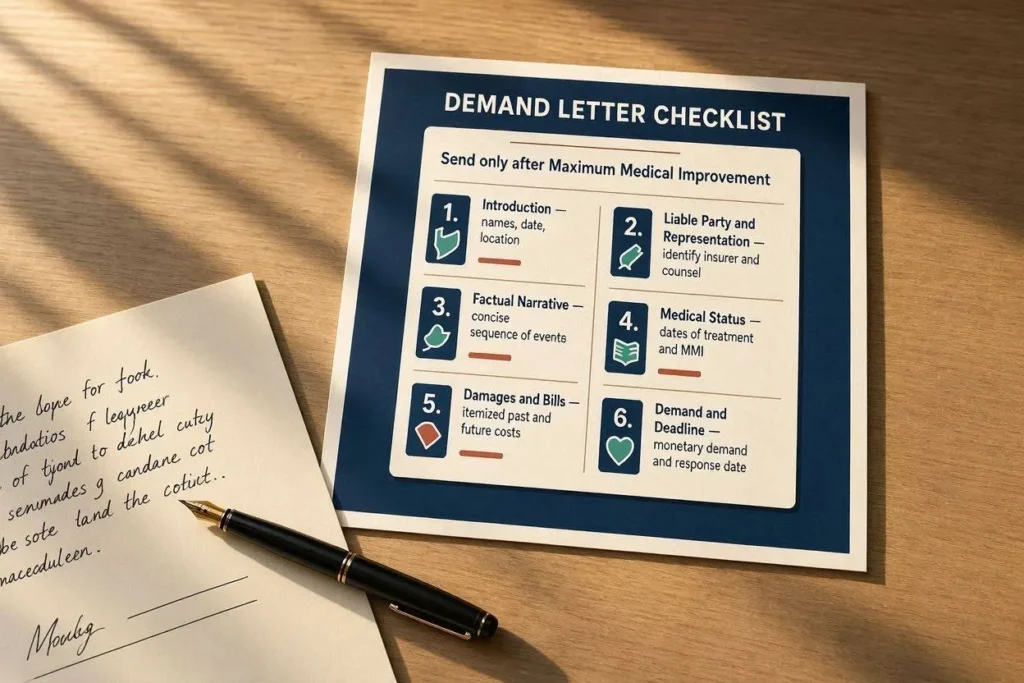
Send a demand letter only after reaching maximum medical improvement (MMI) — the point where a doctor confirms the injury has healed as much as it will, or has stabilized into a permanent condition. Sending a demand letter before reaching MMI risks settling for less than the true cost of ongoing treatment.
A demand letter needs six components to function as a serious opening offer:
- Introduction — names, dates, and location of the incident
- Liability statement — a factual explanation of why the other party caused the harm
- Injury description — diagnosis, treatment received, and expected recovery timeline
- Itemized damages — every economic and non-economic cost, listed individually
- Demand amount — a specific dollar figure, not a range, with a 30-day response deadline
- Supporting documents — medical records, bills, photos, and the crash report attached as exhibits
A basic structure looks like this:
[Name and Address] [Date]
Re: Claim Number [XXXX], [Date of Incident]
Dear [Adjuster Name],
On [date] at [location], your insured caused an accident that resulted in [injury description]. I received treatment from [provider names] for [duration], incurring $[amount] in medical expenses and $[amount] in lost wages. Based on the enclosed documentation, I demand $[amount] to resolve this claim within 30 days of this letter’s date.
Sincerely, [Signature]
Step 6: Negotiate the Settlement
Insurance adjusters almost never accept a first demand. Expect a counteroffer between 30% and 60% of the demanded amount as an opening response, and treat it as the start of a negotiation, not a final answer. Respond to each lowball offer with specific evidence — a medical bill, a wage statement, a comparable settlement — rather than a general objection.
Document every phone call and offer in writing. A quick email summary sent after each conversation (“Confirming our call today: you offered $X, I countered with $Y”) prevents disputes later about what either side agreed to.
Step 7: Try Mediation or Arbitration
If direct negotiation stalls after two or three rounds of counteroffers, mediation offers a faster and cheaper path than a lawsuit. A neutral mediator facilitates discussion between both sides without issuing a binding decision, and Texas Dispute Resolution Centers charge between $100 and $300 per party for a half-day session — a fraction of typical litigation costs. Arbitration works differently: a neutral arbitrator hears both sides and issues a decision that becomes binding or non-binding, depending on the agreement signed beforehand.
Step 8: File a Lawsuit or Small Claims Case
If mediation fails to produce a settlement, two paths remain, and the damages amount determines which one applies. Small claims court in Texas handles disputes up to $20,000, requires a completed petition form from the county Justice Court, and costs $50 to $100 in filing fees — no attorney required. District court handles larger claims and follows a longer process:
- File a petition (formal complaint) stating the facts and the compensation sought
- Serve the petition on the defendant through a process server or sheriff
- Exchange evidence during discovery, which often includes a deposition — sworn testimony recorded for use at trial
- Present evidence at trial, where a judge or jury decides liability and damages
District court filing fees range from $250 to $350 depending on the county, with additional costs for service of process ($50–$100 per defendant), depositions ($500 or more each), and expert witnesses ($1,500–$5,000 or more).
Texas Statute of Limitations and the 51% Comparative Negligence Rule
Texas Civil Practice and Remedies Code § 16.003 sets a two-year statute of limitations for personal injury claims, counted from the date of the injury. Three exceptions extend this deadline: the injured person is a minor (the clock starts at age 18 under § 16.001), the injured person has a mental incapacity, or the injury wasn’t discoverable until later, such as with certain medical malpractice cases.
Texas follows a modified comparative negligence system with a 51% bar rule. A claimant who bears 50% or less of the fault recovers damages reduced by that percentage. A claimant who bears 51% or more recovers nothing. A person awarded $20,000 in damages but found 25% at fault receives $15,000; the same person found 55% at fault receives zero dollars, regardless of the accident’s severity.
Realistic Timeline: How Long Each Stage Takes
| Stage | Typical Duration |
| Evidence gathering and initial medical treatment | 1–2 weeks |
| Ongoing treatment to maximum medical improvement | 2–12 months, depending on injury severity |
| Demand letter and initial insurance response | 30–45 days |
| Negotiation rounds | 1–3 months |
| Mediation (if needed) | 1 half-day session, scheduled within 30–60 days |
| Lawsuit through trial (if filed) | 12–24 months |
Minor injuries with clear liability often resolve in 3 to 6 months. Cases involving disputed fault, multiple parties, or catastrophic injuries frequently take 1 to 2 years to reach a resolution.
When to Hire a Personal Injury Lawyer vs. Filing Alone
Self-representation works reasonably well when injuries are minor and fully healed, fault isn’t disputed, damages stay under $10,000, and the claimant has time to manage paperwork and phone calls. Claimants who hire an attorney recover 3 to 3.5 times more money on average than those who negotiate alone, according to Insurance Research Council data, largely because attorneys know how to value non-economic damages and counter adjuster tactics.
Hiring a lawyer becomes the stronger option in five scenarios:
- The injury caused permanent impairment, disfigurement, or long-term disability
- Fault is disputed or shared between multiple parties
- More than one defendant or insurance company is involved
- The insurance company denies the claim or refuses to negotiate in good faith
- The claim value exceeds $20,000, putting it above the small claims court limit
6 Mistakes That Reduce a Settlement
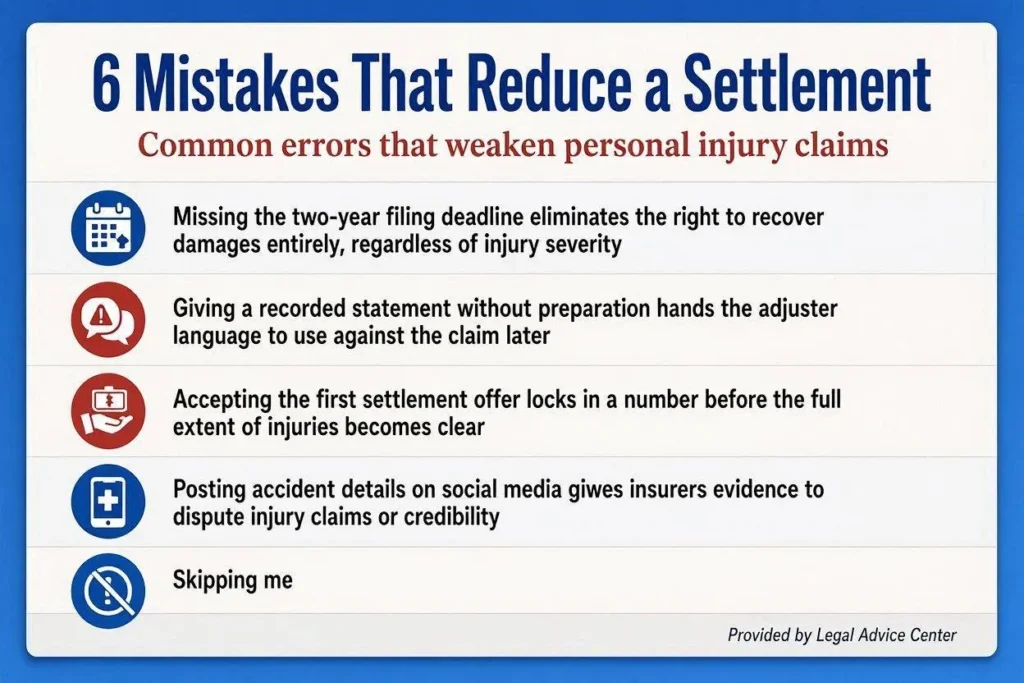
- Missing the two-year filing deadline eliminates the right to recover damages entirely, regardless of injury severity
- Giving a recorded statement without preparation hands the adjuster language to use against the claim later
- Accepting the first settlement offer locks in a number before the full extent of injuries becomes clear
- Posting accident details on social media gives insurers evidence to dispute injury claims or credibility
- Skipping medical follow-up appointments creates gaps that adjusters cite as proof of a minor or resolved injury
- Signing a medical release without reading it can grant the insurer access to unrelated medical history
Conclusion
Every step in this process exists because insurance companies profit when claimants skip one of them. Read the demand letter template twice before sending it, keep a written log of every call with an adjuster, and mark the two-year deadline on a calendar the day the accident happens. Texas law gives injured people the tools to recover fair compensation without a law degree — using them correctly is what separates a fair settlement from a rejected claim.
FAQs

Amanda Brooks
Amanda Brooks leads JusticeInTown’s legal, justice, and community advocacy content division. She holds a background in legal research and public policy and specializes in topics related to civil rights, access to justice, legal awareness, and community issues. With years of experience researching legal and social justice topics, Amanda brings a careful, research-driven approach to complex legal information and public-interest issues. She is the primary author of JusticeInTown’s legal guides, justice-related resources, and community-focused content, helping readers better understand their rights, legal options, and the issues affecting their communities.
Related Posts