How to Get a Criminal Record Expunged: Step-by-Step Guide (2026)
You can get a criminal record expunged by determining eligibility, completing your sentence, filing an expungement petition with the court, and attending a hearing if required. The process takes 3 to 12 months and costs $100 to $500 in filing fees, depending on your state.
Approximately 1 in 3 American adults has a criminal record. A past arrest or conviction follows people through job applications, rental screenings, college admissions, and professional licensing — even decades later. Expungement removes that barrier. Once a record is expunged, the public cannot access it, and in most states, you legally deny the conviction ever happened.
This guide covers every step of the expungement process, who qualifies, what it costs, how long it takes, and what limits apply — including 2026 law changes that affect millions of Americans.
What Expungement Means
Expungement is a court-ordered process that removes or seals a criminal record from public view. After expungement, the arrest, charge, or conviction no longer appears on standard background checks run by employers, landlords, or schools.
States use different terms for this process:
- Expungement — record sealed or destroyed, treated as if the offense never happened
- Record sealing — record still exists but hidden from public access
- Set aside (Arizona) — conviction set aside after sentence completion
- Nondisclosure (Texas) — record sealed from most public searches
- Record restriction (Georgia) — removed from publicly available criminal records
- Vacatur — conviction vacated, typically for trafficking survivors
Regardless of the term your state uses, the practical result is the same: most background checks return clean, and you can legally answer “no” to conviction questions on job and housing applications.
Expungement vs. Record Sealing — 4 Key Differences
| Factor | Expungement | Record Sealing |
| Public access | Record removed or destroyed | Record hidden but still exists |
| Law enforcement access | Limited — may still view for sentencing | Full access retained |
| Immigration effect | No effect on federal immigration record | No effect on federal immigration record |
| Job applications | Legal to answer ‘no’ to most questions | Legal to answer ‘no’ in most states |
Who Qualifies for Expungement — 6 Standard Eligibility Requirements
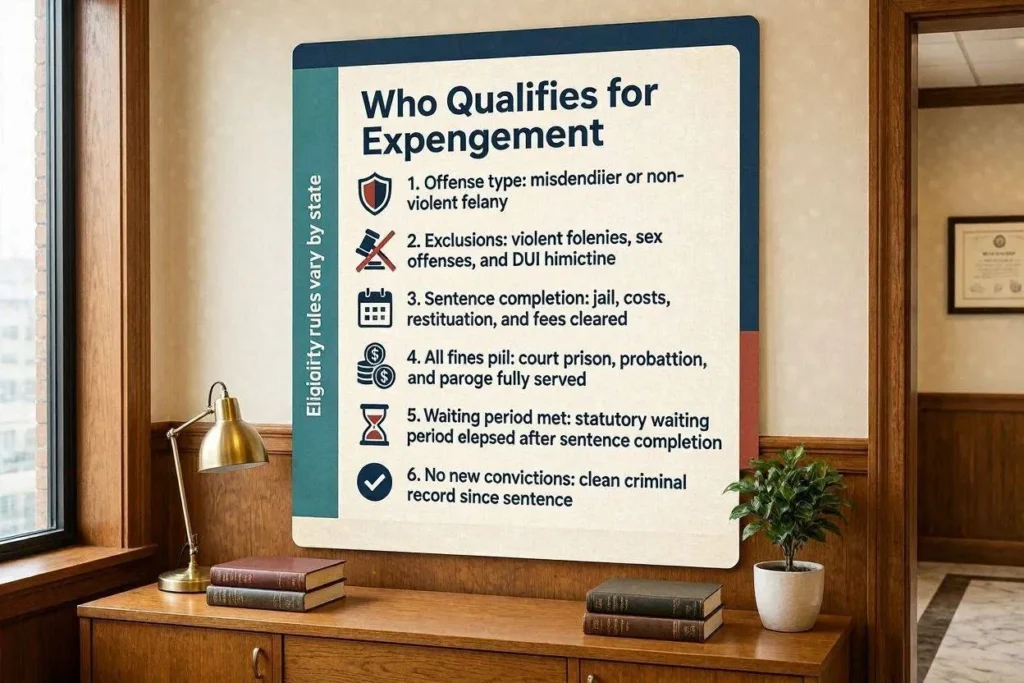
Eligibility rules differ by state, but 6 criteria apply across most jurisdictions:
- Offense type — misdemeanor or non-violent felony. Violent felonies, sex offenses, homicides, and DUIs are excluded in most states.
- Sentence completion — all jail or prison time, probation, and parole must be fully served.
- All fines paid — court costs, restitution, and fees must be cleared. Some states allow expungement with outstanding fines, but most do not.
- Waiting period passed — 1 to 10 years after conviction or sentence completion, depending on the offense and state.
- No new convictions — most states require a clean record during the waiting period.
- Offense not on excluded list — each state maintains a list of crimes ineligible for expungement.
Crimes commonly excluded from expungement in all states:
- Murder and manslaughter
- Sexual assault and rape
- Crimes against children
- Kidnapping
- Domestic violence convictions (in most states)
- DUI convictions (excluded in most states, but California allows some DUI expungements)
- Bribery and fraud offenses
Waiting Periods by Offense Type
| Offense Type | Typical Waiting Period | Examples |
| Dismissed charges / acquittals | 0 to 1 year | Charges dropped, not guilty verdict |
| Non-conviction arrests | 0 to 1 year | Arrested but never charged |
| Misdemeanor convictions | 1 to 3 years | Petty theft, minor drug possession |
| Non-violent felony convictions | 3 to 7 years | Drug charges, property crimes |
| DUI (where eligible) | 5 to 10 years | California, some other states only |
| Violent felonies (rare states) | 7 to 10+ years | Indiana Level 6 felonies |
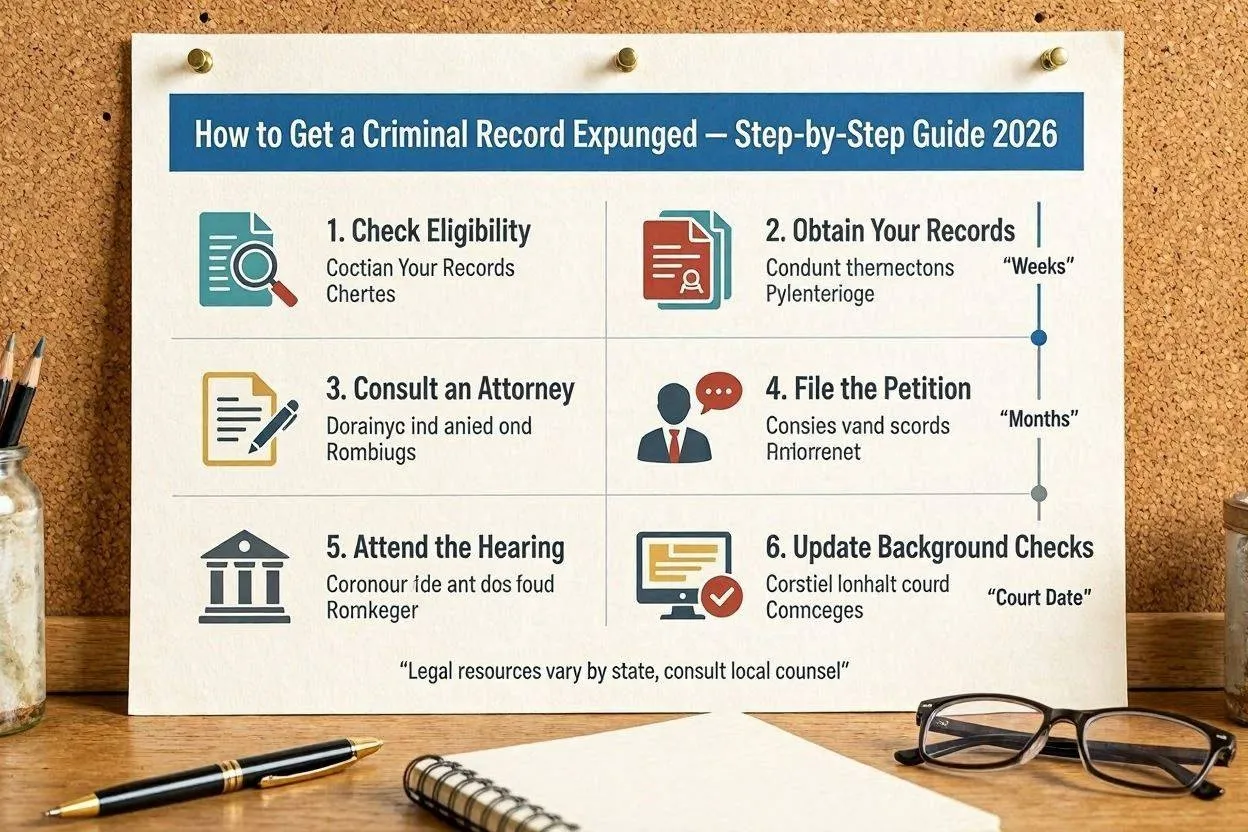
How to Get a Criminal Record Expunged — 8 Steps
Step 1: Obtain Your Criminal Record
Request a certified copy of your complete criminal history from your state’s law enforcement agency or court system. Review it carefully — errors appear more often than people expect. Confirm every charge, date, disposition, and case number. You cannot file an accurate petition without seeing the full record first.
Where to get it: State Bureau of Investigation, State Police, or the court clerk in the county where your case was handled.
Cost: $10 to $30 in most states.
Step 2: Check Your State’s Eligibility Requirements
Look up your state’s expungement statute. Most state court websites publish eligibility guides and forms. Key things to confirm:
- Whether your specific offense is eligible
- Whether the waiting period has passed
- Whether outstanding fines block your application
- Whether prior convictions disqualify you
If the statute is unclear, consult a criminal defense attorney before filing. A denied petition can create additional waiting periods in some states.
Step 3: Gather Required Documents
Courts typically require 6 documents for an expungement petition:
- Certified copy of your criminal history record
- Certified disposition of the charge (guilty plea, not guilty, dismissed, etc.)
- Sentencing order from the original case
- Proof of probation or parole completion
- Proof all fines and restitution are paid
- Government-issued photo identification
Some courts also accept supporting documents: letters from employers, community service records, or certificates from treatment programs. These strengthen your petition but are rarely required.
Step 4: Fill Out the Expungement Petition
File in the court that handled your original case. Most courts provide expungement petition forms on their website or at the clerk’s counter. Fill out every field using your criminal record as the reference — matching exact names, dates, and case numbers.
Common mistakes that cause rejection:
- Wrong court (filing where you live instead of where you were convicted)
- Wrong case number or charge description
- Missing the prosecutor’s office from the service list
- Incomplete proof of sentence completion
Step 5: Pay the Filing Fee or Request a Waiver
Filing fees range from $100 to $500 depending on the state and offense. Low-income applicants qualify for fee waivers in most jurisdictions. Ask the court clerk for a fee waiver form — you typically submit it at the same time as the petition.
| State | Filing Fee Range | Fee Waiver Available |
| California | $0 – $150 | Yes |
| Texas | $0 (expunction) / varies | Yes |
| Florida | $75 (certificate) + court fees | Yes |
| Illinois | $0 – $120 | Yes |
| New York | $0 – $100 | Yes |
| Indiana | $157 average | Yes |
| Pennsylvania | Varies by county | Yes |
Step 6: Serve the Petition on Government Agencies
Most states require you to serve a copy of your petition on 3 to 5 agencies before the court will schedule a hearing:
- The prosecutor’s office (district attorney or state attorney)
- The arresting law enforcement agency
- The state’s central criminal records repository
- The court clerk
- Any other agency involved in your case
The prosecutor has 30 to 45 days to object in most states. If no objection is filed, courts often grant the expungement without requiring a hearing.
Step 7: Attend the Court Hearing
Not all expungement petitions require a hearing. If no one objects and your petition is straightforward, some judges sign the order without a hearing.
If a hearing is scheduled, the judge asks 2 primary questions:
- Why are you seeking expungement?
- What have you done since the conviction to demonstrate you deserve it?
Bring documentation of employment, community involvement, education, or treatment completion. A criminal defense attorney is not required at hearings, but legal representation improves outcomes for contested petitions.
Step 8: Confirm the Order Is Processed by All Agencies
After the judge signs the expungement order, get a certified copy. Courts send the order to relevant agencies, but the process takes 60 to 180 days to complete across all databases.
After 90 days, run a background check on yourself to verify the record has been cleared. Private background check databases — not run by courts — sometimes retain data after expungement. You may need to contact those companies separately to request removal.
How Long Does Expungement Take?
The expungement process takes 3 to 12 months from petition filing to final order. Timeline varies by 4 factors:
- State — California and Illinois process faster than Texas or Florida
- Offense type — misdemeanor petitions clear faster than felony petitions
- Prosecutor response — objection triggers a hearing which adds 60 to 90 days
- Court backlog — busy urban courts run 2 to 3 times slower than rural courts
Automatic expungement programs, now active in 12+ states including Minnesota, Maryland, and Utah, process records without any individual filing. Check whether your state offers automatic expungement before beginning the petition process — you may already qualify and not know it.
What Expungement Does Not Do — 5 Important Limits
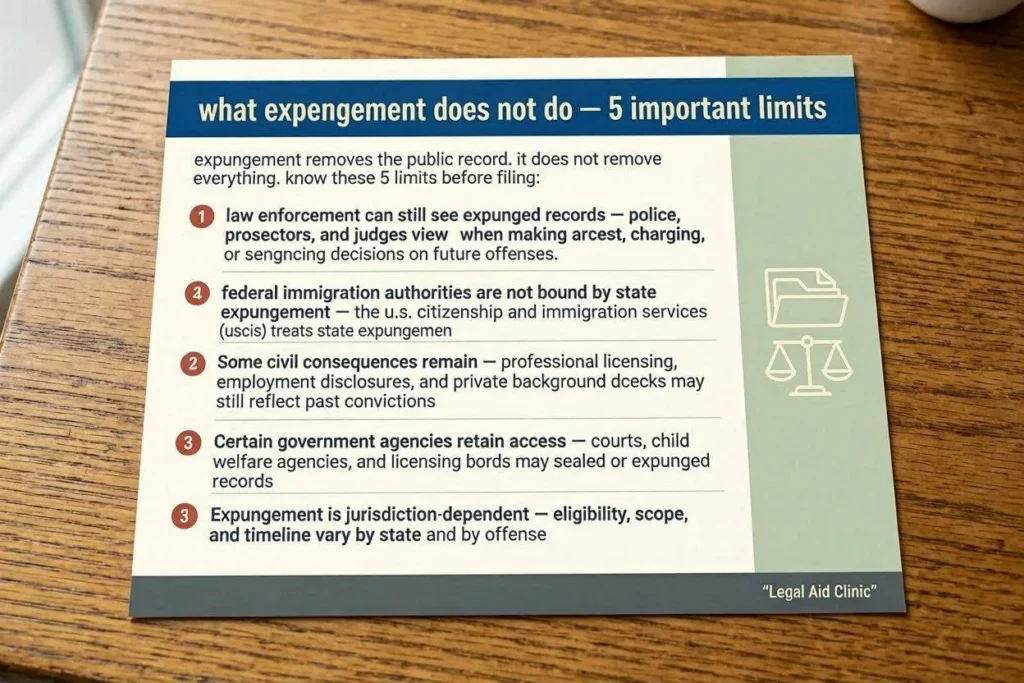
Expungement removes the public record. It does not remove everything. Know these 5 limits before filing:
- Law enforcement can still see expunged records — police, prosecutors, and judges view expunged records when making arrest, charging, or sentencing decisions on future offenses.
- Federal immigration authorities are not bound by state expungement — the U.S. Citizenship and Immigration Services (USCIS) treats state expungements differently. Non-citizens must consult an immigration attorney before relying on expungement for immigration benefits, green card applications, or naturalization.
- Federal background checks may still show the record — security clearances and federal employment background checks access records that state expungements do not reach.
- Private databases are not automatically cleared — newspapers, court records aggregators, and private background check companies may still hold data. You must contact these companies separately after expungement.
- Some employers and licensing boards can still ask — state law enforcement jobs, daycare and nursing home positions, and certain professional licenses allow or require disclosure of expunged records.
Rights Restored After Expungement
Expungement restores 4 categories of rights in most states, depending on the offense:
- Employment rights — employers cannot discriminate based on the expunged conviction in states with Fair Chance laws.
- Housing rights — landlords cannot reject applications based on an expunged record in most jurisdictions.
- Voting rights — most states restore voting rights after sentence completion, not expungement. Confirm your state’s specific rule.
- Gun rights — only a few states restore firearm rights through expungement. Most firearm disabilities survive expungement under federal law. Verify your state’s statute carefully.
State-by-State Highlights — 8 Major States
| State | Misdemeanor Eligible? | Felony Eligible? | Waiting Period | Automatic Option? |
| California | Yes | Yes (limited) | 1–3 years | No |
| Texas | Non-convictions only | No (nondisclosure only) | Varies | No |
| Florida | Dismissed only | Dismissed only | 10 years (sealing) | Partial (records) |
| Illinois | Yes | Yes (Class 3 & 4) | 4 years | No |
| New York | Non-criminal only | No (sealing only) | 10 years (sealing) | Yes (Clean Slate) |
| Indiana | Yes | Yes (Level 6) | 5 years | No |
| Pennsylvania | Limited | No (sealing only) | 7–10 years | Yes (Clean Slate) |
| Utah | Yes | Yes (limited) | Varies | Yes (Jan 2026 law) |
Do You Need a Lawyer?
No — you do not need a lawyer to file for expungement. Many states provide free forms and self-help guides on court websites. Legal aid organizations and law school expungement clinics assist low-income applicants at no cost.
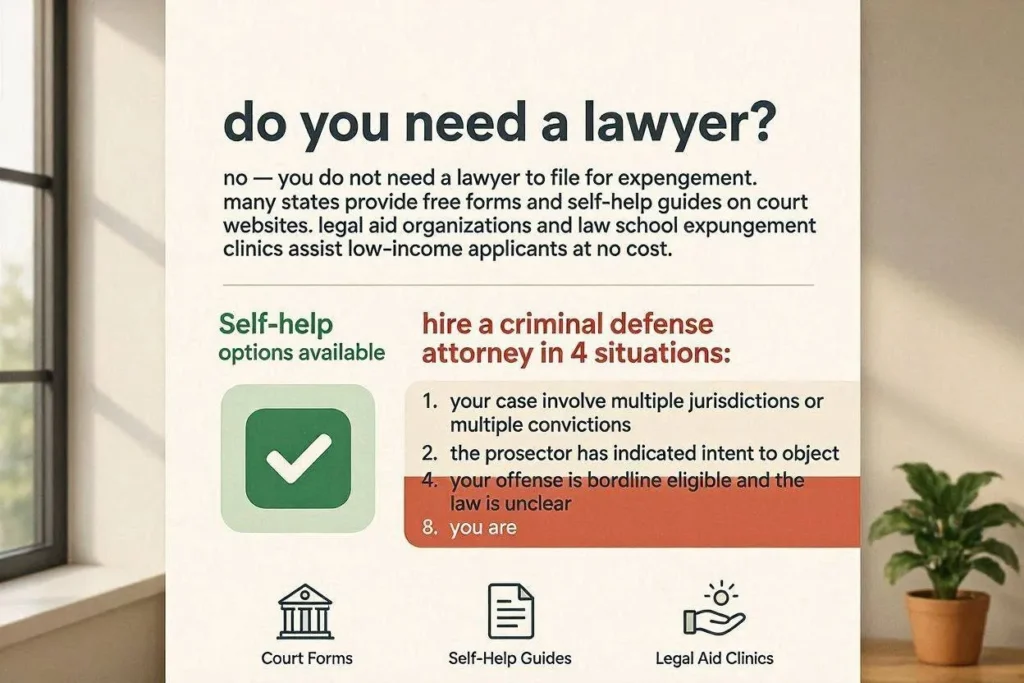
Hire a criminal defense attorney in 4 situations:
- Your case involves multiple jurisdictions or multiple convictions
- The prosecutor has indicated intent to object
- Your offense is borderline eligible and the law is unclear
- You are a non-citizen with immigration consequences at stake
Average attorney fees for expungement: $500 to $1,500. Many criminal defense attorneys offer free initial consultations to assess eligibility before charging.
FAQs

Amanda Brooks
Amanda Brooks leads JusticeInTown’s legal, justice, and community advocacy content division. She holds a background in legal research and public policy and specializes in topics related to civil rights, access to justice, legal awareness, and community issues. With years of experience researching legal and social justice topics, Amanda brings a careful, research-driven approach to complex legal information and public-interest issues. She is the primary author of JusticeInTown’s legal guides, justice-related resources, and community-focused content, helping readers better understand their rights, legal options, and the issues affecting their communities.
Related Posts