How to Get Power of Attorney: Complete Guide 2026
To get power of attorney [POA], the principal signs a state-compliant legal form naming an agent, then notarizes the document with 2 witnesses present. You can set up POA yourself in 6 steps or work with an estate planning attorney for complex situations. Both paths produce a legally valid document when you follow your state’s exact requirements.
POA is a legal document that gives a person you trust — called the agent or attorney-in-fact — the authority to act on your behalf. The principal creates POA voluntarily and must be of sound mind at the time of signing. Once properly executed, the agent can manage your finances, healthcare, or property, depending on the scope you define.
What Is Power of Attorney and Who Are the Key Parties
Power of attorney is a legal instrument that transfers decision-making authority from one person to another. 3 parties appear in every POA document: the principal (the person granting authority), the agent or attorney-in-fact (the person receiving authority), and — in many transactions — a notary public who witnesses the signing.
The principal must be at least 18 years old and mentally competent. The agent does not need to be a licensed attorney. Many principals choose a spouse, adult child, or close friend. The agent accepts a fiduciary duty — a legal obligation to act in the principal’s best interest at all times.
POA differs from guardianship and conservatorship in 1 critical way: the principal creates POA voluntarily before incapacity. A court appoints a guardian or conservator only after a person can no longer make decisions. Court-supervised guardianship typically takes 3 to 6 months to establish and costs $3,000 to $10,000 in legal fees, versus $100 to $500 for a standard POA.
6 Types of Power of Attorney and When to Use Each
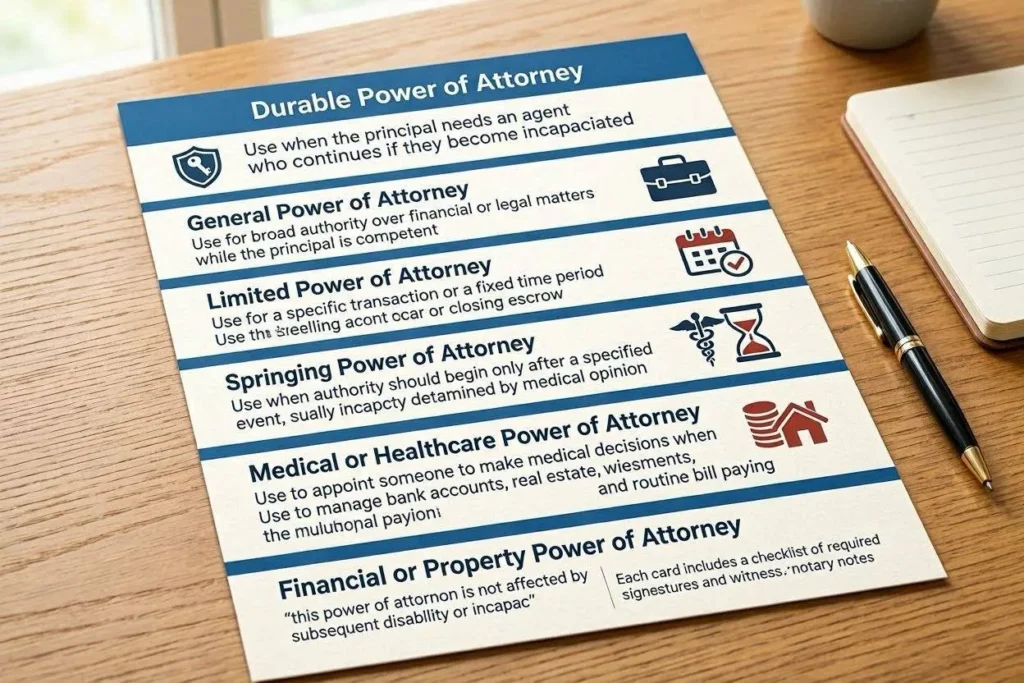
6 types of POA exist, each serving a distinct purpose. Selecting the correct type before drafting saves time and prevents the document from being rejected by banks or healthcare providers.
Durable Power of Attorney
A durable POA remains in effect if the principal becomes incapacitated. The document must include the exact statutory phrase — typically “This power of attorney is not affected by subsequent disability or incapacity of the principal” — for durability to apply. Without that language, the POA terminates automatically upon the principal’s incapacity.
Medical Power of Attorney
A medical POA — also called a healthcare proxy or healthcare POA — authorizes the agent to make healthcare decisions when the principal is unable to communicate. Medical POA activates only when a licensed physician certifies the principal’s incapacity in writing. The agent can then authorize surgery, select treatment plans, admit or discharge from care facilities, and make end-of-life decisions if the principal specified those powers.
General, Limited, Springing, and Financial POA
General POA grants the agent broad financial and legal authority but terminates automatically when the principal becomes incapacitated — making it less useful for long-term planning.
Limited POA restricts the agent to 1 specific task, such as signing a real estate deed or managing a bank account during the principal’s overseas travel. The document must state the exact scope and an expiration date.
Springing POA activates only after a triggering event — most commonly a physician’s declaration of incapacity. Springing POA gives the principal maximum control but can delay the agent’s ability to act while the triggering condition is confirmed.
Financial POA covers asset management specifically: paying bills, managing retirement accounts, filing taxes, depositing and withdrawing funds, and maintaining real property. Financial POA does not authorize healthcare decisions — a separate medical POA handles those.
How to Get Power of Attorney in 6 Steps
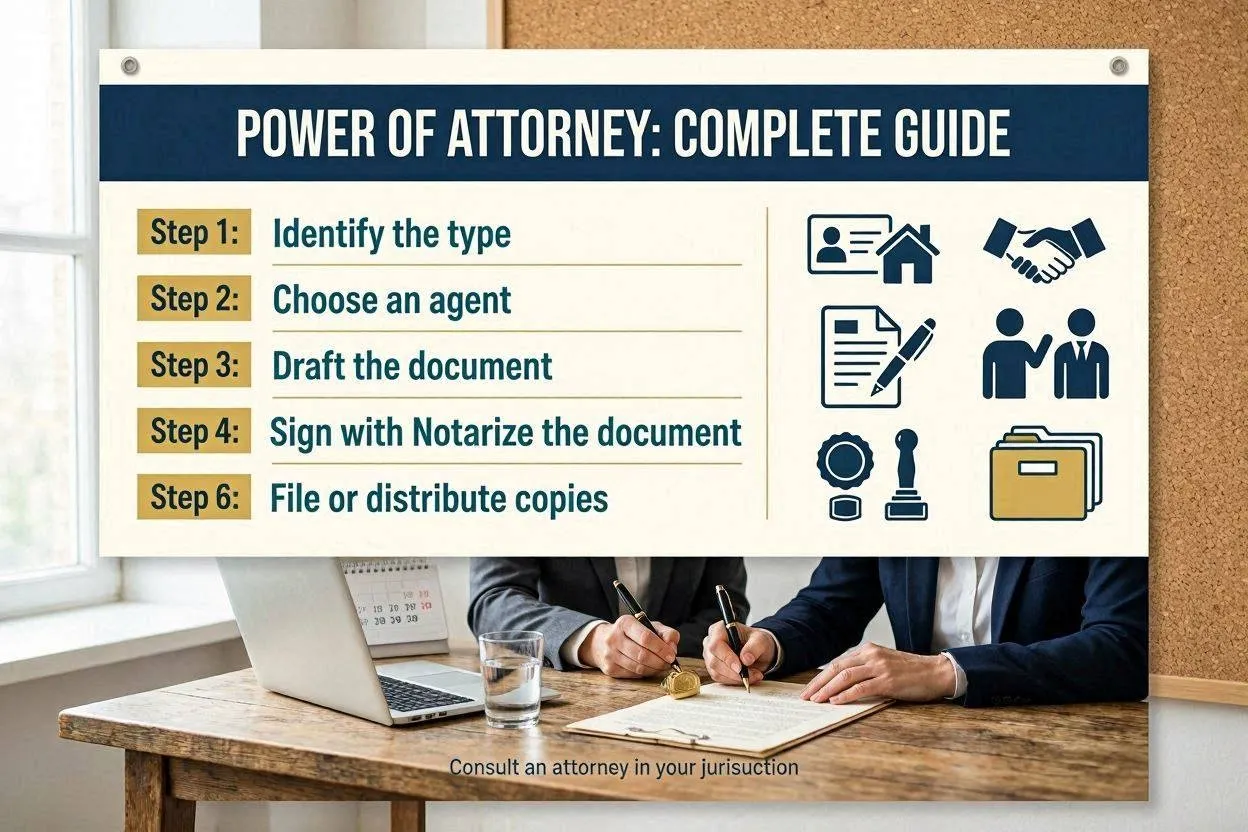
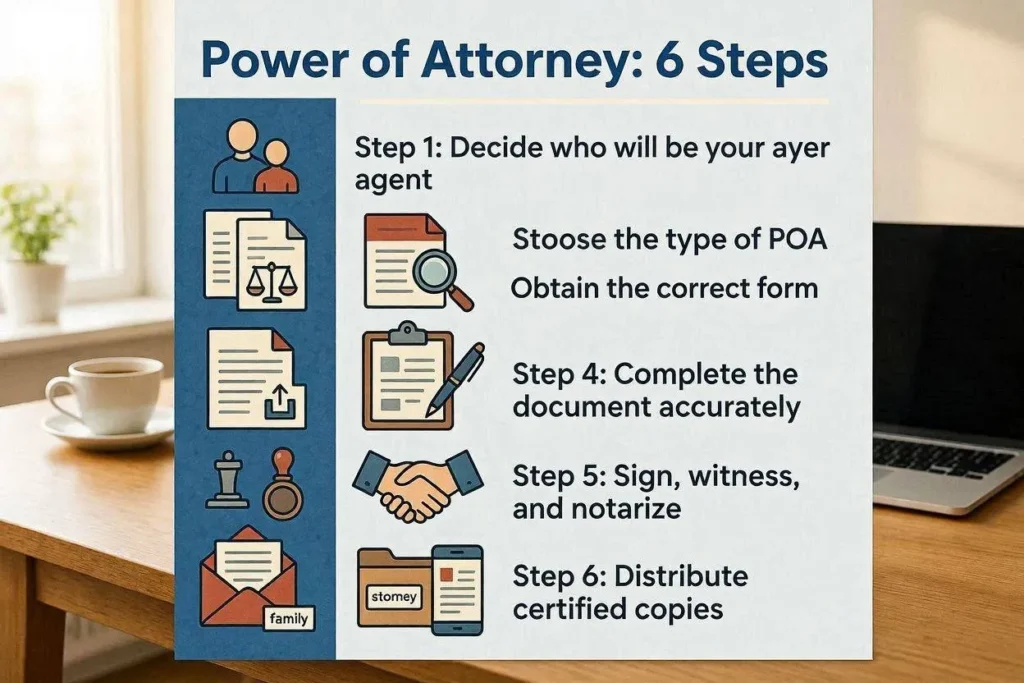
To get power of attorney, follow these 6 steps in order. Skipping or reversing any step creates a document that banks, hospitals, or courts may reject.
Quick-Reference: Power of Attorney — 6 Tasks at a Glance
| Task | Timing | Method | Difficulty |
| Choose POA type | Before drafting | Review 6 POA types; match to your needs | Easy |
| Select your agent | Before drafting | Apply 5-criteria checklist | Easy |
| Obtain the form | Day 1 | Attorney, state website, or online service | Easy |
| Complete the form | Day 1–2 | Fill fields; define agent’s authority clearly | Moderate |
| Sign and notarize | Day 2–3 | Notary public; 2 witnesses in most states | Easy |
| Distribute copies | After signing | Agent, bank, hospital, attorney | Easy |
Step 1: Choose the Correct POA Type for Your Situation
To choose the correct POA type, answer 3 questions: Do you need the POA to survive incapacity? Do you need to cover healthcare decisions or financial decisions or both? Do you need the agent to act immediately or only after a specific event? Durable POA is the most common choice for long-term planning because it covers financial authority and survives incapacity. Add a separate medical POA for healthcare decisions — most states treat the 2 documents separately.
Step 2: Select an Agent Using 5 Criteria
To select an agent, apply these 5 criteria: trustworthiness, financial responsibility, geographic availability, willingness to serve, and understanding of your wishes. The agent must be at least 18 years old and mentally competent. Agents who live within 50 miles (80 km) of the principal can respond faster to time-sensitive decisions. Discuss the role explicitly with your chosen agent before naming the agent in the document — an agent who declines after signing creates delays.
Step 3: Obtain the Correct State-Specific Form
To obtain the correct form, access your state’s statutory form from 3 sources: your state legislature’s official website, an estate planning attorney, or a legal document service. 26 states have adopted the Uniform Power of Attorney Act [UPOAA], which standardizes POA language across jurisdictions including Colorado, Idaho, and New Mexico. In non-UPOAA states such as California, New York, and Texas, the statutory form differs — use only your state’s approved version. Using the wrong form results in automatic rejection by institutions.
For help preparing state-compliant documents, see the legal document templates resource, which provides verified forms across all 50 states.
Step 4: Complete the Form with Exact, Specific Language
To complete the form correctly, fill every required field and avoid leaving any section marked “TBD” or “to be determined.” Define the agent’s powers explicitly — list each power separately rather than using broad phrases like “all financial matters.” Specify the effective date: either immediately upon signing or upon a physician’s declaration of incapacity. Include the durability clause verbatim from your state’s statute. A single missing field makes the document unenforceable.
Review how draft legal documents explains drafting principles that apply directly to POA completion — including consistent party naming and clause-by-clause specificity.
Step 5: Sign, Witness, and Notarize the Document
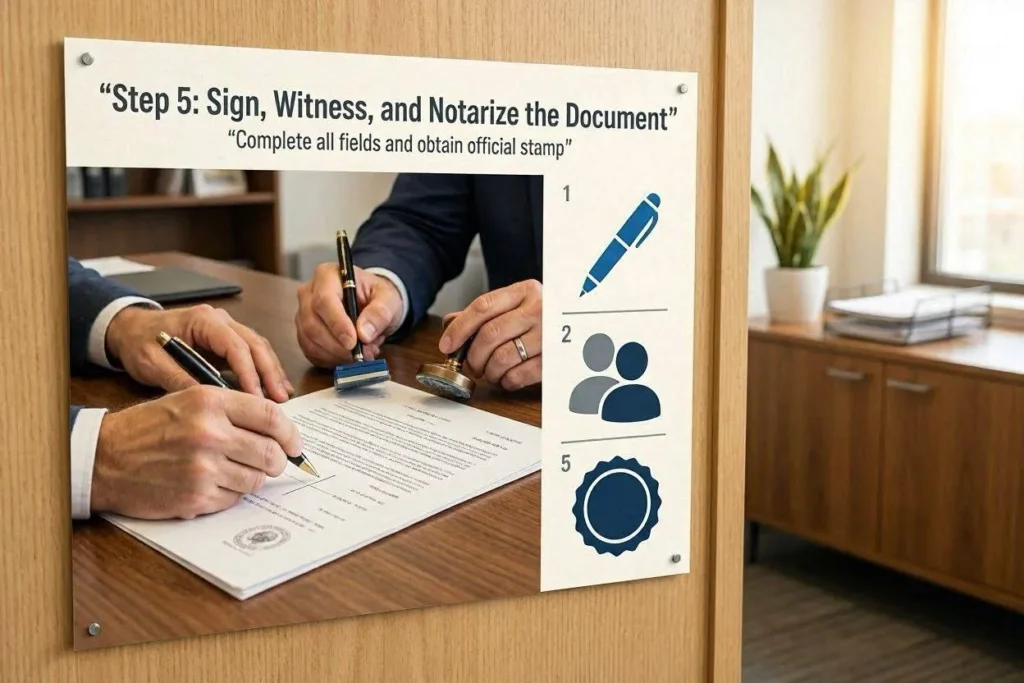
To notarize the POA, schedule an appointment with a notary public — available at banks, UPS Stores, law offices, and online via services like Notarize.com. Most states require 2 adult witnesses and 1 notary present simultaneously. Witnesses cannot be the agent, the agent’s spouse, or a beneficiary of the principal’s estate. Some states — including California and New York — require the agent to sign a separate acknowledgment section. Signing without the required witnesses or notary voids the document in all 50 states.
Step 6: Distribute and Store Certified Copies
To distribute the POA, make at least 4 certified copies and deliver them to 4 parties: your agent, your primary bank, your doctor or healthcare provider, and your estate planning attorney. Store the original in a fireproof safe or a safe deposit box at a bank. Upload a digital scan to cloud storage such as Google Drive or Dropbox set to view-only access for family members. Your agent must carry a copy every time the agent acts on your behalf — institutions require physical proof of authority at the time of each transaction.
How Much Does Power of Attorney Cost in 2026
The cost of POA depends on 3 factors: the type of POA, whether you use an attorney, and your state’s filing requirements. A standard durable POA costs $100 to $500 when drafted by an attorney. DIY online POA templates from services like LegalTemplates or eForms cost $35 to $80. Notarization fees add $5 to $25 per signature depending on the state. If the POA involves real estate transactions, county recording fees add $15 to $50 (£12 to £40).
Complex POAs — those covering business interests, multi-state real estate portfolios, or special needs trusts — cost $500 to $2,000 (£400 to £1,600) for attorney drafting. That cost is lower than the average guardianship petition, which costs $3,000 to $10,000 and takes 90 to 180 days to complete.
When You Cannot Get Power of Attorney and What to Do Instead
POA requires the principal’s informed, voluntary consent at the time of signing. You cannot obtain POA for a person who is already mentally incapacitated. If an elderly parent with dementia has never executed a POA, the only legal path is a court-ordered conservatorship or guardianship. A probate court appoints the conservator, which may not be the family member the incapacitated person would have chosen.
3 situations block POA creation: the principal lacks mental capacity, the principal signs under coercion, or the principal is under 18 years of age. In each situation, the family must file a guardianship or conservatorship petition. Consult a find a qualified lawyer to identify the fastest path when POA is no longer an option.
How to Get a Bank to Accept Your Power of Attorney
Banks reject POA documents for 4 common reasons: the document is outdated (some banks require POA executed within the last 12 months), the form lacks the correct state language, the agent lacks a certified copy, or the bank suspects elder financial abuse. Under the UPOAA, a business presented with a valid durable POA must accept or reject the document within 10 business days and must provide a written explanation for any rejection.
To prevent rejection at a bank, take these 3 steps before you need the POA activated: provide the bank with a certified copy immediately after signing, ask the bank to note the POA on the account record, and check whether the bank has its own POA acceptance form — Bank of America and Wells Fargo, for example, each have internal review processes. Addressing these 3 steps proactively eliminates 90% of institutional rejections.
How to Revoke Power of Attorney Before It Expires
To revoke a POA, the principal signs a written revocation form, notarizes it, and delivers copies to the agent and every institution holding the original POA. The revocation takes legal effect the moment the agent receives written notice. Simply tearing up the POA document does not legally revoke the agent’s authority if the agent still holds a certified copy. A divorce automatically revokes a spouse’s POA in most states — Texas Estates Code and California Family Code both include this provision. Execute a new POA if you wish to name a different agent after revocation.
Conclusion
Getting power of attorney right requires 3 things: choosing the correct POA type, completing the exact state-required form, and notarizing the document with the right witnesses. Act before you need the POA activated — the process takes 1 to 3 days when you are healthy and months of costly court proceedings once capacity is lost. A durable POA combined with a medical POA covers the 2 most common scenarios: long-term financial management and healthcare decisions during incapacity.
JusticeInTown connects you with licensed U.S. attorneys who specialize in estate planning and elder law across all 50 states. Whether you need a durable POA drafted, a medical POA reviewed, or guidance on revoking an existing document, the attorneys at JusticeInTown deliver precise, enforceable documents. Schedule a free consultation today and protect your future with the right legal foundation.
Frequently Asked Questions About Power of Attorney

Amanda Brooks
Amanda Brooks leads JusticeInTown’s legal, justice, and community advocacy content division. She holds a background in legal research and public policy and specializes in topics related to civil rights, access to justice, legal awareness, and community issues. With years of experience researching legal and social justice topics, Amanda brings a careful, research-driven approach to complex legal information and public-interest issues. She is the primary author of JusticeInTown’s legal guides, justice-related resources, and community-focused content, helping readers better understand their rights, legal options, and the issues affecting their communities.
Related Posts