Lease Agreement Guide: Clauses, Disclosures & Rules Explained
Most lease disputes trace back to one thing: somebody skipped a clause they assumed didn’t matter. A landlord leaves the late-fee amount vague, a tenant never gets a move-in photo on record, and six months later both sides are arguing over a security deposit with nothing in writing to settle it.
This lease agreement guide closes those gaps before a signature goes on the page. It covers the required clauses, the disclosures tied to specific states, and the 2026 law changes that already make some older templates unenforceable. Whether you’re drafting your first lease or reviewing one someone handed you, the sections below cover what actually holds up in a dispute.
What Is a Lease Agreement?
A lease agreement is a legally binding contract between a landlord and a tenant that sets the rent amount, the length of the tenancy, and the rules both parties must follow. Every state treats it as enforceable under contract law, and in most cases, under landlord-tenant statutes specific to that state.
A written lease removes the guesswork that ruins tenancies, the kind of guesswork that turns a $1,800 monthly rent dispute into a small-claims court filing. Verbal agreements exist too, but they rarely hold up when a disagreement lands in front of a judge.
This lease agreement guide breaks down the clauses, disclosures, and 2026 rule changes that determine whether a lease actually protects the people who sign it.
Lease Agreement vs. Rental Agreement: What’s the Difference?
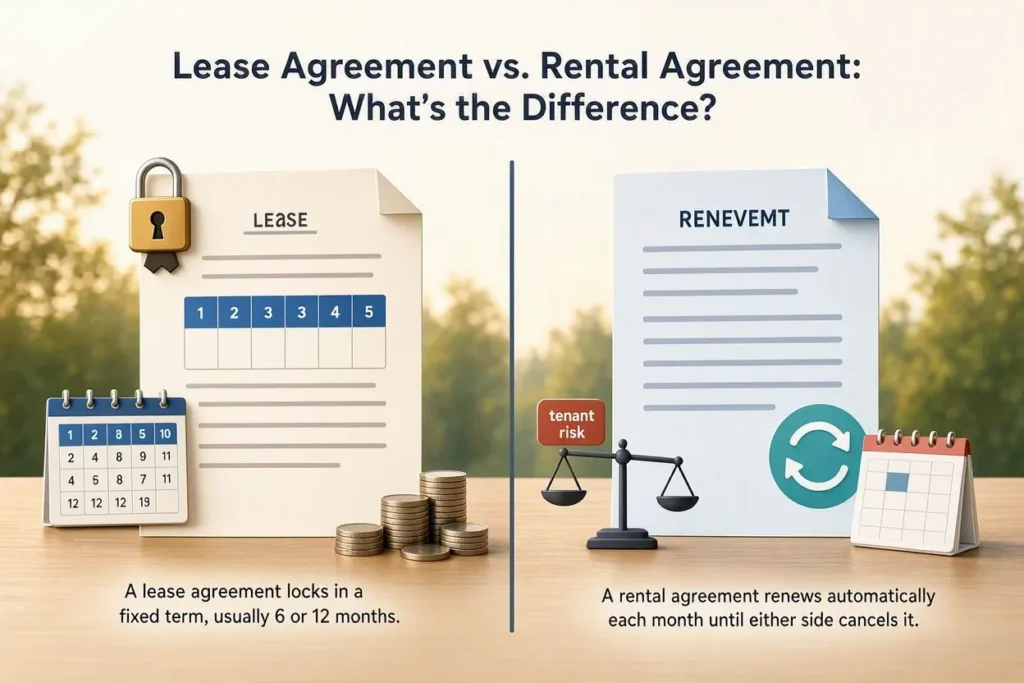
A lease agreement locks in a fixed term, usually 6 or 12 months. A rental agreement renews automatically each month until either side cancels it. That’s the whole distinction in one sentence, but it’s worth sitting with, because it changes who bears the risk. Rent and terms stay frozen for the whole lease period unless the contract has a rent-escalation clause tied to a specific index, so a landlord locked into a 12-month lease can’t just raise the rent because the market moved. A month-to-month rental agreement flips that: nobody’s locked in, which is either freeing or unstable depending on which side of the transaction you’re on.
Take a landlord in Austin, Texas, renting a two-bedroom unit. A 12-month lease at $2,100 a month guarantees $25,200 in income for the year, barring default. The same unit on a month-to-month rental agreement could see a rent adjustment in 30 days if market conditions shift, but the landlord also risks a 30-day notice to vacate from the tenant at any point.
Neither format wins outright. Landlords who want turnover stability lean toward fixed-term leases. Tenants relocating for a short-term job assignment usually prefer the month-to-month structure instead.
What Clauses Should Every Lease Agreement Include?
Every residential lease agreement needs 12 to 15 core clauses to hold up legally, covering identity, money, property condition, and exit terms. Missing even one, a vague deposit clause or an undefined occupancy limit, creates an opening a court won’t fill in for either party.
Names of all tenants
Every adult occupant’s name belongs on the lease, with each person’s signature attached. This makes each tenant jointly and severally liable, meaning any one roommate can be held responsible for 100% of unpaid rent if the others stop paying. Leave two names off a four-bedroom lease and the landlord has no legal standing against the other two occupants when rent stops coming in.
Lease term and key dates
State a start date, an end date, and what happens at expiration: automatic month-to-month conversion, a mandatory renewal notice, or a hard move-out deadline. Notice periods for ending or declining renewal typically run 30 to 60 days. Leaving this section open to interpretation is one of the most common drafting errors landlords make.
Rent amount and payment terms
This one seems obvious until you see how many leases get it wrong. The rent figure, the due date, any grace period, accepted payment methods, all of it needs to be on the page in numbers, not phrases like “reasonable fee” for late payments. California actually caps late fees at whatever damages the landlord can show, which means a flat $150 charge tacked onto a $1,500 rent payment might not survive a challenge; a court could call that punitive instead of compensatory.
Security deposit terms
The amount, who holds the money, what can be deducted, and when it comes back (usually 14 to 30 days after move-out) all belong here. California changed the math on this one in July 2024: AB 12 caps most security deposits at one month’s rent, though there’s a carve-out for smaller landlords, those who own two properties or fewer totaling four units, who can still ask for two months. A Sacramento landlord outside that carve-out who’s still collecting a two-month deposit isn’t just pushing their luck. They’re breaking the law.
Maintenance and repair responsibilities
Landlords carry the legal duty to maintain habitable conditions: working heat, plumbing, structural integrity. Tenants handle cleanliness and prompt damage reporting. Crack a bathroom tile moving furniture and that repair cost is yours. Live with a broken furnace in February, and it isn’t, and the landlord’s failure to fix it can trigger rent withholding rights in several states.
Right of entry
Most states require 24 to 48 hours’ notice before a landlord enters an occupied unit, except during genuine emergencies like a gas leak or burst pipe. Letting yourself in unannounced to “check the paint job” violates this clause even with good intentions. Spell out the acceptable entry reasons up front: repairs, inspections, showings to prospective tenants.
Pet policy
State which animals are permitted, any breed or size restrictions, and the pet deposit or monthly fee attached. A blanket no-pets policy shrinks the applicant pool more than most landlords realize, given how many renters keep pets. Service animals and emotional support animals sit outside this clause entirely under the Fair Housing Act. No pet fee, no denial based on either category.
Subletting policy
State whether subletting is allowed and, if so, under what conditions the landlord approves a subtenant. Leave it unaddressed and unauthorized subletting becomes one of the most common lease violations landlords discover after the fact, sometimes months in. A Chicago tenant who sublets a room through a short-term rental app without written approval can face lease termination even if rent keeps arriving on time.
Early termination and renewal
What happens if someone wants out early? The lease should spell out the buyout math, whether that’s rent through the lease end, a flat fee, or rent until a replacement tenant is found, along with whether the lease auto-renews or needs action from someone. There’s one group this section doesn’t fully control: active-duty military tenants get protections no lease clause can override (more on that below, under SCRA).
Default, eviction, and severability
Nonpayment, unauthorized occupants, other violations, whatever counts as default needs a definition, not just a vibe. Throw in a severability clause too, so if one part of the lease gets struck down, the rest survives. Eviction itself runs on state law no matter what the lease says, but landlords who show up in court with a clearly written default section tend to fare better than ones who don’t.
What Legal Disclosures Must a Lease Agreement Include?
Skipping a required disclosure doesn’t just look bad. It can void lease provisions outright or trigger real financial penalties, and federal law sets the floor here before states add anything. Take the lead-based paint rule: any property built before 1978 needs that disclosure, and HUD can fine a landlord up to $22,263 per violation under 24 C.F.R. § 30.65. States build on top of that baseline, sometimes substantially.
Disclosure requirements by category
| Disclosure | Required By | Penalty Risk if Omitted |
| Lead-based paint | Federal (HUD, pre-1978 units) | Up to $22,263 per violation |
| Mold history | CA, TX, WA, NY, and others | Deposit disputes, liability exposure |
| Bedbug history | NY, ME, AZ, and others | Voided fee collection, tenant lawsuits |
| Rental fee transparency | Growing list of states; California legislation pending | Unenforceable fee collection |
| Domestic violence rights summary | Illinois, statewide (Safer Homes Act, 765 ILCS 752) | Non-compliance as of January 1, 2026 |
Those last two rows are worth slowing down on, because they’re easy to get wrong. Illinois’ Safer Homes Act applies statewide, not just in Chicago. Every Illinois landlord signing or renewing a written lease on or after January 1, 2026 has to attach a state-prepared summary of domestic violence survivors’ housing rights as the first page, and collect a tenant signature confirming they’ve seen it.
Fee transparency is messier. California doesn’t have one settled statute the way Illinois does, just a string of bills (SB 611, SB 381, SB 681, AB 1248) that have moved through the last two legislative sessions without fully landing yet. Check the current status of whichever bill is live before naming a specific one in a lease template. This is one of the faster-moving corners of California housing law right now.
HUD (U.S. Department of Housing and Urban Development) maintains the federal disclosure baseline, but local ordinances often add requirements HUD doesn’t track. A landlord operating in three different states needs three different disclosure checklists, not one template copied across all properties.
Other Types of Lease Agreements to Know

Beyond the standard residential lease, three variations show up often enough to matter: sublease agreements, lease addendums, and rent-to-own agreements.
Sublease agreement
An existing tenant rents the unit to a third party while staying legally responsible for rent and property condition. The primary lease has to explicitly permit this, or the sublease itself becomes a violation.
Lease addendum
Modifies or adds to a signed lease without rewriting the whole document. Pet addendums, parking addendums, and move-in condition addendums come up most often, and both parties have to sign for any addendum to hold legal weight.
Rent-to-own agreement
Gives the tenant an option to purchase the property at a pre-agreed price once the rental term ends, backed by a non-refundable option fee. These run more complex than standard leases and are generally worth handing to an attorney to draft.
How Do You Break a Lease Early?
Breaking a lease early usually means paying rent through the lease end date, covering a set buyout fee, or paying rent until the landlord re-leases the unit, whichever the lease specifies. A tenant on a $1,900-a-month lease with four months remaining could owe $7,600 outright, a flat buyout of $2,000, or nothing further once a replacement tenant signs, depending entirely on what the original contract states.
Active-duty military orders change this calculation. Under the Servicemembers Civil Relief Act (SCRA), a tenant who receives permanent-change-of-station orders can terminate a lease with 30 days’ written notice and no financial penalty, and no landlord can contract around that federal right.
What Happens If a Landlord Doesn’t Follow the Lease Agreement?
Tenants can pursue remedies ranging from rent withholding to lawsuit filings if a landlord violates the lease agreement or fails required maintenance. A landlord who ignores a broken water heater for three weeks in a state that recognizes the implied warranty of habitability may face a rent-reduction claim, repair-and-deduct action, or a habitability lawsuit, depending on state statute.
Documentation decides these disputes more often than intent does. A tenant who emails the landlord about the water heater on day one, follows up on day seven, and files a complaint with local housing authorities on day 21 builds a far stronger case than a tenant who calls once and waits silently for a month.
Common Lease Agreement Mistakes to Avoid
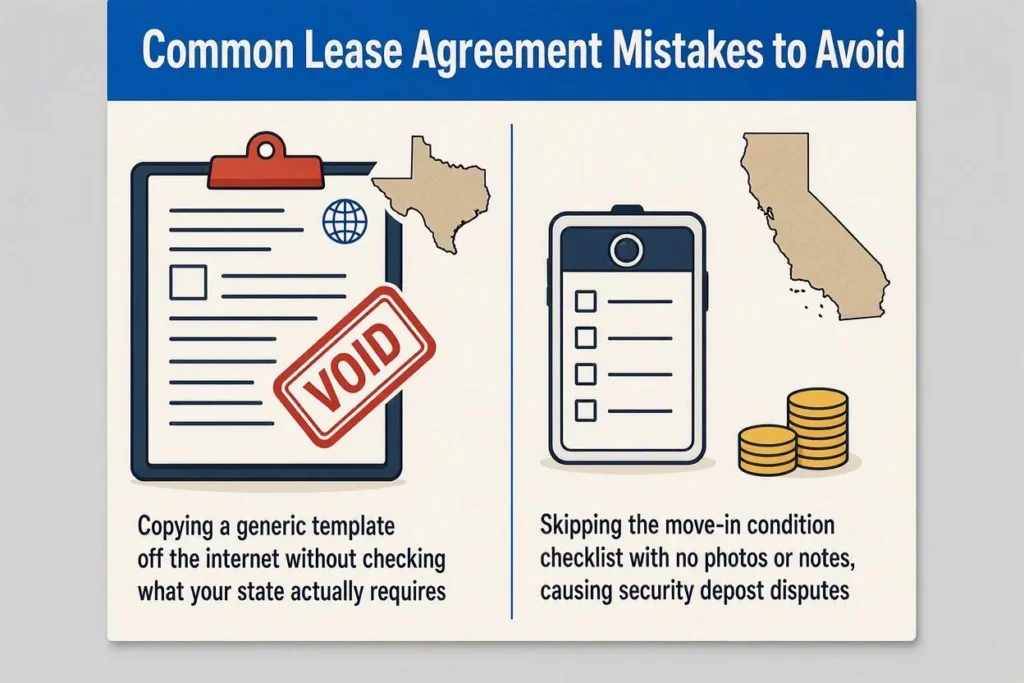
The first one is copying a generic template off the internet without checking what your state actually requires. A lease that’s perfectly legal in Texas can have void provisions the moment you use it in California.
Then there’s the move-in condition checklist nobody bothers with, no photos, no notes, nothing. Skip that step and a security deposit dispute six months later comes down to one person’s memory against another’s, which is a bad place to be in front of a judge.
Rent-increase notice periods get left blank more often than you’d think, especially on month-to-month agreements, and that gap can end up binding a landlord to a longer state-minimum notice window than they expected. Maintenance language suffers the same fate: “tenant handles minor repairs” sounds fine until someone has to argue over whether a $40 fix or a $400 fix counts as minor. Put a dollar threshold on it, or list what’s covered.
And then there’s the verbal side agreement, the handshake deal that contradicts what’s actually on the page. Courts almost never care what got said out loud. They care what got signed.
How to Sign a Lease Agreement Electronically
Electronic signatures are legally binding on a lease agreement in all 50 states under the federal ESIGN Act (Electronic Signatures in Global and National Commerce Act) and state-level UETA (Uniform Electronic Transactions Act) laws. A digital signing platform should confirm three things: both parties consented to sign electronically, the intent to sign is documented, and a full audit trail exists (timestamp, IP address, identity verification). Both signers should receive a copy of the fully executed lease immediately after signing.
Conclusion
A lease agreement works only when every clause does its job: deposit terms that specify a return date, entry rules that name a notice window, and disclosures that match the state where the property sits. This lease agreement guide covers the clauses, the required disclosures, and the 2026 rule changes shaping leases across California, Illinois, and beyond, but state and local law shifts fast enough that a template from three years ago may already be out of date. Review the lease against the current state statute before either party signs, and put every side agreement in writing. A signature on a document with a gap in it protects no one.
FAQs

Amanda Brooks
Amanda Brooks leads JusticeInTown’s legal, justice, and community advocacy content division. She holds a background in legal research and public policy and specializes in topics related to civil rights, access to justice, legal awareness, and community issues. With years of experience researching legal and social justice topics, Amanda brings a careful, research-driven approach to complex legal information and public-interest issues. She is the primary author of JusticeInTown’s legal guides, justice-related resources, and community-focused content, helping readers better understand their rights, legal options, and the issues affecting their communities.
Related Posts