

Real Estate Disclosure Requirements: What Sellers Must Tell Buyers in 2026
Real estate disclosure requirements are the state and federal rules that force a home seller to tell a buyer about known defects, hazards, or legal issues before the sale closes. They exist because a house sits on one side of an information gap: the seller has lived in it, the buyer hasn’t, and the law decided that gap shouldn’t decide who eats the cost of a bad roof or a flooded basement. Under real estate law, this duty sits alongside contract law and property law, part of the same chain that runs from signed purchase agreement to recorded deed. Florida leans on court-created duties stacked on a handful of statutes. Other states just hand sellers a form and call it done.
A seller in Tampa and a seller in Austin are working from different rulebooks, even though both are selling the same three-bedroom ranch house.
What Must Sellers Legally Disclose?
Sellers must disclose any fact they know about that materially affects the property’s value and that a buyer wouldn’t discover through a normal walk-through. Florida set the national tone for this rule in Johnson v. Davis (Fla. 1985), where the state supreme court ruled that a seller who knew about a leaking roof and stayed quiet had violated a legal duty, not just a moral one.
Three conditions have to line up for the duty to apply:
- The fact affects value. A cracked slab foundation counts. A hairline crack in a garage wall, visible to anyone who walks past it, usually doesn’t.
- The seller knows about it. Courts don’t punish ignorance, only silence about something the seller actually knew.
- The buyer can’t reasonably spot it during inspection. Courts keep drawing the line at what’s “readily observable,” and that line shifts case by case.
The duty doesn’t stop at the seller:
- Licensed agents share the exposure. Under Section 475.278 of the Florida Statutes, this obligation extends past the seller to the licensed agent handling the deal. If an agent knows about termite damage a seller hid, the agent’s license is on the line too.
- Civil and regulatory liability can both apply. Both seller and agent can face civil liability under real estate law, and in Florida, the state’s Department of Business and Professional Regulation can suspend or revoke a broker’s license over a proven disclosure violation, separate from whatever a civil court awards the buyer.
- It applies regardless of how the deal gets done. This disclosure duty is a settled part of property law now, not a gray area. The same duty applies whether the listing runs through the MLS (multiple listing service) with a full-service broker or gets negotiated directly between two parties.
What Are the Most Common Types of Real Estate Disclosures?
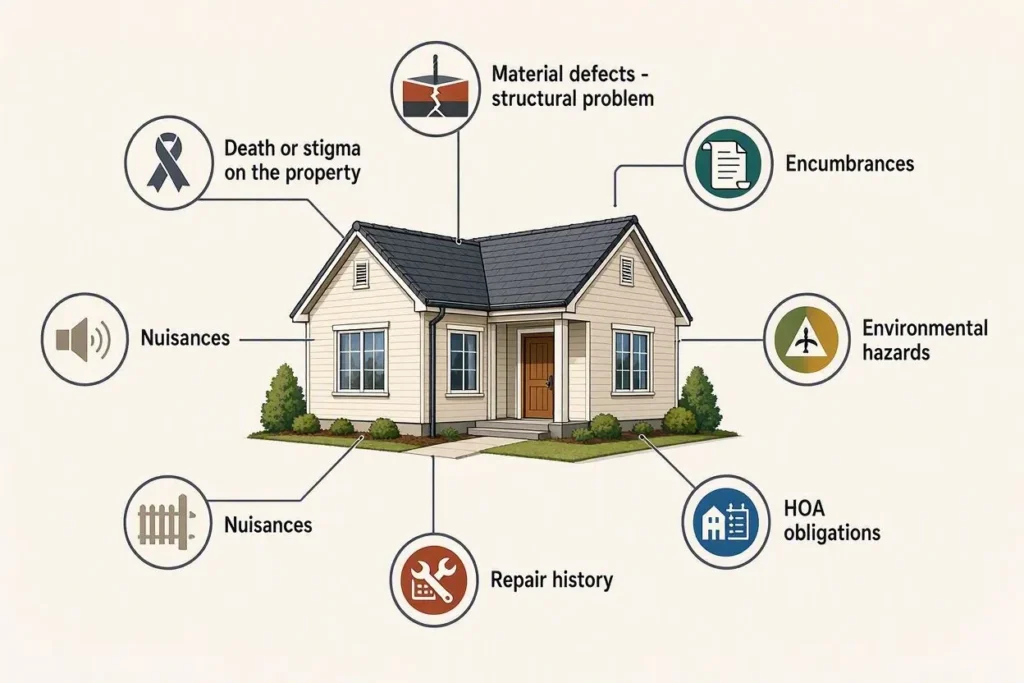
The most common real estate disclosures fall into seven categories: material defects, encumbrances, environmental hazards, HOA (homeowners association) obligations, repair history, nuisances, and death or stigma on the property. Each category shows up in a standard seller disclosure form or property condition disclosure statement, though the exact wording varies by jurisdiction.
- Material defects – structural problems, faulty wiring, plumbing failures, roof damage
- Encumbrances – liens, easements, boundary disputes, unresolved title claims
- Environmental hazards – radon gas, lead-based paint, asbestos, mold, contaminated soil
- HOA disclosures – mandatory membership, monthly dues, pending special assessments
- Repair history – past fixes to the foundation, roof, or major systems, even ones the seller believes are resolved
- Nuisances – nearby airports, industrial odor sources, chronic noise complaints
- Stigmatized property facts – deaths, crimes, or paranormal claims, which most states (Florida included, under Section 689.25) specifically exempt from mandatory disclosure
A buyer in a Miami condo deal, for example, is entitled to review the association’s declaration, bylaws, and a financial summary under Section 718.503 before closing. A single-family buyer never sees any of that paperwork.
Most of these disclosures surface during the same window a title company runs its title search and issues title insurance. A seller who lists an unresolved lien on the disclosure form but clears it before closing avoids the cloud on title that would otherwise delay or kill the deal at the settlement table.
What Is Caveat Emptor, and Does Your State Use It?
Caveat emptor, Latin for “let the buyer beware,” is the older legal default that puts nearly all the burden of discovering property problems on the buyer rather than the seller. It’s a doctrine rooted in common law property rules, from an era when courts treated real property transactions as arm’s-length deals with no built-in duty to speak. A handful of states still lean on this doctrine more heavily than others, which means a disclosure form there might ask for far less detail than one in a state with strict statutory disclosure rules.
If you’re buying in a caveat emptor state, hire an inspector before you sign anything. The seller’s silence isn’t protection, and it isn’t evidence of a clean property either.
Most states have moved away from pure caveat emptor since the 1980s, following the same reasoning courts used in Johnson v. Davis: a seller who knows about a hidden problem has more power in the transaction than a buyer walking through a staged living room for twenty minutes.
What Specific Disclosures Does Federal Law Require?
Federal law requires exactly one disclosure nationwide: sellers of homes built before 1978 must disclose known lead-based paint hazards under the Residential Lead-Based Paint Hazard Reduction Act of 1992, also called Title X. Every other disclosure requirement comes from state or local law, not federal statute.
Under the lead paint rule, sellers or their listing agents give buyers an EPA-approved pamphlet, disclose any known lead-based paint in writing, and provide a 10-day window for a lead inspection before the contract becomes binding. Sellers who knowingly skip this step face liability for up to a decade after closing, plus triple damages in some cases.
Radon and flood disclosures work differently. Florida requires both by state statute, but a seller in Ohio or Colorado follows a separate set of rules entirely, sometimes none at all for radon specifically.
Does an “As Is” Sale Remove the Duty to Disclose?
No, selling a home “as is” does not eliminate the seller’s duty to disclose known material defects. The “as is” language changes what a buyer can demand after inspection (repairs, credits, price cuts), but it doesn’t give a seller permission to hide a known problem.
Florida’s First District Court of Appeal confirmed this directly in Rayner v. Wise Realty Co. of Tallahassee, ruling that the Johnson v. Davis disclosure duty applies even when a contract carries “as is” language. A seller who knows the plumbing backs up every winter still has to say so, whether the buyer is getting the house with repairs included or taking it exactly as it stands.
Buyers sometimes assume “as is” means “don’t ask.” It means the opposite: ask more, because the contract structure assumes you’re accepting known risk, not unknown fraud. The purchase agreement itself usually still gives the buyer an inspection contingency, so “as is” limits what you can renegotiate after inspection, not whether you get to inspect at all.
What Happens If a Seller Fails to Disclose a Defect?
A seller who fails to disclose a known material defect can face three legal outcomes: contract rescission, a damages claim, or a fraud lawsuit, depending on what the buyer can prove. All three are civil claims litigated in state court, not criminal matters, though a pattern of intentional concealment can also draw regulatory action against a licensed seller’s agent.
Rescission cancels the sale and returns the purchase price to the buyer. That’s the remedy the court granted in Johnson v. Davis itself, over an undisclosed roof leak.
Damages let the buyer keep the house and sue for repair costs plus the gap between the home’s represented value and its actual value.
Fraud claims apply when a seller made an affirmative false statement rather than staying silent, and these can carry punitive damages on top of actual losses.
Buyers carry the burden of proof in every one of these cases. A homeowner who suspects a hidden foundation problem after closing needs documentation, inspection reports, repair invoices, even neighbor testimony, before a court takes the claim seriously.
Most buyers pursuing any of these remedies bring in a real estate attorney early, since each cause of action (rescission, damages, fraud) has its own pleading requirements and its own evidentiary bar. A poorly framed complaint can lose a winnable case before it reaches a judge.
How Long Do Buyers Have to Sue Over a Disclosure Problem?
Buyers generally have four years from the date they discover, or reasonably should have discovered, an undisclosed defect to file a nondisclosure claim in Florida. That four-year window is the statute of limitations for this specific cause of action under Florida real estate law. Other states set their own windows, ranging from two to six years, and some start the clock at closing rather than at discovery.
Waiting matters here. A buyer who notices water stains in month three but doesn’t investigate until month twenty may find a court less sympathetic, since the “reasonably should have discovered” standard cuts against delay.
Do FSBO Sellers Have to Follow the Same Disclosure Rules?
Yes, FSBO (for sale by owner) sellers carry the exact same disclosure obligations as sellers working with a licensed agent. No state exempts a private seller from material defect disclosure just because there’s no commission changing hands.
An owner selling a house directly to a neighbor still has to disclose a failing septic system, a code enforcement notice, or a pending HOA lien, the same categories a listing agent would flag on a standard disclosure form. Without an agent double-checking the paperwork, the research burden shifts entirely onto the seller. That’s exactly where FSBO transactions run into the most disputes, and it’s why many FSBO sellers still hire a real estate attorney or a title company to review the closing documents before signing.
Are New-Construction Homes Subject to Different Disclosure Rules?
Yes, builders selling new construction face disclosure rules that differ from resale disclosure rules, particularly around insulation, warranties, and materials. Under 16 CFR 460.16, every new home sales contract must state the type, thickness, and R-value of insulation installed in each part of the house.
If a buyer signs before the builder knows the final insulation specs, the builder must issue a written receipt with that information as soon as it’s confirmed. Resale sellers never deal with this requirement. It exists specifically because new-construction buyers can’t inspect walls that haven’t been built yet.
Can a Home Inspection Replace a Seller Disclosure?

No, a home inspection cannot replace a seller disclosure, because the two documents cover different information gathered through different methods. Disclosure forms rely on what the seller personally knows; inspections rely on what a licensed professional can physically observe during a single visit.
An inspector might flag an aging HVAC (heating, ventilation, and air conditioning) system that still works but will likely need replacement within five years. That’s the kind of thing a disclosure form wouldn’t capture, since the seller hasn’t lived through a failure yet. Skipping the inspection because a disclosure form looked clean is one of the most common, and costliest, mistakes buyers make.
What Real Estate Disclosure Trends Matter in 2026?
Three disclosure trends are reshaping real estate transactions in 2026: expanded flood history rules, insurance-claim transparency, and digital disclosure delivery.
Florida’s flood disclosure statute, Section 689.302, expanded on October 1, 2025, to require sellers to reveal three categories of flood information: prior flood damage during their ownership, any flood-related insurance claims filed, and any FEMA (Federal Emergency Management Agency) assistance received. States with rising flood risk are watching Florida’s model closely.
Insurance claim history is becoming part of the disclosure conversation even where it isn’t legally mandated yet. A CLUE (Comprehensive Loss Underwriting Exchange) report shows a property’s claims history, and it increasingly shapes buyer decisions in states facing insurance affordability pressure, Florida chief among them.
Digital disclosure delivery through e-signature platforms has replaced paper packets in most transactions. Buyers now review radon statements, HOA documents, and property condition forms inside the same portal used for the purchase contract, cutting the disclosure timeline from days to hours in many deals.
How Does Disclosure Fit Into Real Estate Law More Broadly?

Disclosure is one piece of a larger legal framework that governs every residential real estate transaction: contract formation, title transfer, financing, and closing. A real estate attorney reviewing a deal checks the purchase agreement, the disclosure form, the title commitment, and the closing disclosure as a single package, because a problem in one document usually shows up as a problem in another.
Real property law treats the deed as the final word on ownership, but the disclosure form is what protects the buyer’s decision to sign the purchase agreement in the first place. Courts keep the two separate. A defective deed is a title problem, solved through a quiet title action. A bad disclosure is a contract and tort problem, solved through rescission, damages, or a fraud claim. Real estate brokers and agents in most states carry errors-and-omissions insurance for exactly this reason: disclosure disputes are among the most common claims filed against them.
Conclusion
Real estate disclosure requirements protect both sides of a transaction, not just the buyer. A seller who documents every known defect in writing walks away from closing with far less legal exposure than one who stayed quiet and hoped nobody would notice. The rules shift by state, by property type, and increasingly by year, given how fast flood, insurance, and digital-delivery standards are changing in 2026. Sellers who treat disclosure as a formality to rush through are the ones who end up back in a courtroom eighteen months later, defending a breach of contract or fraud claim and explaining why they never mentioned the roof. Anyone unsure where their state’s real estate law lands on a specific disclosure question should get a straight answer from a licensed real estate attorney before listing, not after a buyer’s lawyer calls.
FAQs

Amanda Brooks
Amanda Brooks leads JusticeInTown’s legal, justice, and community advocacy content division. She holds a background in legal research and public policy and specializes in topics related to civil rights, access to justice, legal awareness, and community issues. With years of experience researching legal and social justice topics, Amanda brings a careful, research-driven approach to complex legal information and public-interest issues. She is the primary author of JusticeInTown’s legal guides, justice-related resources, and community-focused content, helping readers better understand their rights, legal options, and the issues affecting their communities.
Related Posts